1. The Clinical Approach
The correct approach to dysuria does not start with "which test should I do" but with mechanism and questions:
The same symptom can arise from a different anatomical site and need a different sample/test. This guide follows the current EAU Guidelines on Urological Infections (2026).
2. What Exactly Is Dysuria
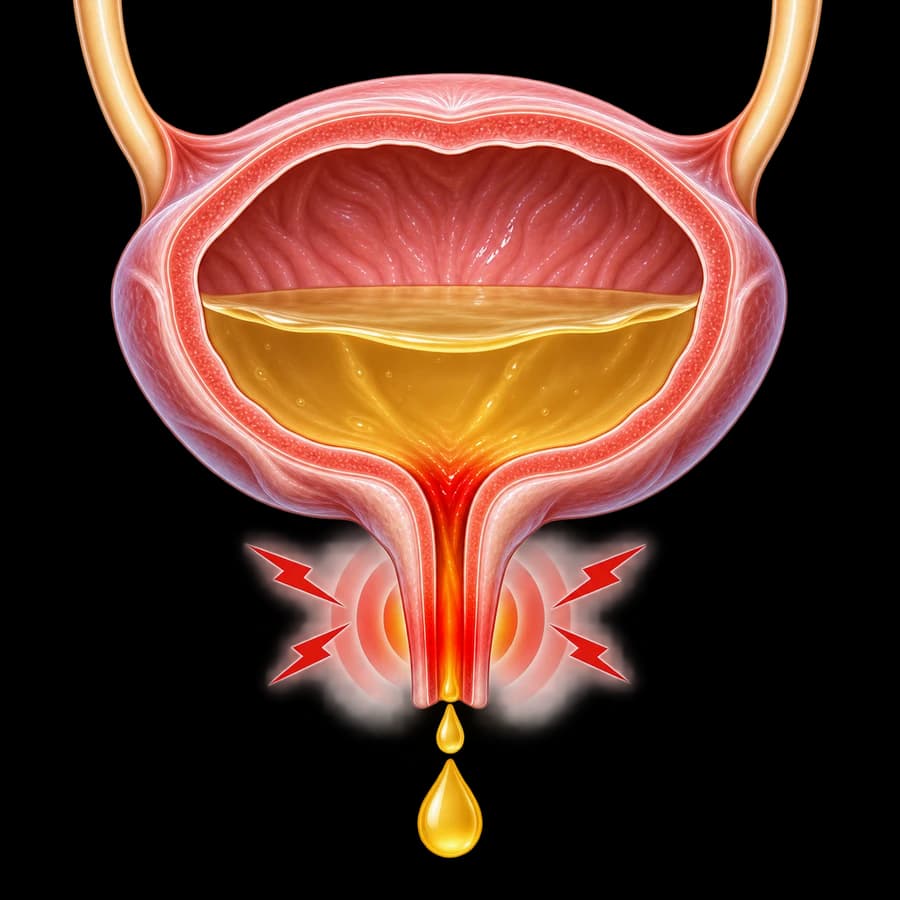
Dysuria includes pain, burning, stinging, or discomfort related to urination. It may be felt in the urethra, the external meatus, the suprapubic/bladder area, or the external genital tissues. It should not automatically be equated with a bladder infection.
Internal vs External Burning
Internal (urethra/bladder)
Can occur in cystitis, urethritis, prostatitis, a stone, or after an endoscopic procedure.
External (when urine touches the skin/mucosa)
Can occur in vaginal/vulvar irritation, balanitis, genital ulcers, herpes, or dermatitis/chemical irritation.
"It burns when urine passes" does not always mean the cause is inside the bladder.
3. Dysuria ≠ UTI
One of the most important distinctions on this page: dysuria is a symptom, not a diagnosis.
Dysuria
A UTI is a common cause of dysuria — not the only one.
4. Localised vs Systemic UTI
Based on the current EAU 2026 classification, the older "uncomplicated vs complicated" framing is no longer used as the central distinction. The crucial question is not simply "do I have a UTI?" but "are there signs of systemic infection?".
Localised UTI
A UTI without signs of systemic infection. Typical local symptoms:
- dysuria
- frequency
- urgency
- suprapubic discomfort
Systemic UTI
A UTI with systemic features such as:
- fever/hypothermia
- chills
- hypotension
- tachycardia
- confusion
- flank pain/CVA tenderness
Same urological symptom, very different clinical urgency.
5. Cystitis in Women
According to the current EAU 2026 guideline, in women without risk factors for systemic infection, a typical diagnosis of cystitis can often be established based on:
- dysuria
- frequency
- urgency
- AND absence of vaginal discharge/irritation
A urine culture is not required in every woman with a completely typical cystitis episode.
Details on the diagnosis and treatment of cystitis are covered on the dedicated page for cystitis.
6. When Urine Culture Is Really Needed
Urine culture is particularly indicated in specific scenarios, not for every episode:
- suspected systemic UTI
- atypical symptoms
- pregnancy
- symptoms that do not resolve after treatment
- recurrence within the interval defined by the guidelines
- high risk of a resistant organism
Dipstick & Urinalysis
Dipstick testing can show leukocyte esterase, nitrite, or blood. Urinalysis assesses white/red blood cells and other findings.
Dipstick testing supports the diagnosis; it does not identify the exact cause of dysuria. A negative nitrite result does not rule out infection. Pyuria alone does not prove a symptomatic bacterial infection.
Neither urinalysis nor dipstick testing can reliably diagnose chlamydial or gonococcal urethritis, genital herpes, or vaginitis on their own.
7. Urethritis & the Ureaplasma/Mycoplasma Nuance
Urethritis may present with burning/dysuria, itching in the urethra, discomfort at the meatus, urethral discharge, or redness at the meatus.
Important infectious causes include:
- N. gonorrhoeae
- C. trachomatis
- M. genitalium
with other causes depending on the clinical context. Not every case of urethritis is gonorrhoea or chlamydia.
The Ureaplasma / Mycoplasma Nuance
According to current EAU guidance, detection of U. urealyticum may sometimes represent simple colonisation, while U. parvum and M. hominis frequently represent colonisation rather than clinically significant urethritis.
Detecting an organism does not always mean a causative infection. Not every positive PCR panel finding is automatically treated.
8. NAAT vs Urine Culture & the Right Sample
Standard Urine Culture
Mainly evaluates common bacterial urinary pathogens and their antibiotic sensitivity.
NAAT
Detects selected STI pathogens such as gonorrhoea, chlamydia, or M. genitalium, depending on the test.
A negative standard urine culture does not rule out STI-related urethritis. The correct test depends on what is being looked for.
Which Sample Do I Need?
Midstream Urine
Usually used for standard urinalysis / urine culture.
First-Void Urine
Preferred for selected NAAT testing of urethral/STI pathogens.
Lesion Swab
For selected testing of herpes/genital lesions.
Urethral/Meatal Swab
For selected testing of urethritis/gonorrhoea.
The right sample depends on what is being looked for. Not all samples are needed in every patient.
Sexual Exposure
The likelihood of urethritis/an STI is particularly increased with urethral discharge, a recent new partner, unprotected intercourse, a partner with symptoms/an STI, genital lesions, or epididymal/testicular symptoms. Dysuria alone does not confirm an STI.
9. Vaginal Discharge & Gynaecological Causes
When dysuria is accompanied by vaginal discharge, vulvar irritation, itching, dyspareunia, or external burning, vaginitis, vulvovaginal pathology, or cervicitis/an STI are considered rather than automatically assuming cystitis.
Dysuria + vaginal discharge is not the typical pattern of simple cystitis.
10. Genital Herpes
Painful external lesions/ulcers can cause intense burning when urine contacts the affected tissue. Diagnosis relies on history/examination and a lesion swab/PCR where indicated.
Genital herpes is not confirmed by dysuria alone.
See the dedicated page for genital herpes.
11. Balanitis / Balanoposthitis
In men, inflammation of the glans/foreskin can cause burning during urination. Indicative findings include redness, irritation, discharge under the foreskin, itching, and local tenderness.
It should not automatically be labelled a UTI.
See the pages on balanitis and balanoposthitis.
12. Prostatitis
Dysuria can accompany acute bacterial prostatitis (often with systemic involvement) or chronic prostatitis/chronic pelvic pain syndromes.
Signs of systemic involvement include:
- fever
- chills
- malaise
- perineal/pelvic pain
- obstructive voiding symptoms
Not every case of male dysuria should automatically be labelled prostatitis.
13. Pyelonephritis — Systemic Infection
Dysuria together with fever, chills, flank pain, nausea/vomiting, or systemic illness raises suspicion of pyelonephritis or an upper/systemic UTI.
Burning when urinating + fever/chills/flank pain ≠ simple cystitis until evaluated.
14. Urinary Stones
Stones, particularly located in the distal ureter or bladder, can cause dysuria, blood in the urine, frequency/urgency, or colicky pain.
Burning plus blood together does not automatically prove a stone.
See the pages on renal colic, kidney stones and ureteral stones.
15. Bladder Pain Syndrome
Considered when there is persistent frequency/urgency, pain/pressure related to bladder filling, repeatedly negative infection testing, and chronic symptoms.
"Interstitial cystitis" is not confirmed simply because cultures are negative.
See the page on interstitial cystitis / bladder pain syndrome.
16. After Catheterisation, Cystoscopy & JJ Stent
Temporary dysuria can occur after catheterisation, flexible cystoscopy, ureteroscopy, or stent placement/removal.
Mild, temporary irritation is expected. Fever, significant bleeding, retention, or worsening pain need re-evaluation.
JJ Stent
A ureteral stent can cause urgency, frequency, dysuria, and suprapubic/flank discomfort.
Stent-related symptoms do not automatically mean a UTI — although one can coexist. Neither condition is diagnosed from symptoms alone.
17. Other Causes & Special Populations
Chemical / Local Irritation
Soaps, antiseptics, scented products, spermicides, or friction may irritate the tissues — "chemical cystitis" is not confirmed by history alone.
Genitourinary Syndrome of Menopause
In peri/post-menopausal women, mucosal changes can contribute to burning, urgency, frequency, and recurring symptoms — not every such episode is an infection.
Pregnancy
Dysuria in pregnancy needs appropriate evaluation because a UTI has different implications. Urine culture is recommended especially in symptomatic pregnant women.
Men
Male dysuria is not always "complicated" nor does it automatically mean prostatitis. Urethritis/STIs, a stone, voiding disorders, and endoscopic causes should also be considered.
Children
In children, painful urination may relate to infection, local irritation, genital inflammation, or dysfunctional voiding and needs age-appropriate evaluation.
18. Blood in Urine & Urinary Retention
Haematuria
A UTI can cause haematuria, but persistent blood after the infection resolves needs re-evaluation.
See: Blood in Urine (Haematuria)Urinary Retention
Dysuria with inability to urinate is a different situation from simple painful urination and needs prompt evaluation.
See: Urinary Retention19. Red Flags — When It Is Urgent
Seek prompt evaluation when dysuria is accompanied by:
- fever or hypothermia
- chills
- flank pain/CVA tenderness
- hypotension
- tachycardia with systemic illness
- confusion
- inability to urinate
- severe vomiting/dehydration
- pregnancy with significant symptoms
- visible blood/clots in the urine
- severe testicular pain or swelling
- genital ulcers with severe symptoms
- significant immunosuppression/high-risk context
- rapid deterioration
Mild, typical dysuria is not, by definition, an emergency.
20. The Patient Journey
- 1"It burns / hurts when I urinate"
- 2Are there systemic red flags? (fever / chills / flank pain / hypotension / severe illness)
- 3YES → systemic UTI pathway → urinalysis + culture + targeted lab/imaging work-up → prompt treatment
- 4NO → Frequency + urgency + no vaginal discharge? → cystitis pattern
- 5Urethral discharge / sexual exposure? → urethritis/STI pathway (NAAT)
- 6External genital burning/lesions? → external genital/vaginal irritation pathway
- 7Flank pain / blood in the urine? → stone/haematuria pathway
- 8Persistent/recurring symptoms with negative cultures? → re-evaluate non-bacterial causes
- 9Treatment targeted to the diagnosis — not to the symptom itself
21. Myths to Forget
"It burns, so I definitely have a UTI"
Not necessarily. The combination of symptoms determines the probability. Discharge, genital lesions, vaginal symptoms, or negative cultures may point elsewhere.
"My culture is negative, so I have nothing"
False. A negative standard culture does not rule out STI-related urethritis, genital inflammation, a stone, or non-infectious urethral/bladder pathology.
"I have white blood cells, so I need antibiotics"
Pyuria indicates inflammation, not automatically the pathogen, the location, or the need for antibiotics. It does not automatically dictate treatment.
"It happened after sex, so it must be a UTI"
Sexual activity can be related to cystitis, urethral irritation, or an STI. Timing alone does not determine the diagnosis.
"It only burns at the end, so it must be the bladder"
Timing can offer clues but should not be used as a definitive rule for anatomical location.
"It burns at the start, so it must be the urethra"
Similarly, this may suggest urethral/meatal involvement in the right context, but it does not confirm the diagnosis on its own.
22. Initial Evaluation & Choosing the Right Test
History
The physical examination is guided by the clinical picture: a prostate exam in men with pelvic/systemic symptoms, a gynaecological assessment for atypical symptoms/vaginal discharge, direct examination for genital lesions, and a scrotal exam for testicular pain. A single fixed panel of tests is not required for everyone.
Choosing the Test by Pattern
| Clinical Pattern | Indicated Testing |
|---|---|
| Typical cystitis in a suitable woman | Targeted history ± dipstick |
| Atypical/recurrent/high-risk symptoms | Urinalysis + culture |
| Systemic UTI | Urinalysis + culture + lab/imaging work-up as indicated by severity |
| Urethral discharge/suspected STI | NAAT / appropriate swab or first-void urine |
| Haematuria | Haematuria pathway |
| Colicky flank pain | Stone pathway |
| External genital lesions | Genital examination / lesion testing |
Simple painful urination does not automatically need an ultrasound or cystoscopy. Ultrasound is useful in recurrent/complex symptoms, suspected stones, retention, or obstruction. Cystoscopy is not a first-line test for simple dysuria — it is indicated in persistent haematuria, unexplained recurrence, or suspected urethral/bladder pathology.
23. Recurrent or Persistent Dysuria
Persistent or recurring episodes need re-evaluation based on pattern, not simply repeating antibiotics.
Possibilities to consider:
- genuine recurrent bacterial cystitis
- a resistant organism
- urethritis/an STI
- a stone
- voiding dysfunction
- an anatomical factor
- genitourinary syndrome of menopause
- bladder pain syndrome
- repeated unnecessary antibiotic exposure
Persistent symptoms after treatment require re-evaluation of the diagnosis, not simply repeating the same treatment.
24. Antibiotics — Correct Use
- In typical cystitis in a suitable woman, the diagnosis can often be clinical.
- Culture is indicated in specific scenarios, not always.
- Suspected systemic infection requires urinalysis + culture.
- STI-related urethritis needs an appropriate NAAT/sample.
- In severe/systemic infection, necessary treatment should not be delayed simply for a routine outpatient culture.
Antimicrobial stewardship means using antibiotics when indicated — not withholding necessary treatment and not prescribing blindly.
Do I Definitely Need Antibiotics?
Not every case of dysuria needs antibiotics. The decision depends on the likely diagnosis, localised vs systemic infection, pregnancy, risk factors, testing where indicated, prior cultures/resistance, and a possible STI pathogen.
25. Your First Visit
26. The Doctor

Dr. Marinos Vasilas, Urologist – Andrologist
Dr. Marinos Vasilas evaluates painful urination according to the current EAU guidelines, with an emphasis on correctly distinguishing the underlying cause before any treatment.
Meet the Doctor27. The Team
Investigating dysuria — from the initial evaluation to the correct test and targeted treatment — is organised in collaboration with an experienced urology team.
Meet Our Team28. Frequently Asked Questions
What is dysuria?
Dysuria is pain, burning or stinging during urination. It is a symptom, not a diagnosis — it can originate from the bladder, urethra, prostate, a stone, or the surrounding tissues.
Why does it burn when I urinate?
Most often it is caused by an infection or inflammation of the lower urinary tract, but the same symptom appears in urethritis, a sexually transmitted infection, prostatitis, a stone, or external genital irritation.
Is it always a urinary tract infection?
No. A UTI is a common cause but not the only one. Urethritis, prostatitis, a stone, vaginal irritation, herpes, or irritation after an endoscopic procedure can all give an identical symptom.
How is cystitis recognised?
In a woman without risk factors for systemic infection, the typical cystitis pattern is dysuria with frequency and urgency, without vaginal discharge or irritation.
Do I always need a urinalysis?
Not necessarily for every typical episode. Urinalysis and dipstick testing help, but a typical cystitis episode in a suitable woman can often be diagnosed clinically.
Do I always need a urine culture?
No. A culture is not required for every completely typical cystitis episode. It is particularly indicated in suspected systemic infection, atypical symptoms, pregnancy, failure to resolve after treatment, recurrence, or a high risk of a resistant organism.
Can I have a UTI with a negative dipstick?
Yes. A negative nitrite result does not rule out infection, and dipstick testing supports the diagnosis without proving it on its own.
Can I have urethritis with a negative urine culture?
Yes, quite often. A standard urine culture does not reliably test for gonorrhoea, chlamydia or M. genitalium — a targeted NAAT is needed.
What is a NAAT?
It is a molecular test (Nucleic Acid Amplification Test) that detects specific STI pathogens such as gonorrhoea, chlamydia, or M. genitalium, using a sample appropriate for that purpose.
What is the difference between first-void and midstream urine?
A midstream sample is usually used for urinalysis and culture. A first-void sample is preferred for NAAT testing of urethritis/STIs.
Does urethral discharge always mean an STI?
Not always, but it significantly changes the diagnostic probability and usually leads to targeted testing for urethritis.
Which STIs cause dysuria?
Gonorrhoea, chlamydia and M. genitalium are most commonly involved, with other causes depending on the clinical context.
Can herpes cause burning?
Yes. Painful external ulcers can cause intense burning when urine contacts the affected tissue — diagnosis relies on history, examination, and a lesion swab/PCR where indicated.
Could it be balanitis?
Yes, in men inflammation of the glans/foreskin can cause burning during urination without this automatically being a UTI.
Could it be vaginitis?
Yes, especially when vaginal discharge or irritation is present — this changes the probability of simple cystitis.
What does vaginal discharge together with dysuria mean?
It is not the typical pattern of simple cystitis and often leads to gynaecological evaluation rather than antibiotics.
Could it be prostatitis?
Yes, especially with fever, perineal pain, or difficulty urinating, but it should not automatically be assumed to be the cause of every case of male dysuria.
Could it be a stone?
Yes, particularly with blood in the urine, colicky pain, or frequency, but burning plus blood together do not automatically prove a stone.
Could it be bladder pain syndrome?
In persistent or recurring symptoms with repeatedly negative infection testing, this possibility is considered — not simply because the culture is negative.
What does dysuria with fever mean?
Dysuria with fever, chills, or flank pain is not simple cystitis until it has been evaluated — it raises suspicion of a systemic urinary infection.
What does dysuria with flank pain mean?
It may suggest involvement of the upper urinary tract (pyelonephritis) and needs prompt evaluation.
What does dysuria with blood in the urine mean?
A UTI can cause haematuria, but persistent blood after the infection resolves needs re-evaluation.
Do I always need antibiotics?
No. The need for antibiotics depends on the likely diagnosis, presence of systemic signs, pregnancy, risk factors, and test results where indicated.
Can I take antibiotics before a culture?
In typical cystitis in a suitable woman, treatment is often started clinically. In suspected systemic infection, necessary treatment should not be delayed simply for a routine culture.
What do white blood cells in the urine mean?
Pyuria indicates inflammation, not automatically a bacterial infection — it can appear in urethritis, a stone, irritation, or after an endoscopic procedure.
Can it burn after cystoscopy?
Yes, mild and temporary burning is common after an endoscopic procedure. Fever, significant bleeding, or worsening pain need re-evaluation.
Can a JJ stent cause burning?
Yes, a ureteral stent often causes burning, urgency, and suprapubic discomfort — this does not automatically mean infection, although it can coexist.
Could soaps or local products be the cause?
Yes, scented products, antiseptics, or spermicides can cause local irritation, but this is not confirmed by history alone.
What happens during pregnancy?
Dysuria in pregnancy needs appropriate clinical evaluation, with urine culture recommended especially in symptomatic pregnant women.
Why does it keep coming back?
Recurrence can be due to genuine repeated cystitis, a resistant organism, urethritis/STI, a stone, voiding dysfunction, menopause, or bladder pain syndrome — not just "bad luck".
What does a negative culture with persistent burning mean?
It may be due to prior antibiotics, urethritis/STI, a gynaecological cause, bladder pain syndrome, a stone, or local irritation — not "nothing".
Do I need an ultrasound?
Not for every simple episode of dysuria. It is useful in recurrent/complex symptoms, suspected stones, retention, or obstruction.
Do I need a cystoscopy?
Not as a first test for simple dysuria. It is indicated in persistent haematuria, unexplained recurrence, or suspected urethral/bladder pathology.
When is it an emergency?
When there is fever, chills, flank pain, inability to urinate, significant blood in the urine, severe testicular pain, or significant deterioration of general condition.
When should I see a urologist?
For persistent, recurrent or atypical symptoms, in men, when the diagnosis is unclear, or when symptoms do not improve with initial treatment.
Related Topics
Evaluation of Persistent or Recurrent Dysuria
The correct evaluation of painful or burning urination is based on the clinical pattern. Frequency and urgency without vaginal discharge may support cystitis, while urethral discharge or sexual exposure leads to different testing for urethritis/an STI. Fever, chills, or flank pain shift the evaluation towards a possible systemic urinary infection pathway.
References
- EAU Guidelines on Urological Infections 2026 — uroweb.org
- EAU Guidelines on Sexual and Reproductive Health 2026 — uroweb.org
- EAU Guidelines on Urolithiasis 2026 — uroweb.org
- CDC Sexually Transmitted Infections Treatment Guidelines — cdc.gov
The content of this page is for informational purposes only and does not replace an individualised urological evaluation. Dysuria has multiple possible causes and online content cannot determine the exact origin. Do not start leftover antibiotics on your own. Do not delay evaluation when systemic red flags are present. Testing for sexually transmitted infections requires appropriate examination and confidentiality. Pregnancy requires specialised medical evaluation.


