My Clinical Approach
The ureteral stent is one of the most common yet most misunderstood procedures in everyday urological practice. Many patients don't know exactly what it is, how long it will stay in, or which symptoms are expected versus which should worry them.
The core message I always give: the stent secures drainage, it does not by itself treat the cause of obstruction, and every stent must have a clear plan for removal or exchange — it is never left “to chance”.
- I do not place a JJ stent after every ureteroscopy — only when there is a real indication.
- In infected obstruction: priority is drainage, not definitive lithotripsy.
- Every patient leaves knowing why they have the stent and when removal is planned.
- Fever with a stent is always assessed immediately, never automatically attributed to the stent itself.
- I do not give continuous "preventive" antibiotics while a stent is in place without a clinical indication.
What Is a Ureteral Stent (Double-J / JJ)
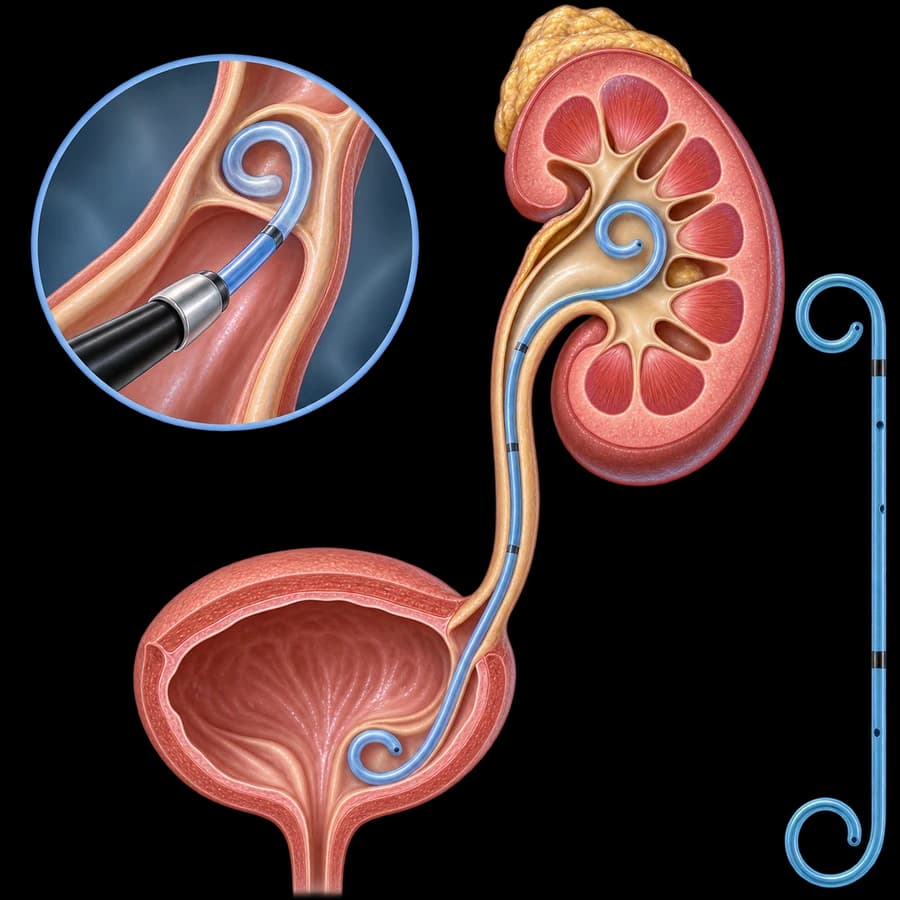
A ureteral stent is a thin internal tube placed inside the ureter to allow urine to drain from the kidney to the bladder when the ureter is obstructed, swollen, or needs temporary support after a procedure.
- The JJ stent is not a permanent implant in most cases.
- The JJ stent does not by itself treat the cause of obstruction.
- The JJ stent secures drainage.
The terms Double-J stent, JJ stent, DJ stent, and ureteral stent are all used to refer to the same device.
Where the JJ Stent Is Located
The stent is entirely inside the body and is not visible externally, unless an extraction string is used in selected cases. It is not a Foley catheter.
Why It Has Two “J”s
Proximal curl
Sits in the renal pelvis.
Distal curl
Sits in the urinary bladder.
The two curls help the stent stay in place without stitches.
JJ ≠ Urinary Catheter ≠ Nephrostomy ≠ Urostomy
JJ Stent
Kidney → ureter → bladder. Internal, not visible externally.
Foley Catheter
Bladder → urethra → outside the body, with an external bag.
Nephrostomy / Urostomy
Percutaneous drainage directly from the kidney, with an external tube/bag.
A JJ stent does not require an abdominal bag, is not a ureterostomy, and is not an ileal conduit. These are different devices with different drainage pathways — do not confuse them.
Why a Ureteral Stent Is Needed
- Ureteral obstruction caused by a stone.
- Ureteral oedema after ureteroscopy.
- Drainage after laser lithotripsy.
- Infected obstructed collecting system (combined with antimicrobial treatment).
- Ureteral stricture.
- Ureteral injury.
- Postoperative support after ureteral surgery.
- Extrinsic ureteral compression.
- Selected tumour-related obstruction.
- Protection/healing after ureteral procedures.
A JJ stent is not a treatment for every ureteral problem — it is a drainage tool, not a definitive solution.
JJ Stent and Ureteral Stones
A stent can bypass the obstruction, restore drainage, and reduce pressure in the kidney, but this does not mean the stone has been removed. Definitive stone treatment may take place later, or may already have been performed with URS, RIRS, or ESWL, depending on the clinical scenario.
See the full page on endoscopic ureteral lithotripsy (URS) for definitive treatment of ureteral stones.
JJ Stent After Ureteroscopy
After URS, a stent may be placed for ureteral oedema, trauma, drainage, residual fragments, difficult access, or concern about infection.
A JJ stent is not mandatory after every uncomplicated ureteroscopy.
According to EAU guidelines, a stent is not necessary after simple ureteroscopy with complete stone removal — routine placement without an indication may increase morbidity without additional benefit.
Pre-Stenting Before URS/RIRS
Pre-stenting (placing a JJ stent before ureteroscopy) can be used for passive ureteral dilation, improved access, or as a staged approach after a failed initial access attempt.
Routine pre-stenting is not required for everyone. According to EAU guidelines, it appears to improve outcomes mainly for renal stones, not necessarily for ureteral stones.
Stone + Fever + Obstruction
An infected obstructed kidney is a urological emergency.
Immediate management may require a ureteral JJ stent or percutaneous nephrostomy, combined with antimicrobial treatment and supportive care. Definitive lithotripsy usually follows once the infection is controlled.
For a full picture, see the pyelonephritis page.
JJ Stent vs Nephrostomy
| JJ Stent | Nephrostomy | |
|---|---|---|
| Drainage route | Internal, kidney → bladder | Percutaneous, kidney → external bag |
| External tube | Usually no | Yes |
| Goal | Internal drainage | Direct external drainage |
| Use | Selected obstruction | Selected obstruction/emergency |
| Which is better? | Depends on the case | Depends on the case |
According to the available literature, both a stent and a nephrostomy are equally effective for decompression in emergency infected obstruction. A JJ stent tends to have a greater impact on quality of life due to stent-related symptoms, while a nephrostomy is often associated with a longer hospital stay. Neither method is universally superior.
How It Is Placed & Anaesthesia
Placement or removal can occur under different anaesthetic settings, depending on the reason for insertion, the associated procedure, the patient, urgency, and the local protocol. Placement during URS often occurs under the anaesthesia already used for the procedure — general anaesthesia is not always required.
This description is deliberately high-level — it is not a surgical technique manual.
Can It Be Placed Urgently?
Yes, in selected obstructed systems. Emergency drainage may be needed in infected obstruction, severe obstructive renal impairment, a solitary kidney with significant obstruction, or selected uncontrolled obstruction, depending on the clinical context.
Symptoms From the JJ Stent
Symptom severity varies considerably between patients. Possible symptoms:
Frequency / Urgency
From bladder irritation caused by the distal end of the stent.
Dysuria
Burning or discomfort during urination.
Bladder discomfort
Suprapubic discomfort, especially at the end of voiding.
Haematuria
Mild, intermittent, especially after activity.
Flank pain
During or immediately after urination.
Discomfort during activity
May increase with physical activity.
Why My Kidney Hurts When I Urinate
The stent can allow transient vesicoureteral reflux during voiding, as the bladder contracts and some urine can be pushed back up the ureter and towards the kidney through the lumen of the stent. This can cause flank discomfort or pain during or immediately after urination.
Not every flank pain is harmless. Severe or worsening pain, especially with fever, needs assessment.
Symptoms ≠ Infection
Frequency, urgency, burning, and blood in the urine can be caused by the stent itself and do not automatically mean a urinary tract infection.
Conversely, fever, rigors, or general deterioration require assessment for infection.
I Have a JJ Stent and Fever — What Should I Do?
Fever or rigors in a patient with a ureteral stent need immediate medical assessment.
Possible causes include urinary tract infection, pyelonephritis, infected obstruction, or obstruction of the stent itself. Do not start antibiotics without medical assessment.
Obstruction & Encrustation
The stent can rarely become obstructed due to encrustation, debris, a blood clot, stone material, or displacement. Persistent pain, infection, or worsening renal function need assessment.
Over time, crystalline deposits can form on the stent (encrustation). The risk may increase with:
- Longer indwelling time
- Stone disease
- Urinary tract infection
- Metabolic stone risk
- Pregnancy
- Specific urine composition
The JJ Stent Must Not Be Forgotten
A forgotten/retained stent can lead to severe encrustation, stone formation, infection, obstruction, much more difficult removal, the need for multiple procedures, and, in severe cases, renal damage.
Every JJ stent must have a clear plan for removal or replacement.
Stent Follow-up Plan
Before leaving, the patient should know:
- Why they have the JJ stent
- Approximately when removal/exchange is planned
- Who is responsible for follow-up
- Which symptoms require contacting the doctor
How Long Can the JJ Stent Stay In
There is no single safe duration for all stents and all situations.
Duration depends on the indication for placement, the type/material of the stent, any infection, stone disease, pregnancy, the need for definitive surgery, and the specific device's manufacturer limits.
Short-term stent
Often after an endoscopic procedure or temporary obstruction.
Longer-term stent
In selected chronic obstruction, may need a scheduled exchange — never left indwelling without monitoring.
How the JJ Stent Is Removed
Usually removed endoscopically, with flexible cystoscopy in appropriate cases, or with an extraction string in selected short-term stents, always according to the clinical protocol.
Removal with flexible cystoscopy
A thin flexible scope enters via the urethra, the distal end of the stent is identified in the bladder, and the stent is grasped and removed.
Discomfort from removal varies — local anaesthetic gel may be used depending on the method. The procedure is usually brief, but it is not always completely painless.
Stent on a String
Selected short-term stents may have an external extraction string, allowing removal without cystoscopic retrieval. It is not suitable for every patient — considerations include possible accidental dislodgement, hygiene, patient selection, and sex/activity.
Follow your urologist's exact instructions on how and when to remove it.
Do not pull the string yourself unless this is a specific, explicit plan from your treating urologist.
After Removal
Transiently there may be dysuria, urgency, mild haematuria, or flank discomfort/spasm, but these usually improve soon.
Persistent or severe symptoms after removal need assessment — ongoing severe renal colic should not be considered automatically normal.
Can Stent Symptoms Be Reduced?
In selected patients, pharmacological strategies may be used for stent-related symptoms such as pain and urgency. According to the available literature, these may include alpha-blockers or antimuscarinic agents, on a per-patient basis.
We do not give specific brands, doses, or a universal prescription here. This treatment is not mandatory for every patient and should be decided individually.
Antibiotics, Bacteriuria & Urine Culture
The presence of a JJ stent does not mean the patient must take continuous antibiotics.
A foreign body such as a stent can be associated with bacterial colonisation or bacteriuria, without this always meaning symptomatic infection. A positive culture without symptoms does not automatically mean antibiotics are needed.
A urine culture may be needed when there is fever, significant infection symptoms, a preoperative context, or selected high-risk situations — not as a routine schedule for everyone.
Sex, Exercise, Work, Travel
Sexual activity
Many patients can be sexually active with the stent when they feel comfortable and there are no restrictions from a recent procedure. With an extraction string, follow the surgeon’s advice — symptoms may increase in some patients.
Exercise
Light to moderate activity is usually tolerated. Vigorous exercise/running may increase haematuria, flank pain, or bladder symptoms in selected patients. Bed rest is not generally required.
Cycling / motorcycling
Prolonged vibration or perineal pressure may worsen discomfort in some patients, without this being a universal prohibition.
Work
Return depends on symptoms, the reason for the stent, a recent procedure, and the type of occupation — office work differs from heavy manual work or jobs with limited access to a toilet. We do not give a universal sick-leave duration.
Travel
Travel may be possible in a stable patient, considering the reason for the stent, infection risk, the planned removal date, symptoms, and access to medical care. Travel should never lead to a "forgotten" stent.
Flying & MRI
The stent itself is not an aviation security issue. The ability to fly depends more on a recent procedure, symptoms, infection, and general surgical/thrombotic considerations — not on the material of the stent itself.
Many contemporary ureteral stents are compatible with MRI environments under specified conditions. This does not apply universally to every model — the exact device/model should be verified when necessary.
Pregnancy
A JJ stent may be needed in selected pregnant patients with obstruction, a symptomatic stone, or infection. Pregnancy is associated with a tendency for faster encrustation in some cases, and often requires closer follow-up and exchange planning.
We do not give a universal exchange interval here — it must be individualised in collaboration with the treating physician.
Oncologic Obstruction & Metallic Stents
Tumours can cause intrinsic or extrinsic ureteral obstruction, and a stent can be used for renal drainage. In some cases, a nephrostomy, a different stent type, or repeated exchange may be needed. We do not promise success in every malignant obstruction.
Metallic stents are used in selected chronic/malignant obstruction and have different characteristics and exchange protocols from standard polymeric JJ stents — they should not be confused.
Stent Migration & Fracture
Rarely, the stent can migrate proximally or distally, causing discomfort, reduced drainage, or urinary symptoms.
Stent fracture can occur, particularly in prolonged or forgotten stents, without being a common finding — it can complicate removal.
Urinary Retention
A JJ stent by itself is usually not a catheter for bladder drainage. Inability to urinate needs separate evaluation — it may relate to clots, a bladder/outlet problem, or another cause. The JJ stent does not “empty the bladder”.
Ureteral Stricture & Postoperative Use
A JJ stent can be used in selected ureteral stricture for temporary drainage, after reconstruction, or in other management contexts, but it does not necessarily cure the ureteral stricture definitively.
After pyeloplasty or ureteral reimplantation/surgery, a temporary JJ stent acts as an internal splint/support during healing of the anastomosis.
When Should I Contact a Doctor Immediately?
Contact a doctor immediately
- Fever or rigors.
- Significant general deterioration.
- Severe or worsening flank pain.
- Inability to urinate.
- Heavy haematuria / clots.
- Persistent vomiting or dehydration.
- Significant reduction in urine output.
- Visible accidental stent displacement / string-related concern.
- Severe symptoms in a solitary kidney.
- Missing your planned removal appointment.
Fever with a JJ stent should never simply be attributed to the stent.
What Is Normal and What Is Not
✓ Often expected
- Frequency
- Urgency
- Mild burning
- Intermittent mild haematuria
- Bladder discomfort
- Flank discomfort during urination
✗ Needs assessment
- Fever / rigors
- Severe, progressive pain
- Heavy bleeding / clots
- Inability to urinate
- Significant systemic deterioration
- Suspected displacement
The Patient's Journey
Frequently Asked Questions
What is a JJ stent?
It is a thin internal tube placed inside the ureter to allow urine to drain from the kidney to the bladder when the ureter is obstructed, swollen, or needs temporary support after a procedure.
Why is it called Double-J?
The two ends of the stent are usually curled in a J shape, so that one stays anchored in the renal pelvis and the other in the bladder, without any stitches.
Why was a stent placed in me?
To maintain urine drainage from the kidney to the bladder when the ureter is obstructed (e.g. by a stone), swollen after a procedure, or needs temporary support during healing.
Is it always needed after ureteroscopy?
No. According to EAU guidelines, a stent is not needed after every uncomplicated ureteroscopy with complete stone removal. It is placed when there is trauma, oedema, residual obstruction, residual fragments, or infection risk.
Does the JJ stent hurt?
It can cause frequency, urgency, bladder or flank discomfort during urination, and mild haematuria. Severity varies considerably between patients.
Why does my kidney hurt when I urinate?
The stent can allow transient reflux of urine back towards the ureter during voiding (vesicoureteral reflux), causing flank discomfort. Severe or worsening pain with fever needs evaluation.
Why do I have frequency?
The distal end of the stent in the bladder can cause irritation and frequency/urgency, resembling cystitis or an overactive bladder. It does not automatically mean infection, but infection should be excluded when clinically indicated.
Is blood in the urine normal?
Mild, intermittent haematuria can occur, especially after physical activity. Heavy persistent bleeding, large clots, or inability to urinate need assessment.
Is fever with a JJ stent normal?
No. Fever or rigors in a patient with a ureteral stent need immediate medical assessment for possible infection or obstruction — it should never simply be attributed to the stent itself.
Can the JJ stent cause a urinary tract infection?
The presence of a foreign body such as a stent can be associated with bacterial colonisation/bacteriuria, without this always meaning symptomatic infection. Symptomatic infection needs assessment and targeted treatment.
Do I need antibiotics while I have a JJ stent?
Not automatically. The presence of a JJ stent alone is not an indication for continuous antibiotic therapy. Antibiotics are used only when there is an appropriate clinical indication.
How long can it stay in place?
There is no single safe duration for all stents and all situations. It depends on the indication, the type of stent, any infection or stone disease, and must be verified with the treating physician on a case-by-case basis.
What happens if it is forgotten?
A forgotten/prolonged stent can become encrusted, form a stone on its surface, cause infection or obstruction, and become much harder to remove, potentially requiring multiple procedures.
How is it removed?
Usually endoscopically with flexible cystoscopy, or — in selected short-term stents — by simple traction on an extraction string, always according to the specific plan set by the urologist.
Does removal hurt?
Discomfort varies. Local anaesthetic gel may be used depending on the method. The procedure is usually brief, but it is not always completely painless.
What is a stent with a string?
Selected short-term stents may have an external extraction string, allowing removal without cystoscopy. It is not suitable for every patient, and removal must follow the urologist’s specific instructions.
Can I have sex?
Many patients can be sexually active with an internal stent when they feel comfortable and there are no restrictions from a recent procedure. With an extraction string, follow the surgeon’s specific advice.
Can I exercise?
Light to moderate activity is usually tolerated. Vigorous exercise may increase haematuria or discomfort in some patients. Bed rest is not generally required.
Can I travel?
Travel is often possible in a stable patient, but the reason for the stent, infection risk, planned removal date, symptoms, and access to medical care should be considered. Travel should never lead to a "forgotten" stent.
What happens if it migrates?
Rarely, the stent can move proximally or distally, causing discomfort or reduced drainage. It needs clinical assessment and possibly repositioning.
What is the difference between a JJ stent and a nephrostomy?
The JJ stent drains internally, from the kidney to the bladder, with no external tube. A nephrostomy drains percutaneously, from the kidney to an external bag. Neither method is universally better — the choice depends on the case.
When should I contact a doctor immediately?
In case of fever/rigors, severe or worsening pain, inability to urinate, heavy haematuria with clots, or significant deterioration in general condition. Fever with a JJ stent should never be considered a normal stent symptom.
Related Topics
Ureteral Stent Management in Rhodes
A ureteral stent is very useful for maintaining kidney drainage, but requires a clear follow-up and removal plan. Frequency, urgency, blood in the urine, and some pain are often stent-related, while fever, severe pain, significant bleeding, or inability to urinate need immediate assessment.
Scientific References
- EAU Guidelines on Urolithiasis 2026 — uroweb.org
- EAU Guidelines on Urological Infections — uroweb.org
- Joshi HB, et al. Ureteral stent symptom questionnaire: development and validation of a multidimensional quality of life measure. J Urol. 2003;169(3):1060–1064.
Meet the Doctor

Dr. Marinos Vasilas, Urologist – Andrologist
Dr. Marinos Vasilas places and manages ureteral stents in line with current EAU guidelines, with emphasis on clearly informing every patient about the reason for placement and the removal plan, and on the safe recognition of symptoms that need immediate assessment.
Full Profile

