My Clinical Approach
PBPS/IC-BPS is one of the most misunderstood urological conditions. Many patients receive repeated courses of antibiotics with no benefit, while the true cause of their symptoms remains unaddressed.
I follow the EAU Guidelines on Chronic Pelvic Pain 2026 and the AUA Guideline on IC/BPS, recognising that the two do not fully align:
- Diagnosis of exclusion — infection and other confusable conditions are ruled out first.
- Phenotyping: Hunner or non-Hunner disease, together with pelvic floor, psychosocial, and neurological considerations.
- Cystoscopy ± hydrodistension/biopsy only when clinically indicated — not as a blanket rule for everyone.
- Multimodal treatment, always starting from the least invasive option that may help.
- Targeted treatment of Hunner lesions when present — a different strategy from non-Hunner disease.
- Collaboration with a pelvic-floor physiotherapist, gynaecologist, gastroenterologist, and pain specialist where needed.
- Avoiding prolonged empirical antibiotics when cultures are repeatedly negative.
Terminology: IC, PBPS, IC/BPS
“Interstitial cystitis” is the established term most patients search for. Current European Association of Urology (EAU) terminology mainly uses Primary Bladder Pain Syndrome (PBPS), while the American Urological Association (AUA) widely uses Interstitial Cystitis / Bladder Pain Syndrome (IC/BPS).
These are not entirely different diseases. The terminology shift reflects that: there is no infection explaining the symptoms, there is no single pathological finding across all patients, this is a heterogeneous syndrome, and different subsets (phenotypes) of patients may need different treatment. Current guidance generally avoids terms ending in “-itis” unless infection or inflammation is proven as the cause.
Central message & pain pattern
PBPS/IC-BPS is a chronic or recurrent syndrome of pain, pressure, or discomfort perceived in the bladder region, accompanied by lower urinary tract symptoms, often worsening as the bladder fills and providing temporary relief after voiding, without proven infection or another obvious cause.
Bladder fills → pain/pressure/discomfort increases → patient voids → temporary relief
This pattern is characteristic, but not mandatory in every patient.
Frequency without bladder-related pain or discomfort does not automatically mean PBPS.
There is no single test that confirms the diagnosis in every patient — this is a clinical diagnosis of exclusion.
PBPS vs urinary tract infection
UTI
Bacterial growth, pyuria, acute dysuria, possibly systemic signs in complicated infection.
PBPS / IC-BPS
Chronic/recurrent symptoms without a proven infection explaining them.
Repeated negative cultures with persistent symptoms should prompt reconsideration of continued empirical antibiotics, not another course. PBPS is not treated as chronic bacterial cystitis when infection is repeatedly unproven — prolonged empirical antibiotics are not recommended.
At the same time, one negative culture alone does not establish a diagnosis of PBPS — assessment always includes urinalysis and urine culture, never dipstick alone.
PBPS vs overactive bladder
| PBPS / IC-BPS | Overactive Bladder (OAB) | |
|---|---|---|
| Dominant symptom | Pain / pressure / discomfort | Urgency |
| Filling | Often worsens pain | Urgency without pain as the defining feature |
| Voiding | Often relieves discomfort | Performed to avoid leakage |
| Incontinence | Not a defining feature | Urgency incontinence may occur |
| Infection | Absent as an explanation | Absent as an explanation |
Overlap is possible — a patient may have features of both syndromes at once. See also our page on Overactive Bladder Syndrome.
Men, women & pelvic pain
Men
In men, symptoms may overlap with chronic prostatitis / chronic pelvic pain syndrome (CP/CPPS) and pelvic-floor dysfunction. Assessment must consider the relationship to bladder filling, perineal pain, urethral pain, and pain with ejaculation.
Male pelvic pain does not automatically mean prostatitis.
Women
Possible overlap with pelvic-floor myalgia, dyspareunia, vulvodynia, endometriosis-related pain, and irritable bowel syndrome (IBS). Not all pelvic pain should be assumed to originate in the bladder — assessment considers the full range of possible sources.
Differential diagnosis
Depending on the clinical picture, the following are considered or excluded:
- Bacterial cystitis / recurrent UTI
- Bladder cancer / CIS
- Bladder stones
- Overactive bladder (OAB)
- Urethral pathology / urethral pain syndrome
- Endometriosis
- Pelvic-floor dysfunction
- Chronic pelvic pain syndrome (CPPS)
- Neurogenic lower urinary tract dysfunction
- Radiation cystitis
- Chemical cystitis
- Ketamine-associated cystitis
- Genital pathology
Not every possibility needs to be investigated in every patient — test selection is guided by the clinical picture.
Conditions not to miss
Ketamine-associated cystitis
In younger patients with severe frequency, bladder pain, low functional capacity, and haematuria, an appropriate drug/recreational history is needed. Ketamine-associated cystitis is not the same as primary PBPS and is managed differently.
Haematuria
Blood in the urine should not automatically be attributed to PBPS. It is assessed based on age, smoking, severity, persistence, and other urothelial cancer risk factors.
Bladder cancer / CIS
Carcinoma in situ (CIS) can cause urgency, frequency, dysuria, and irritative symptoms that mimic PBPS. Selected patients require cystoscopy, cytology, and appropriate cancer work-up — see the full page on Bladder Cancer. PBPS itself is not regarded as a typical premalignant lesion, but alternative causes must be excluded when indicated.
Initial assessment & bladder diary
History covers: pain location, relationship to filling/voiding, urgency, frequency, nocturia, prior cultures/antibiotics, haematuria, smoking, sexual symptoms, pelvic-floor/bowel symptoms, menstrual/endometriosis history where relevant, neurological symptoms, ketamine/recreational drug history, and prior pelvic radiotherapy. Physical examination may include abdominal, pelvic, pelvic-floor, and genital examination, or a prostate exam in selected men — not every element is mandatory for every patient.
A bladder diary (frequency-volume chart) records voided volumes, frequency, nocturia, fluid intake, and pain related to filling/voiding. Important: small voided volumes may reflect early voiding because filling hurts — they do not automatically prove an anatomically small, fibrotic bladder.
Cystoscopy: EAU & AUA
The need for cystoscopy depends on the clinical context and the guideline framework being followed — the two major organisations do not fully agree.
EAU
Gives cystoscopy ± hydrodistension/biopsy an important role for phenotyping and excluding confusable disease, in selected diagnostic pathways.
AUA
Does not require routine cystoscopy in every uncomplicated presentation. It becomes particularly useful when diagnosis is uncertain, Hunner lesions are suspected, or another pathology must be excluded.
A normal cystoscopy does not necessarily exclude PBPS — many patients with the non-Hunner phenotype have a relatively normal-looking mucosa. Office flexible cystoscopy can assess mucosa, stones, tumours, suspicious lesions, and alternative pathology.
Hunner Lesions
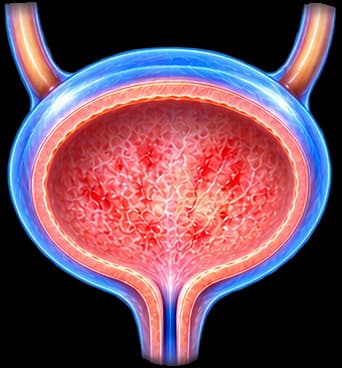
Hunner lesions are characteristic inflammatory lesions of the bladder mucosa, present in a subset of PBPS patients. They matter because they identify a clinically meaningful phenotype, and lesion-directed therapy can be particularly effective.
A Hunner lesion is an inflammatory mucosal lesion with a characteristic cystoscopic appearance — not simply “a red area.” Not every erythematous patch is a Hunner lesion.
Hunner phenotype
Visible characteristic lesion, often a stronger inflammatory phenotype, relevant to lesion-directed treatment.
Non-Hunner phenotype
Mucosa may look normal; pain mechanisms may involve sensory/pelvic/systemic contributors.
Hunner lesion disease and non-Hunner PBPS should not be treated as identical conditions. Rigid demographic rules for who gets which phenotype should be avoided.
Glomerulations
Glomerulations are small pinpoint mucosal haemorrhages that may appear after bladder hydrodistension.
They are a non-specific finding — they do not by themselves establish a PBPS diagnosis. They can appear in people without PBPS. They should not be used as a diagnostic gold standard.
Biopsy & urodynamics
A biopsy can be useful to exclude CIS, investigate suspicious mucosa, rule out selected other pathology, or support phenotyping. It is not mandatory for every patient with suspected PBPS.
Urodynamic testing is not routinely required in every uncomplicated case. It can be useful for retention, voiding dysfunction, complex LUTS, suspected neurological cause (see also neurogenic bladder), or diagnostic uncertainty. There is no urodynamic pattern specifically diagnostic of PBPS.
Pathophysiology
Proposed mechanisms include urothelial barrier dysfunction, sensory hypersensitivity, central sensitisation, neurogenic inflammation, immune/inflammatory mechanisms, pelvic-floor dysfunction, and mast-cell involvement in selected phenotypes.
There is no single proven mechanism that explains every patient.
Central sensitisation describes how pain-processing pathways can become hypersensitive. This does not imply that symptoms are imaginary or that the disease is purely psychological.
PBPS may coexist with irritable bowel syndrome, fibromyalgia, migraine, vulvodynia, and endometriosis-related pain — without this implying direct causation between them.
Pelvic floor
Possible findings include pelvic-floor hypertonicity, tenderness, trigger points, and impaired relaxation, which may contribute to bladder pain, frequency, dyspareunia, and voiding dysfunction.
For patients with hypertonicity/tenderness, manual/myofascial physiotherapy can help significantly.
Kegel/strengthening exercises are not automatically appropriate for a painful, hypertonic pelvic floor — they can worsen symptoms. The right approach always depends on assessment.
Treatment philosophy
Treatment should be multimodal, phenotype-directed, and iterative.
Goals: reduce pain, improve frequency/nocturia, improve sleep, reduce flares, address pelvic-floor dysfunction, improve sexual function, and improve quality of life.
No single treatment cures every patient.
Self-management, diet & fluids
May include education, identifying individual triggers, a symptom diary, a fluid strategy, sleep, stress management, and activity adjustment. Self-management alone is not adequate in severe disease.
Possible individual triggers: coffee, alcohol, acidic drinks, spicy foods, carbonated drinks, selected foods.
There is no universal “IC diet” required for every patient. Unnecessarily restrictive diets are avoided.
For fluid intake, both forced overhydration and unnecessary dehydration are avoided — individualised.
Pain management
A multimodal strategy is followed: simple analgesic approaches, neuropathic-pain modulation, pelvic-floor therapy, and multidisciplinary pain care in refractory disease. No opioid-based treatment pathway is built.
Oral therapy
In selected patients, options considered include amitriptyline, cimetidine, hydroxyzine, pentosan polysulfate sodium (PPS), and, in highly selected refractory or Hunner disease, cyclosporine A. Evidence and side-effect profiles differ substantially between options — no one drug fits everyone, and dosing is always individualised by the treating physician.
PPS safety: A recognised association exists between long-term pentosan polysulfate exposure and pigmentary maculopathy/retinal toxicity. PPS is not presented as a universally preferred option — discuss the risk profile with your treating physician.
Intravesical therapy
Depending on current evidence and availability, selected preparations are considered, such as DMSO, lidocaine, heparin, hyaluronic acid, or chondroitin sulfate. The exact composition, concentration, and dwell time are always determined by the treating physician.
BCG is not standard treatment for PBPS/interstitial cystitis. It is a treatment for selected forms of bladder cancer — it should not be confused with intravesical therapy for PBPS.
Hydrodistension
Bladder hydrodistension under anaesthesia may be used in selected patients for diagnostic phenotyping, lesion identification, and temporary symptomatic relief.
Hydrodistension is not a guaranteed or permanent cure. The EAU and AUA do not fully agree on its role — it should not be presented as a mandatory step under every guideline framework.
Aggressive high-pressure or prolonged techniques are not promoted — the choice of procedural parameters is strictly a medical decision.
Treatment of Hunner lesions
For documented Hunner lesions, depending on current evidence, fulguration/cauterisation of the lesion or targeted corticosteroid injection into the lesion may be considered.
Lesions or symptoms can recur — repeat treatment may sometimes be needed. There is no guarantee of permanent cure.
Botulinum toxin & neuromodulation
In selected refractory patients, intravesical botulinum toxin A is considered, with potential benefit for pain reduction and improved storage symptoms. Retention requiring catheterisation may occur.
Sacral neuromodulation may also be considered in selected refractory patients. Neither is presented as a first-line treatment or a universal cure.
Major surgery
Major reconstructive surgery, urinary diversion, or cystectomy are reserved for highly selected, severely refractory, carefully phenotyped patients.
Cystectomy is not standard treatment for PBPS. Importantly, pain may persist even after bladder removal in selected patients with broader pain sensitisation.
Functional vs anatomical capacity
Functional capacity
The volume tolerated by the patient during normal daily life.
Anatomical capacity
Capacity assessed under anaesthesia/hydrodistension.
Small voided volumes do not automatically mean permanent bladder shrinkage. In selected severe Hunner-type disease, fibrosis and reduced anatomical capacity can occur, but this does not describe every PBPS patient.
Frequency & nocturia
In PBPS, frequent voiding may be an attempt to prevent the pain caused by bladder filling. Symptom management should therefore not focus only on suppressing frequency.
Nocturia may occur but is non-specific — alternative or additional causes are considered, such as nocturnal polyuria, sleep disorder, OAB, excessive evening fluids, or sleep apnoea. Not all nocturia is attributed to PBPS.
Sexual function & mental health
Possible symptoms: dyspareunia, post-coital flares, pelvic-floor pain, and ejaculatory pain in men. This is discussed clinically and sensitively.
Chronic pain may contribute to anxiety, depression, sleep disturbance, catastrophising, and reduced quality of life. Psychological impact does not mean the symptoms are psychogenic or imaginary.
Flares & true UTI
Symptoms may fluctuate. Potential individual triggers include intercourse, stress, menstruation, food/drink, prolonged sitting, and infection. There are no universal triggers for everyone.
A patient with established PBPS may later develop a genuine bacterial UTI. New symptoms should not automatically be labelled an “IC flare” without reassessment.
The diagnosis should be reconsidered if: bladder-related pain is absent, cultures repeatedly confirm infection, significant haematuria appears, retention develops, neurological findings appear, upper tract changes develop, cystoscopy/cytology is abnormal, systemic symptoms occur, or multiple well-selected treatments fail repeatedly.
Treatment failure should trigger diagnostic reassessment, not endless escalation.
When to seek help immediately
Seek prompt assessment if you notice:
- • Gross haematuria
- • Clot retention
- • Fever or chills
- • Flank pain
- • Urinary retention
- • Unexplained weight loss
- • Abnormal cytology
- • A new neurological deficit
- • Rapidly changing, severe symptoms
These should not be labelled a normal PBPS flare.
Your Patient Journey
Bladder pain/pressure/discomfort + frequency/nocturia
Initial patient presentation.
History + urinalysis/urine culture
Excluding active infection and identifying other obvious causes.
Does pain relate to filling/voiding?
Bladder diary and pelvic-floor assessment.
Haematuria/cancer-risk evaluation where appropriate
Excluding a more serious cause before proceeding with a PBPS diagnosis.
Cystoscopy ± hydrodistension/biopsy when clinically indicated
Not automatically in every patient.
Phenotype: Hunner or non-Hunner
Determines the treatment strategy.
Multimodal, phenotype-directed treatment
Education, pelvic-floor physiotherapy, oral therapy, intravesical therapy, selected hydrodistension, Botox, neuromodulation.
Reassess response
If treatment repeatedly fails: reconsider diagnosis & phenotype.
Frequently Asked Questions (FAQ)
What is interstitial cystitis?
It is the established term for a chronic or recurrent syndrome of pain, pressure, or discomfort perceived in the bladder region, often worsening as the bladder fills and providing temporary relief after voiding, without proven infection or another obvious cause.
What does PBPS / IC-BPS mean?
These are the current scientific terms. The EAU mainly uses Primary Bladder Pain Syndrome (PBPS), while the AUA widely uses Interstitial Cystitis / Bladder Pain Syndrome (IC/BPS). These are not different diseases — the terminology shift reflects that no infection explains the symptoms and that this is a heterogeneous syndrome, not a single “-itis.”
Is it an infection?
No. PBPS/IC-BPS is defined precisely by the absence of a proven infection that explains the symptoms. Interstitial cystitis ≠ a urinary tract infection.
What are the most common symptoms?
Pain, pressure, or discomfort related to the bladder, often worsening as the bladder fills and temporarily relieved after voiding, along with urinary frequency and nocturia. Not every patient has the “textbook” presentation.
Why does the bladder hurt when it fills?
This pattern (pain increasing with filling and easing after voiding) is characteristic but not mandatory in every patient. It is considered a key diagnostic clue because it distinguishes PBPS from other causes of frequency.
Why does voiding provide temporary relief?
Because voiding reduces bladder volume and pressure, which appears to be the core mechanism of discomfort in many patients. In PBPS, frequent voiding is often an attempt to avoid the pain of filling, not fear of leakage as in classic overactive bladder.
Can it occur without very severe pain?
Yes. The severity spectrum is broad — from mild discomfort to severe pain. However, frequency without bladder-related pain or discomfort does not automatically mean PBPS — other causes must be considered.
What is the difference from a UTI?
A UTI is an infectious syndrome with bacterial growth, pyuria, and often acute dysuria. PBPS is chronic/recurrent without a proven infection explaining it. One negative culture is not enough to diagnose PBPS, but repeated negative cultures with persistent symptoms should prompt reconsideration of continued empirical antibiotics.
What is the difference from overactive bladder (OAB)?
In OAB, the dominant symptom is urgency (difficult to defer), and voiding occurs to avoid leakage. In PBPS, the dominant symptom is pain/pressure/discomfort, and voiding occurs to relieve the pain of filling. Overlap in the same patient is possible.
What is the difference from chronic prostatitis?
In men, symptoms may overlap with chronic prostatitis/chronic pelvic pain syndrome (CP/CPPS) and pelvic-floor dysfunction. Pelvic pain in a man does not automatically mean prostatitis — assessment must consider the relationship to bladder filling, perineal pain, urethral pain, and ejaculatory pain.
Is a urine culture needed?
Yes, urinalysis and urine culture are part of the basic assessment, to rule out active infection. A dipstick test alone is not enough.
Does every patient need cystoscopy?
Not necessarily — and this is where guidelines differ. The EAU gives cystoscopy ± hydrodistension/biopsy an important role for phenotyping and excluding confusable disease in selected diagnostic pathways. The AUA does not require routine cystoscopy in every uncomplicated presentation, but considers it particularly useful when the diagnosis is uncertain, Hunner lesions are suspected, or another pathology must be excluded.
What is a Hunner lesion?
It is a characteristic inflammatory lesion of the bladder mucosa, visible in a subset of PBPS patients. Its presence defines a clinically meaningful phenotype (“Hunner lesion disease”), which often responds particularly well to lesion-directed therapy.
What are glomerulations?
They are small pinpoint mucosal haemorrhages that may appear after bladder hydrodistension.
Are glomerulations diagnostic?
Not on their own. They are a non-specific finding — they can also appear in patients without PBPS, and should not be used as a “gold standard” for diagnosis.
Is a biopsy needed?
It can be useful to exclude CIS, investigate suspicious mucosa, rule out selected other pathology, or support phenotyping. However, it is not mandatory for every patient with suspected PBPS.
Is urodynamic testing needed?
It is not required routinely in every uncomplicated case. It can be useful when there is retention, voiding dysfunction, complex LUTS, suspected neurological cause, or diagnostic uncertainty. There is no urodynamic pattern that is specifically diagnostic of PBPS.
Can it cause haematuria?
Haematuria should not automatically be attributed to PBPS. It requires assessment based on age, smoking, severity, persistence, and other risk factors for urothelial cancer.
Is it a precancerous condition?
No. PBPS itself is not regarded as a typical premalignant bladder lesion. However, alternative causes of symptoms (such as carcinoma in situ) must be excluded when indicated, as they can mimic PBPS.
Can a true urinary tract infection coexist?
Yes. A patient with established PBPS can later develop a genuine bacterial UTI. New symptoms should not automatically be labelled a “flare” without reassessment.
Is there a specific diet?
There is no single universal “IC diet” required for everyone. Some patients identify individual triggers (e.g. caffeine, alcohol, acidic or spicy foods), but the dietary approach is individualised — without unnecessarily restrictive diets.
Does pelvic-floor physiotherapy help?
In patients with pelvic-floor hypertonicity or tenderness, manual/myofascial physiotherapy can significantly help reduce pain and dysfunction.
Should I do Kegel exercises?
Not automatically. Kegel/strengthening exercises are not automatically appropriate for a painful, hypertonic pelvic floor — they can worsen symptoms. The right approach depends on pelvic-floor assessment.
Which medications are used?
In selected patients, oral options considered include amitriptyline, cimetidine, hydroxyzine, pentosan polysulfate sodium (PPS), and, in highly selected refractory/Hunner disease, cyclosporine A. Evidence and side-effect profiles differ substantially — no single drug fits everyone, and dosing is always individualised by the treating physician.
What are intravesical instillations?
This is direct placement of medication inside the bladder (e.g. DMSO, lidocaine, heparin, hyaluronic acid/chondroitin sulfate in selected preparations), depending on availability and current evidence. The exact regimen and concentration are determined by the treating physician.
Is BCG used?
No. BCG is not standard treatment for PBPS/interstitial cystitis — it is a treatment for selected forms of bladder cancer and should not be confused with intravesical therapy for PBPS.
What is hydrodistension?
It is distension of the bladder with fluid under anaesthesia, used in selected patients for diagnostic phenotyping, lesion identification, and possible temporary symptomatic relief. It is not a guaranteed or permanent cure.
How are Hunner lesions treated?
Depending on current evidence and guideline context, fulguration/cauterisation of the lesion or targeted corticosteroid injection may be considered. Lesions or symptoms can recur, so repeat treatment may sometimes be needed — there is no guarantee of permanent cure.
Can Botox be used?
In selected refractory patients, intravesical botulinum toxin A may be considered for pain reduction and improved storage symptoms. Catheterisation may be required due to retention risk. It is not a first-line treatment.
Can neurostimulation be used?
Sacral neuromodulation may be considered in selected refractory patients, but it is not a first-line treatment or a universal cure.
Is cystectomy ever needed?
Rarely. Major reconstructive surgery, urinary diversion, or cystectomy are reserved for highly selected, severely refractory, carefully phenotyped patients — it is not standard treatment for PBPS. Importantly, pain may persist even after bladder removal in patients with broader pain sensitisation.
When should the diagnosis be reconsidered?
If bladder-related pain is absent, cultures repeatedly confirm infection, significant haematuria appears, retention develops, neurological findings appear, upper tract changes develop, cystoscopy/cytology is abnormal, systemic symptoms occur, or multiple well-selected treatments fail repeatedly. Treatment failure should trigger diagnostic reassessment, not endless escalation.
Related Topics
Bladder pain syndrome: individualised diagnosis, not guesswork
Diagnosing bladder pain syndrome should not rely on frequency alone or a single cystoscopy. It requires confirming that the pain truly relates to the bladder, excluding infection and other conditions that can cause similar symptoms, and identifying whether a Hunner lesion or another phenotype is present. Treatment is individualised and usually combines more than one intervention.
Scientific References
- EAU Guidelines on Chronic Pelvic Pain 2026 — uroweb.org
- Clemens JQ, Erickson DR, Varela NP, Lai HH. Diagnosis and Treatment of Interstitial Cystitis/Bladder Pain Syndrome: AUA Guideline Amendment. J Urol. 2022;208(1):34-42 — auanet.org
- van de Merwe JP, Nordling J, Bouchelouche P, et al. Diagnostic criteria, classification, and nomenclature for painful bladder syndrome/interstitial cystitis: an ESSIC proposal. Eur Urol. 2008;53(1):60-67
- Pape J, Falconi G, De Mattos Lourenco TR, et al. Variations in bladder pain syndrome/interstitial cystitis (IC) definitions, pathogenesis, diagnostics and treatment: a systematic review. Int Urogynecol J. 2019;30(11):1795-1805
Meet the Doctor

Dr. Marinos Vasilas, Urologist & Andrologist
Individualised management of PBPS/IC-BPS following EAU & AUA 2026 guidance: Hunner/non-Hunner phenotyping, selective cystoscopy/hydrodistension, and multimodal treatment in collaboration with a pelvic-floor physiotherapist.
View Full Profile


