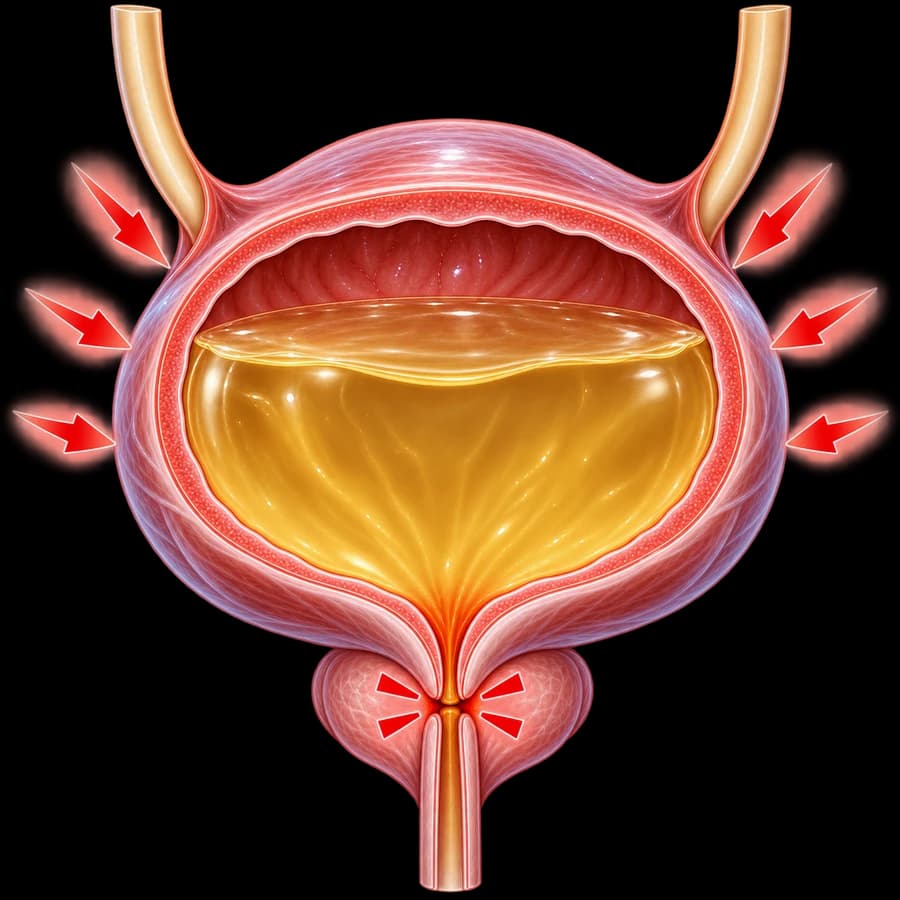
1. The Clinical Approach
Managing retention does not end with catheter placement. The catheter treats the result — not necessarily the cause. The key clinical questions are:
This guide follows current EAU Guidelines on Non-neurogenic Male LUTS, Non-neurogenic Female LUTS, Neuro-Urology, Urological Infections, and Urological Trauma (2026).
2. What Urinary Retention Actually Is
Urinary retention describes failure to empty the bladder adequately. It exists on a spectrum: complete inability to void, partial emptying, a large residual volume, or chronic incomplete emptying.
Not every patient with retention produces zero urine through the urethra. A patient may still urinate small amounts, dribble, or have overflow leakage and still have major retention.
3. Acute vs Chronic Retention
Acute Retention
- sudden onset
- strong urge to void
- suprapubic pain
- complete inability to void
- distended bladder
- needs prompt decompression
Chronic Retention
- gradual progression
- often less painful
- weak stream
- prolonged voiding
- incomplete emptying
- frequency/nocturia
- overflow leakage
- recurrent infection
Chronic retention can exist without the severe pain seen in acute retention.
Acute-on-Chronic Retention
Some patients with longstanding incomplete emptying suddenly become completely unable to urinate. This is acute-on-chronic retention and often indicates significant underlying voiding dysfunction, needing both urgent decompression and subsequent cause-directed evaluation.
4. Retention ≠ Anuria
Urinary Retention
Kidneys → produce urine → reaches the bladder → the bladder cannot empty.
Anuria
Little or no urine is produced or reaches the bladder — possible causes include acute kidney injury, bilateral upper-tract obstruction, shock, or other renal/systemic causes.
“I am not passing urine” does not always mean the bladder is full. Bladder examination or a bladder scan helps distinguish the two conditions.
5. A Few Drops ≠ Good Emptying
Retention needs to be distinguished from simple difficult urination:
Hesitancy
Delay in starting the urinary stream.
Weak Stream
Reduced force or speed of flow.
Straining
Using abdominal effort to void.
Incomplete-Emptying Sensation
A subjective feeling, not always an objective finding.
Feeling incompletely emptied ≠ measured high PVR. Symptoms and objective emptying do not always correlate. A markedly full bladder can still dribble, pass small amounts, or produce overflow leakage and still have major retention.
6. PVR — Post-Void Residual
PVR is the amount of urine remaining after voiding, measured preferably non-invasively by bladder ultrasound or a bladder scanner where practical.
PVR is a measurement — not a diagnosis.
A high PVR can result from outlet obstruction, detrusor underactivity, neurological dysfunction, dysfunctional voiding, or mixed pathology.
There is no single universally accepted PVR that defines clinically relevant retention for every patient. Avoid a simplistic cliff such as “<50 = normal, >300 = chronic retention” — it does not reflect current clinical reality.
Current EAU male LUTS/underactive bladder guidance uses PVR >300 mL in a specific context for considering intermittent catheterisation and notes increasing UTI risk — this must not be converted into a universal definition of chronic urinary retention.
300 mL is not a universal biological border between “normal” and “retention”.
7. Bladder Outlet Obstruction vs Weak Bladder
Low flow combined with high PVR can result from:
Outlet Resistance / Obstruction (BOO)
The bladder pushes against resistance at the outlet.
Detrusor Underactivity
The bladder\u2019s contraction is insufficient.
Or both together. High residual urine does not tell us why the bladder did not empty.
8. BPH, BPE & BPO — The Prostate as a Cause
BPH
Histological hyperplasia of the prostate.
BPE
Benign prostatic enlargement.
BPO
Functional benign prostatic obstruction.
A large prostate does not automatically mean significant obstruction or retention caused by the prostate. A small prostate does not exclude bladder-neck or urethral obstruction.
In older men, BPO is an important and common cause of acute urinary retention, but “retention in an older man = prostate” is not a safe automatic assumption. Urethral stricture, bladder-neck obstruction, detrusor underactivity, neurological disease, medications, stones/clots, and infection/inflammation should also be considered.
See: Benign Prostatic Hyperplasia9. Urethral Stricture, Bladder Neck, Stones & Clots
Urethral Stricture
Urethral narrowing can cause weak flow, straining, incomplete emptying, recurrent infection, and eventually retention. Uroflow/PVR may raise suspicion but do not define location, length, or severity — further urethral evaluation is often needed.
See: Urethral StrictureBladder-Neck Obstruction / Functional Outlet Dysfunction
Retention can arise from functional or anatomical outlet disorders that are not explained simply by prostate size.
Stones
A urethral or bladder-outlet stone can cause mechanical obstruction. A renal or upper-ureteral stone usually causes upper-tract obstruction rather than retention from a full bladder.
Blood Clots — Clot Retention
Visible haematuria with clots obstructing the bladder outflow and inability to void requires prompt urological assessment.
See: Blood in Urine (Haematuria)10. Detrusor Underactivity & Underactive Bladder
The detrusor is the muscle that contracts to empty the bladder. If contraction is weak, short, or absent, emptying can become incomplete. Possible associations include ageing, neurological disease, diabetes-related neuropathy, longstanding obstruction, pelvic surgery, and other factors.
Underactive Bladder (UAB)
A clinical symptom syndrome.
Detrusor Underactivity (DU)
A urodynamic diagnosis.
The two terms are not perfect synonyms. Symptoms alone cannot reliably diagnose detrusor underactivity — formal pressure-flow urodynamics may be needed in selected patients when understanding the mechanism will change treatment.
11. Neurological Causes & Cauda Equina
Spinal cord disease/injury, multiple sclerosis, diabetic neuropathy, cauda equina/spinal compression, or other neurological disease can cause neurogenic retention.
Urinary retention together with:
- new leg weakness
- saddle anaesthesia
- severe new back pain
- bowel dysfunction
- altered perineal sensation
May indicate serious spinal/neurological pathology and requires urgent emergency assessment — do not treat it as routine prostate-related retention.
See our page on neurogenic bladder.
12. Medication-Induced Retention
Review any recent start or change in medications that can impair bladder emptying, including:
- anticholinergic drugs
- selected antihistamines
- sympathomimetic decongestants
- opioids
- selected antidepressants
- selected antipsychotics
- other medications affecting bladder/outlet function
New urinary retention should trigger a medication review. Do not stop a prescribed medication independently — any change should be made in consultation with your treating doctor.
13. Postoperative & Postpartum Retention
Postoperative Retention
May occur after general/spinal anaesthesia, opioids, pelvic surgery, prolonged immobility, high perioperative fluid load, or pre-existing LUTS. Not every postoperative patient should be treated as a BPH case — management depends on bladder volume, symptoms, type of surgery, ongoing anaesthesia effects, and individual risk.
Postpartum Retention
Can occur after childbirth, with possible contributors including regional anaesthesia, perineal trauma, pain, pelvic floor dysfunction, or bladder overdistension. It is not a male-only condition.
14. Female Urinary Retention
Potential mechanisms include:
- pelvic organ prolapse
- previous anti-incontinence surgery (sling/tape)
- urethral obstruction/stricture
- functional obstruction
- detrusor underactivity
- neurological disease
- medications
- postoperative/postpartum states
Urinary retention is not exclusively a male or prostate condition. Current EAU female LUTS guidance includes management of female voiding dysfunction and retention.
After Anti-Incontinence Surgery
New retention or significant voiding difficulty after sling/tape surgery deserves specific assessment. Current EAU female LUTS guidance includes sling revision/release in appropriately selected cases — detailed surgical management remains outside the scope of this page.
15. Infection, Fever & Retention
Infection or severe inflammation can occasionally precipitate retention, for example acute prostatitis, significant lower urinary tract infection, or swelling around the outlet. Severe constipation/faecal impaction can also contribute to voiding difficulty in vulnerable or older patients, without being a default explanation.
Retention + fever/chills/hypotension/confusion ≠ a routine outpatient catheter problem — it requires urgent evaluation.
See our pages on acute prostatitis and painful urination.
16. Pelvic/Urethral Trauma — A Different Pathway
If retention occurs after a pelvic fracture, perineal, or genital trauma, especially with blood at the urethral meatus or perineal/scrotal bruising, routine blind catheterisation should not be presented as the universal next step.
Suspected urethral injury changes the drainage pathway.
Further evaluation may require retrograde urethrography or cystourethroscopy and an experienced catheter/drainage strategy, following current EAU Guidelines on Urological Trauma (2026).
17. First Priority in Acute Retention
For typical, uncomplicated acute painful retention without suspected urethral trauma, the priority is bladder decompression, most commonly with transurethral catheter drainage. If urethral catheterisation is unsafe, fails, or is contraindicated, alternative drainage such as suprapubic catheterisation may be required depending on clinical context.
Urethral Catheter
Passes through the urethra into the bladder.
Suprapubic Catheter
Drains the bladder through the lower abdominal wall.
Neither is universally superior. The choice depends on anatomy, urethral condition, duration, patient factors, and clinical indication. For long-term drainage where intermittent catheterisation is not possible, current EAU male LUTS/UAB guidance generally favours a suprapubic over a chronic urethral catheter where feasible.
There is no clear evidence of a safety advantage of routine gradual/staged decompression over rapid, complete drainage — routine repeated clamping is not automatically required solely because the bladder contains a large volume.
Transient haematuria can occur after decompression, particularly in a markedly distended or chronic retention case — this does not necessarily imply new traumatic injury, but significant bleeding requires clinical assessment.
18. The Catheter Empties the Bladder — It Doesn’t Explain Why
Acute Retention → Catheter/Drainage → Bladder Decompressed
But why did it happen?
Catheterisation relieves retention. It does not establish the cause.
Post-Obstructive Diuresis
After relief of substantial or prolonged obstruction, some patients can produce a very large amount of urine. This may cause dehydration, electrolyte disturbance, or hypotension and may require monitoring. After draining a markedly overdistended bladder, management may not end when the catheter starts flowing.
19. Which Test Answers Which Question
| Test | What It Answers |
|---|---|
| Bladder scan / PVR | Is the bladder retaining urine? |
| Renal/bladder ultrasound | Upper tract? Hydronephrosis? Bladder/prostate anatomy? |
| Creatinine/eGFR | Renal-function effect? |
| Urinalysis | Infection or haematuria clues? |
| Uroflowmetry | How is urine flowing once the patient can void? |
| Cystoscopy | Is there relevant urethral/bladder/outlet pathology? |
| Urodynamics / pressure-flow | Is poor emptying due to obstruction or weak detrusor in selected cases? |
No single test answers every retention question.
Uroflowmetry is not meaningful while a patient is completely unable to void — it becomes useful after decompression, once spontaneous voiding resumes. Cystoscopy and urodynamics are not routine after every first acute retention episode. PSA should not be interpreted simplistically in acute retention, since it can be transiently affected by retention itself, infection/inflammation, or recent instrumentation — it is requested when it will genuinely influence prostate-cancer/BPO management, per current EAU guidance.
20. Trial Without Catheter (TWOC)
TWOC means removing the temporary catheter and checking whether spontaneous bladder emptying is successful, assessing ability to void, symptoms, voided volume, and PVR according to clinical protocol. Timing is not fixed for every patient — it depends on the cause, degree of retention, treatment, and clinical context.
For men with acute retention associated with suspected BPO, current evidence supports alpha-blocker treatment as potentially improving the chance of successful TWOC — without implying that every patient with retention should receive an alpha-blocker.
Successful spontaneous voiding after catheter removal does not necessarily eliminate the underlying risk. Subsequent assessment depends on LUTS, PVR, prostate/outlet findings, recurrence, upper-tract effects, and cause.
Failure does not automatically mean immediate prostate surgery for everyone. Obstruction, detrusor function, urethra, neurological/medication factors, and patient fitness/preferences are reassessed — definitive treatment follows the mechanism.
21. Chronic Retention, Overflow & Frequency
An overfilled bladder may leak small amounts. The patient may report dribbling, continuous leakage, or frequent small voids and assume they are “urinating too often”.
Urine leakage does not always mean the bladder is emptying well.
Incomplete emptying creates a smaller functional bladder capacity between voids, so a patient may have frequency, nocturia, or urgency-like symptoms despite retaining significant urine. See our pages on frequent urination and nocturia.
22. Long-Term Management
Intermittent Catheterisation
In persistent high PVR or an underactive bladder, intermittent catheterisation is generally preferred over long-term indwelling catheter drainage when feasible. Current EAU male LUTS guidance notes increased UTI risk with persistent PVR and recommends intermittent catheterisation as first-line drainage in UAB with significant high residual/upper-tract risk. Hand function, cognition, caregiver support, and patient preference are all considered.
Long-Term Indwelling Catheter
Generally reserved for patients where intermittent catheterisation is unsuitable or other emptying strategies have failed or are inappropriate. Potential complications include UTI, colonisation, stones, urethral complications, and discomfort.
Surgical Treatment of BPO
Recurrent or refractory retention in a man with confirmed BPO is an important indication for surgical management under current EAU guidance. Actual options depend on prostate anatomy/volume, bladder function, antithrombotic considerations, comorbidity, and preference — with no “best treatment” ranking here.
In detrusor underactivity, parasympathomimetic drugs are not reliably shown to “strengthen” the bladder based on current evidence. Management may involve addressing reversible causes, timed/double voiding in selected cases, intermittent catheterisation, or treating relevant outlet obstruction where appropriate.
23. The Patient Journey
Acute Retention
- 1"I want to urinate but I can’t" — Is the bladder full/distended?
- 2YES → check immediately: trauma/urethral injury? fever/systemic infection? haematuria/clots? neurological red flags? renal impairment/high-risk context?
- 3Typical uncomplicated AUR → prompt bladder decompression
- 4Special/high-risk pathway → adapted specialist drainage/emergency evaluation
- 5After decompression: urine output, renal function where indicated, urinalysis/infection assessment, medication history, neurological history, outlet/prostate/urethral evaluation
- 6Determine likely mechanism: BOO/BPO, urethral obstruction, detrusor underactivity, neurogenic, medication/postoperative, mixed
- 7Temporary catheter ± TWOC when appropriate
- 8Persistent/recurrent problem? → cause-directed long-term treatment
Chronic Retention
- 1Weak stream / prolonged voiding / frequency / overflow leakage / recurrent UTI
- 2Measure PVR
- 3High/persistent residual? → assess renal function, upper urinary tract where indicated, bladder/prostate/outlet, neurological/medication factors
- 4Is the mechanism clear? → likely obstruction: outlet pathway | suspected weak detrusor/unclear: selected pressure-flow urodynamics
- 5Safe emptying strategy
- 6Cause-directed treatment
24. Red Flags — When It Is an Emergency
Seek urgent assessment when there is:
- complete inability to urinate
- severe painful bladder distension
- fever/chills/systemic illness
- gross haematuria with clots
- anuria or near-anuria
- acute renal impairment
- solitary kidney/upper-tract concern where relevant
- new neurological deficits
- saddle anaesthesia
- pelvic/perineal trauma
- blood at the urethral meatus
- significant clinical deterioration
- significant post-decompression diuresis with instability
Stable, mild, chronic elevation of PVR is not the same emergency.
25. Myths Worth Forgetting
"I can pass a few drops, so I don’t have retention"
False. A markedly full bladder can still dribble or produce overflow leakage and still have major retention.
"My bladder doesn’t hurt, so it can’t be retention"
False in chronic retention. Longstanding distension may be minimally painful or poorly sensed, especially in neurological disease or an underactive bladder.
"My prostate is large, so that must be the cause"
Prostate volume alone does not prove BOO. The mechanism may involve outlet obstruction, detrusor weakness, or both.
"My prostate is small, so it can’t be obstruction"
Also false. Outlet resistance can occur due to the bladder neck, urethral stricture, or functional anatomy even without a very large prostate.
"The catheter is in, so the problem is solved"
False. The acute danger/full bladder may be relieved. The underlying cause still requires evaluation.
"If the catheter comes out and I urinate, I’m cured"
Not necessarily. TWOC success does not prove normal PVR, normal detrusor function, absence of obstruction, or low recurrence risk.
26. Your First Visit
27. The Doctor

Dr. Marinos Vasilas, Urologist – Andrologist
Dr. Marinos Vasilas evaluates urinary retention according to current EAU guidelines, with emphasis on prompt safe decompression and correct cause-directed evaluation before any long-term decision.
Meet the Doctor28. The Team
Investigating urinary retention — from urgent decompression to correct cause-directed evaluation — is organised in collaboration with an experienced urological team.
Meet Our Team29. Frequently Asked Questions
What is urinary retention?
Urinary retention means the bladder fails to empty adequately or at all, while the kidneys continue producing urine. It can be acute (sudden) or chronic (gradual, often less obvious).
What is the difference between acute and chronic retention?
Acute retention is a sudden, complete inability to void, usually with severe suprapubic pain, and is a urological emergency. Chronic retention develops gradually, may be painless, and can present with weak stream, frequency, or overflow leakage.
Is acute retention always an emergency?
Yes. Complete inability to urinate with pain requires prompt medical assessment and bladder decompression.
Why do I feel like urinating but can’t?
This can result from bladder outlet obstruction, inadequate detrusor contraction, neurological dysfunction, medication, or a combination of factors. Clinical assessment is needed to identify the cause.
Can I have retention if I still pass a few drops?
Yes. A markedly full bladder can still dribble or produce overflow leakage without that meaning it is emptying properly.
Can retention be painless?
Yes, especially in chronic retention, where bladder distension may be minimally sensed or even asymptomatic.
What is the difference between retention and anuria?
In retention, the kidneys produce urine but the bladder fails to empty. In anuria, little or no urine is produced or reaches the bladder at all, which can indicate serious kidney or systemic disease.
What is PVR?
PVR (post-void residual) is the amount of urine remaining in the bladder after voiding, typically measured non-invasively with a bladder ultrasound or scanner.
What PVR is considered high?
There is no single universally accepted PVR that defines clinically relevant retention for every patient. Interpretation depends on symptoms, upper-tract effects, infection risk, and treatment context.
Does high PVR mean BPH?
Not automatically. A high residual can result from outlet obstruction, weak bladder contraction, or both, regardless of whether an enlarged prostate is present.
Does high PVR mean obstruction?
Not on its own. PVR is a measurement, not a diagnosis of mechanism — further evaluation is needed to clarify whether it reflects obstruction, detrusor underactivity, or a mix.
What is detrusor underactivity?
It is a urodynamically confirmed diagnosis of an inadequate or insufficiently sustained bladder-muscle contraction, leading to incomplete emptying.
What is underactive bladder?
It is a clinical symptom syndrome (e.g. weak stream, incomplete emptying) that suggests a possibly weak bladder, but does not automatically equal the urodynamic diagnosis of detrusor underactivity.
Could the prostate be the cause?
In older men, benign prostatic obstruction is a common cause of acute retention, but it is not the only possible cause in every man.
Could a urethral stricture be the cause?
Yes. Urethral stricture can cause weak flow, straining, and eventually retention regardless of prostate status.
Could medications be responsible?
Yes. Anticholinergics, certain decongestants, opioids, and other drugs can impair bladder emptying — new retention should always prompt a medication review.
Could a neurological problem be the cause?
Yes, conditions such as multiple sclerosis, spinal cord injury, or diabetic neuropathy can cause neurogenic retention. New neurological symptoms with retention require urgent evaluation.
Can it happen after anaesthesia or surgery?
Yes, postoperative retention is relatively common, particularly after general/spinal anaesthesia, opioid use, pelvic surgery, or prolonged immobility.
Can it occur in women?
Yes. Retention is not exclusively a male or prostate condition — it can result from pelvic organ prolapse, prior incontinence surgery, urethral obstruction, neurological disease, or medications.
Can it happen after childbirth?
Yes, postpartum retention can be related to regional anaesthesia, perineal trauma, pain, or bladder overdistension during labour.
What happens first in acute retention?
The priority is prompt bladder decompression, usually with a urethral catheter, unless there is a contraindication such as suspected urethral injury.
Does catheterisation hurt?
There may be transient discomfort during insertion, but decompression usually relieves the severe pain of bladder distension quickly.
Is a urethral catheter always needed?
Not always. If urethral catheterisation is unsafe, fails, or is contraindicated (e.g. suspected urethral injury), a suprapubic catheter may be required depending on clinical context.
What is a suprapubic catheter?
It is a catheter that drains the bladder through the lower abdominal wall instead of the urethra. It is not universally superior — the choice depends on anatomy, duration, and clinical indication.
When should blind urethral catheterisation be avoided?
When urethral injury is suspected (e.g. blood at the meatus, perineal/scrotal bruising after pelvic or genital trauma), where a different assessment pathway is needed before drainage.
What is TWOC?
Trial Without Catheter means removing the temporary catheter and checking whether the patient can void spontaneously and effectively.
Do alpha-blockers help before TWOC?
In men with acute retention associated with suspected benign prostatic obstruction, giving an alpha-blocker before TWOC may improve the chance of successful voiding, without being suitable or necessary for every patient.
If I urinate after the catheter is removed, is the problem solved?
Not necessarily. Successful TWOC does not prove a normal residual, normal detrusor function, or a low risk of recurrence.
When is prostate surgery needed?
Recurrent or refractory retention in a man with confirmed benign prostatic obstruction is an important indication for surgical treatment, always after proper evaluation — not automatically after a single episode.
What is intermittent catheterisation?
It is a repeated, scheduled catheter insertion to empty the bladder, generally preferred over an indwelling catheter for persistent high residual or a weak bladder, when feasible.
What is overflow incontinence?
It is leakage from an overfilled bladder, which can be mistaken for frequency or normal voiding, while actually reflecting incomplete emptying.
Can retention harm the kidneys?
In selected patients, chronic or high-pressure retention can affect the upper urinary tract and kidney function, which is why creatinine and ultrasound are assessed when indicated.
What is post-obstructive diuresis?
It is the production of an unusually large volume of urine after relief of significant or prolonged obstruction, which may require fluid and electrolyte monitoring.
Can there be bleeding after decompression?
Transient haematuria can occur after rapid drainage of a markedly distended bladder; significant or persistent bleeding needs clinical assessment.
What if I have retention and a fever?
Retention combined with fever, chills, or systemic illness requires urgent assessment, as it may indicate serious infection.
When should I go straight to the emergency department?
For complete inability to urinate with pain, fever, gross haematuria with clots, new neurological symptoms, pelvic/urethral trauma, or significant deterioration.
Related Topics
Urinary Retention Evaluation
A complete acute inability to urinate needs prompt bladder decompression. After the acute episode, the important question is why it happened: outlet obstruction, urethral stricture, reduced bladder contractility, neurological dysfunction, medication, or a combination of factors. The correct diagnosis determines whether follow-up, a trial without catheter, medication, intermittent catheterisation, or treatment of the underlying obstruction is needed.
References
- EAU Guidelines on Management of Non-neurogenic Male LUTS 2026 — uroweb.org
- EAU Guidelines on Non-neurogenic Female LUTS 2026 — uroweb.org
- EAU Guidelines on Neuro-Urology 2026 — uroweb.org
- EAU Guidelines on Urological Trauma 2026 — uroweb.org
- EAU Guidelines on Urological Infections 2026 — uroweb.org
The content on this page is for informational purposes and does not replace individualised urological assessment. A complete acute inability to urinate is not suitable for online self-management. Do not repeat self-catheterisation attempts unless you have already been trained and instructed to do so. Do not stop prescribed medicines on your own. Neurological, trauma, or infection red flags require urgent assessment. Catheter choice depends on individual clinical circumstances.


