My clinical approach
Genital herpes is a chronic recurrent disease with significant psychosocial dimensions — comprehensive care combines antiviral therapy, transmission prevention and patient support.
Per the guidelines of EAU STI 2024, IUSTI 2017 and CDC STI 2021:
- Diagnostic confirmation with HSV PCR from active ulcer (gold standard).
- HSV-1 vs HSV-2 typing (different recurrence prognosis).
- Screening for other STIs: HIV, syphilis, hepatitis B/C, chlamydia, gonorrhea.
- Early initiation of antiviral therapy in primary episode (within 72 hours).
- Patient education: prodromal symptom recognition, self-treatment of recurrences.
- Discussion of suppressive therapy for ≥6 recurrences/year or with serodiscordant partner.
- Partner notification & examination — HSV-2 IgG serological testing.
- Psychosocial support — diagnosis is often accompanied by anxiety and stigma.
What is genital herpes
Genital herpes is a chronic infection by herpes simplex virus (HSV), member of the Herpesviridae family. Two types: HSV-1 (classically oral) and HSV-2 (classically genital).
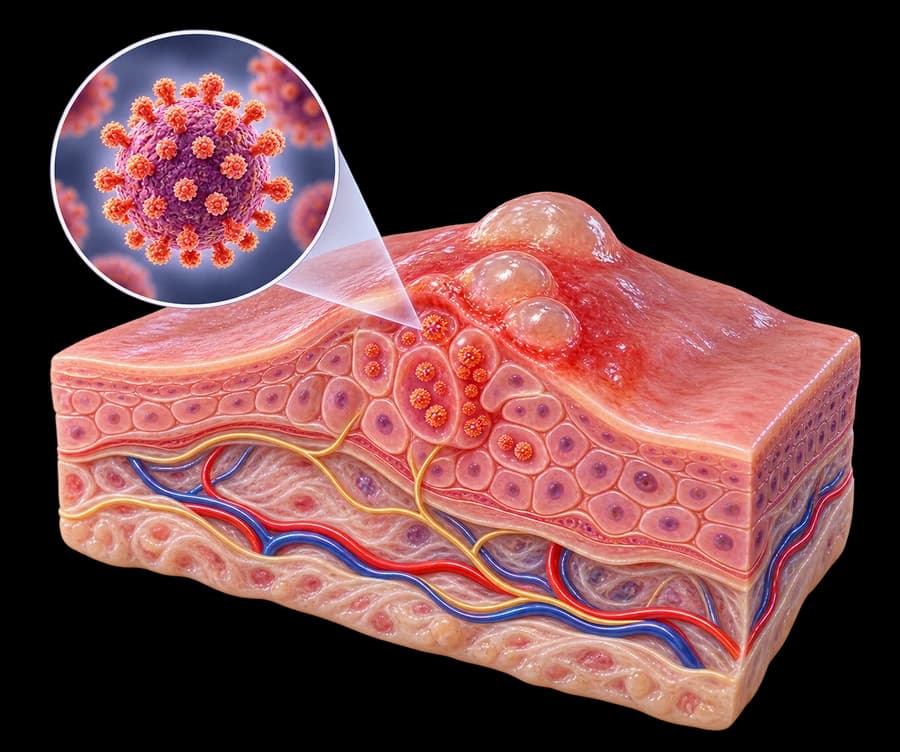
The virus enters through skin/mucosa, replicates locally (primary episode), and then travels through sensory nerves to the sacral ganglia where it persists lifelong in latent state. Periodically reactivates causing recurrences.
Epidemiology (WHO 2020): ~491 million people aged 15-49 worldwide with HSV-2, ~3.7 billion with HSV-1. In USA: 11.9% HSV-2 prevalence. Increasing proportion of genital HSV-1 in young adults (~30-50% of new cases).
Transmission & epidemiology
- Sexual contact — vaginal, anal, oral.
- Transmission during asymptomatic viral shedding — accounts for >70% of transmissions.
- Skin-to-skin contact in the area — not only via secretions.
- Mother-to-newborn during delivery (neonatal HSV — severe condition).
- Risk factors: multiple partners, young age at first contact, other STIs.
- Primary infection incubation: 2-12 days (mean 4 days).
- Condom reduces transmission ~30% (does not fully cover entire area).
- Suppressive antiviral therapy in carrier reduces transmission ~50%.
Clinical picture on the penis
Primary episode
More symptomatic, lasting 2-4 weeks:
- • Vesicles grouped on erythematous base → painful ulcers → crusts → healing without scar.
- • Severe pain, burning, itching.
- • Systemic symptoms: fever, myalgias, malaise, headache.
- • Painful inguinal lymphadenopathy.
- • Dysuria (if periurethral lesions).
Locations on the penis
- • Glans — most common location.
- • Foreskin (inner and outer surface).
- • Penile shaft.
- • Scrotum, pubis, thighs.
- • Perineum and perianal area.
- • Rarely in the urethra (herpetic urethritis).
Atypical presentations
Many patients (~70%) have mild or atypical symptoms and are not diagnosed: small fissures, redness, itching without vesicles. Asymptomatic carriage is significant for transmission.
Recurrences & prodromes
After the primary episode, the virus persists in latent state in the sacral ganglia. Reactivation causes recurrences, milder and shorter (5-10 days) than the primary episode.
Recurrence frequency
HSV-2: mean 4-6 recurrences/year in the first year. Genital HSV-1: ~1 recurrence/year — clearly milder course.
Prodromal symptoms
In 50-60% of patients 1-2 days before recurrence: tingling, burning, or pain in the area. Important for early initiation of self-treatment.
Trigger factors
Stress, febrile illness, sun exposure (UV), menstruation (in women), trauma to the area, immunosuppression, fatigue.
Long-term course
Frequency of recurrences gradually decreases over time (usually after 2-3 years). Some patients remain practically asymptomatic carriers.
Diagnosis
Clinical inspection
Recognition of characteristic lesions: grouped vesicles on erythematous base, painful ulcers with eroded crust.
HSV PCR (gold standard)
Swab from base of fresh ulcer or vesicle. Sensitivity 95-100%, specificity 100%. Additionally HSV-1 vs HSV-2 typing.
Viral culture
Less sensitive (50-70%) — superseded by PCR. Maintained in some centers.
Type-specific serology
IgG antibodies against gG1 (HSV-1) and gG2 (HSV-2). Useful for asymptomatic patients, partner assessment, distinguishing primary from recurrence. Not for acute recurrence diagnosis.
Tzanck smear
Outdated method (multinucleated giant cells) — low sensitivity (40-50%) and does not distinguish HSV/VZV.
STI screening
Always concurrent screening for HIV, syphilis (RPR/VDRL), hepatitis B/C, chlamydia & gonorrhea (urine NAAT or urethral).
Differential diagnosis
Genital warts (HPV — exophytic, painless), syphilitic ulcer (painless, indurated), chancroid (Haemophilus ducreyi), Behcet syndrome, aphthous stomatitis.
Treatment
There is no cure — the virus persists lifelong in nerve ganglia. Antiviral nucleoside analogs (HSV DNA polymerase inhibitors) reduce duration, severity and infectivity.
Primary episode
Initiation within 72 hours — preferably within 24-48 hours:
- • Acyclovir 400 mg PO 3 times/day × 7-10 days
- • Valacyclovir 1 g PO 2 times/day × 7-10 days
- • Famciclovir 250 mg PO 3 times/day × 7-10 days
Recurrence — episodic therapy
Initiation at prodromes or within 24 hours — shorter regimens:
- • Acyclovir 400 mg × 3/day × 5 days or 800 mg × 2/day × 5 days
- • Valacyclovir 500 mg × 2/day × 3 days or 1 g × 1/day × 5 days
- • Famciclovir 1 g × 2/day × 1 day (rapid regimen)
Suppressive therapy
Indications: ≥6 recurrences/year, severe recurrences, psychological burden, transmission reduction to serodiscordant partner, immunosuppression.
- • Acyclovir 400 mg × 2/day continuously
- • Valacyclovir 500 mg × 1/day (or 1 g in >10 recurrences/year)
- • Famciclovir 250 mg × 2/day continuously
Reduces recurrences by 70-80% and transmission ~50%. Reassessment every 12 months — discontinuation for frequency reassessment.
Special groups
Pregnancy: acyclovir is safe. Suppressive from 36th gestational week with history to reduce risk of neonatal HSV. HIV/immunosuppression: higher doses, prolonged regimens. In resistant strains: foscarnet or cidofovir. Renal failure: dose adjustment according to GFR.
Symptomatic measures
Paracetamol or NSAIDs for pain. Saline solution for compresses. Avoid topical steroids (prolong disease). Comfortable cotton underwear. In severe dysuria or urinary retention: counseling and possible hospitalization.
Transmission prevention
- Avoid sexual contact during active recurrence or prodromal symptoms.
- Consistent condom use — reduces 30% (not full coverage).
- Partner notification — moral and legal duty.
- Partner serological testing (HSV-2 IgG) in stable relationships.
- Suppressive antiviral in carrier — reduces transmission ~50%.
- Avoid orogenital contact in oral herpes of partner.
- In pregnancy: gynecologist information for suppressive therapy and delivery planning.
- Trigger factor management — stress, sun protection.
Frequently asked questions (FAQ)
What is genital herpes?
A chronic infection by herpes simplex virus (HSV-1 or HSV-2). Characterized by recurrent episodes of painful vesicles-ulcers on the genitals. The virus persists lifelong in nerve ganglia.
How is it transmitted?
By sexual contact (vaginal, oral, anal) — and during asymptomatic viral shedding. Condoms reduce risk by ~30% (do not cover the entire area). Mother-to-newborn transmission during delivery.
What is the difference between HSV-1 and HSV-2?
HSV-2 is mainly responsible for genital herpes with frequent recurrences (4-6/year). HSV-1 (classically oral) accounts for ~30-50% of new genital herpes cases — has rarer recurrences (≤1/year).
What are the symptoms?
Primary episode: vesicles → ulcers → crusts, lasting 2-4 weeks, with fever, lymphadenopathy. Recurrence: milder, lasting 5-10 days, often with prodromal symptoms (tingling, burning) 1-2 days before.
How is the diagnosis made?
Clinical inspection of characteristic lesions + confirmation by PCR (gold standard) from ulcer. In doubtful cases: HSV type-specific IgG serology (gG1/gG2). Tzanck smear has low sensitivity.
Is there treatment?
No cure — the virus persists lifelong. Antivirals (acyclovir, valacyclovir, famciclovir) reduce duration and severity. With ≥6 recurrences/year, suppressive therapy is recommended (valacyclovir 500 mg/day).
When is suppressive therapy given?
≥6 recurrences/year, severe/prolonged recurrences, significant psychological burden, reducing transmission risk to seronegative partner, immunosuppression. Reduces recurrences by 70-80% and transmission by ~50%.
How do I prevent transmission?
Condom for every contact (reduces 30%). Avoid sexual contact during active recurrence or prodromal symptoms. Notify partner. Suppressive antiviral in patient with frequent recurrences to protect seronegative partner.
Related topics
Vesicles or ulcers on the penis?
Contact us for immediate assessment, diagnostic confirmation by HSV PCR and early initiation of antiviral therapy. Complete STI screening and integrated recurrence management.
Scientific literature
- EAU Guidelines on Sexually Transmitted Infections (2024) — uroweb.org
- Workowski KA, Bachmann LH, Chan PA, et al. CDC Sexually Transmitted Infections Treatment Guidelines, 2021. MMWR Recomm Rep 2021;70(4):1-187 — cdc.gov
- Patel R, Kennedy OJ, Clarke E, et al. 2017 European guidelines for the management of genital herpes. Int J STD AIDS 2017;28(14):1366-1379 — pubmed.ncbi.nlm.nih.gov
- Looker KJ, Magaret AS, May MT, et al. Global and regional estimates of prevalent and incident HSV-1 and HSV-2 infections in 2016. Bull World Health Organ 2020;98(5):315-329 — pubmed.ncbi.nlm.nih.gov
- Whitley R, Baines J. Clinical management of herpes simplex virus infections: past, present, and future. F1000Res 2018;7:F1000 Faculty Rev-1726 — pubmed.ncbi.nlm.nih.gov
Meet the doctor

Dr. Marinos Vasilas, Urologist – Andrologist
Dr. Marinos Vasilas offers comprehensive diagnosis and management of genital herpes with HSV PCR confirmation, individualized antiviral therapy (acyclovir/valacyclovir/famciclovir) and suppressive regimens per EAU 2024 and IUSTI 2017 guidelines.
View full profile


