My Clinical Approach
Balanoposthitis is the most common inflammatory penile condition I see in clinic and at the same time the most frequently misunderstood. Many patients postpone consultation for months or self-treat with antiseptics and steroid creams without a diagnosis, which results in chronicity or in masking an underlying lesion (BXO, premalignant change).
The correct clinical approach always starts with classification: infectious (mycotic, bacterial), irritant/allergic, or chronic autoimmune form. This classification fully determines treatment and prognosis.
In my practice I consistently apply the following principles, in line with the EAU Guidelines on Male Sexual and Reproductive Health 2024 and the BASHH/UK National Guideline on the Management of Balanoposthitis 2022:
- Detailed history for irritants (soaps, antiseptics, latex, spermicides).
- Assessment of foreskin retractability — coexisting phimosis changes the algorithm.
- In recurrence or patients > 40 years: HbA1c measurement and low threshold for biopsy.
- Close cooperation with the partner when STIs are involved, to avoid "ping-pong" reinfection.
Correct diagnosis and cause-specific therapy resolves an episode in 1–2 weeks, while circumcision — when indicated — provides permanent protection from recurrence and complications.
What is balanoposthitis?
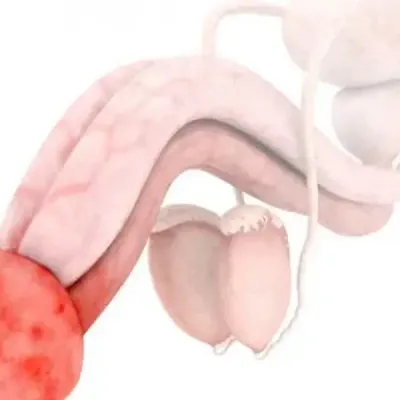
Balanoposthitis is the combined inflammation of the glans (head of the penis) and the prepuce (foreskin). It is the most common clinical form of penile inflammation and develops almost exclusively in uncircumcised men.
Lifetime prevalence in the adult male population is estimated at 3–11%, with higher rates in men with diabetes mellitus (up to 35%) and in men with inadequate personal hygiene.
Important: In men over 40 with chronic or treatment-refractory balanoposthitis, penile lichen sclerosus (BXO) and premalignant lesions (PeIN, Bowen disease, erythroplasia of Queyrat) must be excluded. The threshold for biopsy is low.
Causes and subtypes
Infectious balanoposthitis
- Candida albicans — the most common cause. Strong association with diabetes and partner vaginal candidiasis.
- Anaerobic bacteria (Bacteroides, Prevotella) — produce the characteristic malodour and purulent discharge.
- Group B Streptococcus, Staphylococcus aureus.
- STIs: Trichomonas, HSV, HPV, syphilis.
Non-infectious / irritant
- Irritant dermatitis from perfumed soaps, shower gels, antiseptics (e.g. povidone-iodine), spermicides.
- Allergic reaction to condom latex, lubricants, topical drugs.
- Traumatic from forceful or repeated retraction of the foreskin, intercourse, masturbation.
- Smegma accumulation due to poor hygiene.
Chronic dermatological forms
- Lichen sclerosus / BXO — fibrotic disease with risk of progression to penile cancer.
- Zoon balanitis (plasma-cell) — shiny, well-demarcated orange plaques.
- Psoriasis, lichen planus, Reiter syndrome, pemphigoid.
Premalignant lesions (always to be excluded)
- PeIN (Penile Intraepithelial Neoplasia) — premalignant, HPV-associated.
- Bowen disease / erythroplasia of Queyrat — intra-epidermal carcinoma in situ.
Symptoms and clinical picture
In balanoposthitis the inflammation involves both glans and foreskin simultaneously, so symptoms are more diffuse and more evident than in isolated balanitis.
Local objective
- Diffuse erythema and oedema of glans + foreskin
- Whitish, purulent or malodorous discharge
- White plaques (Candida or BXO)
- Small fissures or superficial ulcers
- Fibrotic preputial ring (BXO)
- Orange plaques (Zoon)
Subjective
- Itching and burning
- Pain or discomfort during intercourse
- Dysuria or pain at the meatus
- Malodour
- Sensation of foreskin tightness
- Psychological burden and avoidance of sexual activity
Functional
- Difficult or impossible foreskin retraction
- Reduced urinary stream (meatal stenosis)
- Intermittent or deviated stream
- Erectile discomfort due to pain
- Acquired phimosis from fibrotic changes
Systemic / associated
- Newly diagnosed diabetes mellitus
- Inguinal lymphadenopathy (rare)
- Fever in severe infection
- STI symptoms in the partner
Red flags — immediate urological assessment
- Non-healing ulcer or palpable mass after 4 weeks — suspicion of penile cancer.
- White fibrotic plaques with meatal stenosis in an older patient — BXO.
- Acute pain with inability to reduce the foreskin — paraphimosis (emergency).
- Severe inflammation with fever, rapidly spreading erythema, crepitation — suspicion of Fournier gangrene.
- Recurrent candidal balanoposthitis — work-up for diabetes.
Diagnosis: clinical & lab
Diagnosis is clinical in most episodes. In recurrent or refractory disease a structured step-by-step algorithm is applied:
Detailed clinical examination
Inspection of glans and foreskin, assessment of retractability (phimosis), recognition of characteristic lesions (white plaques in BXO, HSV ulcers, exophytic HPV lesions, orange Zoon plaques).
Microbiological work-up of the discharge
Aerobic + anaerobic culture, KOH preparation and Sabouraud for Candida, NAAT for Trichomonas / Chlamydia / Gonorrhoea, HSV PCR from ulcers.
Metabolic work-up
Fasting glucose and HbA1c — mandatory in recurrent candidal disease. Frequent first diagnosis of unknown or poorly controlled diabetes.
STI screening
In sexually active patients: HIV, syphilis (VDRL/RPR), hepatitis B/C. Parallel referral of the partner.
Lesion biopsy
Low threshold for indication. Mandatory in chronic lesions, white plaques, suspicion of BXO, Zoon balanitis, PeIN or Bowen disease. The only reliable way to exclude cancer.
Common diagnostic pitfalls
The most common mistake is the empirical use of corticosteroids without a diagnosis. Symptoms are temporarily suppressed while a candidal infection or BXO continues to progress silently. Any "balanoposthitis" that does not respond to antifungals must be biopsied.
Recurrent balanoposthitis
Recurrent balanoposthitis is defined as ≥ 4 episodes per year or ≥ 2 episodes within six months. It is an absolute indication for radical reassessment and a firmly established indication for circumcision.
- Common underlying causes: uncontrolled diabetes, undiagnosed BXO, chronic smegma accumulation due to relative phimosis, reinfection from an untreated partner.
- Mandatory work-up: HbA1c, discharge culture, NAAT for STIs, biopsy if a chronic or suspicious lesion is present.
- Optimisation of glycaemic control (target HbA1c < 7%).
- Discontinuation of all topical irritants (perfumed soaps, antiseptics).
- If recurrence persists despite the above → definitive treatment with circumcision.
Critical point: Circumcision in recurrent patients is not a "last resort" — it is the most effective and low-risk intervention that permanently removes the anatomical substrate of inflammation. Related: phimosis and lichen sclerosus.
Treatment
Candidal balanoposthitis
First-line: clotrimazole 1% topical twice daily for 7–14 days. In severe or recurrent cases: fluconazole 150 mg orally as a single dose, possibly repeated at 72 hours. Treat the partner only if she has symptomatic vaginal candidiasis.
Bacterial / anaerobic
Metronidazole 500 mg orally twice daily for 7 days for anaerobes + topical mupirocin 2%. In selected cases: co-amoxiclav 1 g twice daily.
Irritant / allergic
Trigger withdrawal (change of soap / condom), emollients + mild topical steroid (hydrocortisone 1%) for 5–7 days. Excellent response.
Lichen sclerosus / BXO
Clobetasol 0.05% topical once daily for 8–12 weeks with gradual taper. Close follow-up. In failure or severe phimosis: circumcision with histological examination of the specimen.
Zoon balanitis
Conservative: topical tacrolimus 0.1% or mild steroids. In refractory cases circumcision is definitive and usually curative.
Circumcision — definitive treatment
Indicated in recurrent balanoposthitis, coexisting phimosis, BXO with steroid failure and other refractory forms. Solves the problem radically in most cases. See: adult circumcision.
Prevention and daily care
- Daily gentle hygiene with lukewarm water beneath the foreskin.
- Thorough drying after washing and urination.
- Avoidance of perfumed soaps, shower gels and antiseptic solutions.
- Strict glycaemic control in diabetics (HbA1c < 7%).
- Use of condoms with new or multiple partners.
- Avoidance of aggressive disinfectants after intercourse.
- Early urological reassessment in recurrent episodes.
Follow-up and prognosis
Prognosis with correct targeted therapy is excellent. Infectious forms resolve completely in 1–2 weeks. Chronic forms (BXO, Zoon) require long-term follow-up.
- Reassessment at 2 weeks for every new episode.
- In recurrent candidal disease: HbA1c every 6 months.
- In BXO: annual urological review with clinical inspection and low threshold for biopsy.
- Patients after circumcision: usually free of recurrence.
In summary: correct classification and cause-specific therapy cure most episodes. Circumcision — when indicated — provides definitive protection and almost completely eliminates the risk of recurrence and chronic complications.
Frequently asked questions (FAQ)
What exactly is balanoposthitis?
Balanoposthitis is the simultaneous inflammation of the glans (head of the penis) and the foreskin (prepuce). It is the most common clinical form of penile inflammation — more common than isolated balanitis — and almost exclusively affects uncircumcised men.
How is it different from balanitis?
Balanitis affects only the glans, while balanoposthitis affects the foreskin at the same time. In practice, in uncircumcised men the two entities almost always coexist, since the foreskin acts as a "closed chamber" that retains moisture, smegma, and microorganisms.
What are the most common causes?
Candida albicans (the most frequent — strongly associated with diabetes mellitus), anaerobic bacteria (Bacteroides, Prevotella) responsible for the characteristic odour, irritants (perfumed soaps, antiseptics), allergic reactions (latex), sexually transmitted infections, and chronic dermatoses such as lichen sclerosus (BXO).
What are the typical symptoms?
Diffuse erythema and oedema of both glans and foreskin, whitish or purulent discharge under the foreskin, malodour, itching, burning, difficult retraction of the foreskin, pain during intercourse and — in chronic forms — fibrosis and loss of elasticity.
How is it treated?
Targeted by cause: topical antifungal for Candida (clotrimazole), oral metronidazole ± topical mupirocin for anaerobes, irritant withdrawal and mild topical steroid for irritant cases, potent topical steroid (clobetasol) for BXO. In recurrent or stenotic forms, circumcision is curative.
Is it contagious?
Balanoposthitis as an entity is not a contagious disease; however many of its causes are sexually transmitted (Candida from vaginal candidiasis, Trichomonas, HSV, HPV). In these cases the partner needs to be examined and treated.
When is circumcision needed?
When balanoposthitis recurs despite correct topical therapy, when phimosis coexists, when there is BXO unresponsive to steroids, and when premalignant lesions are suspected. Circumcision provides definitive resolution and removes the "closed chamber" that perpetuates inflammation.
What are the risks if left untreated?
Acquired phimosis, paraphimosis (emergency), meatal stenosis, chronic scarring, increased risk of penile cancer in chronic BXO (~5%), and in diabetic patients the dreaded risk of Fournier gangrene (life-threatening).
Related Topics
Book your appointment in Rhodes
In recurrent balanoposthitis, chronic erythema or fibrotic changes of the glans and foreskin, correct classification and cause-specific therapy are decisive. Experience in conservative and surgical management of penile conditions ensures rapid resolution and excellent long-term outcomes.
Scientific References
- EAU Guidelines on Male Sexual and Reproductive Health (2024) — uroweb.org
- Edwards SK, Bunker CB, Ziller F, van der Meijden WI. 2014 European guideline for the management of balanoposthitis. Int J STD AIDS 2014;25(9):615-626 — pubmed.ncbi.nlm.nih.gov
- Kirtschig G, Becker K, Günthert A, et al. Evidence-based (S3) Guideline on (anogenital) Lichen sclerosus. J Eur Acad Dermatol Venereol 2015;29(10):e1-e43 — pubmed.ncbi.nlm.nih.gov
- Morris BJ, Krieger JN. Penile inflammatory skin disorders and the preventive role of circumcision. Int J Prev Med 2017;8:32 — pubmed.ncbi.nlm.nih.gov
Meet the Physician

Dr. Marinos Vasilas, Urology Surgeon – Andrologist
Dr. Marinos Vasilas runs a private urology practice in Rhodes with a particular focus on inflammatory and chronic penile conditions and microsurgical adult circumcision. He guides patients through the full spectrum of diagnostic and therapeutic management of balanoposthitis based on the most recent international guidelines.
View full profile


