Clinical Perspective
In clinical practice, many patients are started on prostate medication or overactive bladder treatment before it has been clarified whether the problem is truly obstructive, whether nocturnal polyuria is the dominant factor, or whether sleep itself is fragmented for another reason. Making this distinction accurately — based on history, associated symptoms, and above all a bladder diary — reduces unnecessary medication burden and leads to more effective, targeted treatment.
Key Takeaways
- Nocturia does not automatically mean a prostate problem, and it does not automatically mean overactive bladder either.
- Urinating after waking does not prove the bladder woke you — you may have woken for another reason (insomnia, pain, sleep apnea) and simply decided to void while awake.
- There are four core mechanisms: 24-hour (global) polyuria, nocturnal polyuria, reduced nighttime bladder capacity, and sleep-driven awakening — more than one often coexists.
- A properly completed 3-day bladder diary (frequency-volume chart) often gives more useful information than a single test.
- Meeting the technical definition of a symptom does not mean every episode needs treatment — clinical significance depends on frequency, bother, sleep disruption, age, and fall risk.
- The right treatment depends far more on the underlying mechanism than on the raw number of nighttime voids.
What Is Nocturia: Causes, Diagnosis, and Treatment?
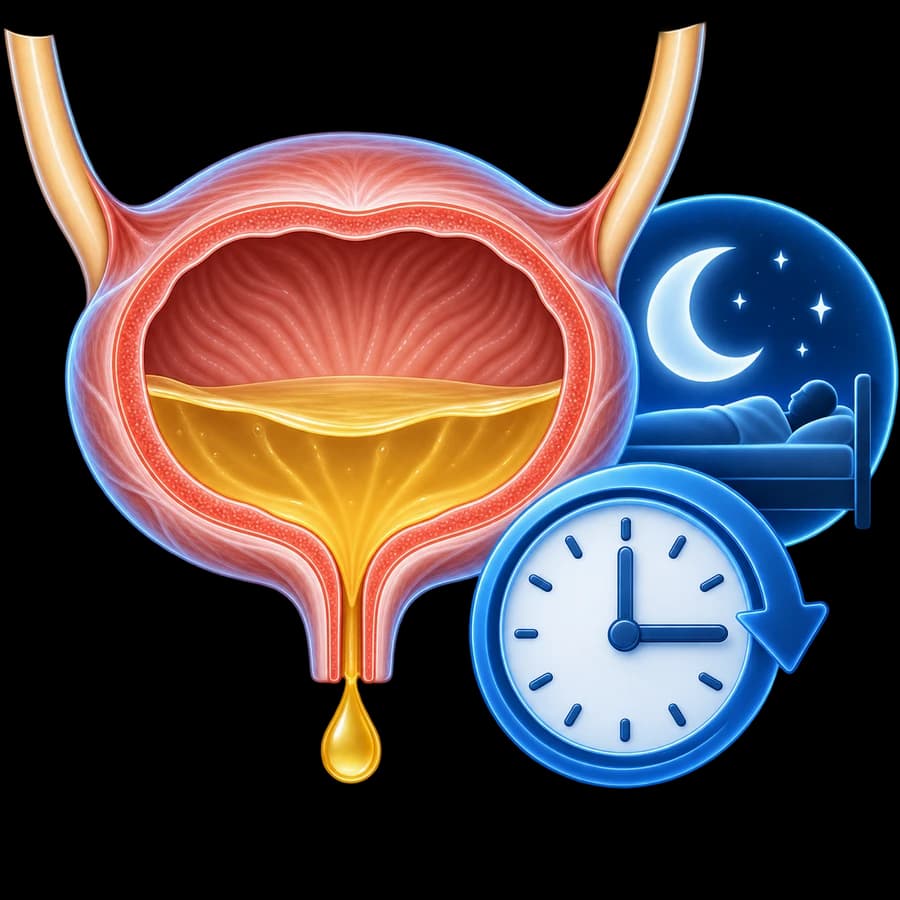
According to current International Continence Society (ICS) terminology, nocturia is waking from your main sleep period to urinate, with the intention of returning to sleep afterward. It is not defined by urinating at a particular time of evening; what matters is the relationship to your main sleep period, not the clock. Strictly defined, even a single interruption of sleep to void counts as nocturia, but this does not mean every such episode requires medical intervention.
How Patients Typically Describe It
- I wake up one or more times a night to urinate
- I don’t sleep through the night because of my bladder
- I get up every two to three hours to use the toilet
- I wake up for another reason and then decide to urinate
Symptoms That Often Occur Together
- frequent urination
- weak urinary stream
- urgency
- leg swelling
- loud snoring
- daytime sleepiness
- breathlessness on lying down
What Are the Most Common Causes
24-hour (global) polyuria
The body produces an unusually large volume of urine across the full 24 hours, day and night, not just at night. Possible causes include diabetes mellitus, diabetes insipidus, excessive fluid intake, or selected kidney/endocrine disorders. Global polyuria is not the same as frequent urination: someone may void often because they produce a large urine volume, or because their bladder holds very little.
Nocturnal polyuria
Disproportionately high urine production specifically during the main sleep period, without necessarily any overall 24-hour polyuria. It relates to a possible shift in the regulation of antidiuretic hormone, sleep apnea, leg swelling, heart failure, kidney disease, excess evening fluids or alcohol, medications, and normal ageing. It is not caused by reduced ADH in every case.
Reduced nighttime bladder capacity
Urine output is not necessarily increased, but the bladder cannot comfortably store the volume produced between awakenings. Possible causes: overactive bladder, benign prostatic hyperplasia/bladder outlet obstruction, reduced functional bladder capacity, cystitis/urinary infection, bladder pain syndrome, neurogenic dysfunction, or a significant post-void residual.
Benign prostatic hyperplasia (BPH)
Can contribute to nocturia, but its relationship to nocturia is weaker and more complex than its relationship to classic voiding symptoms. Nocturia in a man with an enlarged prostate does not prove the prostate is the only cause — sleep apnea or nocturnal polyuria may coexist.
Overactive bladder (OAB)
Can contribute when nocturia is accompanied by urgency, daytime frequency, or urgency incontinence. Nocturia alone does not automatically mean OAB, and OAB medications typically have limited to moderate effect when nighttime urine overproduction is the dominant driver.
Sleep apnea and other sleep disorders
Obstructive sleep apnea is frequently linked to nocturia, likely through repeated arousals, cardiovascular/neurohormonal changes, and increased nighttime sodium excretion/diuresis. In addition, insomnia, pain, anxiety, or environmental factors can wake someone for an unrelated reason, who then decides to urinate because they are already awake — the act of voiding does not prove the bladder caused the awakening.
Diabetes mellitus
Hyperglycemia can cause osmotic diuresis and increased urine production, with nocturia as part of a polyuria/polydipsia picture in poorly controlled diabetes. Nocturia alone does not establish a diagnosis of diabetes, but when the history suggests it, appropriate medical assessment is needed.
Heart failure, leg swelling, and kidney disease
Fluid that accumulates in the legs during the day can redistribute when lying down, increasing venous return, kidney blood flow, and nighttime urine production. Kidney dysfunction can also alter urine-concentrating ability and sodium/water handling. Nocturia with leg swelling or breathlessness should not be treated as a simple bladder problem.
Medications and habits
Diuretics, certain blood-pressure medications that cause fluid retention, SGLT2 inhibitors, and other drugs can affect nighttime urine production. Fluids, alcohol, or caffeine late in the evening can also worsen the symptom. No medication should be changed without your treating physician.
Mixed nocturia and ageing
Many patients have more than one mechanism at the same time — for example nocturnal polyuria together with overactive bladder, or BPH together with disrupted sleep. Nocturia becomes more common with age due to changes in the circadian pattern of urine production, sleep architecture, bladder function, comorbidities, and medications — but being common with age does not mean it should simply be accepted without evaluation.
When It May Be Harmless — and When It Is Not
Less Concerning
An occasional, single nighttime awakening to urinate, especially after a lot of fluids, alcohol, or a late-afternoon diuretic, can be normal or temporary and does not always need medical intervention. The significance of a symptom is not determined only by whether it meets a technical definition, but by how bothersome and how repetitive it is.
Needs Attention
Nocturia becomes clinically significant when it occurs consistently, seriously disrupts sleep, is combined with daytime sleepiness, loud snoring, leg swelling, breathlessness, a sudden marked increase in frequency, or other worsening urinary symptoms. Two or more nighttime awakenings are more often linked to genuine sleep disruption, reduced quality of life, and daytime fatigue, without this meaning nocturia is strictly defined as two or more voids.
When Immediate Medical Evaluation Is Needed
- marked new thirst with polyuria
- visible blood in the urine
- complete inability to urinate (retention)
- high fever or chills
- flank pain with systemic illness
- significant leg swelling or breathlessness/orthopnea
- unexplained weight loss
- new neurological symptoms
- severe daytime sleepiness with strong suspicion of sleep apnea
- confusion or seizures in a patient on desmopressin (possible severe hyponatremia)
How the Diagnosis Is Made and Which Tests May Be Needed
The diagnostic approach starts with a focused history: number of nighttime voids, whether the awakening is truly driven by the need to urinate, daytime voiding symptoms, evening fluid/alcohol/caffeine intake, medications, sleep symptoms (snoring, witnessed apneas, daytime sleepiness), leg swelling, and any history of diabetes, heart disease, kidney disease, or neurological conditions.
A 3-day bladder diary is the central tool: it allows calculation of 24-hour urine output, nighttime urine output, maximum voided volume, and the frequency pattern, so that global polyuria, nocturnal polyuria, reduced nighttime bladder capacity, a sleep disorder, or a mixed cause can be distinguished. Indices such as the nocturnal polyuria index are used by some guidelines with indicative cut-offs (roughly above 20% in younger adults, above 33% in those over 65), but these thresholds are not exact biological boundaries and are always interpreted alongside the overall clinical picture and age.
Physical examination, urinalysis, ultrasound with post-void residual, and uroflowmetry are used selectively based on the clinical picture rather than routinely in every patient, while urodynamic testing is reserved for more complex or unclear cases.
urinalysis
3-day bladder diary (frequency-volume chart) recording time and volume of each void, sleep/wake times, and fluid intake
basic metabolic work-up (glucose/HbA1c, kidney function, serum sodium when desmopressin is being considered)
urinary tract ultrasound with post-void residual (PVR) when voiding symptoms are present
uroflowmetry when a weak stream or voiding difficulty is present
urodynamic study in selected, more complex cases
How It Differs From Similar Symptoms
Nocturia must be distinguished from simply urinating before bed, from nocturnal polyuria as a distinct concept (a urine-production problem, not just a frequency problem), from 24-hour polyuria and daytime frequency, and from insomnia with precautionary voiding, where the patient wakes for another reason and urinates because they are already awake.
What to Expect at Your First Medical Evaluation
Before your appointment, keep a simple 3-day bladder diary: the time of each void, the estimated volume, your sleep and wake times, fluid intake, and any sense of urgency. Also note snoring, witnessed apnea or choking episodes during sleep, daytime sleepiness, leg swelling in the late afternoon, breathlessness on lying down, your medications (especially diuretics), and any history of diabetes or heart disease. The more precise the diary, the more targeted the assessment can be.
The information in this article is general and does not replace an individualized medical examination. If your symptoms persist, recur, or are accompanied by red-flag warning signs, please schedule an evaluation with a urologist.
Book an appointmentFrequently Asked Questions
What is nocturia?
It is the need to wake from your main sleep period to urinate, with the intention of going back to sleep afterward. It is not simply urinating late in the evening before bed.
Does one nighttime void count as nocturia?
Strictly defined, yes — even a single interruption of sleep to void meets the definition. That does not mean every such episode is abnormal or needs treatment.
How many nighttime voids are normal?
There is no single number that applies to everyone. Two or more awakenings are more often linked to genuine sleep disruption and bother, but significance depends on frequency, age, and how much it affects your life.
Why do I get up so often to urinate?
It can be due to increased urine production (global or nocturnal polyuria), a reduced ability of the bladder to store urine, a sleep disorder, or a combination — a bladder diary helps clarify which applies to you.
Does nocturia mean a prostate problem?
Not always. The prostate can contribute, but its relationship to nocturia is more complex than with other urinary symptoms. An enlarged prostate does not prove it is the cause.
Could it be caused by an enlarged prostate?
Yes, particularly with a weak stream, difficulty starting urination, or a significant post-void residual, but this needs to be confirmed rather than assumed.
Could it be caused by overactive bladder?
Yes, especially when combined with urgency and daytime frequency. Nocturia alone, however, does not automatically mean overactive bladder.
What is nocturnal polyuria?
It is disproportionately increased urine production specifically during your main sleep period, regardless of whether there is any overall 24-hour polyuria.
What is the difference between nocturia and nocturnal polyuria?
Nocturia is the symptom (waking to urinate), while nocturnal polyuria is one of the possible mechanisms behind it — specifically, a problem of nighttime urine overproduction.
What is 24-hour (global) polyuria?
It is an unusually high total urine output across the full 24 hours, not just at night, with possible causes such as diabetes, diabetes insipidus, or excessive fluid intake.
What is the nocturnal polyuria index?
It is an index comparing the volume of urine produced during your main sleep period with total 24-hour output; some guidelines use it with indicative, not absolute, cut-off values.
Why is a bladder diary needed?
Because it provides objective data on voiding volume and pattern, helping to distinguish whether the problem is urine overproduction, reduced bladder capacity, or a sleep disorder — information a single test often cannot provide.
How many days should I keep a bladder diary?
A 3-day diary recording the time and volume of each void, sleep/wake times, and fluid intake is typically recommended, following the specific method your doctor gives you.
Is the first morning void included in the diary?
The exact method for recording the first morning void is determined by your doctor when interpreting the diary, since it affects the calculation of nighttime urine output.
Could sleep apnea be the cause?
Yes. It is a common and often under-recognized cause, especially with loud snoring, witnessed apneas, and marked daytime sleepiness. Diagnosis is not made from symptoms alone and requires referral to a sleep specialist.
Could diabetes be the cause?
Yes, through osmotic diuresis in poorly controlled diabetes mellitus, often together with excessive thirst. Nocturia alone does not establish the diagnosis, but metabolic testing is needed when it is suspected.
Could the heart be the cause?
Yes. Heart failure and fluid retention can increase nighttime urine production through fluid redistribution when lying down.
Why does leg swelling increase nocturia?
Fluid that accumulates in the legs during the day redistributes into the circulation when you lie down, increasing kidney blood flow and nighttime urine production.
Do diuretics cause nocturia?
They can contribute, depending on their timing. Any change to diuretic dosing or timing should only be made in consultation with your treating physician, never on your own.
Does alcohol affect nocturia?
Yes, through both a diuretic effect and disruption of sleep quality.
Does caffeine affect nocturia?
In sensitive individuals, caffeine late in the day can worsen sleep quality, urgency, and voiding frequency.
Should I stop drinking fluids in the evening entirely?
No. The goal is appropriate timing of fluid intake, not dehydration, which can be dangerous, especially in older patients.
Is an ultrasound always needed?
Not always, but it is useful when voiding symptoms are present, to assess post-void residual or anatomical findings. A normal ultrasound alone does not determine nighttime urine production.
Is uroflowmetry always needed?
No. It is used when there is a weak stream, difficulty starting urination, or incomplete emptying, but it is not the primary test for isolated nocturia.
Is urodynamic testing always needed?
No. It is reserved for selected patients with more complex or unclear lower urinary tract dysfunction, not for every case of nocturia.
What is desmopressin?
It is a synthetic analogue of vasopressin that reduces urine production. It applies mainly to carefully selected patients with nocturnal polyuria, not to every case of nocturia.
Is desmopressin safe?
It can be effective in appropriately selected patients, but the key risk is hyponatremia, particularly in older adults, those with kidney dysfunction, or fluid-balance disorders. Dosing and sodium monitoring are determined individually by your doctor, not by a fixed generic schedule.
Why does sodium need to be monitored with desmopressin?
Because the main serious side effect is hyponatremia. Starting and monitoring this treatment must always be done under medical supervision with individualized serum sodium checks.
Do prostate medications reduce nocturia?
They can help when there is genuine bladder outlet obstruction, but their effect on isolated nocturia is usually modest when another mechanism dominates.
Does prostate surgery (e.g., HoLEP, TURiS) cure nocturia?
It can improve nocturia when bladder outlet obstruction is truly relevant, as part of overall symptom improvement. It does not guarantee nocturia will disappear when the cause is not mainly prostatic.
Do overactive bladder medications help nocturia?
They can help with storage symptoms, but usually have a limited effect on nocturia when the main driver is nighttime urine overproduction.
Can treating sleep apnea help nocturia?
In some patients, yes, when sleep apnea is responsible or a significant contributor. It does not guarantee complete resolution in every case.
Why does nocturia cause fatigue?
Because it interrupts sleep continuity, reducing deep sleep stages and leading to daytime fatigue, difficulty concentrating, and affected mood.
Does nocturia increase fall risk?
Yes, particularly in older adults with visual impairment, sedating medications, orthostatic hypotension, or gait disturbance. Repeated nighttime trips to the bathroom increase the risk of falls and fractures.
When does it need immediate medical evaluation?
When nocturia is accompanied by blood in the urine, fever, marked thirst, inability to urinate, significant swelling or breathlessness, unexplained weight loss, new neurological symptoms, or confusion while on desmopressin.
Can nocturia be treated?
Yes, it is treated effectively once the real mechanism is identified (urine overproduction, reduced bladder capacity, a sleep disorder, or a combination), with targeted treatment rather than a generic approach to the number of nighttime voids.
Medical Review

Dr. Marinos Vasilas, Surgical Urologist — Andrologist
This content has been written and reviewed based on established urological guidelines, with the goal of providing practical, safe guidance for the initial assessment of each symptom.
View full profileSources / References
Book an Appointment for a Personalized Evaluation
If the symptom persists, recurs, or is accompanied by red-flag warning signs, prompt evaluation by a urologist supports an accurate diagnosis and targeted treatment.


