Clinical Perspective
In clinical practice, the most common mistake with frequent urination is not a wrong test, but a rushed interpretation: "you urinate often, so you must have an infection," or "you urinate often, so it must be the prostate." The single most useful tool is mapping the actual voiding pattern — how many voids, what volume each time, and what the total 24-hour output is — because this immediately separates a bladder/lower urinary tract problem from a problem of urine production itself.
Key Takeaways
- There is no universal number of daily voids that defines frequent urination — interpretation depends on fluid intake, bladder capacity, habits, and how bothersome it is.
- Frequent urination is not the same as polyuria: frequency is about how often someone urinates, polyuria is about how much urine the body produces in total over 24 hours.
- Urgency is the defining symptom of overactive bladder; frequency alone does not establish that diagnosis.
- In men, frequency does not automatically prove a prostate problem, and an enlarged prostate does not automatically prove it is the cause.
- A 2–3 day bladder diary, recording the time and volume of every void, often reveals more than a single test.
- Not every episode of frequent urination is a urinary tract infection — empirical antibiotics without supporting evidence are not appropriate.
What Is Frequent Urination: Causes, Polyuria & When to Seek Assessment?
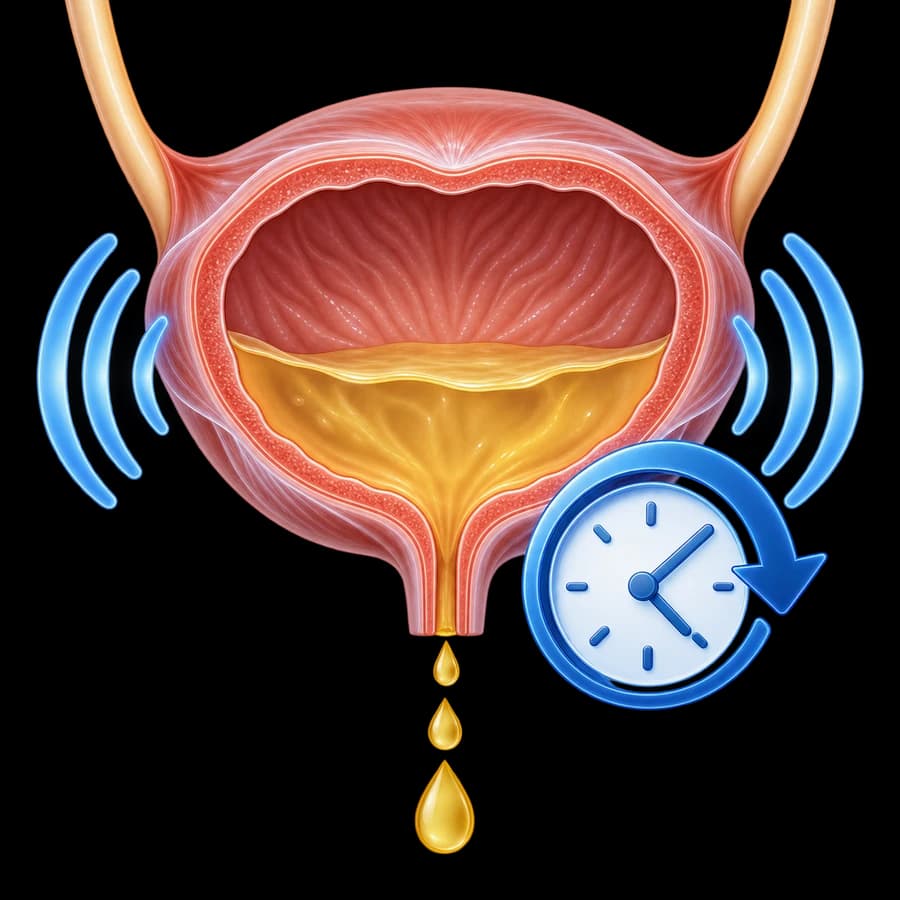
According to current International Continence Society (ICS) terminology, increased daytime urinary frequency is the complaint that urination occurs more often during the day than the individual considers normal for themselves. There is no universally valid number of voids that defines the symptom; research studies sometimes use numerical thresholds (for example, more than 8 voids per day) for statistical purposes, but these thresholds are not the definition of the symptom. What is "normal" is not the same number for everyone — it depends on fluid intake, bladder capacity, climate, age, and individual habits. Frequency describes how often someone urinates — not how much urine they produce in total. The first step is separating many small voids caused by the bladder or lower urinary tract from a genuinely increased 24-hour urine output, i.e. polyuria.
How Patients Typically Describe It
- I keep going to the bathroom all the time
- I pass small amounts of urine very often
- I can’t hold it for very long
- I urinate every one or two hours
- frequent urination without pain
- it feels like my bladder never fully empties
Symptoms That Often Occur Together
- burning sensation
- nighttime urination
- urgency
- incontinence
- weak urinary stream
- incomplete emptying
- excessive thirst
What Are the Most Common Causes
Urinary tract infection / cystitis
A localised lower urinary tract infection can cause frequency, urgency, burning, and suprapubic discomfort. However, frequency alone does not establish an infection diagnosis, and a urinalysis does not explain every case of frequent urination.
Overactive bladder (OAB)
A syndrome whose central symptom is urgency, often with accompanying daytime frequency and nocturia, with or without urgency urinary incontinence, once infection or another obvious cause has been excluded. OAB is not the same as detrusor overactivity observed on urodynamic testing — OAB is a clinical syndrome, not a urodynamic finding.
Incomplete bladder emptying / elevated post-void residual (PVR)
A bladder that does not empty completely leads to more frequent small voids, nocturia, and sometimes overflow incontinence. Possible causes include outlet obstruction, detrusor underactivity, or neurological dysfunction. PVR tells you how much remains — not why.
Benign prostatic hyperplasia / obstruction (BPH/BPO)
In men, this may coexist with frequency, but age and frequency alone do not prove obstructive prostate pathology. A weak stream, hesitancy, straining, or incomplete emptying should also be present.
Diabetes mellitus and metabolic causes
Poorly controlled hyperglycaemia causes glycosuria, osmotic diuresis, and polyuria, often with accompanying thirst. In these cases, frequency usually reflects increased urine production rather than a small-bladder problem.
Medications (diuretics, SGLT2 inhibitors)
Diuretics and SGLT2 inhibitors increase urine production or excretion, particularly after starting treatment. No medication should be stopped independently — this calls for a medication review with the prescribing clinician, not self-directed discontinuation.
High fluid intake, caffeine, and alcohol
Excessive intake of water, caffeine, or alcohol can itself cause frequent, large-volume voids. Severe fluid restriction is not needed — an individualised, appropriate intake pattern is.
Diabetes insipidus and primary polydipsia
True high-volume polyuria can result from central or nephrogenic diabetes insipidus, or from habitually excessive fluid intake (primary polydipsia). This is a different mechanism from storage-related frequency and warrants appropriate medical/endocrine evaluation in selected cases.
Pregnancy
Frequency is a common finding due to hormonal and anatomical changes. New dysuria, fever, blood in the urine, or systemic symptoms should not automatically be attributed to normal pregnancy.
Genitourinary syndrome of menopause (GSM)
In peri- or postmenopausal women, reduced oestrogen can contribute to frequency, urgency, dysuria, and recurrent urinary symptoms. Not every such episode should be attributed to a recurrent urinary tract infection.
Neurological causes
Conditions such as multiple sclerosis, Parkinson’s disease, spinal cord injury, or peripheral neuropathy can disrupt the bladder’s storage function. New leg weakness or saddle sensory symptoms require prompt assessment.
Habitual / "just in case" voiding
Some people void frequently as a precaution — before leaving home or whenever a toilet is nearby — often out of fear of urgency or leakage. This can reduce functional bladder capacity, but it should not be assumed before an appropriate medical assessment.
When It May Be Harmless — and When It Is Not
Less Concerning
Temporary frequent urination after drinking a lot of fluids, coffee, or alcohol, or due to stress or cold weather, is usually not a cause for concern. Clinical significance is not determined by a number of voids, but by persistence, bother, a sudden change from baseline, and associated symptoms.
Needs Attention
Frequent urination needs attention when it is new, persists, worsens, significantly disrupts sleep or daily life, or occurs together with pain, blood in the urine, fever, unexplained weight loss, marked thirst with high urine output, or new neurological symptoms.
When Immediate Medical Evaluation Is Needed
- fever or chills
- visible blood in the urine
- severe pelvic or flank pain
- complete inability to urinate (retention)
- marked thirst with significantly increased urine output
- unexplained weight loss
- new neurological symptoms or leg weakness
- rapid deterioration or significant dehydration/weakness
- frequent urination in pregnancy with systemic symptoms
How the Diagnosis Is Made and Which Tests May Be Needed
We do not treat "frequent urination" as a single diagnosis — we treat the mechanism causing it. The assessment starts with one core question: is this person urinating often, or genuinely producing a lot of urine? A 2–3 day bladder diary, recording the time and volume of every void, answers this question better than any single test. If total 24-hour urine output is genuinely increased, the assessment turns toward a polyuria pathway: fluid intake, diabetes mellitus, medications (SGLT2 inhibitors, diuretics), or, less commonly, diabetes insipidus. If the total volume is normal but voids are frequent and small, the assessment looks for urgency (possible OAB), dysuria/burning (possible infection), a weak stream or a sense of incomplete emptying (possible obstruction/incomplete emptying), pain (possible bladder pain syndrome or a stone), or behavioural factors. Individual tests (urinalysis, culture, PVR, uroflowmetry, metabolic screening, urodynamics) are selected according to this pattern, not applied as one fixed bundle for everyone.
bladder diary / frequency-volume chart over 2–3 days recording the time and volume of every void and the total 24-hour urine output
urinalysis, when there is suspicion of infection, blood, or glucose — not automatically in every case
urine culture, only when there is a clinical indication of infection, an atypical or recurrent presentation, or treatment failure
post-void residual (PVR) assessment when a weak stream, incomplete emptying, or suspected obstruction coexist
uroflowmetry when voiding symptoms are present (weak stream, hesitancy), particularly in men
glucose / HbA1c when diabetes, polydipsia, or a high 24-hour urine volume is suspected
renal function / electrolytes in selected cases of significant polyuria or systemic illness
urodynamic study only in selected, complex, or treatment-resistant cases
How It Differs From Similar Symptoms
Frequent urination must be distinguished from polyuria (a genuinely increased total 24-hour urine output, not simply frequent voids), from urgency (a sudden, difficult-to-defer need, a different concept from frequency), and from nocturia (waking from the main sleep period to void, with its own diagnostic framework). Each of these patterns leads to a different diagnostic pathway, so they should not be treated as synonyms.
What to Expect at Your First Medical Evaluation
Before your visit, keep a simple bladder diary for 2–3 days: the time of every void, an estimated volume (even roughly — small/moderate/large), fluid intake, caffeine/alcohol, and any urgency. Also note any burning, weak stream, sense of incomplete emptying, thirst, medications you take (especially diuretics or SGLT2 inhibitors), and any history of diabetes. The more precise the diary, the more targeted the work-up — and the fewer unnecessary tests are needed.
The information in this article is general and does not replace an individualized medical examination. If your symptoms persist, recur, or are accompanied by red-flag warning signs, please schedule an evaluation with a urologist.
Book an appointmentFrequently Asked Questions
What is frequent urination?
It is the complaint of urinating more often during the day than an individual considers normal for themselves. It is not a separate disease, but a symptom with many possible causes.
Is there a normal number of voids per day?
No single number applies to everyone. It depends on fluid intake, bladder capacity, climate, and habits. Research thresholds (e.g. >8/day) are used in studies, not as the definition of the symptom.
Does urinating more than 8 times a day mean there is a problem?
Not necessarily. Interpretation depends on the volume of each void, total 24-hour output, urgency, and how much it bothers you — not the number alone.
What is polyuria?
It is a genuinely increased total urine output over 24 hours, regardless of how many times someone goes to the toilet. As an indicative framework, current guidance defines 24-hour polyuria as urine output greater than 40 mL per kilogram of body weight per 24 hours.
What is the difference between frequency and polyuria?
Frequency is about how often someone urinates, often in small volumes. Polyuria is about the total amount of urine produced over 24 hours, regardless of frequency.
What does "40 mL/kg/24h" mean?
It is an indicative, weight-based criterion for 24-hour polyuria. For a 75 kg adult, this corresponds to roughly 3 litres/24h — but that is just an illustrative example, not a universal ">3 litres for everyone" definition, because body weight varies.
What does it mean if I urinate small amounts often?
This usually points toward a bladder or lower urinary tract storage problem — urgency/OAB, infection, incomplete emptying, or low functional capacity — rather than increased total urine production.
What does it mean if I urinate often and in large volumes?
This shifts the assessment toward increased total urine production (polyuria) — high fluid intake, diabetes, medications, or, less commonly, diabetes insipidus — rather than a bladder problem itself.
What is a bladder diary?
It is a record of the time and volume of every void (a frequency-volume chart), which can be supplemented with fluid intake, urgency, and leakage (a bladder diary). It gives an objective picture of the voiding pattern.
How many days does a bladder diary need to cover?
A duration of at least 3 days is generally recommended, to representatively capture total 24-hour urine output and the voiding pattern.
What should I record in the diary?
The time of every void, an estimated volume, fluid intake, any urgency or leakage, and sleep/wake times if you are also tracking nocturia.
What is urgency?
It is the sudden, difficult-to-defer sensation that you must urinate immediately. It is a different concept from frequency, although they often occur together.
What is overactive bladder (OAB)?
It is a clinical syndrome whose central symptom is urgency, usually with accompanying daytime frequency and nocturia, with or without urgency incontinence, once infection or another obvious cause has been excluded.
Does frequency automatically mean overactive bladder?
No. OAB is defined primarily by urgency. Frequency without urgency has a broader differential diagnosis.
What is the difference between frequency and nocturia?
Frequency concerns frequent voids during the day. Nocturia concerns waking from the main sleep period to void — a different symptom with its own diagnostic framework.
Does frequent urination always mean a urinary tract infection?
No. Infection is only one possible cause. Overactive bladder, incomplete emptying, diabetes, medications, and fluid habits are equally common alternative explanations.
Can there be a urinary infection without burning?
In some cases, yes, particularly with an atypical presentation. Urinalysis and, where indicated, culture help confirm this.
Is urine culture always needed?
No. It is used when there is a clinical suspicion of infection, an atypical or recurrent presentation, pregnancy, or treatment failure — not in every case of frequent urination.
Does frequent urination in a man mean a prostate problem?
Not necessarily. The prostate is a common but not the only cause. A weak stream, hesitancy, or incomplete emptying should also be present before it is attributed to the prostate.
Can there be prostate obstruction without an enlarged prostate?
Yes. Prostate size (BPE) does not always equate to functional bladder outlet obstruction (BPO). The functional picture (flow, residual volume) has greater diagnostic value than size alone.
What is PVR (post-void residual)?
It is the amount of urine remaining in the bladder after voiding. It shows whether emptying is incomplete, but does not by itself explain the mechanism.
Can incomplete emptying cause frequent urination?
Yes. A bladder that does not empty completely fills back up sooner, leading to more frequent small voids, even if total urine production is normal.
Is uroflowmetry always needed?
No. It is useful when a weak stream, hesitancy, or incomplete emptying coexist, mainly in men. It is not necessary for isolated frequency without voiding symptoms.
Is a PSA test always needed?
No. PSA is not a test for frequent urination. It is measured when a prostate cancer diagnosis would genuinely change clinical management, according to appropriate risk assessment.
Could it be diabetes?
Yes. Poorly controlled diabetes mellitus can cause glycosuria and osmotic polyuria, often with thirst. In these cases, frequency usually reflects increased urine production.
What is the relationship between thirst and frequent urination?
Marked thirst with high urine output shifts the assessment toward metabolic causes (diabetes, diabetes insipidus) or simple excessive fluid intake, rather than a bladder storage problem.
What is diabetes insipidus?
It is a condition with genuinely high-volume polyuria, of central or nephrogenic origin — a different mechanism from storage-related frequency. It requires appropriate medical/endocrine evaluation in suspected cases.
Could my SGLT2 inhibitor be the cause?
Yes, SGLT2 inhibitors increase glucose excretion in the urine and can increase urine output, particularly after starting treatment. Do not stop the medication yourself — a review with your doctor is needed.
Could my diuretic be the cause?
Yes, diuretics increase urine production. Any change to their dose or timing should only be made in consultation with your prescribing clinician.
Could coffee be the cause?
Caffeine has a mild diuretic effect and can worsen urgency/frequency in sensitive individuals. A targeted reduction trial helps more than complete avoidance.
Could alcohol be the cause?
Yes, alcohol increases urine production and can affect sleep quality, resulting in more voids.
Should I drink less water?
Not as a blanket rule. The goal is an appropriate, individualised fluid intake based on climate, activity, and underlying conditions — not dehydration, which can be harmful.
What changes during pregnancy?
Frequency is common due to hormonal and anatomical changes. New dysuria, fever, or blood in the urine during pregnancy should be assessed, not automatically attributed to normal pregnancy.
What changes at menopause?
Genitourinary syndrome of menopause (GSM), due to reduced oestrogen, can contribute to frequency, urgency, and recurrent symptoms — without this always meaning a recurrent infection.
Could my ureteral (JJ) stent be the cause?
Yes, a ureteral (JJ) stent commonly causes frequency, urgency, and dysuria due to bladder irritation. This does not automatically mean a urinary tract infection, although one can coexist.
Is an ultrasound always needed?
No. It is selectively useful, for example to assess post-void residual, suspected stone/obstruction, or a more complex picture — not routinely for simple frequent urination.
Is cystoscopy always needed?
No. It is indicated when there is blood in the urine, recurrent unexplained symptoms, or suspected bladder/urethral pathology — not for isolated frequency without other findings.
Is a urodynamic study always needed?
No. It is used selectively when the mechanism remains unclear, when previous treatment has failed, or before certain more invasive treatment decisions.
When does frequent urination need treatment?
Treatment targets the underlying mechanism — infection, OAB, incomplete emptying, a metabolic cause, or GSM — rather than simply reducing the number of voids. It usually begins once the cause has been identified.
When is it an emergency?
When it occurs together with fever, visible blood in the urine, severe pain, inability to urinate, new neurological symptoms, or marked thirst with significantly increased urine output.
Medical Review

Dr. Marinos Vasilas, Surgical Urologist — Andrologist
This content has been written and reviewed based on established urological guidelines, with the goal of providing practical, safe guidance for the initial assessment of each symptom.
View full profileSources / References
Book an Appointment for a Personalized Evaluation
If the symptom persists, recurs, or is accompanied by red-flag warning signs, prompt evaluation by a urologist supports an accurate diagnosis and targeted treatment.


