Clinical Perspective
In clinical practice, the first question for any testicular pain is whether it is a true acute emergency or a persistent/recurring symptom. In sudden, severe pain, the priority is not to miss testicular torsion — clinical suspicion carries more weight than any single examination finding or imaging result, and Doppler ultrasound is used as an adjunct, not as a precondition for surgical exploration when suspicion remains strong. In chronic or persistent pain, by contrast, the goal is a systematic search for a cause — testicle, epididymis, spermatic cord, groin, pelvic floor, or a referred source — before considering the diagnosis of Chronic Scrotal Content Pain (CSCP) and the need for multimodal treatment.
Key Takeaways
- Testicular pain does not always mean a problem with the testicle itself — it can come from the epididymis, the spermatic cord, the groin, or be referred from the ureter or pelvis.
- Sudden, severe pain is treated as possible torsion until adequately excluded by clinical assessment.
- Normal or preserved blood flow on Doppler does not fully rule out torsion, especially early, partial, or intermittent torsion.
- Pain with fever does not automatically mean epididymitis, and pain that resolves on its own does not rule out a prior episode of intermittent torsion.
- Chronic scrotal pain is not the same as chronic infection — repeated courses of antibiotics are not a default solution.
- Acute and chronic scrotal discomfort are two different clinical problems that require different diagnostic approaches.
What Is Testicular Pain: Causes & When It’s an Emergency?
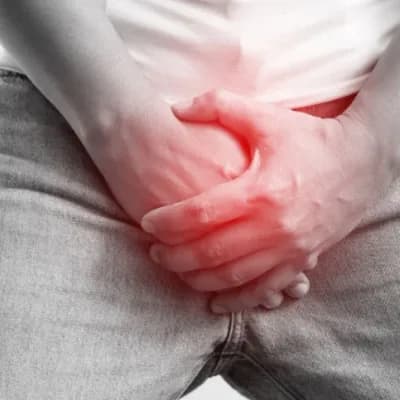
Testicular pain (orchialgia) is a symptom felt in the testicle or scrotum, but it can originate in the testicle, the epididymis, the spermatic cord, the groin, or be referred from the ureter, pelvis, or spine. It can be acute or chronic, one-sided or bilateral, with or without swelling.
How Patients Typically Describe It
- sudden, severe pain in the testicle
- a dragging heaviness in the scrotum that worsens with standing
- pain radiating up into the groin
- pain on touch or during intercourse
- persistent or recurring testicular discomfort lasting for months
Symptoms That Often Occur Together
- scrotal swelling
- scrotal redness
- fever
- nausea or vomiting
- burning during urination
- urethral discharge
- blood in the urine
- a palpable mass
- pain in the back or groin
What Are the Most Common Causes
Testicular torsion
An emergency caused by twisting of the spermatic cord that cuts off blood flow — requires immediate clinical assessment and often surgical exploration without waiting for imaging.
Intermittent torsion
Episodes of severe pain that resolve on their own; between episodes, the examination and Doppler ultrasound can appear normal, which does not rule out the diagnosis.
Torsion of a testicular/epididymal appendage
More common in children/adolescents; may show a "blue dot sign," which is not always visible.
Epididymitis
Usually a gradual onset with tenderness over the epididymis, possible dysuria, or fever — a gradual onset alone does not rule out torsion.
Orchitis / epididymo-orchitis
Inflammation extending into the testicle, often together with epididymitis, less commonly viral (e.g., associated with mumps).
Varicocele
Usually causes a dull, dragging heaviness that worsens on standing and improves lying down — it does not explain sudden, severe pain.
Testicular trauma
From a blow or sports injury; persistent pain, rapidly increasing swelling, or a hematoma need immediate assessment for possible rupture.
Referred pain from a ureteral stone
A stone in the lower ureter can cause testicular pain with a completely normal scrotal examination.
Inguinal hernia
A painful groin or scrotal swelling; worsening pain or a swelling that will not reduce increases concern for a complication.
Testicular mass or tumor
Pain does not rule out malignancy — a persistent mass, firmness, or asymmetry always needs evaluation.
Chronic Scrotal Content Pain (CSCP)
Persistent one-sided pain lasting more than 3 months after other causes have been assessed and excluded; may involve a neuropathic mechanism, the pelvic floor, or a prior surgery/vasectomy.
When It May Be Harmless — and When It Is Not
Less Concerning
Mild, stable heaviness without acute worsening — for example, a known varicocele — can be monitored, but any new episode of severe pain is assessed on its own and is not automatically attributed to an already known condition.
Needs Attention
Sudden, severe, one-sided pain — especially with nausea/vomiting, an unusual or high-riding testicle, or rapidly progressing swelling — is treated as possible torsion until proven otherwise. Neither preserved blood flow on Doppler nor spontaneous resolution of the pain fully rules out torsion (partial, early, or intermittent).
When Immediate Medical Evaluation Is Needed
- sudden, severe, one-sided pain
- nausea or vomiting with acute scrotal pain
- an unusual, high-riding, or horizontal testicular position
- rapidly progressing scrotal swelling
- significant trauma with marked swelling or a hematoma
- a painful groin or scrotal swelling that will not reduce
- fever with marked scrotal inflammation
- skin necrosis, crepitus, or foul-smelling discharge (possible Fournier’s gangrene)
- a new firm mass that is rapidly enlarging or has other concerning features
How the Diagnosis Is Made and Which Tests May Be Needed
In acute pain, the priority is rapid clinical assessment for torsion; Doppler ultrasound is used as an adjunct and should not delay surgical exploration when clinical suspicion remains strong, since preserved blood flow can coexist with early, partial, or intermittent torsion. Neither the Prehn sign nor the cremasteric reflex is a reliable stand-alone criterion for ruling in or ruling out torsion. When epididymitis is suspected, mid-stream urine culture and first-void urine NAAT testing answer different questions (bacterial infection versus a sexually transmitted infection) and do not replace one another — a normal urinalysis does not rule out epididymitis. In chronic pain, the assessment is more systematic and looks for a correctable cause before Chronic Scrotal Content Pain is considered.
immediate clinical examination (position, tenderness, swelling; the cremasteric reflex is one data point, not an absolute rule)
scrotal Doppler ultrasound as an adjunct — not a precondition for emergency surgical exploration when suspicion of torsion is strong
urinalysis
mid-stream urine culture when bacterial infection is suspected
first-void urine (or another appropriate sample) for STI NAAT testing when urethritis or STI-related epididymitis is suspected
tumor markers (AFP, beta-hCG, LDH) only when a suspicious intratesticular mass is found
How It Differs From Similar Symptoms
Torsion must be immediately distinguished from epididymitis/orchitis, trauma, an inguinal hernia, and pain referred from a stone or a musculoskeletal/spinal cause. In chronic pain, the differential also includes varicocele, spermatocele, neuropathic pain after surgery or vasectomy, pelvic floor dysfunction, and Chronic Scrotal Content Pain — none of which is equivalent to chronic infection.
What to Expect at Your First Medical Evaluation
Useful information includes the exact time of onset, intensity, side, any relation to trauma or sexual activity, presence of fever, nausea, blood in the urine, or a change in urination, as well as — for persistent or recurring pain — the duration in months, any prior surgery or vasectomy, a known varicocele, and the impact on daily life.
The information in this article is general and does not replace an individualized medical examination. If your symptoms persist, recur, or are accompanied by red-flag warning signs, please schedule an evaluation with a urologist.
Book an appointmentFrequently Asked Questions
Why does my testicle hurt?
Pain can come from the testicle itself, the epididymis, the spermatic cord, the groin, or be referred from the ureter, pelvis, or spine. It does not always mean a problem with the testicle itself.
What does sudden testicular pain mean?
Sudden, severe pain is treated as possible torsion until clinically excluded, especially if it is accompanied by nausea, vomiting, or a change in testicular position.
When is testicular pain an emergency?
It is an emergency when the pain started suddenly and is severe, especially with nausea/vomiting, an unusual testicular position, rapid swelling, fever with marked inflammation, or after significant trauma.
What is testicular torsion?
It is the twisting of the spermatic cord that cuts off blood flow to the testicle — a surgical emergency where time is critical for saving the organ.
At what age does testicular torsion occur?
It is most common in adolescents and young adults, but it can occur at any age — it should not be excluded on age alone.
How is torsion distinguished from epididymitis?
Torsion tends to start suddenly and severely, while epididymitis often develops gradually with tenderness over the epididymis; however, the clinical picture is not always clear-cut, and careful assessment is required in every case.
What does a high-riding testicle mean?
It can be a sign of torsion, but it is not an absolute diagnostic criterion on its own — it is assessed together with the rest of the clinical picture.
Is the cremasteric reflex reliable?
Its absence raises suspicion of torsion, but neither its presence nor its absence is an absolute rule for ruling it in or out.
What is the Prehn sign?
It is the observation of whether pain improves when the scrotum is elevated. It is not a reliable test for ruling torsion in or out.
Is Doppler ultrasound always needed before treatment?
Doppler ultrasound is a very useful adjunct, but it should not dangerously delay surgical exploration when clinical suspicion of torsion is strong.
Can torsion be present with a normal Doppler flow study?
Yes. Preserved blood flow can coexist with early, partial, or intermittent torsion — "there is flow" does not always mean "it is not torsion."
If the pain went away, is torsion ruled out?
Not necessarily. Spontaneous resolution of pain can correspond to an episode of intermittent torsion that untwisted on its own — it is not a guarantee of safety.
What is intermittent torsion?
Episodes of severe pain that start suddenly and resolve on their own. Between episodes, the examination and Doppler ultrasound may appear normal.
What is torsion of a testicular appendage?
More common in children/adolescents; localized pain at the upper pole, sometimes with a "blue dot sign," which is not always visible.
What is epididymitis?
Inflammation of the epididymis, usually with gradual onset of pain, tenderness, swelling, possible dysuria, and sometimes fever.
When is a urine culture needed?
When a bacterial infection of the urinary tract or epididymitis related to a urinary infection is suspected.
When is NAAT testing needed for an STI?
When urethritis or STI-related epididymitis is suspected, using an appropriate sample (such as first-void urine) — a different test from a urine culture.
Could it be orchitis?
Yes, especially when inflammation extends into the testicle together with the epididymis, or less commonly in a viral context.
Could it be a varicocele?
A varicocele usually causes a dull heaviness that worsens on standing, not sudden severe pain — new acute pain in a known varicocele needs separate assessment.
Could it be a hydrocele?
A hydrocele usually presents as a painless swelling rather than severe pain — severe pain is not automatically attributed to a known hydrocele.
Could it be a spermatocele?
Usually a painless finding; it does not by itself explain chronic pain without further correlation on examination.
Could it be an inguinal hernia?
Yes; a painful groin or scrotal swelling can be due to a hernia, with more concern if it will not reduce.
Can a kidney or ureteral stone cause testicular pain?
Yes, a stone in the lower ureter can cause referred pain in the testicle with a normal scrotal examination.
Can back problems cause testicular pain?
Less commonly, musculoskeletal or nerve-related causes from the spine can cause referred pain, but scrotal causes are ruled out first.
What happens after a testicular injury?
The severity of pain, swelling, any hematoma, and whether the testicle can still be felt on examination are assessed; persistent or worsening pain after trauma needs immediate evaluation for possible rupture.
Does testicular cancer cause pain?
It usually presents as a painless mass, but pain does not rule out a testicular tumor — any persistent mass or firmness needs evaluation.
What does a mass with pain mean?
A new palpable mass needs an ultrasound evaluation regardless of whether pain is present.
What is chronic testicular pain?
Persistent or recurring pain in the testicle/scrotum that is not explained by an acute cause and requires a systematic assessment different from that for acute pain.
What is Chronic Scrotal Content Pain (CSCP)?
One-sided chronic pain in the scrotal contents lasting more than 3 months, affecting daily life, diagnosed after other causes have been assessed and excluded.
Does the 3-month definition mean I should wait?
No. The 3-month period defines the chronic scrotal pain syndrome; it is not a reason to delay seeking help for newer or acute pain.
Does chronic pain mean a chronic infection?
Not necessarily. Possible causes include a varicocele, prior vasectomy or surgery, neuropathic pain, pelvic floor dysfunction, or idiopathic CSCP.
Why doesn’t antibiotics always help chronic pain?
Repeated courses of antibiotics are not a standard solution when the work-up for infection is negative or the findings do not support an infectious cause.
What is post-vasectomy pain?
Persistent pain after a vasectomy that, after appropriate evaluation, may correspond to a post-vasectomy chronic pain syndrome.
Could the pelvic floor be the cause?
Yes, pelvic floor dysfunction can contribute to chronic pain, especially when there is also pelvic/perineal pain or pain with ejaculation.
What is a spermatic cord block?
A diagnostic injection into the spermatic cord that, in selected cases of one-sided CSCP, helps determine whether the pain originates from the spermatic cord.
What is microsurgical denervation?
A selected procedure for certain patients with CSCP, especially when a diagnostic block showed a significant response — it is not a first-line treatment or a guaranteed solution.
When is scrotal ultrasound needed?
For acute pain, swelling, a palpable mass, or trauma — always as a supporting element, not as the sole decision criterion when suspicion of torsion is strong.
When should I go to the emergency department immediately?
For sudden severe pain, nausea/vomiting, an unusual testicular position, rapid swelling, significant trauma, fever with marked scrotal inflammation, or suspicious signs of skin necrosis.
Medical Review

Dr. Marinos Vasilas, Surgical Urologist — Andrologist
This content has been written and reviewed based on established urological guidelines, with the goal of providing practical, safe guidance for the initial assessment of each symptom.
View full profileSources / References
Book an Appointment for a Personalized Evaluation
If the symptom persists, recurs, or is accompanied by red-flag warning signs, prompt evaluation by a urologist supports an accurate diagnosis and targeted treatment.


