My Clinical Approach
For varicocele, I apply a selective approach: I do not operate on every varicocele. The indication must be clear (symptoms, infertility, asymmetric testicular growth in adolescents).
When surgery is needed, I prefer microsurgical subinguinal varicocelectomy (Marmar) with microscope, which has lower recurrence (1-4%) and complications (hydrocele <1%) than classic techniques.
For subfertile couples, I coordinate with the gynecologist/embryologist. Semen improvement appears at 3-6 months postoperatively.
What is Varicocele?
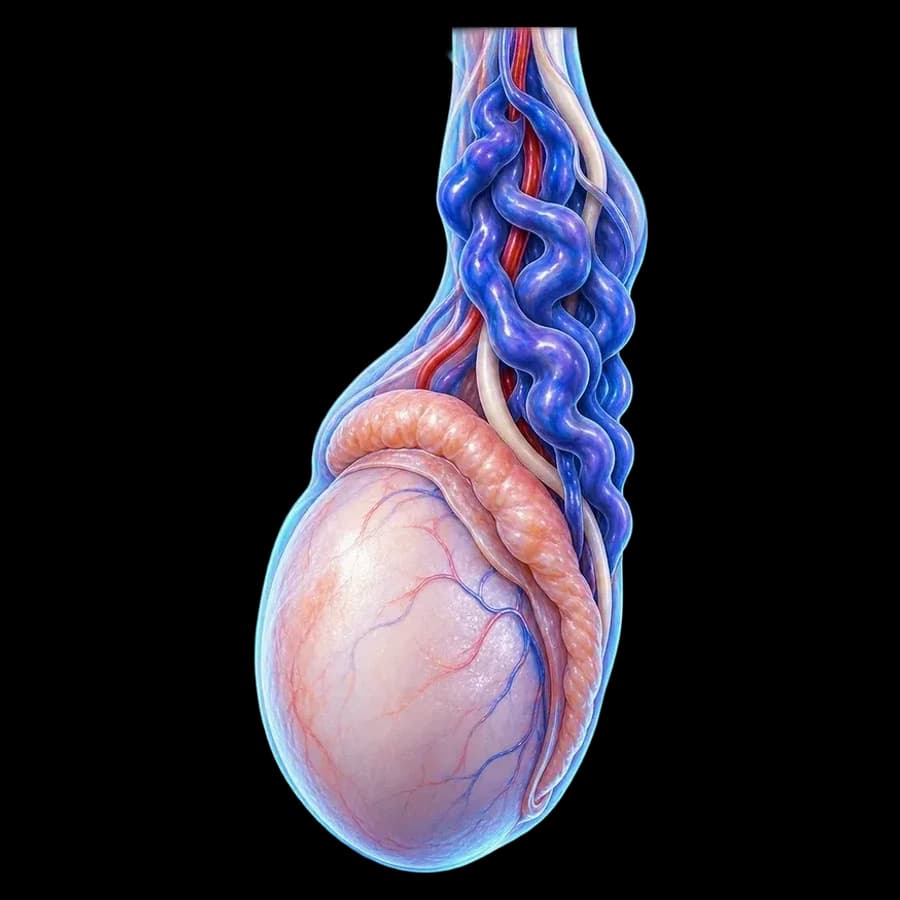
Varicocele is the abnormal dilation of the spermatic venous plexus (pampiniform plexus) within the scrotum. It resembles varicose veins of the legs and is caused by venous valve insufficiency with retrograde blood flow.
- Prevalence: 15% of general male population
- 35-40% of men with primary infertility
- 75-81% of men with secondary infertility
- 80-90% left-sided (anatomical reasons)
- Isolated right-sided is rare - requires kidney tumor workup
- Often appears in adolescence (10-25 years)
Symptoms
- Many varicoceles are asymptomatic
- Heaviness or discomfort in scrotum
- Pain that worsens when standing, after exercise, or end of day
- "Bag of worms" feeling on palpation
- Visible vein protrusion (grade 3)
- Testicular atrophy (smaller testis on affected side)
- Infertility or abnormal semen analysis
- Rarely: chronic testicular pain syndrome
An isolated right-sided varicocele or one appearing after age 40 requires investigation for a possible retroperitoneal or renal tumor (vein obstruction).
Varicocele Grades (Dubin-Amelar)
Subclinical
Not clinically palpable, detected only by Doppler ultrasound. Treatment usually not recommended.
Grade 1
Palpable only during Valsalva maneuver (abdominal pressure).
Grade 2
Palpable in standing position without Valsalva.
Grade 3
Visible to the naked eye through scrotal skin - "bag of worms".
Diagnosis
- Clinical examination in standing and supine positions
- Valsalva maneuver
- Color Doppler scrotal ultrasound (gold standard)
- Vein diameter measurement (>3mm pathological)
- Recording of retrograde flow during Valsalva (>2 sec pathological)
- Testicular size comparison (>20% difference in adolescents)
- Semen analysis in subfertile patients
- Hormonal panel (FSH, LH, testosterone) in atrophy
Treatment (EAU 2024)
Indications for Surgery
- • Symptomatic varicocele (persistent pain)
- • Abnormal semen analysis in conception-attempting couples
- • Testicular size difference >20% in adolescents
- • Grade 2-3 varicocele with testicular atrophy
- • Testosterone decline associated with varicocele
Microsurgical Subinguinal Varicocelectomy (Marmar)
- • Gold standard
- • 2-3 cm incision below the inguinal canal
- • Surgical microscope (×8-15 magnification)
- • Preservation of artery, lymphatics, vas deferens
- • Recurrence: 1-4%
- • Postoperative hydrocele: <1%
Other Techniques
- • Open high ligation (Palomo): recurrence 5-15%, hydrocele 5-10%
- • Laparoscopic: similar results to Palomo
- • Percutaneous embolization: alternative, recurrence 5-10%
Recovery & Follow-up
- Discharge same day or next
- Daily activities in 2-3 days
- Return to work in 3-7 days
- Exercise/heavy lifting in 2-3 weeks
- Sexual activity in 1-2 weeks
- Reevaluation at 4-6 weeks
- Semen analysis at 3 and 6 months
- Doppler ultrasound at 6 months
Impact on Fertility
Varicocele affects spermatogenesis through increased testicular temperature, oxidative stress, hypoxia, and backflow of metabolites from the adrenal vein.
- Semen analysis improvement in 60-70% post-varicocelectomy
- Natural pregnancy rates increase by 30-50%
- IVF/ICSI success increase by 20-30%
- Reduction in sperm DNA fragmentation
- Testosterone increase by 100-200 ng/dL
- Improvement in oxidative stress (ROS)
Frequently Asked Questions (FAQ)
When is varicocele surgery needed?
Per EAU 2024 guidelines, surgical treatment is indicated for: symptomatic varicocele (pain), abnormal semen analysis in men whose couples are trying to conceive, significant testicular size discrepancy (>20%) in adolescents, and large grade 3 varicocele.
Does varicocele affect fertility?
Yes. Varicocele is found in 35-40% of men with primary infertility and 75-81% with secondary infertility. Surgical treatment (varicocelectomy) improves semen parameters in 60-70% and increases pregnancy probability by 30-50%.
What is the best surgical technique?
Microsurgical subinguinal varicocelectomy (Marmar) has the lowest recurrence (1-4%) and complication rates (hydrocele <1%) compared to open high-ligation techniques (Palomo) or laparoscopic (5-15%).
How long is recovery?
Return to daily activities in 2-3 days, work in 3-7 days, sports in 2-3 weeks. Semen analysis improvement is assessed at 3 and 6 months (full spermatogenesis cycle is 72 days).
What causes varicocele?
Valvular insufficiency of the spermatic venous plexus causes retrograde blood flow. 80-90% are left-sided due to anatomy (nutcracker syndrome, perpendicular angle of insertion). Prevalence: 15% of general population, 35% of subfertile men.
Book Your Appointment in Rhodes
Varicocele diagnosis with Doppler ultrasound, fertility impact assessment, and microsurgical Marmar varicocelectomy with low recurrence and complication rates.
References
- EAU Guidelines on Sexual and Reproductive Health, 2024 update — uroweb.org
- Marmar JL, et al. Reassessing the value of varicocelectomy as a treatment for male subfertility. Fertil Steril 2007 — PMID: 17222598
- Kroese AC, et al. Surgery or embolization for varicoceles in subfertile men. Cochrane Database 2012 — PMID: 23076940
Medical review

Dr. Marinos Vasilas, Urologist – Andrologist
Dr. Marinos Vasilas runs a private urological practice in Rhodes specializing in microsurgical varicocelectomy and male infertility management.
View full bio


