My Clinical Approach
My first task in any patient with scrotal pain is to rule out testicular torsion — a surgical emergency. When clinical findings and color Doppler suggest epididymitis, I immediately start age-tailored empirical antibiotic therapy.
Beyond antibiotics, I emphasize conservative measures: rest, scrotal elevation, ice packs, non-steroidal anti-inflammatories. I also recommend sexual abstinence until treatment completion and partner testing when STI is suspected.
In men >50 with recurrent epididymitis, I always investigate underlying obstruction (benign prostatic hyperplasia, urethral stricture) that may perpetuate the problem.
What Is Epididymitis?
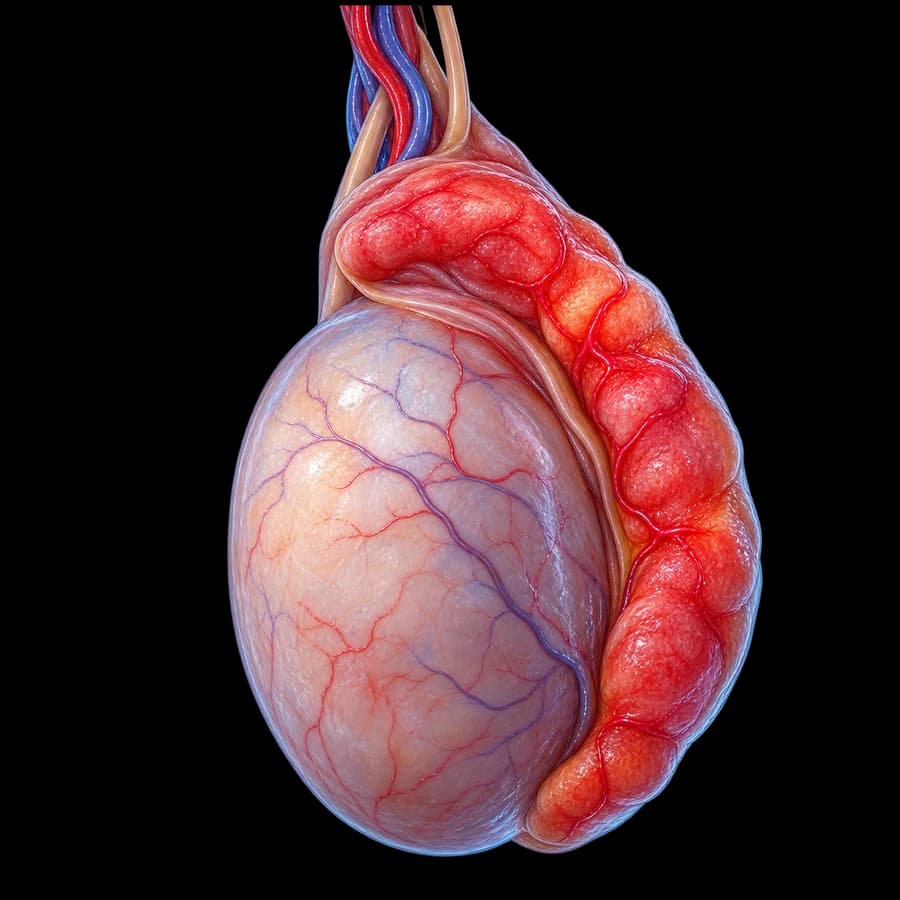
The epididymis is a thin tube behind each testicle that stores and transports sperm. Inflammation causes swelling, pain and tenderness.
- Acute epididymitis: <6 weeks (most common form)
- Chronic epididymitis: >3 months with mild non-acute pain
- Epididymo-orchitis: when it spreads to the testicle
- Common ages: 18–35 and >50 years
Symptoms
- Gradually increasing unilateral scrotal pain
- Scrotal swelling and erythema
- Hard, tender epididymis on palpation
- Fever (mild to high)
- Dysuria, frequency, urgency
- Urethral discharge (when STI-related)
- Positive Prehn sign (relief on elevation)
In young men (<25) with sudden, severe pain: testicular torsion must be ruled out immediately by Doppler or surgical exploration.
Causes
Men <35 years — STI
- • Chlamydia trachomatis (most common)
- • Neisseria gonorrhoeae
- • Mycoplasma genitalium
Men >35 years — UTI pathogens
- • Escherichia coli
- • Klebsiella, Proteus, Enterococcus
- • Often associated with underlying BPH or urethral stricture
Rare causes
- • Tuberculosis (endemic regions, immunosuppressed)
- • Amiodarone (drug-induced epididymitis)
- • Behçet syndrome, sarcoidosis
Diagnosis
- Clinical examination and palpation
- Urinalysis and urine culture
- Urethral swab + PCR (Chlamydia, Gonococcus, Mycoplasma) in men <35
- Blood tests (CRP, WBC)
- Color Doppler scrotal ultrasound (increased flow in epididymis)
- On recurrence: urodynamics + cystoscopy to rule out obstruction
Treatment
Men <35 years (CDC 2021)
Ceftriaxone 500 mg IM single dose + doxycycline 100 mg twice daily for 10 days. For anaerobic coverage (anal intercourse): add metronidazole.
Men >35 years (EAU 2024)
Fluoroquinolone (levofloxacin 500 mg/day) or trimethoprim/sulfamethoxazole for 10–14 days. Adjust per culture and sensitivity.
Conservative measures
- • Rest and scrotal elevation
- • Ice packs 15 min × 4/day
- • NSAIDs (ibuprofen 600 mg three times daily)
- • Sexual abstinence until healing + partner therapy if STI
Fertility
Acute epididymitis can leave scar tissue and ductal obstruction, resulting in obstructive azoospermia or oligospermia. A semen analysis 3 months after recovery is recommended in men of reproductive age. Bilateral involvement can severely impair fertility.
Follow-up
- Reassessment at 7–14 days
- Urine check at 4 weeks
- Semen analysis at 3 months (reproductive age)
- On recurrence: investigate underlying obstruction
- In chronic form: evaluation for epididymectomy
Frequently Asked Questions (FAQ)
How does epididymitis differ from testicular torsion?
Epididymitis usually has a gradual onset with mild fever and a positive Prehn sign (testicular elevation relieves pain). Torsion appears suddenly with severe pain and a negative Prehn sign. In young men, the rule is: until proven otherwise, it is torsion.
How long does antibiotic therapy last?
In men <35 years (usually STI): doxycycline 100 mg twice daily for 10 days plus single-dose ceftriaxone 500 mg IM (CDC 2021). In men >35 years (usually coliforms): a fluoroquinolone or co-trimoxazole for 10–14 days, per EAU 2024.
Why does the partner need to be tested?
When the cause is sexually transmitted (Chlamydia, Gonococcus), the partner may be an asymptomatic carrier and reinfect. Simultaneous treatment of both partners is mandatory for cure.
Can it cause permanent fertility damage?
Yes. Severe or chronic epididymitis can cause stricture or obstruction of the epididymis, leading to obstructive azoospermia. A semen analysis 3 months after recovery is recommended in men of reproductive age.
When is surgery needed?
Only for complications: abscess formation (drainage), epididymo-orchitis with necrosis, or chronic epididymitis refractory to conservative treatment (epididymectomy).
Book Your Appointment in Rhodes
Severe scrotal pain or swelling needs prompt urological evaluation for accurate diagnosis and individualized therapy.
References
- EAU Guidelines on Urological Infections, 2024 update — uroweb.org
- CDC STI Treatment Guidelines, 2021 — cdc.gov
- Trojian TH et al. Epididymitis and orchitis: an overview. Am Fam Physician 2009 — PMID: 19378875
Medical Review

Dr. Marinos Vasilas, Urologist – Andrologist
Dr. Marinos Vasilas runs a private urology practice in Rhodes, with clinical experience in the diagnosis and treatment of urogenital infections and epididymitis across all age groups.
See full biography


