My Clinical Approach
In testicular trauma, timely ultrasound is critical. For every patient with significant scrotal trauma, I order Doppler ultrasound immediately to assess tunica albuginea integrity and blood flow.
When rupture is suspected, I do not delay. Surgical exploration within 72 hours achieves >80% salvage rates per EAU 2024. Delay drops salvage to 32%.
For young patients I include fertility evaluation (semen analysis at 6 months) and discuss sperm cryopreservation in bilateral severe injuries.
What is Testicular Trauma?
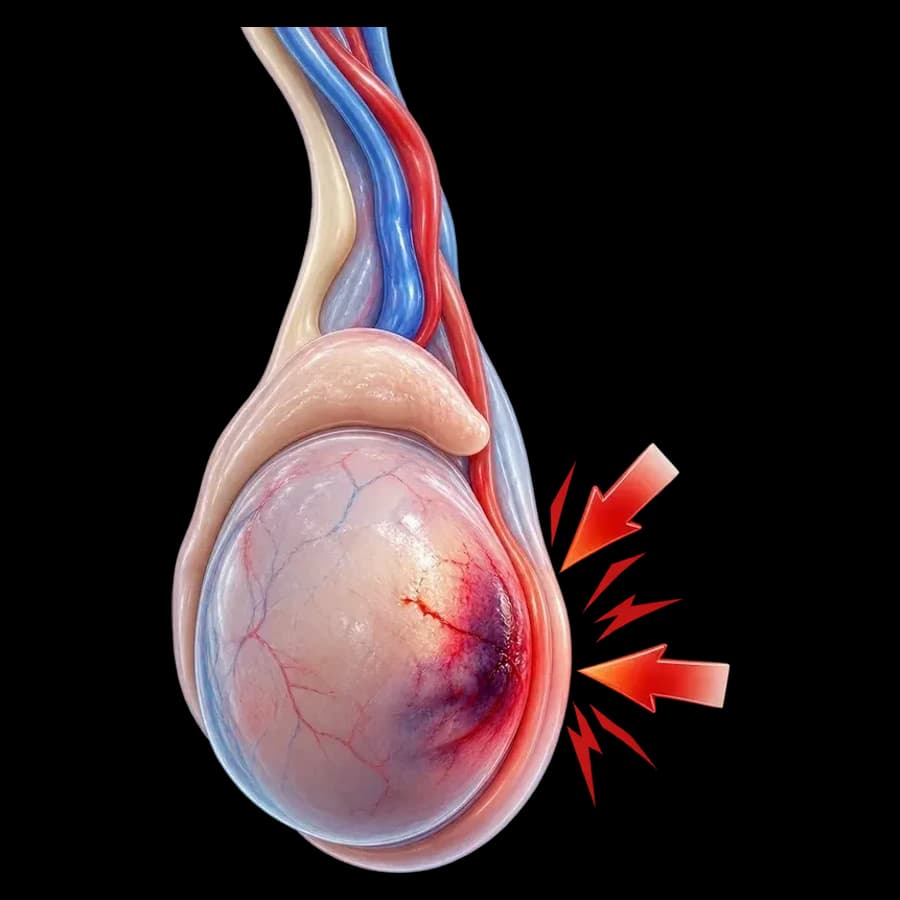
Testicular trauma includes any injury affecting the testes, epididymis, or scrotum. Despite their protective position, the testes can be injured by blunt or penetrating forces.
- Blunt trauma: 80% of cases (sports, accidents)
- Penetrating trauma: 20% (knife, gunshot)
- Most common age: 15–40 years
- Usually unilateral
- Association with contact sports, motorcycle accidents
Symptoms
- Severe sudden scrotal pain
- Swelling and hematoma
- Scrotal ecchymosis (bruising)
- Nausea, vomiting (from severe pain)
- Difficulty walking
- Dysuria or hematuria (if urethral injury coexists)
- Possible syncope (vasovagal reaction)
Any severe scrotal trauma with persistent pain, marked swelling, or inability to palpate the testis requires immediate urological evaluation and ultrasound.
Mechanisms of Injury
Blunt — 80%
- • Sports trauma (ball, kick)
- • Falls, road traffic accidents
- • Assaults, fights
- • Mechanical tools
Penetrating — 20%
- • Gunshot
- • Stab, sharp objects
- • Animal bite
Other
- • Testicular dislocation
- • Thermal burns
- • Electrical injuries
Diagnosis
- Detailed history of injury mechanism
- Clinical examination: palpation, scrotal integrity
- Color Doppler scrotal ultrasound (investigation of choice)
- Tunica albuginea integrity assessment
- Hematocele size assessment
- Urinalysis (if urethral injury suspected: retrograde urethrography)
- Pelvic CT in complex trauma
Treatment (EAU Urological Trauma 2024)
Conservative (minor injuries)
- • Rest and scrotal elevation
- • Ice packs 15 min × 4–6/day
- • NSAIDs for pain and inflammation
- • Athletic cup protection
- • Repeat ultrasound at 7–10 days
Surgical Exploration (indications)
- • Tunica albuginea rupture on ultrasound
- • Large hematocele (>3× the testis)
- • Penetrating trauma
- • Non-palpable testis (dislocation)
- • Ongoing bleeding
Surgical Goals
- • Hematocele drainage
- • Removal of non-viable tissue
- • Tunica albuginea repair
- • Testicular salvage (orchiectomy in extensive necrosis)
Follow-up & Fertility
- Reevaluation at 4–6 weeks
- Ultrasound at 3 months (atrophy assessment)
- Hormonal evaluation (testosterone, FSH, LH) if atrophy present
- Semen analysis at 6 months (young patients)
- Psychological support after orchiectomy
- Discussion of testicular prosthesis if desired
Prevention
- Athletic cup protection in contact sports
- Helmet and protective gear on motorcycles/bicycles
- Vehicle seatbelts
- Safe handling of mechanical tools
- Immediate medical evaluation for severe scrotal trauma
Frequently Asked Questions (FAQ)
When is surgery needed after testicular trauma?
When ultrasound shows tunica albuginea rupture, large hematocele (>3× the contralateral testis), or testicular dislocation is suspected. Per EAU 2024, immediate surgery within 72 hours increases testicular salvage >80% (vs. 32% with conservative management).
Can blunt trauma cause infertility?
Yes. Bilateral severe trauma can cause subfertility, testicular atrophy, or anti-sperm antibody response. Semen analysis at 6 months is recommended for young patients.
How dangerous is a hematocele?
A large hematocele (>3 cm) untreated leads to testicular atrophy from compression, infection, or chronic pain. Usually requires surgical drainage and repair.
How can I protect myself in sports?
Use of an athletic cup in contact sports (football, baseball, hockey, MMA). Reduces severe injury risk >85%.
What is testicular dislocation?
A rare injury where the testis moves out of the scrotum to another anatomical location (inguinal canal, retroperitoneum). Usually after motorcycle trauma. Requires immediate reduction.
Book Your Appointment in Rhodes
For severe testicular trauma, timely evaluation within hours of injury is critical for organ salvage and future fertility.
References
- EAU Guidelines on Urological Trauma, 2024 update — uroweb.org
- Bryk DJ, Zhao LC. Guideline of guidelines: a review of urological trauma. BJU Int 2016 — PMID: 27258617
- Buckley JC, McAninch JW. Use of ultrasonography for the diagnosis of testicular injuries in blunt scrotal trauma. J Urol 2006 — PMID: 16952634
Medical review

Dr. Marinos Vasilas, Urologist – Andrologist
Dr. Marinos Vasilas runs a private urological practice in Rhodes with experience in urological trauma and testicular salvage following injuries in athletes and patients of all ages.
View full bio


