My Clinical Approach
Testicular torsion is one of the few true urological emergencies where time is measured in minutes. When an adolescent or young adult presents with sudden, acute unilateral testicular pain, my principle is one: torsion is first on the differential until proven otherwise.
I do not wait for laboratory tests, nor do I insist on repeating Doppler if clinical suspicion is strong. Per the 2024 EAU guidelines, in clear clinical pictures surgical exploration must not be delayed by imaging. I have seen too many patients lose a testicle because of delays in initial ED assessment.
In surgery, I always perform bilateral orchidopexy, even if the contralateral testicle has no symptoms: the predisposing anatomic variant is almost always bilateral.
What Is Testicular Torsion?
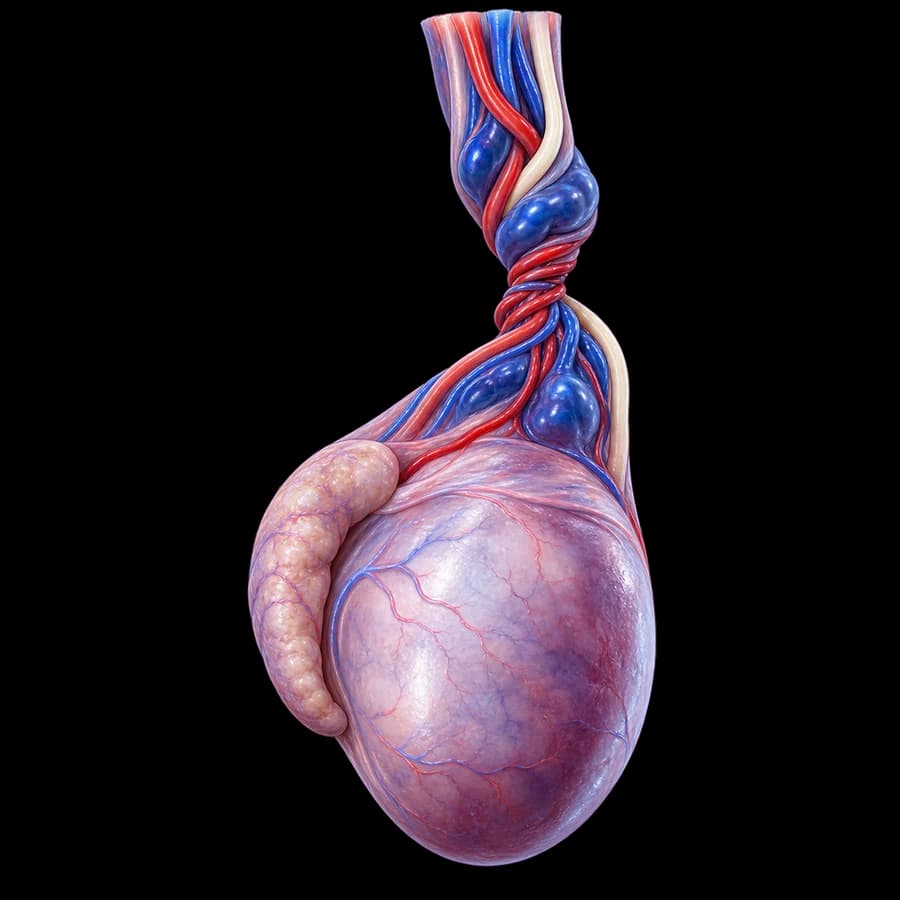
Testicular torsion is the rotation of the spermatic cord around its longitudinal axis. This causes:
- Venous outflow obstruction → edema and increased pressure
- Progressive arterial inflow loss → ischemia
- Testicular necrosis within 6–12 hours if untreated
Incidence: 1 in 4,000 men under 25 years. Two age peaks: neonatal period and adolescents 12–18 years.
Symptoms
- Sudden, severe unilateral testicular pain
- Pain may radiate to groin or abdomen
- Nausea and vomiting (in >50% of cases)
- Scrotal swelling and erythema
- High-riding testicle (elevated) with horizontal orientation
- Absent cremasteric reflex on the affected side
Prehn's sign: testicular elevation does not relieve pain (in contrast to epididymitis where it does). Not pathognomonic but helpful.
Causes & Risk Factors
- "Bell-clapper" anatomic variant — loose attachment of testicle to scrotum
- Vigorous physical activity or trauma (trigger, not cause)
- Cold weather (increases cremasteric muscle contraction)
- Rapid testicular volume increase during puberty
- Neonatal perinatal torsion — without bell-clapper deformity
Diagnosis
Clinical examination
The most important diagnostic step. With high clinical suspicion, we do not wait for tests — we proceed to the operating room.
Color Doppler ultrasound
Shows absent or markedly reduced arterial flow in the affected testicle. Sensitivity 88–100%, specificity 90–100%. Should not delay surgical exploration when the clinical picture is clear.
TWIST score
Clinical scoring system (scrotal swelling, hard testis, high-riding, absent cremasteric reflex, nausea/vomiting). Score ≥5 has high predictive value.
Treatment — Emergency Surgery
Scrotal exploration
Emergent scrotal incision, detorsion of the cord, viability assessment after warm saline application. If color returns → bilateral orchidopexy with non-absorbable sutures.
Orchiectomy
If the testicle is non-viable (necrotic, dark). Retaining a non-viable testicle causes inflammation and possibly anti-sperm antibodies. Simultaneous orchidopexy of the healthy contralateral testicle.
Manual detorsion
In selected cases prior to surgery — "opening the book", outward rotation of the testicle. May relieve pain but does not replace surgical fixation.
Fertility
Even successful detorsion may affect long-term spermatogenesis of both the affected and the contralateral testicle (via autoimmune mechanism). A semen analysis 3–6 months post-op and hormonal workup are recommended.
In young men with future fatherhood plans, discussing sperm cryopreservation before scheduled procedures (e.g., orchiectomy of a non-viable testicle) is important.
Follow-up
- Wound check at 7–10 days
- Scrotal ultrasound at 6 weeks (atrophy assessment)
- Semen analysis at 3–6 months
- Hormonal panel (testosterone, FSH, LH) annually if orchiectomy was needed
- Psychological support (especially adolescents post-orchiectomy)
- Discussion of testicular prosthesis (after 6 months)
Frequently Asked Questions (FAQ)
How quickly do I need to act?
The golden window is the first 6 hours from pain onset. Within this period, testicular salvage exceeds 90%. After 12 hours it drops to 50%, and after 24 hours to 10%. It is a 24/7 surgical emergency.
Can it be confused with other conditions?
Yes. Epididymitis and torsion of the appendix testis (Hydatid of Morgagni) mimic the symptoms. Color Doppler ultrasound is the key differential tool, but no test should delay surgical exploration when clinical suspicion is high.
If I lose the testicle, what does it mean for fertility?
The remaining healthy testicle usually compensates total testosterone and sperm production. However, studies suggest that unilateral torsion may affect contralateral sperm quality through an autoimmune mechanism (anti-sperm antibodies).
Why does the healthy testicle also need fixation?
The anatomic factor that predisposes to torsion ("bell-clapper" deformity) is usually bilateral. In the same surgery, prophylactic orchidopexy of the contralateral testicle is performed to prevent future torsion.
Is it more common at a specific age?
Yes. It has a bimodal distribution: newborns (perinatal torsion) and adolescents 12–18 years. In adolescents it classically occurs during sleep or after sports activity.
In Emergency
If you experience sudden severe testicular pain, go immediately to an emergency department. For post-operative follow-up and andrological evaluation, my practice is at your disposal.
References
- EAU Guidelines on Paediatric Urology, 2024 update — uroweb.org
- EAU Guidelines on Urological Trauma, 2024 update — uroweb.org
- Sharp VJ et al. Testicular Torsion: Diagnosis, Evaluation, and Management. Am Fam Physician 2013 — PMID: 24364548
- Barbosa JA et al. TWIST score validation. J Urol 2013 — PMID: 23770138
Medical Review

Dr. Marinos Vasilas, Urologist – Andrologist
Dr. Marinos Vasilas runs a private urology practice in Rhodes, with surgical experience in urological emergencies including testicular torsion and bilateral orchidopexy.
See full biography


