My Clinical Approach
Bladder stones are almost always secondary — removing the stones is not enough. The same operation must address the cause.
I follow the EAU Guidelines on Urolithiasis 2024 and AUA recommendations:
- Holmium laser lithotripsy as the technique of choice — minimal mechanical stress, excellent fragmentation.
- Concurrent treatment of obstruction (TURP, optical urethrotomy) at the same setting.
- Urodynamics before TURP in neurogenic disease to confirm obstructive cause.
- Thorough check for foreign bodies (sutures, catheters) in patients with prior surgery.
- Paediatric stones: metabolic workup, dietary intervention, exclusion of metabolic disorders.
- Antibiotic prophylaxis based on culture — chronic infection is the rule.
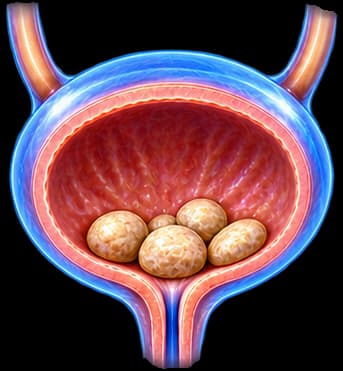
What are bladder stones
Crystalline aggregates (stones) formed within the bladder. Two types:
Primary stones
Rare in Western countries. Mainly children in endemic regions (Africa, Asia) with dietary phosphorus deficiency.
Secondary stones
Over 95% — due to urinary stasis from obstruction, foreign bodies, or chronic infection.
Aetiology
- Benign prostatic hyperplasia (BPH) — the most frequent cause in men >50 (~70% of cases).
- Urethral strictures — post-surgical, post-traumatic, post-catheterisation.
- Neurogenic bladder — urinary stasis, chronic catheter drainage.
- Post-void residual >100 mL.
- Foreign bodies: surgical sutures, indwelling catheters, migrated IUD.
- Chronic urinary infection with Proteus, Klebsiella (struvite stones).
- Bladder diverticula — local stasis.
- Stones descending from the kidney that lodge and grow in the bladder.
Symptoms
Typical
Intermittent suprapubic pain, interrupted stream (stone obstructs the urethra), gross haematuria (often terminal), urgency.
Additional
Recurrent cystitis, dysuria, nocturia, pain that resolves with positional change (the stone shifts).
Asymptomatic in ~25% — found incidentally on ultrasound or during BPH evaluation. This does not mean treatment can be deferred (risk of recurrent infections).
Diagnosis
Detailed history
LUTS (obstruction), prior surgery, catheter use, history of upper-tract stones.
Physical examination
Abdominal palpation, digital rectal exam, neurological exam if neurogenic bladder is suspected.
Urinalysis + culture
Leukocyturia, pyuria, red cells. Culture guides perioperative antibiotic prophylaxis.
Bladder ultrasound
First line: detects stones >5 mm, measures post-void residual, evaluates prostate, bladder wall thickness.
KUB X-ray
90% of stones are radiopaque (calcium phosphate, struvite, calcium oxalate). Uric acid stones are radiolucent.
Non-contrast CT
Confirmation, size assessment, exclusion of ureteral/renal stones. HU density guides choice of lithotripsy.
Cystoscopy
Direct visualisation + assessment of diverticula, foreign bodies, obstructive prostatic tissue. Often diagnostic and therapeutic.
Urodynamics (selective)
In neurogenic bladder, in patients without obvious obstruction. Confirms obstructive vs neurogenic pattern.
Endoscopic management
Transurethral cystolitholapaxy (gold standard)
Through a cystoscope, no incision. Fragmentation methods:
- • Holmium:YAG laser: gold standard for all stone types.
- • Pneumatic lithotripter (Lithoclast): fast, economical.
- • Ultrasonic: continuous fragment suction.
- • Mechanical (Mauermayer): older, used less now.
Percutaneous cystolitholapaxy
Reserved for children and adults with narrow urethra or very large stones. 30-Fr percutaneous access with Holmium laser or ultrasound.
Open cystolithotomy
Rare indication: stones >4-5 cm, multiple large stones, combined with open prostatectomy. Small suprapubic incision, stone extraction, bladder closure.
ESWL (extracorporeal shock-wave lithotripsy)
Not first line — low efficacy in the bladder and risk of fragment migration. Reserved for high-risk patients unfit for anaesthesia.
Treating the underlying cause
Crucial — without it recurrence is 30-60%. At the same operation:
- TURP (transurethral resection of prostate) for BPH with proven obstruction.
- HoLEP / GreenLight for large prostates or anticoagulated patients.
- Endoscopic urethrotomy or urethroplasty for urethral strictures.
- Foreign-body removal (sutures, migrated IUD).
- In neurogenic bladder: optimisation of clean intermittent catheterisation (CIC), intravesical botox, neuromodulation.
Recovery & follow-up
- Day-case or 24-48 h hospital stay (after combined TURP).
- Foley catheter for 1-3 days (up to 7 after TURP).
- Return to daily activities in 5-7 days.
- Avoid strenuous exercise for 2-3 weeks.
- Follow-up ultrasound at 4-6 weeks, post-void residual measurement, IPSS assessment.
- Sterile urine culture before surgery and 4 weeks afterwards.
Prevention of recurrence
- Complete treatment of the cause: usually sufficient.
- Adequate hydration >2.5 L/day (urine output >2 L).
- Monitor post-void residual <100 mL.
- Prompt treatment of any new urinary infection.
- In recurrent disease: 24-h metabolic urine workup, stone composition analysis, targeted pharmacotherapy (allopurinol, citrate, etc.).
- In patients with indwelling catheters: change every 4-6 weeks, use silicone.
Frequently Asked Questions (FAQ)
What are bladder stones?
Bladder stones are crystalline aggregates formed within the bladder. In Western countries they account for <5% of all urinary stones and primarily affect men >50 with underlying lower urinary tract obstruction (BPH).
What causes them?
In >70% of cases there is underlying obstruction: prostatic enlargement, urethral stricture, neurogenic bladder with urinary stasis. Other causes: foreign bodies (catheters, sutures, migrated IUD), recurrent urinary infections, dietary deficiencies in developing countries (children).
What are the symptoms?
Intermittent suprapubic pain (worse on movement), interrupted urinary stream, gross haematuria, recurrent cystitis, urinary urgency. About 25% are asymptomatic and discovered incidentally.
How are they diagnosed?
First line: bladder ultrasound (simple, no radiation). KUB X-ray (90% of stones are radiopaque). Non-contrast CT for confirmation and to exclude other stones. Cystoscopy for direct visualisation and treatment.
How are they treated?
Endoscopically with cystolitholapaxy: mechanical (Mauermayer), Holmium laser (gold standard), pneumatic (Lithoclast), ultrasonic. Open cystolithotomy is rare, reserved for very large stones (>4-5 cm). Always treat the underlying cause (TURP, urethrotomy).
How long is recovery?
Cystolitholapaxy is day-case surgery: discharge same day or next morning. Catheter for 24-48 hours. Return to activities in 3-7 days. Follow-up ultrasound at 4-6 weeks to confirm complete clearance.
Can stones recur?
Yes, in 30-60% if the cause (BPH, stricture) is not treated. For this reason, combined TURP or urethrotomy is often performed at the same operation. With proper aetiological treatment recurrence drops to <5%.
Do I need a special diet?
In adults with symptomatic BPH-related stones diet plays a small role — the main treatment is decompression. For recurrent disease: 24-hour metabolic urine workup, increased hydration (>2.5 L/day), sodium and oxalate restriction (children).
Related Topics
Bladder stones: a symptom, not a diagnosis
Get in touch for comprehensive treatment: Holmium laser lithotripsy combined with TURP or optical urethrotomy in a single operation.
Scientific References
- EAU Guidelines on Urolithiasis 2024 — uroweb.org
- Philippou P, Moraitis K, Masood J, et al. The management of bladder lithiasis in the modern era of endourology. Urology 2012;79(5):980-6 — pubmed.ncbi.nlm.nih.gov
- Ramos-Cuellar A, Rodriguez-Patron R, et al. Cystolitholapaxy with Holmium:YAG laser. World J Urol 2019;37(5):881-7
- Donaldson JF, Ruhayel Y, Skolarikos A, et al. Treatment of bladder stones in adults and children: a systematic review for the EAU Guidelines. Eur Urol 2019;76(3):352-67 — pubmed.ncbi.nlm.nih.gov
- Rivera ME, Bhojani N, Heinsimer K, et al. Holmium laser for bladder calculi: a multi-institutional study. J Endourol 2020;34(2):153-7
Meet the Doctor

Dr. Marinos Vasilas, Urologist & Andrologist
Combined approach to bladder stones per EAU 2024: Holmium laser cystolitholapaxy and concurrent TURP / optical urethrotomy in a single setting — definitive resolution and low recurrence rate.
See full profile


