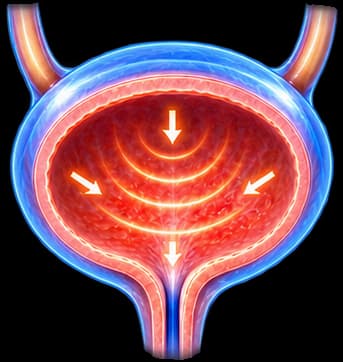
My Clinical Approach to Overactive Bladder
Many patients with overactive bladder come to the clinic believing they have “incontinence,” or that their problem is simply a habit of urinating too often. Correctly identifying the central symptom – urgency – is the first step.
My approach always begins by excluding other causes (infection, polyuria, obstruction, retention) before an OAB diagnosis is made, followed by a stepwise treatment pathway — from bladder training to advanced treatments when needed.
- Clear identification of urgency as the central symptom before any treatment decision.
- Exclusion of infection, polyuria, obstruction and retention before an OAB diagnosis is made.
- A stepwise approach: behavioural therapy → medication → advanced treatments when needed.
- Particular attention to distinguishing OAB from stress incontinence, cystitis, and bladder pain syndrome.
What Is Overactive Bladder
According to current International Continence Society (ICS) terminology, overactive bladder (OAB) is a syndrome characterised mainly by urgency to urinate, usually with increased frequency and nocturia, with or without urgency urinary incontinence, when there is no urinary infection or other obvious cause that explains the symptoms.
OAB ≠ urinary incontinence. A patient may have OAB with urgency incontinence, or with no urine leakage at all.
The Main Symptom of OAB Is Urgency
Urgency – the sudden, difficult-to-defer need to urinate – is the main symptom of overactive bladder.
Urgency = a sudden, strong need to urinate that is difficult to defer. This differentiates OAB from:
Symptoms of Overactive Bladder
Urgency
The central symptom – a sudden, strong need to urinate.
Frequency
Frequent urination during the day.
Nocturia
Waking at night to urinate.
Urgency Urinary Incontinence
Involuntary urine loss following urgency.
Not all four need to be present in every patient. A patient may have only urgency and frequency, without nocturia or leakage.
“It Hits Me Suddenly and I Can’t Make It to the Toilet in Time”
When sudden urgency is followed by urine leakage, this is called Urgency Urinary Incontinence (UUI). See our page on Urinary Incontinence for the full picture of all incontinence types.
“It Hits Me Suddenly and I Can’t Make It – Do I Have Overactive Bladder?” Urgency is the main symptom of OAB, but before a diagnosis is made, infection, voiding dysfunction, and other causes must be considered depending on the clinical context.
OAB Without Urgency Incontinence vs OAB With Urgency Incontinence
Without Urgency Incontinence
Urgency/frequency/nocturia without leakage.
With Urgency Incontinence
Urgency is accompanied by involuntary urine loss.
Overactive Bladder vs Stress Incontinence
| Overactive Bladder / Urgency Incontinence | Stress Incontinence |
|---|---|
| Preceded by a strong urge to urinate | Leakage with coughing, sneezing, laughing, running, lifting |
| “I can’t make it to the toilet” | Without a preceding sense of urgency |
| Frequency | Related to increased abdominal pressure |
| Nocturia | Rarely associated with nocturia |
The two forms have a different mechanism and a different treatment.
Mixed Urinary Incontinence
Urgency leakage and stress leakage can coexist in the same patient – this is then called mixed urinary incontinence. Treatment must take the dominant symptom into account.
How Often Is Considered “Frequency”? Frequency vs Polyuria
An absolute number-of-voids threshold is not used as an OAB diagnosis. Frequency is influenced by fluid intake, caffeine, diuretics, diabetes, bladder capacity, sleep and environmental factors. Clinical significance depends on symptoms and bother, not on a number.
“I Urinate Every Hour – Do I Have OAB?” Not necessarily. Frequency needs to be distinguished from true polyuria. A bladder diary is particularly useful here.
Frequency
Many visits to the toilet, often with smaller amounts each time.
Polyuria
Increased total urine volume over 24 hours – possible causes: excess fluids, diabetes mellitus, diuretics, diabetes insipidus, other systemic causes.
OAB should not be diagnosed in a patient with true polyuria without appropriate evaluation.
Overactive Bladder and Nocturia
Nocturia can coexist with OAB, but nocturia ≠ always overactive bladder.
Nocturia does not always mean a bladder problem and can be related to increased nighttime urine production or sleep disorders.
Other possible causes of nocturia:
“I Get Up 3–4 Times a Night – Is It the Bladder?” It may be, but not necessarily. Nighttime urine production, sleep, oedema, diabetes, medications, BPH and OAB should all be assessed. Not all nocturia should be attributed to the bladder.
Bladder Diary
The bladder diary is one of the most important diagnostic tools in OAB. It can record:
It helps distinguish OAB, polyuria, nocturnal polyuria and behavioural frequency, over an appropriate time period as instructed by the physician.
Why Does Overactive Bladder Occur?
Often there is no single cause. Possible contributors:
OAB is not exclusively a psychological problem – it is a syndrome with multiple possible physiological mechanisms.
OAB vs Detrusor Overactivity
Detrusor overactivity on urodynamic testing is not the same thing as the clinical syndrome OAB.
OAB is a clinical syndrome based on symptoms. Detrusor Overactivity (DO) is a urodynamic finding – involuntary detrusor contractions during filling.
Therefore: OAB can exist without demonstrable DO, and DO can be found in different clinical contexts. The two terms are not synonyms.
Overactive Bladder in Women
Possible relevant factors include:
It is not true that childbirth or menopause always cause OAB – these are possible contributing factors, not inevitable causation.
Overactive Bladder in Men & Benign Prostatic Hyperplasia
In men, urgency/frequency can coexist with benign prostatic hyperplasia (BPH), bladder outlet obstruction, post-void residual urine, detrusor overactivity, or changes after prostate surgery. Not every male urgency should be assumed to be BPH.
Storage symptoms and obstruction can coexist.
In a man with a weak stream, hesitancy, incomplete emptying, and urgency/frequency, the prostate, uroflowmetry, and post-void residual should also be assessed. See our page on Benign Prostatic Hyperplasia.
OAB After BPH Surgery (TURP / TURis / HoLEP)
Storage symptoms may persist temporarily after surgical treatment, may have pre-existed due to bladder remodelling, or may continue in selected patients even after relief of obstruction. Persistent urgency does not mean the surgery failed.
OAB After Radical Prostatectomy
This can coexist with incontinence after radical prostatectomy. Stress leakage must be distinguished from urgency leakage, as treatment differs. See our page on Urinary Incontinence.
OAB, Urinary Infection & Cystitis
A urinary infection can cause urgency, frequency, dysuria and leakage. Before new symptoms are characterised as OAB, infection must be considered where clinically appropriate. See our page on Cystitis.
OAB vs Cystitis
OAB
Chronic/recurrent urgency, frequency, nocturia – usually no infection.
Cystitis
Dysuria, burning, frequency, urgency – in the context of infection/inflammation.
The presence of dysuria and acute onset increase the need to check for a urinary infection.
OAB vs Bladder Pain Syndrome
OAB
Urgency driven primarily by the need to void.
Bladder Pain Syndrome
Pain/pressure/discomfort related to bladder filling is more central.
Frequency/urgency can coexist. Bladder pain syndrome should not be treated using the OAB algorithm without reassessment. See our page on Interstitial Cystitis / Bladder Pain Syndrome.
Blood in Urine
Blood in the urine is not a typical symptom of simple overactive bladder. Visible or persistent microscopic haematuria needs separate evaluation. See our page on Blood in Urine.
Neurogenic Bladder
Symptoms similar to OAB can appear in multiple sclerosis, Parkinson’s disease, spinal cord disease, stroke, or diabetic neuropathy. If a known neurological disease is present, the neuro-urological pathway may differ from idiopathic OAB.
See our page on Neurogenic Bladder.
When Urgent/Different Evaluation Is Needed
Different/urgent evaluation is needed with:
These findings should not be treated as simple OAB.
How Is Overactive Bladder Diagnosed?
OAB is mainly a symptom-based clinical diagnosis after appropriate exclusion of other relevant causes. Initial evaluation may include history, symptom assessment, physical examination, urinalysis, a bladder diary, and medication review, with selected additional tests case by case.
Medical History
Questions cover urgency, frequency, nocturia, leakage, fluid intake, caffeine, bowel habits, medications, previous pelvic/prostate surgery, neurological symptoms, urinary infection, and voiding symptoms.
Questionnaires
Validated OAB symptom/quality-of-life questionnaires may be used. An online score is not a diagnosis – it is a tool to support clinical assessment, not a substitute for it.
Urinalysis & Culture
Urinalysis can help identify infection, blood, or glucosuria, depending on the clinical context. It does not, on its own, prove OAB.
Routine urine culture is not needed for every known, stable OAB patient. It has greater value when there is an acute symptom change, dysuria, recurrent infection, or suspected infection, according to current guidance.
Post-Void Residual (PVR)
PVR is the amount of urine remaining in the bladder after voiding. It has particular relevance in men with BPH, weak stream, neurological patients, previous pelvic/prostate surgery, and before selected therapies. An arbitrary PVR cutoff is not used without the appropriate guideline context.
In a patient with significant bladder-emptying dysfunction, retention risk should be assessed before and during treatment. Antimuscarinics do not cause retention in every patient.
Uroflowmetry
Uroflowmetry can help when there is a weak stream, male LUTS, suspected obstruction, or incomplete emptying, and is performed in our clinic as part of the individualised assessment.
Bladder Ultrasound
Can be used in selected patients to assess post-void residual, the bladder/upper tract, and the prostate. It is not mandatory in every uncomplicated OAB patient.
Do I Need Urodynamic Testing?
Not routine for every uncomplicated OAB.
It may have greater value in diagnostic uncertainty, neurological disease, significant voiding dysfunction, elevated post-void residual, previous surgery, refractory symptoms, or in selected patients before invasive treatment, according to current guidelines.
Urodynamic testing can record involuntary detrusor contractions during filling, but the absence of detrusor overactivity does not exclude the clinical syndrome OAB. It is performed in our clinic as part of the individualised approach. See our page on Urodynamic Study.
Do I Need Cystoscopy?
Not for every patient with OAB.
May be needed with blood in the urine, recurrent infection, suspected bladder lesion, previous pelvic surgery, a foreign body, obstruction/urethral pathology, or in selected complex contexts. See our page on Flexible Cystoscopy.
First Step: Bladder Training and Behavioural Changes
First-line treatment includes bladder training, appropriate fluid management, caffeine reduction, moderating alcohol where relevant, weight management, treating constipation, and timing diuretics appropriately after medical review.
Bladder Training
Aims for a gradual increase in the ability to defer voiding, a reduction in urgency-driven voids, and a structured voiding pattern, with urgency suppression techniques. No rigid programme is given here – the programme is individualised.
Urgency Suppression Techniques
May include stopping rather than rushing, controlled breathing, pelvic-floor contractions in selected patients, and attention/distraction strategies. These are not presented as a cure.
Pelvic Floor Muscle Training
Can help with urgency suppression and with mixed incontinence with an associated stress-leakage component, but it is not the same as bladder training – it is a different technique.
Fluids, Caffeine, Weight & Constipation
Fluid Intake
Do not restrict fluids excessively, but do not drink “as much water as possible” either. Excessive fluid restriction can have consequences, while excessive intake can worsen frequency/nocturia. The goal is appropriate, individualised fluid intake.
Caffeine
Caffeine can worsen urgency/frequency in selected patients. Not every patient needs to completely eliminate coffee.
Body Weight
In overweight patients, weight loss can improve lower urinary tract/incontinence symptoms.
Constipation
Constipation can worsen bladder symptoms and is a relevant, modifiable factor.
Medications for Overactive Bladder
The main categories are antimuscarinics and beta-3 adrenergic agonists, with selected combination therapy in some patients. No medication is presented as universally best. No brand names or dosages are given as self-treatment.
Antimuscarinics
Reduce involuntary bladder activity/storage symptoms. Examples of active substances that may be mentioned include solifenacin, tolterodine, oxybutynin, fesoterodine, and trospium – without dosing and without stating that all have identical efficacy/safety.
Possible Side Effects
Dry mouth, constipation, blurred vision in selected patients, urinary retention risk, and, in vulnerable older adults, cognitive burden. Not every side effect occurs in every patient.
Cognitive Risk & Anticholinergic Burden
Particularly in older adults, total anticholinergic burden, cognitive status, and polypharmacy can influence treatment selection, according to current evidence and guidelines. No absolute dementia-causation claims are made here without sufficient evidence.
Beta-3 Adrenergic Agonists
Relax the detrusor muscle during the storage phase and improve urgency/frequency/urgency incontinence in selected patients. Mirabegron is an available, approved medication in this class.
Blood pressure considerations may be relevant when selecting mirabegron therapy – specific contraindications/thresholds should always be verified against the current Summary of Product Characteristics (SmPC) and current guidelines at the time of prescribing.
Vibegron is another beta-3 agonist whose availability varies by country – its local availability in Greece should be confirmed before it is discussed as an option, and it is not presented here as automatically superior to mirabegron.
Combination Therapy & “The Medication Didn’t Help”
In selected patients with inadequate response to monotherapy, combining a beta-3 agonist with an antimuscarinic may be considered according to current guidelines. It is not the first choice for everyone.
“How Fast Do Medications Work?” Improvement can appear gradually, and a full assessment of effectiveness requires an appropriate trial duration. No fixed universal number of days is given here without individualised context.
“The Medication Didn’t Help” – before this is characterised as treatment failure, the following should be assessed:
Simply switching medications endlessly is not recommended without reassessment.
Topical Vaginal Estrogen
In postmenopausal women with genitourinary syndrome of menopause, topical vaginal estrogen may have a role in selected urinary symptoms or in the context of recurrent urinary infection. It is not presented as a universal primary treatment for OAB, and no dosage is given here.
What Happens When Medications Are Not Enough?
When behavioural therapy and medications are not enough, effective advanced options such as Botox and neuromodulation exist for appropriate patients.
Options for refractory OAB, according to current guidelines, may include intravesical botulinum toxin, sacral neuromodulation, and PTNS, depending on patient preference.
Botox for the Bladder
Botulinum toxin is injected intravesically into the detrusor muscle, via cystoscopy, to reduce urgency, frequency, and urgency incontinence in selected patients with refractory OAB. No technical injection protocol is given here.
Possible risks: urinary infection, elevated post-void residual, urinary retention, and a possible need for intermittent self-catheterisation in selected patients. The patient must be informed about the possible need for catheterisation before treatment – there is no guarantee that retention will not occur.
The effect is temporary and repeat treatment may be needed – the exact duration varies by patient.
Sacral Neuromodulation (SNM)
Modulates neural signalling between the sacral nerves and the bladder/pelvic floor, for selected patients with refractory OAB. It is not brain or spinal surgery. An evaluation/test phase usually precedes any permanent implantation.
Posterior Tibial Nerve Stimulation (PTNS)
A peripheral neuromodulation that influences sacral bladder pathways, with repeated sessions in many protocols and often a need for ongoing maintenance therapy. It is not presented as equivalent to SNM.
Botox vs Sacral Neuromodulation vs PTNS
| Botox | Sacral Neuromodulation | PTNS | |
|---|---|---|---|
| Mechanism | Detrusor chemodenervation/modulation | Sacral neural modulation | Peripheral neuromodulation |
| Invasiveness | Cystoscopic injections | Implanted device after evaluation | Minimally invasive sessions |
| Repeat treatment | Usually yes | Long-term device-based therapy | Maintenance often required |
| Retention risk | Relevant | Different adverse-effect profile | Low retention concern |
| Patient commitment | Repeat procedures | Implant management | Multiple sessions |
The choice is individualised – no treatment is labelled here as “the best.” When Botox administration is described, it is performed endoscopically with cystoscopic guidance – flexible cystoscopy is not characterised as “3D.”
Major reconstructive surgery such as augmentation cystoplasty has only a very limited role in severe, refractory cases and is not a routine OAB treatment.
Overactive Bladder in Older Adults
In older adults, frailty, cognition, mobility, polypharmacy, anticholinergic burden, constipation, and functional incontinence should be taken into account. Urgency should not be considered “normal because someone got older.”
In patients with cognitive impairment, toileting strategies, medication selection, and caregiver considerations may be particularly important. No OAB→dementia causation claims are made here.
Quality of Life, Sleep & Sexual Function
Urgency/incontinence can affect confidence, intimacy, and sexual activity.
Nocturia can affect sleep quality, fatigue, and fall risk in older patients. However, evaluation must also look for non-urological sleep causes.
The Patient Journey
Sudden urgent need to urinate
The starting point.
Frequency / nocturia ± leakage
Accompanying symptoms.
Exclude relevant alternative causes
Urinary infection, polyuria, obstruction, retention, blood in urine/bladder pathology, neurological disease.
History + urinalysis + bladder diary
Initial assessment.
PVR / uroflowmetry where indicated
Selected tests.
Uncomplicated OAB → bladder training + lifestyle changes
First line.
Medication if needed (antimuscarinic / beta-3 agonist / selected combination)
Second line.
Persistent, bothersome OAB → Botox / PTNS / sacral neuromodulation
Advanced treatments.
This is an informational overview, not a self-treatment algorithm – each case is discussed individually with the treating urologist.
Frequently Asked Questions
What is overactive bladder?
It is a syndrome characterised mainly by urgency to urinate, usually with increased frequency and nocturia, with or without urgency urinary incontinence, when there is no urinary infection or other obvious cause that explains the symptoms.
What is the main symptom?
Urgency — a sudden, strong need to urinate that is difficult to defer. The other symptoms (frequency, nocturia, leakage) usually follow from it.
What does urgency mean?
It means a sudden, strong need to urinate that is difficult to defer — different from simply feeling that "the bladder is full."
Is OAB the same as incontinence?
No. OAB is a symptom syndrome. It may exist with or without involuntary urine loss. When it is accompanied by leakage, that is called urgency urinary incontinence.
Why can’t I make it to the toilet in time?
This relates to urgency — when the need is so sudden and strong that the trip to the toilet does not leave enough time, potentially resulting in leakage before the person can get there.
Does frequency always mean OAB?
No. Frequency (many small voids) needs to be distinguished from polyuria (increased total urine volume). It needs assessment, not an automatic assumption of OAB.
Is nocturia always caused by the bladder?
No. It can be related to nocturnal polyuria, sleep disorders, sleep apnoea, oedema, heart disease, diabetes, excessive evening fluid intake, diuretics, or BPH — not only OAB.
How is it diagnosed?
Mainly clinically, based on history and symptoms, after appropriately excluding other relevant causes (infection, polyuria, obstruction, retention). A bladder diary and selected tests help on a case-by-case basis.
What is a bladder diary?
A record of voiding times, urine volume, fluid intake, urgency episodes, leakage and nocturia over a defined period. It helps distinguish OAB from polyuria, nocturnal polyuria, or behavioural frequency.
Is urodynamic testing needed?
Not for every uncomplicated OAB. It has greater value in diagnostic uncertainty, neurological disease, significant voiding dysfunction, elevated residual, refractory symptoms, or before selected invasive treatments.
Is cystoscopy needed?
Not for every patient with OAB. It may be needed with blood in the urine, recurrent infection, suspected bladder lesion, previous pelvic surgery, or obstruction/urethral pathology.
What medications are used?
The two main categories are antimuscarinics and beta-3 agonists (e.g. mirabegron). In selected patients with inadequate response, a combination may be considered.
What are antimuscarinics?
Medications that reduce involuntary bladder activity during filling. Possible side effects include dry mouth, constipation, and, in vulnerable older adults, cognitive burden.
What are beta-3 agonists?
Medications (such as mirabegron) that relax the detrusor muscle during the storage phase, improving urgency/frequency in selected patients, with a different side-effect profile from antimuscarinics.
Can medications be combined?
In selected patients with inadequate response to monotherapy, combining a beta-3 agonist with an antimuscarinic may be considered — it is not the first choice for everyone.
What is Botox for the bladder?
An intravesical injection of botulinum toxin into the detrusor muscle, used in selected patients with refractory OAB when conservative and medical treatment have not been sufficiently effective.
Can Botox cause urinary retention?
Yes, it is a possible risk, along with urinary infection and elevated post-void residual. The patient must be informed before treatment about the possible need for intermittent self-catheterisation.
What is sacral neuromodulation?
A therapy that modulates neural signalling between the sacral nerves and the bladder/pelvic floor, for selected patients with refractory OAB. It is not brain or spinal surgery.
What is PTNS?
Posterior tibial nerve stimulation — a peripheral neuromodulation that influences sacral bladder pathways, with repeated sessions in many protocols.
Can OAB be cured or controlled?
Many patients achieve significant improvement with a stepwise approach — behavioural therapy, medication, and, when needed, advanced treatments. It is not true that every case is completely cured in every patient.
Related Topics
Book an Appointment in Rhodes
Overactive bladder is not treated with just one medication. A proper assessment must confirm the symptom pattern, rule out infection or voiding dysfunction, and determine whether bladder training, medication, or a more advanced treatment such as Botox or neuromodulation is appropriate.
References & Sources
- EAU Guidelines on Non-neurogenic Female LUTS — uroweb.org
- EAU Guidelines on Non-neurogenic Male LUTS — uroweb.org
- Gormley EA, et al. Diagnosis and Treatment of Overactive Bladder (Non-Neurogenic) in Adults: AUA/SUFU Guideline — auanet.org
- Haylen BT, et al. An International Urogynecological Association (IUGA)/International Continence Society (ICS) joint report on the terminology for female pelvic floor dysfunction. Neurourol Urodyn 2010;29:4–20.
- Abrams P, et al. The standardisation of terminology of lower urinary tract function: report from the Standardisation Sub-committee of the International Continence Society. Neurourol Urodyn 2002;21:167–178.
The content of this page is for information only and does not replace an individualised urological assessment. Urgency and frequency can have different causes. Medication choice depends on age, comorbidities, post-void residual, and other medications the patient takes. Botulinum toxin can be associated with a risk of retention/urinary infection. Blood in the urine, infection, retention, or neurological symptoms need separate evaluation.
Medical Editorial

Medically reviewed by Dr. Marinos Vasilas – Urologist – Andrologist
Dr. Marinos Vasilas runs a private urology clinic in Rhodes, with expertise in the diagnosis and treatment of overactive bladder, with uroflowmetry, post-void residual assessment, ultrasound, and flexible cystoscopy available in the clinic.
View full profile


