My clinical approach
A bladder catheter is one of the simplest tools in urology — and, at the same time, one of the most frequently misunderstood. The biggest mistake I see in clinical practice is not the insertion itself, but two opposite extremes: either the catheter stays in place far longer than necessary “just to be safe”, or antibiotics are prescribed for every positive urine culture, even when the patient has no symptoms at all.
The principle I follow is clear: a catheter only when there is a clear indication, for the minimum time necessary, while always actively investigating the underlying cause of retention — so the patient does not remain indefinitely dependent on a catheter without reason.
Important clarification: Current European Association of Urology (EAU) guidance on urological infections has significantly changed the approach to bacteriuria in catheterised patients — treating every positive culture without symptoms is now considered poor practice. This is explained in detail below.
What is a urinary catheter
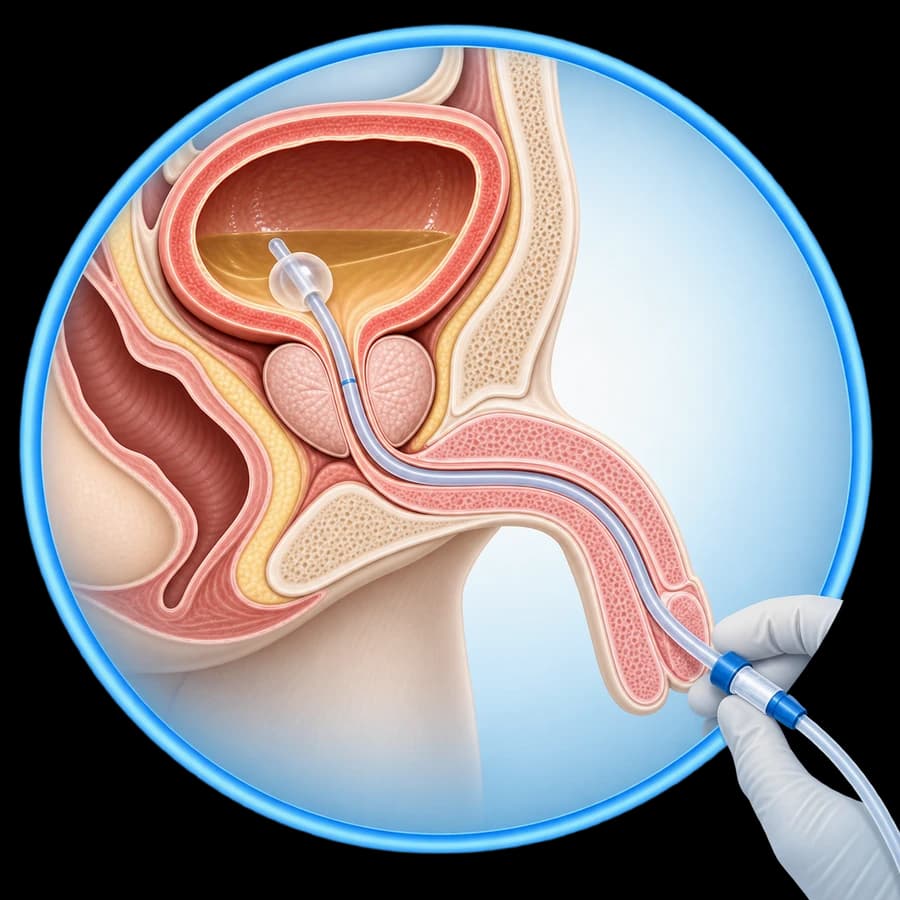
A urinary catheter is a thin, flexible tube inserted into the bladder to drain urine — either through the urethra (urethral/transurethral) or through a small opening in the lower abdominal wall (suprapubic). It is used when a patient cannot void spontaneously (acute retention), when accurate monitoring of urine output is needed, or for long-term bladder drainage in specific conditions.
Types of catheters
Foley catheter (urethral, indwelling)
The most widely used type. It has a retention balloon that is inflated inside the bladder so it does not fall out. Used in acute retention, after surgery, or to monitor urine output in critically ill patients.
Nelaton / Tiemann catheter (single-use)
No balloon. Inserted, empties the bladder, and is removed immediately. Used for one-off drainage or for clean intermittent self-catheterisation (CIC). The Tiemann has a curved tip, useful in difficult catheterisation due to an enlarged prostate.
Suprapubic catheter
Placed through a small opening in the lower abdominal wall, directly into the bladder, under ultrasound guidance. Preferred when urethral catheterisation is not feasible or safe (e.g. significant urethral stricture, suspected urethral trauma).
Clean Intermittent Self-Catheterisation (CIC)
The patient (or caregiver) regularly inserts a single-use catheter, empties the bladder, and removes it immediately — with no permanent tube in place. Generally regarded as preferable to a permanent catheter for long-term drainage needs, whenever the patient is able to perform it.
When a catheter is needed
Acute urinary retention
Sudden inability to void that requires immediate bladder drainage.
Postoperative monitoring
Accurate measurement of urine output after surgery or in critically ill patients.
Neurogenic bladder
Incomplete bladder emptying due to neurological injury — clean intermittent self-catheterisation is usually preferred over a permanent catheter.
Chronic urinary retention
Significant post-void residual volume with symptoms or a risk to the urinary tract.
Bladder irrigation
After endoscopic procedures (e.g. transurethral resection) to prevent obstruction from clots.
Urethral stricture or trauma
When urethral catheterisation is not feasible or safe — a suprapubic catheter is preferred.
Accuracy during urodynamic testing
Temporary placement during specialised diagnostic assessment.
Inability to control voiding in severely ill patients
In selected patients with severe disability or end-of-life care.
How a Foley catheter is placed
Insertion is performed under aseptic conditions:
In men: The urethra is significantly longer than in women, which can make the procedure more difficult, particularly in the presence of benign prostatic hyperplasia. If difficulty arises, the answer is never to push harder — see the next section.
Difficult catheterisation & safety
Catheterisation should never be forced. If resistance is met, the correct response is a change in technique (e.g. a coudé-tip catheter) by an experienced clinician, or referral to a urologist for endoscopic guidance — not repeated attempts with more pressure, which can cause serious injury to the urethra.
When blind urethral catheterisation should NOT be attempted:
- Recent pelvic trauma or perineal injury
- Blood at the urethral meatus
- Extensive scrotal or perineal haematoma
- A high-riding or non-palpable prostate on rectal examination after trauma
In these situations, immediate urological assessment is required before any attempt at catheterisation.
Suprapubic catheter
A suprapubic catheter is inserted percutaneously through a small opening in the suprapubic abdominal wall, directly into the bladder, under local anaesthesia and ultrasound guidance.
It is considered as an alternative to a urethral catheter in:
- Urethral stricture or suspected urethral trauma
- Inability to safely place a urethral catheter
- Long-term drainage needs when CIC is not feasible
- Procedures where the urethra needs to remain free
The insertion site needs daily cleaning. Showering is generally fine. Suprapubic catheter changes, like urethral ones, are not performed on a fixed “universal” schedule, but on an individualised basis.
Clean Intermittent Self-Catheterisation (CIC)
In clean intermittent self-catheterisation, the patient (or caregiver) regularly inserts a single-use catheter, fully empties the bladder, and removes it immediately — with no permanent tube left in place. The frequency is determined individually by the urologist based on bladder capacity and residual urine.
Single-use hydrophilic-coated catheters have a documented lower risk of urinary infection compared with standard PVC catheters in CIC, and are preferred where available.
CIC requires training, manual dexterity, and the cognitive ability of the patient (or an available caregiver) — so its suitability is assessed individually.
Home catheter care
Personal hygiene
Daily cleaning of the urethral area or the suprapubic insertion site with water and mild soap.
Closed drainage system
Keep the bag always below the level of the bladder to prevent reflux of urine. Do not disconnect the closed system without a reason — this significantly increases infection risk.
Hydration
Adequate fluid intake, unless otherwise restricted by your treating physician for a coexisting condition (e.g. heart or kidney failure).
Mobility
Normal movement is fine, taking care that the tube does not kink or become taut. Use a leg bag with a support strap.
Night bag
Connect to a larger-capacity night bag before sleep, with no need to wake up to empty it.
Bacteriuria vs. true infection (CAUTI)
This is perhaps the most misunderstood aspect of catheterisation. Almost all patients with a long-term catheter, sooner or later, develop catheter-associated asymptomatic bacteriuria — that is, bacteria present in the urine culture with no symptoms at all. According to the European Association of Urology (EAU) Guidelines on Urological Infections, this condition should not be actively looked for with routine cultures, nor treated with antibiotics, except in specific situations (such as before invasive procedures that breach the mucosa, e.g. transurethral resection of the prostate).
In contrast, a genuine catheter-associated urinary tract infection (CAUTI) is defined by the presence of symptoms — fever, chills, malaise, flank pain, or a change in mental status in older patients — together with a positive culture. Only then is antibiotic treatment justified.
Important: According to EAU guidance, the presence or absence of cloudy or malodorous urine alone should not be used to distinguish bacteriuria from a genuine infection — nor should the presence of white blood cells in the urine (pyuria) on its own. The overall clinical picture determines the need for treatment.
Possible complications
Catheter-associated urinary tract infection (CAUTI)
Risk increases with the duration the catheter remains in place. Duration is the most important risk factor — which is why a catheter should stay in for the minimum time necessary.
Bladder spasm
A feeling of urgency around the catheter, often due to irritation from the balloon or catheter tip.
Catheter blockage ("bypass")
Due to a clot, sediment, or kinking of the tube — needs assessment, not simply a larger balloon.
Urethral injury
Due to forceful or repeated insertion attempts — which is why force is never used (see difficult catheterisation section).
Encrustation of the lumen
Salt crystallisation, more common in patients with urease-producing bacteria — requires individualised monitoring and replacement when needed, not a fixed universal schedule.
Catheter removal & trial without catheter (TWOC)
Once the cause of acute retention has been stabilised, the catheter is removed in a planned way — known as a trial without catheter (TWOC) — with monitoring to see whether the patient can void spontaneously.
In men with acute retention due to benign prostatic hyperplasia, giving an alpha-blocker before the TWOC improves the chance of successful spontaneous voiding, according to EAU guidance. If the TWOC fails, catheter reinsertion and further investigation of the underlying cause are considered (e.g. prostate size, detrusor muscle function).
When to contact us urgently
Contact us immediately if you notice:
- Fever, chills, or significant malaise — a possible sign of true catheter-associated infection (CAUTI)
- Significant bleeding in the urine or catheter (beyond mild initial pink discolouration)
- No urine flow from the catheter for several hours
- Persistent leakage around the catheter ("bypass")
- Severe abdominal pain or bladder spasm that does not settle
- Inability to void spontaneously after catheter removal
- Redness, swelling, or discharge at a suprapubic catheter insertion site
- Blood at the urethral meatus or a history of recent pelvic trauma before any attempt at catheterisation
The patient journey
Acute event or indication
Inability to void, a postoperative need, or investigation of an underlying condition.
Catheter placement
Selection of the appropriate type (Foley, suprapubic, or CIC) based on the clinical picture.
Stabilisation & care
Proper care, minimum necessary duration, avoidance of unnecessary antibiotics.
Investigation of the underlying cause
Assessment of the prostate, urethra, and bladder function — so the catheter does not remain a "solution" without reason.
Removal or definitive treatment
TWOC with or without an alpha-blocker, or planning of definitive surgery/treatment for the underlying cause.
Frequently asked questions (FAQ)
What is a urinary catheter and when is it needed?
A urinary catheter is a thin tube placed into the bladder to drain urine when normal voiding is not possible or not sufficient — most commonly in acute urinary retention, after surgery, or for accurate monitoring of urine output. It is not a definitive treatment; it is a bridge until the underlying cause is addressed.
Does a long-term catheter need to be changed on a fixed schedule?
There is no single universal “correct” interval that applies to every patient. The right interval depends on the catheter material (silicone versus latex), the manufacturer’s guidance, the individual patient’s tendency to develop encrustation, and the overall clinical picture — it is decided case by case by the urologist, not by a fixed number of weeks. EAU guidance explicitly notes that long-term indwelling catheters should not be changed on a routine, one-size-fits-all schedule.
Does every positive urine culture in a catheterised patient mean antibiotics are needed?
No. Almost all patients with a long-term catheter eventually develop catheter-associated asymptomatic bacteriuria — bacteria in the urine with no symptoms at all. According to the EAU Guidelines on Urological Infections, this should not be treated with antibiotics, as doing so increases resistance without any real benefit. Treatment is only warranted for genuine catheter-associated urinary tract infection (CAUTI) — that is, when symptoms such as fever, chills, or flank pain accompany a positive culture.
Does cloudy or smelly urine mean there is an infection?
Not necessarily. According to EAU guidance, the presence or absence of cloudy or malodorous urine alone should not be used to distinguish simple bacteriuria from a genuine infection. What matters is the presence of systemic symptoms (fever, chills, malaise) or new localised symptoms after the catheter is removed.
Which type of catheter carries the lowest infection risk — urethral, suprapubic, or self-catheterisation (CIC)?
For short-term use, there is no strong evidence that a suprapubic catheter clearly causes fewer infections than a urethral one — the data are mixed. However, suprapubic catheters are associated with fewer urethral complications. For long-term drainage needs, clean intermittent self-catheterisation (CIC) is generally regarded as preferable to a permanent indwelling catheter whenever the patient is able to perform it.
Is catheter insertion painful?
A local anaesthetic gel is applied before insertion, so the procedure should not be intensely painful — some temporary discomfort is possible, particularly in men due to the longer urethra. Significant pain during insertion is a sign to stop and reassess the technique, not to push through.
What happens if the catheter does not pass easily during insertion?
Force should never be used. Difficulty passing a catheter can be due to a urethral stricture, an enlarged prostate, or sphincter spasm. In that case, an experienced clinician should try an alternative technique (e.g. a coudé-tip catheter) or refer to a urologist for endoscopic guidance or a suprapubic catheter — never repeated forceful attempts.
When should urethral trauma be suspected, and when should blind urethral catheterisation be avoided?
In a patient with recent pelvic trauma or perineal injury, blood at the urethral meatus, extensive scrotal or perineal haematoma, or an unusually positioned prostate on rectal examination are warning signs of possible urethral injury. In these situations, blind urethral catheterisation should not be attempted; immediate urological assessment is required.
What is a trial without catheter (TWOC) after acute urinary retention?
A trial without catheter (TWOC) is a planned catheter removal with monitoring to see whether the patient can void spontaneously. In men with acute retention due to benign prostatic hyperplasia, giving an alpha-blocker before the TWOC improves the chances of successful spontaneous voiding, according to EAU guidance.
Is preventive antibiotic treatment needed every time a catheter is inserted or removed?
No, not as a general rule. EAU guidelines do not recommend routine antibiotic prophylaxis for every catheter insertion, removal, or exchange, nor for clean intermittent self-catheterisation, because this increases the risk of resistant organisms without a consistent benefit. Exceptions exist for specific situations before invasive urological procedures that breach the mucosa.
How do I care for the catheter and drainage bag at home?
Daily hygiene of the area with water and mild soap, keeping the bag always below the level of the bladder to prevent reflux, adequate fluid intake unless restricted for another medical reason, and avoiding disconnecting the closed system unnecessarily — a closed drainage system significantly reduces infection risk.
Which catheters reduce infection risk in self-catheterisation?
Single-use hydrophilic-coated catheters have a documented lower risk of urinary infection compared with standard PVC catheters in clean intermittent self-catheterisation, according to EAU guidance, and are recommended where available.
Does a catheter permanently solve urinary retention?
No. A catheter drains the bladder temporarily but does not treat the underlying cause of retention (e.g. benign prostatic hyperplasia, urethral stricture, neurogenic bladder, or impaired detrusor contractility). Once the patient is stable, the underlying cause should be fully investigated so that a definitive treatment can be considered.
Can I shower or bathe with a catheter?
Yes, showering is generally fine with both urethral and suprapubic catheters. With a suprapubic catheter, the insertion site should be dried thoroughly afterwards.
What does "bypass" leakage around the catheter mean?
This is urine leaking around the catheter, usually due to bladder spasm, blockage of the lumen by a clot or sediment, or a disproportionately large retention balloon. It requires urological assessment — it is not simply managed by using a larger balloon, which can make the problem worse.
Related Topics
Book Your Appointment in Rhodes
If you need catheter placement, suprapubic catheter replacement, training in clean intermittent self-catheterisation, or investigation of the underlying cause of urinary retention, we are here to provide individualised guidance.
References
- EAU Guidelines on Urological Infections 2026 — Catheter-associated UTI, Section 3.8 — uroweb.org
- EAU Guidelines on Management of Non-neurogenic Male LUTS 2026 — Acute urinary retention and alpha-blockers prior to TWOC — uroweb.org
- EAU Guidelines on Non-neurogenic Male LUTS 2026 — Underactive bladder and intermittent catheterisation, Section 5.7 — uroweb.org
- CDC Guideline for Prevention of Catheter-Associated Urinary Tract Infections — cdc.gov
Medical Review

Dr. Marinos Vasilas, Urologist – Andrologist
Dr. Marinos Vasilas provides comprehensive management of urinary retention and bladder catheterisation — from the initial placement and CIC training to the investigation and treatment of the underlying cause.
View full profileThis article is for informational purposes only and does not replace medical advice, diagnosis, or treatment. Always consult your urologist for individualised management of your case.