My Clinical Approach
Urethral stricture is treated correctly only when the treatment is matched to the specific stricture — not the other way around. Before recommending any procedure, I need answers to two questions: exactly where is the stricture and how long is it, and what has this patient already had done.
This page explains the condition, the modern diagnostic pathway, and the logic behind treatment selection. Technical details of each procedure (endoscopic incision, Optilume) are described in full on their dedicated procedure pages.
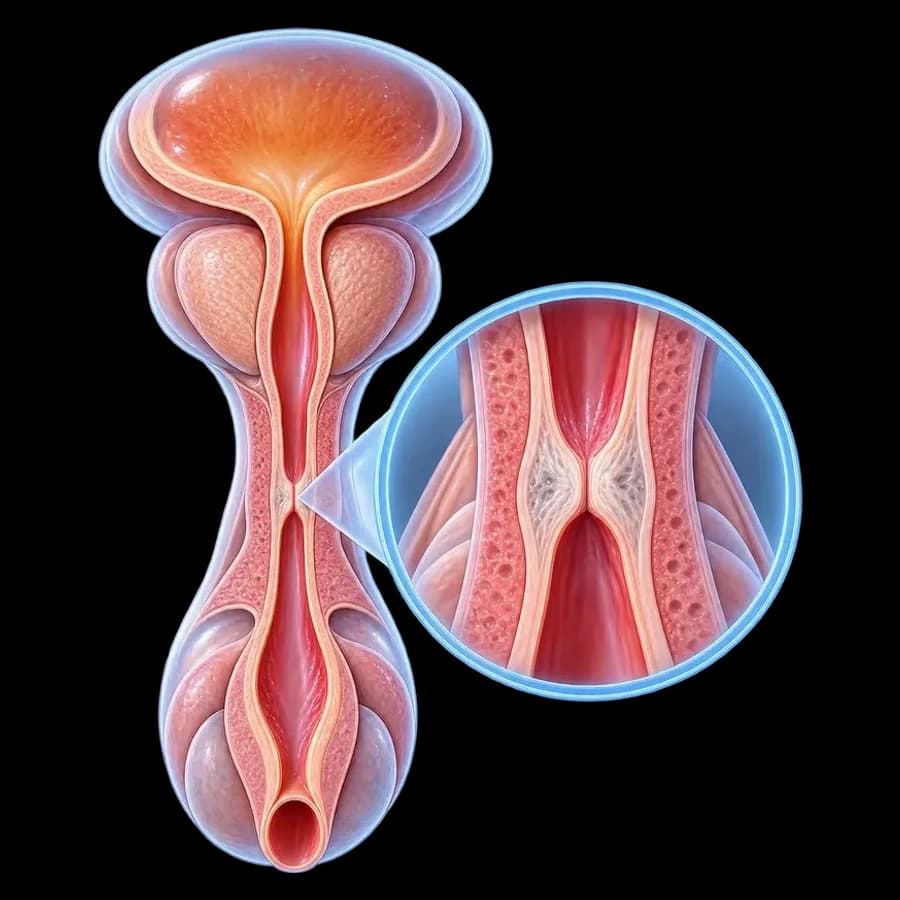
What is Urethral Stricture
In the anterior male urethra (penile, bulbar, fossa navicularis), the lumen is surrounded by spongy erectile tissue. When this tissue is injured or inflamed, it is replaced by scar fibrosis — spongiofibrosis — which narrows the lumen and impedes flow. The precise term for this condition is “stricture”.
In the posterior urethra (membranous segment) there is no spongy tissue around the lumen, so the mechanism of narrowing is different (usually post-traumatic or post-surgical scarring without spongiofibrosis). That is why the posterior urethra is described using the term “stenosis” rather than stricture — the distinction is not semantic, it reflects different pathophysiology and treatment strategy.
Location Matters
The location of the stricture largely determines which treatments are reasonably suitable:
- Penile urethra: thinner spongy tissue, higher recurrence risk after endoscopic incision; urethroplasty is usually the preferred route.
- Bulbar urethra: thicker spongy tissue — the only location where a first DVIU has a reasonable indication for a short, single stricture.
- Membranous/posterior urethra: different mechanism (stenosis), often post-traumatic or post-surgical, requiring a separate approach.
- Multiple or panurethral strictures: fundamentally change the plan, usually toward complex urethroplasty.
Stricture, Stenosis, Bladder Neck & VUAS
Anterior male urethral stricture must be clearly distinguished from other conditions that appear clinically similar but are different entities:
- Bladder neck stenosis: scarring at the bladder outlet, often after TURP — not a urethral stricture.
- Vesicourethral anastomotic stenosis (VUAS): narrowing at the anastomosis after radical prostatectomy — a separate entity with its own treatment algorithm.
- Urethral spasm/dysfunctional sphincter: functional, not anatomical narrowing — does not improve with dilation or incision.
Confusing these entities with a “simple” urethral stricture leads to the wrong treatment choice — which is why anatomical confirmation before any decision is essential.
Causes
Causes vary and more than one often coexist in the same patient. There is no single fixed distribution of causes that applies precisely to every population — the main categories are:
- Iatrogenic: prolonged or repeated catheterisation, endoscopic procedures (TURP, TURBT, ureteroscopy), previous pelvic radiotherapy.
- Inflammatory/dermatological causes: lichen sclerosus (see dedicated section below), previous urethritis from a sexually transmitted infection.
- Traumatic: pelvic fracture with injury to the posterior urethra, straddle injury to the bulbar urethra.
- Idiopathic: no identifiable cause despite investigation — a real, not rare, category.
Lichen Sclerosus
Lichen sclerosus is an inflammatory skin condition affecting the glans, foreskin, and often the meatal/penile urethra, causing progressive fibrosis.
It has particular surgical relevance: in strictures associated with lichen sclerosus, genital skin graft is not the preferred reconstructive tissue, since the disease itself can also affect the transplanted tissue. Buccal mucosa graft is preferred, as it is tissue unaffected by the disease.
Trauma
Traumatic stricture varies significantly by mechanism: a straddle injury (a fall with impact to the perineum, e.g. cycling) typically affects the bulbar urethra with a localised area of fibrosis, while a pelvic fracture with injury to the membranous urethra often causes complete disruption with a gap between the ends — an entirely different surgical challenge from a “simple” stricture, requiring specialised reconstruction.
Symptoms
- Weak, split, or spraying urinary stream.
- Hesitancy, need for abdominal straining to void.
- Prolonged voiding time, sensation of incomplete emptying.
- Post-void dribbling.
- Frequency, nocturia.
- Recurrent urinary tract infections or epididymitis/prostatitis.
- In advanced disease: complete inability to void (acute retention).
These symptoms are non-specific and overlap significantly with benign prostatic hyperplasia — hence the separate section on differential diagnosis that follows.
Stricture or Prostate?
In a man over 50-55 with obstructive symptoms, benign prostatic hyperplasia is statistically more common, but the clinical picture alone is not enough to distinguish them. Findings that raise suspicion of urethral stricture rather than a prostatic cause include prior catheterisation, endoscopic procedure, perineal or pelvic trauma, or a history of urethritis.
The distinction has practical consequences: medication for the prostate will not improve a mechanical stricture, while a prostate procedure (e.g. TURP) in a patient with an undiagnosed stricture can worsen it or create a new one.
The Diagnostic Approach
Diagnosis proceeds in stages: first functional assessment (how difficult voiding is), then anatomical assessment (exactly where and how long the stricture is), and finally, when needed, direct visual confirmation. No single test alone gives a complete picture — it is the combination that guides treatment.
Uroflowmetry & Residual Urine
Uroflowmetry is usually the first step: it records urine flow and may show a characteristic “plateau” curve (flat rather than bell-shaped) that raises suspicion of stricture. Post-void residual (PVR) is also recorded by ultrasound.
Importantly, uroflowmetry raises suspicion, it does not confirm the diagnosis and does not show location or length. A normal result in a patient with strong clinical suspicion does not always exclude a stricture, while an abnormal result does not automatically mean stricture — it can also result from prostatic causes or bladder dysfunction.
Urethrography (RUG/VCUG)
Retrograde urethrography (RUG) is the core anatomical test: contrast is injected through the urethra under fluoroscopy, precisely mapping the location, length, and number of strictures. In select cases it is combined with a voiding cystourethrogram (VCUG), particularly for posterior strictures or to assess bladder emptying.
This mapping is essential before any treatment decision — it determines whether a stricture is technically suitable for endoscopic incision or requires reconstruction.
Cystoscopy
Flexible cystoscopy allows direct visual confirmation of the stricture and assessment of the surrounding tissue quality. It is used to complement imaging, especially when the patency beyond the stricture needs assessment or coexisting bladder pathology needs to be excluded.
Sonourethrography & MRI
In select cases, ultrasound urethrography (sonourethrography) can define the depth of spongiofibrosis around the lumen, aiding preoperative reconstruction planning. Pelvic MRI is mainly used for complex post-traumatic or post-surgical (after radical prostatectomy) posterior urethral stenoses, to assess the distance and anatomy around the sphincter.
Urodynamic Testing
In patients where the clinical picture is unclear — particularly when there is suspicion of coexisting bladder or sphincter dysfunction — urodynamic testing helps distinguish mechanical obstruction from functional causes that do not respond to dilation or incision.
The Principle of Treatment
There is no single treatment suitable for every urethral stricture. The choice depends on location, length, cause, number of prior interventions, and patient preference. As a general principle:
- First, short, bulbar stricture → endoscopic incision has a reasonable role as a first step.
- Recurrence after endoscopic treatment → repeating the same approach has diminishing returns; Optilume (in the suitable subgroup) or urethroplasty are considered.
- Penile, long, or multiple strictures → urethroplasty is usually the appropriate route from the outset, not after failed endoscopic attempts.
Dilation & DVIU
Simple dilation (mechanical widening of the lumen with appropriate instruments, without incision) offers only transient relief and carries a high recurrence rate — it is not a definitive treatment at any location.
Direct Vision Internal Urethrotomy (DVIU) is incision of the stricture under direct vision, with cold knife or laser. Its appropriate indication is limited to: a first, single, short (<2cm), non-obliterative bulbar stricture, or a selected short recurrence after prior bulbar urethroplasty. It is not indicated as first-line treatment for penile strictures or strictures >2cm, where the failure rate is significantly higher. Full details of technique, recovery, and outcomes are described on the procedure page.
Why Not Endless Repetition
Every endoscopic incision or dilation creates new tissue injury, which heals with new fibrosis. Repeating more than two endoscopic treatments, when urethroplasty is technically feasible, does not offer cumulative benefit — on the contrary, it tends to lengthen and thicken the stricture, making future reconstruction more complex. The decision to “try one more time” should be a conscious one, not a default.
Optilume® – Drug-Coated Balloon
Optilume® combines mechanical dilation with local delivery of paclitaxel (an anti-fibrotic agent) via a coated balloon, aiming to reduce re-scarring after dilation.
Based on the ROBUST trial data and current guidance, the strongest documented indication applies to: a recurrent, short (<3cm) bulbar stricture, after at least two failed prior endoscopic treatments, in patients not fit for or unwilling to undergo urethroplasty. It is not a “definitive treatment” or “permanent cure” in the absolute sense — it reduces the need for a further endoscopic procedure in this specific subgroup compared with repeat dilation alone, but the possibility of recurrence remains.
Important pre-procedure information: paclitaxel carries a documented need for counselling on intercourse/semen and contraception for the period defined by current guidelines and the manufacturer’s instructions for use — this discussion is individualised at the consultation, not covered by general statements.
Urethroplasty
Urethroplasty is not a single technique but a family of reconstructive procedures, chosen according to the location, length, and cause of the stricture:
- Excision and primary anastomosis (EPA): removal of the strictured segment and direct suturing of the healthy ends. Suitable mainly for short (<2-2.5cm) bulbar strictures.
- Non-transecting techniques: avoid full division of the urethra, aiming to preserve blood supply and reduce the risk of erectile dysfunction in selected patients.
- Buccal mucosa graft (BMG): for longer strictures (>2-2.5cm) or when tension-free anastomosis is not feasible. Buccal mucosa is preferred for its resistance to a moist environment and ease of harvest, regardless of whether it is placed dorsally or ventrally, which is decided intraoperatively.
No technique is entirely free of recurrence risk. Urethroplasty generally offers the most durable long-term patency for appropriately selected disease, but success depends largely on selecting the right technique for each case, not a single “universal” method.
Penile & Long Strictures
Penile strictures (often associated with lichen sclerosus or prior circumcision/poor healing) and long or panurethral strictures have significantly lower success rates with endoscopic incision and should not be managed with repeated DVIU. The appropriate approach is usually reconstructive from the outset, using buccal mucosa graft, often in one or two stages depending on local tissue quality.
Urethral Stricture in Women
Urethral stricture in women is rare due to the short urethral anatomy, but real — usually following pelvic surgery, radiotherapy, or chronic catheterisation. It presents with weak stream, frequency, incomplete emptying, or recurrent infections — symptoms easily misattributed to other gynaecological or urological causes. The diagnostic and treatment approach differs from the male disease due to the different anatomy, and the same male length/location criteria should not be applied directly.
Retention & Difficult Catheterisation
In a patient with known or suspected urethral stricture presenting with acute urinary retention, blind catheterisation attempts can be difficult or risky — force applied at the wrong point can create a false passage. In such cases, catheterisation under endoscopic guidance is preferred or, when not feasible, temporary suprapubic drainage until definitive treatment is planned.
Sexual Function & Quality of Life
The impact on sexual function depends on the technique and location, not simply on the fact that a procedure was performed. Modern tissue-preserving techniques aim to reduce the risk of erectile dysfunction, but every urethral procedure is discussed individually regarding expected risks — without generalising for or against a specific technique without individual assessment.
Follow-up After Treatment
There is no single fixed follow-up schedule that applies equally to every patient — it depends on the technique performed and individual recurrence risk. Generally it includes:
- Recording symptoms and urinary flow at regular intervals after the procedure.
- Uroflowmetry as a monitoring tool — not the sole criterion of success.
- Re-evaluation with anatomical assessment (cystoscopy or imaging) when there is clinical suspicion of recurrence, regardless of a specific Qmax value.
- Longer follow-up in patients with a history of multiple procedures or lichen sclerosus, where recurrence risk is higher.
Common Misconceptions
“A low Qmax always means a stricture”
Not always. Low flow can result from prostatic causes or bladder dysfunction — anatomical confirmation is needed.
“Endoscopic incision is always the first choice”
Only for a specific subgroup (first, short, bulbar stricture). At other locations or lengths, repeating it delays the definitive solution.
“Optilume replaces urethroplasty”
No. It addresses a specific clinical picture (recurrent short bulbar stricture after failed endoscopic treatment), not every stricture.
“Urethroplasty is a single operation”
It is a family of techniques chosen individually — there is no single “standard” urethroplasty for everyone.
The Patient Journey
- 1Initial assessment: history, symptoms, uroflowmetry and post-void residual.
- 2Anatomical mapping: urethrography (RUG/VCUG) and, when needed, cystoscopy.
- 3Discussing options: explaining the realistic indications and limits of each treatment — not just the “most popular” one.
- 4Procedure: choosing the appropriate technique (DVIU, Optilume, or urethroplasty) based on location, length, and history.
- 5Follow-up: an individualised monitoring schedule based on recurrence risk.
DVIU vs Optilume vs Urethroplasty
| Criterion | DVIU | Optilume® | Urethroplasty |
|---|---|---|---|
| Indication | First, short, bulbar stricture | Recurrence after ≥2 endoscopic treatments, short bulbar | Penile, long, multiple, or recurrent complex stricture |
| Invasiveness | Minimally invasive | Minimally invasive | Open reconstructive procedure |
| Nature | Often a temporary solution | Reduces need for reintervention in selected patients | Aims for the most durable long-term solution |
Frequently Asked Questions about Urethral Stricture
What is a urethral stricture?
It is a scar narrowing of the urethral lumen that restricts urine flow. In the anterior (male) urethra it results from fibrosis of the surrounding spongy tissue (spongiofibrosis) — the correct term is “stricture”. In the posterior urethra, which has no spongy tissue, the term “stenosis” is preferred.
What is the difference between stricture and stenosis?
Stricture refers mainly to the anterior male urethra with spongiofibrosis. Stenosis is used for the posterior urethra, the bladder neck, and the anastomosis after radical prostatectomy — conditions with different pathophysiology and treatment logic, not the same entity.
What are the symptoms?
Weak or split stream, hesitancy, prolonged voiding, sensation of incomplete emptying, post-void dribbling, frequency, recurrent infections, or in severe disease, urinary retention. Symptoms are non-specific and can mimic prostatic disease.
Is uroflowmetry enough for diagnosis?
No. A low maximum flow (Qmax) or a plateau curve raise suspicion but do not prove a stricture or show its location. Anatomical mapping with urethrography and/or endoscopy is needed before treatment is planned.
What is DVIU and when is it indicated?
Endoscopic incision (cold knife or laser) under direct vision. It has a role mainly in a first, single, short (<2cm), non-obliterative bulbar stricture, or in a selected short recurrence after prior bulbar urethroplasty. It is not indicated for penile or long strictures.
Why shouldn’t endoscopic treatment be repeated indefinitely?
Each new endoscopic intervention creates new fibrosis. Repeated (>2) DVIU/dilations, when urethroplasty is feasible, increase stricture complexity and delay definitive treatment without matching benefit.
What is Optilume?
A balloon coated with paclitaxel, applied after mechanical dilation to reduce re-scarring. Its strongest evidence applies to a recurrent, short (<3cm) bulbar stricture after at least two failed endoscopic treatments, in patients not fit for or unwilling to undergo urethroplasty.
Is Optilume a definitive cure?
Not in the absolute sense. It reduces the likelihood of a further endoscopic procedure in selected patients compared with repeat dilation/DVIU alone, but recurrence remains possible and it does not replace urethroplasty as the more durable option for suitable recurrent or complex strictures.
What is the difference between Optilume and urethroplasty?
They are not interchangeable for the same patient population. Optilume targets a specific subgroup (short recurrent bulbar stricture after failed endoscopic treatment). Urethroplasty remains the main reconstructive option for longer, penile, complex, or multiply recurrent strictures.
What is urethroplasty?
It is not a single operation but a family of reconstructive techniques (excision with anastomosis, buccal mucosa graft, tissue-preserving techniques) chosen according to location, length, cause, and tissue quality.
Can a stricture recur after urethroplasty?
Yes, no technique guarantees zero recurrence. Urethroplasty generally offers the most durable long-term patency for appropriately selected disease, but follow-up is still required.
Does urethral stricture occur in women?
It is rare but real. It presents with weak stream, frequency, incomplete emptying, or recurrent infections. Diagnosis and treatment differ from the male disease and the same anatomical criteria do not apply directly.
How is follow-up done after treatment?
There is no single fixed schedule for everyone. Follow-up is individualised based on recurrence risk and includes symptoms, flow, and, when needed, anatomical assessment — not a single Qmax value alone.
Conclusion
Urethral stricture is treated correctly only with an individualised approach: anatomical confirmation before any decision, realistic use of endoscopic incision and Optilume in the appropriate subgroups, and urethroplasty where it offers the most durable long-term solution.
Scientific References
- EAU Guidelines on Urethral Strictures — uroweb.org
- Wessells H et al. Male Urethral Stricture: AUA Guideline. J Urol 2017;197:182-190.
- Mundy AR, Andrich DE. Urethral strictures. BJU Int 2011;107:6-26.
- Elliott SP et al. The ROBUST I & ROBUST III trials of the Optilume® drug-coated balloon for recurrent anterior urethral stricture. J Urol 2022;207:866-875.
- Barbagli G, Lazzeri M. Surgical treatment of lichen sclerosus urethral stricture: buccal mucosa vs genital skin grafts. Eur Urol 2013.
Meet the Doctor

Dr. Marinos Vasilas, Urological Surgeon – Andrologist
Specialising in urethral strictures: Optilume® drug-coated balloon, internal urethrotomy and buccal mucosa graft urethroplasty.
Read full profile


