1. My Clinical Approach to HoLEP
HoLEP is one of the most technically demanding endoscopic procedures in urology for benign prostatic hyperplasia. Its learning curve is longer than other BPH techniques, as it requires specialised training in anatomical enucleation — the experience of the surgeon and the centre matters for the outcome.
In practice, I always:
- Rule out prostate cancer before any procedure for BPH.
- Explain clearly what is, and is not, removed with HoLEP.
- Provide clear information about the possibility of retrograde ejaculation before the procedure.
- Individualise the comparison with other techniques (TURP/TURiS, Aquablation, Rezūm) depending on the case.
2. What Is HoLEP
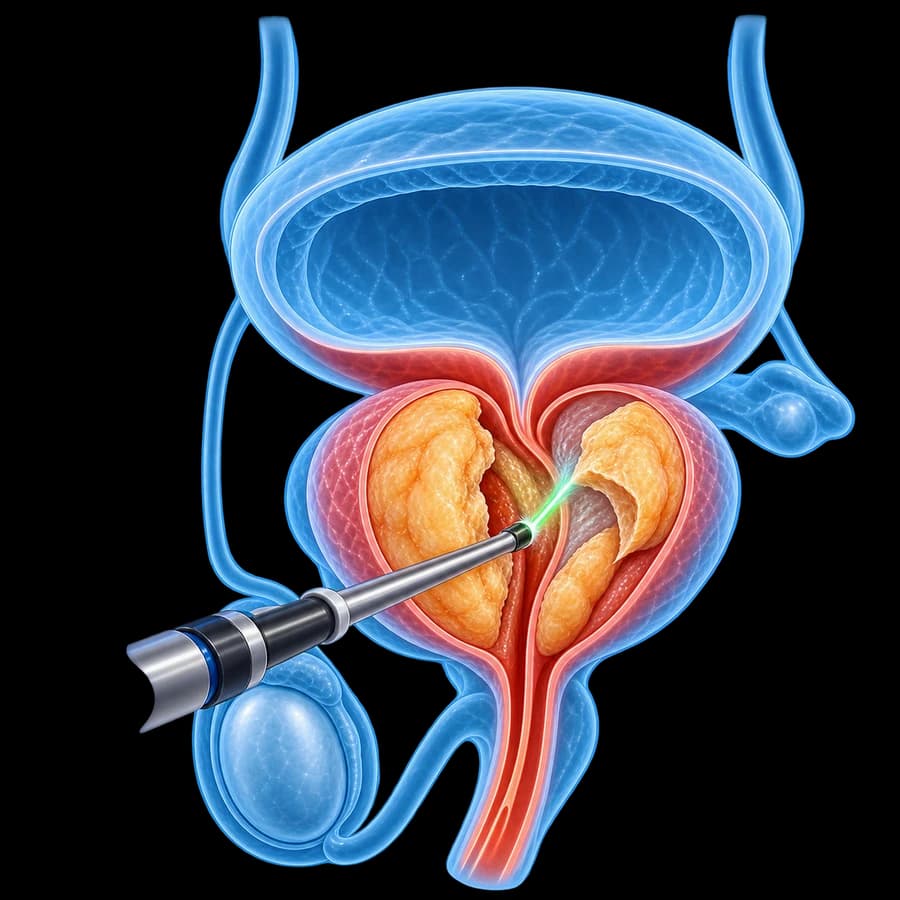
HoLEP (Holmium Laser Enucleation of the Prostate) is the endoscopic, transurethral enucleation of the adenoma tissue of the prostate that causes obstruction due to benign prostatic hyperplasia, using a Holmium laser.
The key difference from transurethral resection (as in TURP/TURiS) is that in enucleation, the surgeon separates and removes the adenoma by following the natural anatomical plane of the surgical capsule, rather than removing tissue piece by piece through sequential resection. The enucleated tissue is then moved into the bladder and fragmented (morcellation) for removal.
HoLEP is a technically demanding procedure. The experience of the surgeon and the surgical centre with anatomical enucleation affects the outcome — the learning curve is considered longer compared to some other BPH techniques.
3. What Is Removed — Not a Radical Prostatectomy
HoLEP does not remove the entire prostate.
The inner, hyperplastic/adenomatous tissue causing the obstruction is removed. The peripheral portion of the gland and the surgical capsule remain in place.
This is fundamentally different from radical prostatectomy (robotic or laparoscopic), which removes the entire prostate and seminal vesicles as a treatment for prostate cancer. HoLEP is not a treatment for prostate cancer.
4. How the Procedure Works
Endoscopic Access
The endoscope is introduced through the urethra.
Identification of Anatomy
The bladder neck, prostate lobes, and verumontanum are assessed.
Enucleation
The Holmium laser is used to separate the adenoma from the surgical capsule, following the anatomical plane.
Haemostasis
The laser is also used to control bleeding during the enucleation.
Morcellation
The enucleated tissue is moved into the bladder and fragmented with a specialised device (morcellator).
Tissue Removal
The fragmented tissue is removed and can be sent for pathological examination.
Catheter
A temporary urinary catheter is placed at the end of the procedure.
The Holmium Laser
The Holmium:YAG laser is widely used in urology, both in HoLEP and in the treatment of urinary tract stones, with different settings and applications in each case. It has a limited depth of tissue penetration and offers a combination of cutting and haemostasis, characteristics that make it suitable for anatomical enucleation of the prostate.
5. Which Patients HoLEP Is Suitable For
HoLEP is not suitable for every patient. It is mainly considered for men with significant lower urinary tract symptoms (LUTS) due to BPH, such as:
Weak urine stream
Difficulty starting urination
Intermittent stream
Sensation of incomplete emptying
Large residual urine
Recurrent urinary retention
Recurrent urinary infections related to obstruction, in the appropriate context
Bladder stones combined with obstruction, where relevant
Failure or insufficient tolerance of medical therapy
6. HoLEP and a Large Prostate
One of the important characteristics of HoLEP is that it is considered, in several guidelines and expert recommendations, a treatment option that is not significantly limited by prostate size. The technique has been used even in very large prostates.
There is no arbitrary upper size limit above which HoLEP cannot be performed. However, surgical complexity is not the same at every prostate size — larger glands usually require longer operative time and greater surgeon experience.
HoLEP and the Median Lobe
An obstructing median lobe can be addressed with HoLEP, as the technique is adapted to each patient’s anatomy. There is no single mandatory anatomical enucleation technique for every case — the surgeon selects the approach depending on anatomical findings.
7. HoLEP and Urinary Retention
In patients with a permanent catheter, recurrent urinary retention, or a large residual, HoLEP can be a suitable surgical option when the obstruction is due to BPH.
The final success of independent urination after removing the obstruction also depends on the functionality of the bladder itself — HoLEP cannot promise a catheter-free outcome for every patient.
8. Pre-operative Evaluation
Pre-operative evaluation follows the same pattern as other BPH procedures, individualised per patient — not every test is necessary for every case:
Medical history
IPSS
Uroflowmetry
Post-void residual measurement
PSA
Digital rectal examination
Ultrasound / prostate volume
Urinalysis / urine culture
Kidney function testing
Complete blood count
Review of anticoagulant/antiplatelet medication
Flexible cystoscopy, where indicated
Urodynamic study, only in selected cases
9. Anaesthesia, Catheter, and Hospital Stay
Anaesthesia
HoLEP is performed in a surgical setting under suitable anaesthesia — general or regional/spinal, depending on the patient, the anaesthetic assessment, and the centre’s protocol.
How Long Does the Catheter Stay In After HoLEP?
The urinary catheter is used temporarily. Its duration depends on prostate size, hematuria, haemostasis, the post-operative course, and the surgical centre’s protocol.
Hospital Stay
Hospital stay is usually relatively short, but depends on age, coexisting conditions, gland size, bleeding, urinary function, and the surgical centre’s protocol.
10. Recovery and When Urination Improves
Possible early discomforts after HoLEP include:
Hematuria
Dysuria
Urgency
Frequent urination
Small clots
Temporary urine leakage in some patients
There may be fluctuations in hematuria during healing. Many patients notice significant improvement in urine flow after catheter removal, but the bladder may need time to adjust, and urgency/frequency may temporarily persist. The final improvement also depends on pre-existing bladder function.
Only general recovery principles are given here, not a rigid schedule — the exact course is determined by the surgeon and the centre’s protocol.
11. Histology and Prostate Cancer
The tissue removed with HoLEP can be sent for pathological examination — an important difference from some other minimally invasive BPH treatments. This examination does not replace a pre-operative cancer assessment when there is a relevant suspicion, and incidental prostate cancer can rarely be detected in some specimens.
HoLEP Is a Procedure for BPH, Not a Treatment for Prostate Cancer
If there is elevated PSA, a suspicious digital rectal exam, or a suspicious MRI, appropriate evaluation must be performed before the procedure, depending on the case.
12. Does HoLEP Affect Ejaculation and Erectile Function?
Ejaculation
Retrograde ejaculation, or the absence of external ejaculation, is common after HoLEP. We do not hide this fact.
- Libido is usually not directly affected.
- Erection is a different function from ejaculation.
- The change in ejaculation is particularly important for younger patients or those concerned about fertility.
Erectile Function
Most data do not show significant long-term worsening of erectile function in the majority of men, though there is no absolute guarantee. Age, vascular profile, diabetes, and pre-existing erectile function affect the outcome.
13. HoLEP and Urinary Continence
It is important to distinguish between:
Temporary stress incontinence
Urgency / urge leakage
Permanent incontinence
- Temporary urine leakage can occur in some patients.
- It usually improves over time.
- Pelvic floor exercises may be used according to the surgeon’s guidance.
- Permanent incontinence is much less common.
14. Bleeding and Anticoagulant Therapy
HoLEP offers good haemostasis due to the properties of the laser, and in several comparisons has a favourable bleeding profile. However, hematuria can occur, clots may appear, and rarely additional intervention or transfusion may be needed.
HoLEP is often considered an attractive option for patients at increased bleeding risk compared with some other procedures. This does not mean it can always be performed without stopping anticoagulant therapy — individualised coordination with a cardiologist, haematologist, or anaesthesiologist is required where needed.
15. Long-term Results and Retreatment
HoLEP has a large body of long-term literature, with follow-up studies over several years showing durable improvement of urinary symptoms.
Might Surgery Be Needed Again After HoLEP?
Because a large portion of the obstructing adenoma is removed, retreatment rates are generally low — but not zero. In a small proportion of patients, urethral stricture, bladder neck contracture, or new obstruction can occur over time.
16. HoLEP vs TURP/TURiS vs Aquablation
The choice between HoLEP, Aquablation, TURP, and other techniques depends on prostate size and anatomy, bladder function, coexisting conditions, and patient priorities. No technique is a universal winner.
| Feature | HoLEP | TURP/TURiS | Aquablation |
|---|---|---|---|
| Mechanism | Laser enucleation of the adenoma | Piece-by-piece tissue resection | Controlled water jet, image-guided planning |
| Prostate size | Not significantly limited by size | Usually smaller to medium prostates | Depending on anatomy |
| Thermal energy | Yes (laser) | Yes | Not in the main tissue-removal stage |
| Bleeding | Usually low | Variable | Often low in suitable candidates |
| Catheter | Temporary | Temporary | Temporary |
| Hospital stay | Usually short | Usually short | Usually short |
| Ejaculation | Often retrograde ejaculation | Often retrograde ejaculation | Often preserved in suitable candidates |
| Long-term evidence | Extensive literature, many years of follow-up | Extensive, historically established technique | Newer technology, growing evidence |
| Learning curve | Demanding, longer than some other techniques | Established, widely taught | Standardised image-guided planning |
This table is indicative and does not constitute an individualised medical recommendation.
Aquablation17. HoLEP vs Adenomectomy, Rezūm, and UroLift
HoLEP vs Adenomectomy
HoLEP has reduced the need for open/simple adenomectomy in many centres, due to its transurethral approach, lower invasiveness, and the ability to treat large glands. Laparoscopic, robotic, or open simple prostatectomy still has a place in selected cases.
HoLEP vs Rezūm
Rezūm is a minimally invasive treatment using thermal energy from water vapor, leading to gradual tissue shrinkage, with a different patient profile. HoLEP directly removes a large volume of adenoma in a surgical setting, with a different recovery and sexual-function profile.
HoLEP vs UroLift
UroLift does not remove tissue — it mechanically lifts the prostate lobes. HoLEP removes the obstructing adenoma. These are very different indications and durability profiles.
Dedicated English-language pages are available for TURiS, Rezūm, and laparoscopic adenomectomy. A dedicated English-language page for TURP is not yet available — see the Greek-language page, or contact our practice for details.
18. The Patient Journey
19. The Doctor

Dr. Marinos Vasilas, Urologist – Andrologist
Dr. Marinos Vasilas specialises in endourology and minimally invasive techniques for the treatment of benign prostatic hyperplasia, following the guidelines of the European Association of Urology (EAU).
Meet the Doctor20. Frequently Asked Questions (FAQ)
What is HoLEP?
It is the endoscopic enucleation of the obstructing adenoma tissue of the prostate caused by benign prostatic hyperplasia, using a Holmium laser, through the urethra and without an external surgical incision.
Is the whole prostate removed?
No. The inner, adenomatous tissue causing the obstruction is removed. The peripheral portion and the surgical capsule of the prostate remain. HoLEP is not a radical prostatectomy.
Is HoLEP suitable for a large prostate?
Yes, HoLEP is considered in several guidelines and expert recommendations to be one of the few endoscopic techniques that is not significantly limited by prostate size, and it has been used even in very large glands. Final suitability is always individualised.
What is the difference between HoLEP and TURP?
TURP/TURiS removes the obstructing tissue piece by piece (resection), while HoLEP enucleates the entire adenoma along the anatomical plane of the surgical capsule before it is fragmented with a morcellator. Both are endoscopic, without an external incision.
HoLEP or Aquablation?
Both are modern techniques for treating BPH, with a different mechanism of action. The choice depends on prostate size and anatomy, available technology, and patient priorities — neither is universally better.
Does HoLEP affect ejaculation?
Yes, retrograde ejaculation or absence of external ejaculation is common after HoLEP. Libido is usually not directly affected. This is particularly important for younger patients or those concerned about fertility.
Does it affect erectile function?
Most data do not show significant long-term worsening of erectile function in the majority of men, though there is no absolute guarantee. Age, vascular profile, diabetes, and baseline erectile function affect the outcome.
Is there incontinence after HoLEP?
Temporary urine leakage (stress or urgency) may occur in some patients and usually improves over time, helped by pelvic floor exercises. Permanent incontinence is much less common.
How long does the catheter stay in?
The catheter is used temporarily. Its exact duration depends on prostate size, hematuria, hemostasis, the post-operative course, and the surgical centre’s protocol.
When can I return to activities?
Return to daily activities happens gradually, depending on the type of activity and the overall course of recovery — determined individually by the surgeon.
Might I need surgery again?
Because a large portion of the obstructing adenoma is removed, retreatment rates are generally low, but not zero. Rarely, urethral stricture, bladder neck contracture, or new obstruction can occur.
Is the tissue examined histologically?
Yes, the tissue removed with HoLEP is sent for pathological examination. This does not replace a pre-operative cancer assessment when there is a suspicion, but incidental prostate cancer can rarely be detected in some specimens.
Related Topics
Book a Consultation in Rhodes
Significant BPH, a large prostate, a permanent catheter, recurrent retention, or insufficient response to medication? The choice between HoLEP, Aquablation, TURP, and other techniques depends on prostate size and anatomy, bladder function, coexisting conditions, and your priorities — discuss your options at our practice in Rhodes.
References & Sources
- EAU Guidelines on the Management of Non-neurogenic Male LUTS. European Association of Urology — uroweb.org
- AUA Guideline on the Surgical Management of Lower Urinary Tract Symptoms/Benign Prostatic Hyperplasia (BPH). American Urological Association — auanet.org
- International Continence Society (ICS): Standardisation of Terminology of Lower Urinary Tract Function — ics.org
The content on this page is for informational purposes only and does not replace an individualised urological evaluation. HoLEP is not suitable for every patient — the choice of procedure depends on anatomy, prostate volume, bladder function, coexisting conditions, and patient priorities. Medically reviewed by Dr. Marinos Vasilas.


