My Clinical Approach
The main goal in kidney cancer surgery is not to remove as much tissue as possible, but to achieve safe oncological control while preserving kidney function where this is feasible.
Before we even consider the approach (robotic, laparoscopic, or open), the first question is always: can the kidney tumour be safely removed while preserving the kidney? Only when the answer is no do we discuss radical nephrectomy.
- I do not recommend radical nephrectomy only because a tumour exceeds a particular size.
- I always consider first whether partial nephrectomy is technically and oncologically feasible.
- I do not remove the adrenal gland or lymph nodes routinely without a specific indication.
- I explain clearly that the robotic approach does not change the biology of the cancer.
- I do not promise zero risk of dialysis or recurrence.
What Is Radical Nephrectomy
Radical nephrectomy involves:
- Removal of the affected kidney.
- Removal of perinephric tissue according to oncological anatomy.
- Management of the renal vessels.
- Removal of other structures only when there is a specific clinical indication.
Radical nephrectomy does not automatically mean ipsilateral adrenalectomy, extensive lymph-node dissection, or ureterectomy in every case.
Radical Nephrectomy ≠ Nephroureterectomy
Radical nephrectomy
Mainly concerns a renal parenchymal tumour (renal cell carcinoma — RCC).
Radical nephroureterectomy
Mainly concerns upper tract urothelial carcinoma (UTUC) and follows a different surgical logic.
These should not be confused — RCC and renal pelvis urothelial carcinoma are different diseases.
When Is Radical Nephrectomy Needed
May be considered when:
- The tumour is too large/complex for safe partial nephrectomy.
- Tumour location makes nephron-sparing surgery technically unsuitable.
- There is locally advanced disease requiring removal of the whole kidney.
- The kidney has very poor function in context.
- Oncological clearance cannot reasonably be achieved with partial nephrectomy.
- Selected recurrent/complex tumours.
We do not use a rule of “above X cm = radical nephrectomy”. The decision is always made in the context of the overall clinical picture, according to current guidance.
Partial or Radical Nephrectomy?
| Partial Nephrectomy | Radical Nephrectomy | |
|---|---|---|
| What is removed | Tumour + small margin of kidney | The entire affected kidney |
| Preservation of kidney function | Greater | Lesser |
| Technical complexity | Often greater | Different |
| Suitable for | Selected localised tumours | Tumours where partial is not suitable |
| Oncological goal | Complete tumour removal | Complete removal of affected kidney/tumour |
We do not present either option as universally “better” — the appropriate choice is individualised per tumour and patient. For full information on nephron-sparing surgery, see the page robotic partial nephrectomy.
Partial Nephrectomy Is Considered First When Feasible
In localised kidney tumours, particularly when it is technically and oncologically feasible, nephron-sparing surgery should be considered before deciding on radical nephrectomy.
We do not use oversimplifications such as “below 4 cm always partial” or “above 4 cm always radical”. The EAU systematically reviews partial nephrectomy evidence (including the influence of centre volume/ experience) — current recommendations are individualised per patient and tumour.
T1 / T2 – Beyond Size
Treatment choice is not based on tumour diameter alone. The following are considered:
- Tumour size.
- Location.
- Depth.
- Hilar involvement.
- Anatomical complexity.
- Kidney function.
- Contralateral kidney.
- Comorbidities.
- Surgeon expertise.
There is no rigid “stage → specific operation” algorithm.
Nephrometry Scores (RENAL / PADUA)
Tools such as RENAL nephrometry and PADUA can be used to assess the anatomical complexity of a kidney tumour.
They help with surgical planning and communicating complexity, but do not by themselves decide whether partial or radical nephrectomy will be performed.
Central/Hilar Tumour
A central/hilar tumour (near the renal hilum) may increase technical complexity and proximity to vessels/collecting system.
This does not automatically mean partial nephrectomy is impossible.
The decision depends on surgeon expertise and anatomy.
Solitary Kidney
In a patient with a solitary kidney, chronic kidney disease, or bilateral tumours, preservation of nephron mass has particular importance.
Partial nephrectomy should be considered where oncologically/technically appropriate. Radical nephrectomy is not absolutely excluded in these patients if partial is not feasible.
Chronic Kidney Disease
Removal of an entire kidney can reduce total GFR and increase the risk of chronic kidney disease (CKD), particularly in patients with pre-existing CKD, diabetes, hypertension, vascular disease, or older age.
Preoperative renal assessment is important.
How Kidney Function Is Checked
May include:
- Serum creatinine.
- eGFR.
- Urinalysis/proteinuria.
- Selected split renal function imaging when needed.
Serum creatinine alone is not a complete renal assessment.
Is a Biopsy Needed Before Nephrectomy?
Not in every case.
Renal mass biopsy has an important role in selected patients, especially when:
- Pathology may change treatment.
- Active surveillance is being considered.
- Ablation is planned.
- Systemic treatment is contemplated.
- Imaging diagnosis is uncertain.
In a highly suspicious, resectable renal mass where surgery is clearly indicated, biopsy may not always be required before surgery.
CT / MRI
Contrast-enhanced multiphasic CT or MRI can assess tumour size, location, enhancement, the renal vein, the inferior vena cava, lymph nodes, the adrenal region, the contralateral kidney, and, depending on staging, distant disease.
We do not present one imaging modality as mandatory for every patient.
Tumour in the Renal Vein or Inferior Vena Cava
RCC can, in selected cases, extend as a venous tumour thrombus — different from ordinary deep vein blood clot disease.
This significantly changes:
- Operative complexity.
- Surgical planning.
- Multidisciplinary team requirements.
Standard robotic radical nephrectomy should not be presented as equivalent to complex IVC thrombectomy. Robotic management may be possible only in carefully selected cases and highly experienced centres. Open/combined approaches remain important.
Metastatic RCC & Cytoreductive Nephrectomy
Radical nephrectomy in metastatic disease:
- Is not automatically indicated for everyone.
- May have a role as cytoreductive nephrectomy in selected patients.
- Timing relative to systemic therapy matters.
Cytoreductive nephrectomy is not a routine treatment — the decision is made in a multidisciplinary setting, according to current EAU/ESMO guidance.
Small Renal Mass
A small kidney tumour does not automatically mean radical nephrectomy.
Options in selected patients can include:
- Partial nephrectomy.
- Active surveillance.
- Ablation.
depending on the tumour, age, comorbidity, kidney function, and patient preference. See also renal oncocytoma and renal angiomyolipoma for benign lesions that can mimic RCC on imaging.
Active Surveillance & Ablation
Selected small renal masses, particularly in patients with advanced age, significant comorbidity, or limited competing life expectancy, may be suitable for active surveillance.
Cryoablation or thermal ablation (radiofrequency/microwave) may be an option in selected renal masses. No alternative is presented as equivalent to surgery for every patient — we do not give universal tumour-growth thresholds without current verification.
What Robotic Nephrectomy Means
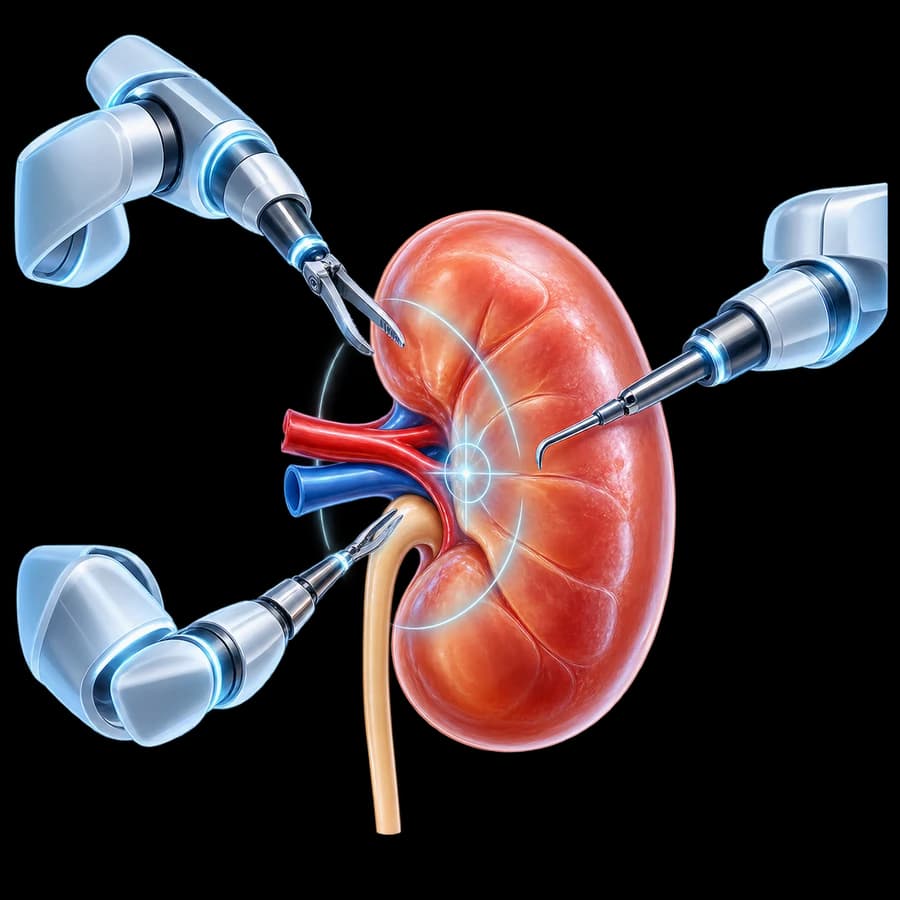
The surgeon sits at the console and controls articulated instruments, with a camera offering a magnified 3D view.
The robot does not operate autonomously. Every movement of the robotic system is controlled by the surgeon.
Why Do It Robotically
Potential technical features:
- Magnified 3D view.
- Wristed instruments.
- Fine dissection.
- Better ergonomics.
- Minimally invasive access.
For standard radical nephrectomy, robotic technology should not be presented as oncologically superior to a properly performed laparoscopic or open procedure.
Robotic vs Laparoscopic
| Robotic | Laparoscopic | |
|---|---|---|
| Minimally invasive | Yes | Yes |
| Camera | Magnified 3D | Depends on the system |
| Instrument articulation | High | Standard laparoscopic |
| Surgeon experience | Critical | Critical |
| Radical nephrectomy feasibility | Yes | Yes |
| Oncological goal | Same | Same |
| Recovery | Often broadly comparable | Often broadly comparable |
In simple radical nephrectomy, the robot’s greater technological sophistication does not necessarily mean a significant clinical advantage. See the page 3D laparoscopic nephrectomy for full information on the laparoscopic technique.
Robotic vs Open
Robotic / minimally invasive
Appropriate for many selected localised tumours.
Open
May be required/preferred with extensive local invasion, a very large/complex mass, a major venous thrombus, need for multivisceral resection, or other anatomical/oncological considerations.
We do not characterise open surgery as outdated.
Where Robotic Technology Adds the Most Value
The greatest value of robotic technology in kidney surgery often relates to the technically demanding partial nephrectomy more than to simple removal of the entire kidney.
This does not undervalue robotic radical nephrectomy as an option — it simply reflects where articulated precision and suturing under ischaemia carry the greatest technical significance.
How the Procedure Is Performed
This description is deliberately kept at a general level — it is not a surgical manual with vessel-control sequence, port coordinates, or device details.
Transperitoneal vs Retroperitoneal Approach
Approach selection can depend on:
- Tumour location.
- Previous abdominal surgery.
- Surgeon experience.
- Anatomy.
- Size.
- Need for other concurrent procedures.
Neither approach is presented as universally better.
Is the Adrenal Gland Always Removed?
No.
Routine ipsilateral adrenalectomy is not required when:
- The adrenal gland is radiologically normal.
- There is no direct tumour involvement/suspicion.
according to current RCC guidance. Adrenalectomy may be indicated with direct invasion, a suspicious adrenal lesion, or another specific oncological reason.
Are Lymph Nodes Always Removed?
No.
Routine extended lymph-node dissection in organ-confined, clinically node-negative RCC has not shown universal therapeutic benefit.
Suspicious/enlarged nodes may be removed for staging, local control, or appropriate oncological management, according to current guidance. Not every radical nephrectomy includes lymphadenectomy.
What Happens to the Ureter
In RCC radical nephrectomy, the ureter is not normally removed en bloc down to the bladder as in nephroureterectomy. Only the necessary ureteral segment/ structures are managed according to the surgery — this helps distinguish RCC from UTUC.
Specimen Removal
The kidney/tumour is removed in an appropriate specimen bag; the incision may need modest enlargement for intact removal.
Especially in malignant disease: preserving specimen integrity and avoiding tumour rupture/spillage are important. Routine morcellation is not suggested for a suspected malignant renal tumour.
This is not “scarless” surgery.
Preoperative Assessment
- Staging imaging.
- Kidney function.
- Contralateral kidney.
- Full blood count.
- Biochemical profile.
- Urinalysis as appropriate.
- Medication review.
- Anticoagulants/antiplatelets.
- Anaesthetic review.
- Comorbidities.
- Cardiovascular risk.
- Previous abdominal operations.
The patient must not stop anticoagulants or antiplatelets on their own.
Management depends on the specific drug, indication, thrombotic risk, bleeding risk, and the perioperative plan.
Anaesthesia
Robotic nephrectomy is performed under general anaesthesia. It is not an office/day-clinic procedure.
How Long Does the Procedure Take
There is no universal duration. It depends on tumour size/location, obesity, prior surgery, adhesions, vascular anatomy, tumour thrombus, lymph-node/adrenal involvement, and team experience.
Hospital Stay
Length of stay is variable. We do not promise next-day discharge or a fixed number of days without an actual centre protocol/current evidence.
Recovery
Covers mobilisation, oral intake, analgesia, wound care, kidney-function monitoring, return to work, driving, and exercise.
We prefer recovery-based advice over rigid dates.
Recovery Timeline
Immediate postoperative phase
Monitoring, mobilisation, pain control, urine output, creatinine/eGFR.
Early home recovery
Incision healing, progressive walking/activity, fatigue may occur.
Pathology review
Tumour type, stage, grade, margins.
Longer term
Renal-function monitoring and oncological surveillance.
No arbitrary fixed dates.
Can I Live With One Kidney?
Most patients with a normally functioning contralateral kidney can live with one kidney.
What matters:
- Blood pressure.
- Kidney function.
- Diabetes control.
- Avoidance of unnecessary nephrotoxicity.
- Long-term medical follow-up.
We do not promise normal kidney function for everyone. Long-term diet depends on kidney function — strict protein/salt/potassium restrictions are not necessary for everyone. If CKD develops, advice should be individualised.
Kidney Function (GFR) After Nephrectomy
Removal of one kidney reduces total nephron mass. The remaining kidney may undergo compensatory adaptation.
Final eGFR depends on baseline function, the contralateral kidney, age, diabetes, hypertension, vascular disease, and pre-existing CKD.
Might I Need Dialysis?
Usually not when the other kidney functions satisfactorily.
The risk can be higher with advanced baseline CKD, a solitary/poorly functioning contralateral kidney, or significant comorbidity. This is why preoperative renal assessment is important. We do not give an absolute guarantee.
Possible Complications
Bleeding
Uncommon but significant, due to proximity to major vessels.
Transfusion
Rare, depending on the course.
Vascular injury
Rare, serious complication.
Injury to adjacent organs
Bowel, spleen, liver, pancreas, depending on side — rare.
Infection
Requires assessment and targeted treatment.
Thromboembolic events
Rare, depending on risk factors.
Respiratory/anaesthetic complications
Rare, depending on the patient.
Conversion to open surgery
A safety decision, see the relevant section.
Postoperative renal impairment
Monitored with creatinine/eGFR.
Hernia/wound problem
Rare with a minimally invasive approach.
Lymphatic complications
If nodal surgery is added.
Rare adjacent-organ injury
Depends on anatomy and side.
We do not use unsourced incidence percentages. We do not promise “bloodless surgery” or zero risk of transfusion.
Conversion to Open Surgery
Conversion to open surgery is a safety decision, not a failure.
It may be necessary due to bleeding, unexpected anatomy, invasion, adhesions, oncological concerns, or patient safety.
What Does the Histology Show
The final specimen can establish tumour type, RCC subtype, grade where applicable, tumour size, pathological stage, margins, venous invasion, and lymph-node findings if sampled, using current WHO terminology.
Common RCC subtypes include clear-cell, papillary, and chromophobe RCC, as well as other less common renal tumours. Grade does not equal stage.
Some radiologically suspicious renal masses prove benign after removal — for example, oncocytoma or fat-poor angiomyolipoma.
This does not mean imaging is generally unreliable.
Adjuvant Therapy After Nephrectomy
In selected high-risk clear-cell RCC after nephrectomy, current adjuvant systemic therapy may be considered, according to the latest risk criteria/approval status and current EAU/ESMO/NCCN guidance. The decision is made in consultation with an oncologist, individualised per patient.
Follow-Up After Nephrectomy
Follow-up is risk-adapted and depends on pathology, stage, grade, subtype, margins, kidney function, and comorbidity. It may include clinical review, creatinine/eGFR, blood pressure, and chest/abdominal imaging according to oncological risk.
Renal follow-up
Kidney function, proteinuria where relevant, blood pressure, cardiovascular risk factors — selected patients may need nephrology input.
Oncological follow-up
Depends on recurrence risk. The same surveillance protocol is not used for low-risk pT1 and high-risk locally advanced RCC.
There is no universal CT schedule for everyone.
Recurrence, Metastasis & Prognosis
Nephrectomy does not eliminate all risk of recurrence. Outcome depends on tumour stage, biology, histology, grade, venous/nodal involvement, and metastatic status.
We avoid generic cure percentages. Prognosis is determined primarily by pathological stage, grade, subtype, and nodal/metastatic disease — not simply by whether surgery was robotic.
Robotic Surgery Does Not Improve Tumour Biology
Robotic technology changes how the surgery is accessed, not the biology of the cancer.
Oncological quality depends on correct indication, complete surgery, tumour stage, surgical expertise, and appropriate multidisciplinary care.
The Patient Journey
Key Questions in Plain Language
I Have a Kidney Tumour – Does the Whole Kidney Need to Be Removed?
Not necessarily. First it is assessed whether partial nephrectomy can achieve safe tumour removal while preserving kidney tissue.
When Is Radical Nephrectomy Preferred?
Depending on tumour anatomy, complexity, oncological extent, kidney function, and the feasibility of partial surgery — not size alone.
Robotic or Laparoscopic?
Both can offer minimally invasive radical nephrectomy. For straightforward radical nephrectomy, team experience and correct patient selection are often more important than the platform.
Can I Live With One Kidney?
Usually yes, provided the remaining kidney is healthy. Kidney function monitoring is needed.
Will I Need Dialysis?
Usually not with satisfactory function of the contralateral kidney, but the risk must be individually assessed.
Is the Adrenal Gland Removed Too?
Not routinely. Only if indicated by tumour location/involvement or suspicious adrenal findings.
Are Lymph Nodes Removed?
Not in every clinically node-negative localised kidney cancer. Suspicious nodes may be removed according to oncological context.
Do I Need a Biopsy Before Surgery?
Not always. Biopsy is particularly useful when it can change management.
Frequently Asked Questions (FAQ)
What is robotic radical nephrectomy?
It is the surgical removal of the entire affected kidney, together with the perinephric fat and any related anatomical structures required by the oncological extent, using a robotic minimally invasive approach.
Does every kidney tumour need to be removed with the whole kidney?
No. When technically feasible and oncologically safe, partial nephrectomy has an important role because it preserves more functioning kidney tissue.
What is the difference between partial and radical nephrectomy?
Partial nephrectomy removes the tumour with a small margin of healthy kidney, preserving the remaining tissue. Radical nephrectomy removes the entire kidney. The choice depends on anatomy, complexity, kidney function, and team experience — not size alone.
When is partial nephrectomy preferred?
In localised kidney tumours, particularly when it is technically and oncologically feasible, nephron-sparing surgery should be considered before deciding on radical nephrectomy.
When is radical nephrectomy needed?
When the tumour is too large/complex for safe partial nephrectomy, its location makes nephron-sparing surgery technically unsuitable, there is locally advanced disease, or oncological clearance cannot reasonably be achieved with partial nephrectomy.
Does tumour size alone determine the decision?
No. Size, location, depth, hilar involvement, complexity, kidney function, the contralateral kidney, comorbidities, and surgeon expertise are all taken into account.
Is a biopsy needed before surgery?
Not always. Renal mass biopsy has an important role in selected patients, particularly when it could change management, active surveillance or ablation is being considered, or the imaging diagnosis is uncertain.
Robotic or laparoscopic nephrectomy?
Both can offer minimally invasive radical nephrectomy. For straightforward radical nephrectomy, team experience and correct patient selection are often more important than the platform.
When is open surgery needed?
With extensive local invasion, a very large/complex tumour, a significant venous thrombus, or need for multivisceral resection, the open approach may be necessary or preferred.
Does the robot operate on its own?
No. Every movement of the robotic system is controlled by the surgeon from the console throughout the entire procedure.
Is the adrenal gland always removed?
No. Routine ipsilateral adrenalectomy is not required when the adrenal gland is radiologically normal and there is no direct tumour involvement/suspicion.
Are lymph nodes always removed?
No. Routine extended lymph-node dissection in organ-confined, clinically node-negative kidney cancer has not shown a universal therapeutic benefit. Suspicious/enlarged nodes may be removed for staging or local control.
What happens if the tumour reaches the renal vein/IVC?
RCC can, in selected cases, extend as a venous tumour thrombus. This significantly changes operative complexity and surgical planning, and may require specialised, multidisciplinary management — it is not equivalent to a standard robotic radical nephrectomy.
How long is the hospital stay?
It is variable, depending on complexity, kidney function, any complications, and the recovery course.
When can I return to work?
It depends on the type of work, healing course, and the surgery performed. Desk-based work usually allows a faster return than manual work.
Can I live with one kidney?
Most patients with a normally functioning contralateral kidney can live with one kidney. Long-term medical follow-up of blood pressure and kidney function is important.
Does kidney function decline afterwards?
Removal of one kidney reduces total nephron mass. The remaining kidney may undergo compensatory adaptation, but the final eGFR depends on baseline function, the contralateral kidney, age, diabetes, hypertension, and vascular disease.
Might I need dialysis?
Usually not, when the other kidney functions satisfactorily. The risk can be higher with advanced pre-existing chronic kidney disease, a solitary/poorly functioning contralateral kidney, or significant comorbidity.
What are the possible complications?
These include bleeding, transfusion, vascular injury, injury to adjacent organs, infection, thromboembolic events, respiratory/anaesthetic complications, conversion to open surgery, postoperative renal impairment, and wound hernia.
What does the histology show?
It establishes tumour type, RCC subtype, grade where applicable, tumour size, pathological stage, margins, venous invasion, and lymph-node findings if sampled.
Is treatment needed after surgery?
In selected high-risk clear-cell RCC, current adjuvant systemic therapy may be considered, according to the latest guideline and approval criteria.
What follow-up is needed?
It depends on pathology, stage, grade, subtype, margins, kidney function, and comorbidity. There is no single universal CT schedule for everyone.
Related Topics
Evaluation for Robotic Radical Nephrectomy in Rhodes
The key question before a radical nephrectomy is not only whether the procedure can be done robotically, but whether it is truly necessary to remove the entire kidney. Tumour anatomy, oncological extent, and the function of both kidneys should be assessed before choosing partial or radical nephrectomy and the appropriate surgical approach.
Scientific References
- Ljungberg B, et al. European Association of Urology Guidelines on Renal Cell Carcinoma. Eur Urol. 2022;82(4):399–410.
- Marconi L, Kuusk T, Hora M, et al. Hospital Volume as a Determinant of Outcomes After Partial Nephrectomy: A Systematic Review by the EAU Renal Cell Carcinoma Guidelines Panel. Eur Urol Oncol. 2025;8(3):616–622.
- Choueiri TK, et al. Adjuvant Pembrolizumab after Nephrectomy in Renal-Cell Carcinoma (KEYNOTE-564). N Engl J Med. 2021;385(8):683–694.
- Choueiri TK, et al. Overall Survival with Adjuvant Pembrolizumab in Renal-Cell Carcinoma. N Engl J Med. 2024;390(15):1359–1371.
Meet the Doctor

Dr. Marinos Vasilas, Urologist – Andrologist
Dr. Marinos Vasilas specialises in robotic and 3D laparoscopic urological oncology, with emphasis on clearly informing every patient about the choice between partial and radical nephrectomy and the real approach options available.
Full ProfileSurgical Team
Robotic nephrectomy is performed in collaboration with a specialised surgical centre and urology team, ensuring access to modern robotic infrastructure.
Meet Our TeamThe content on this page is informational and does not replace individualised urological/oncological assessment. Renal mass treatment is individualised. Tumour size alone does not determine surgery. The feasibility of partial nephrectomy requires specialist evaluation. Kidney function must be assessed before radical nephrectomy. Complex venous tumour thrombus requires specialised planning. Follow-up depends on final pathology.


