Minimally Invasive Urological Surgery
Robotic & 3D Laparoscopic Surgery
Advanced minimally invasive urological procedures using robotic systems — including the Da Vinci X and Edge Medical platforms — and three-dimensional laparoscopic systems, in collaboration with a specialised surgical team and the infrastructure of LEFKOS STAVROS – The Athens Clinic in Athens.
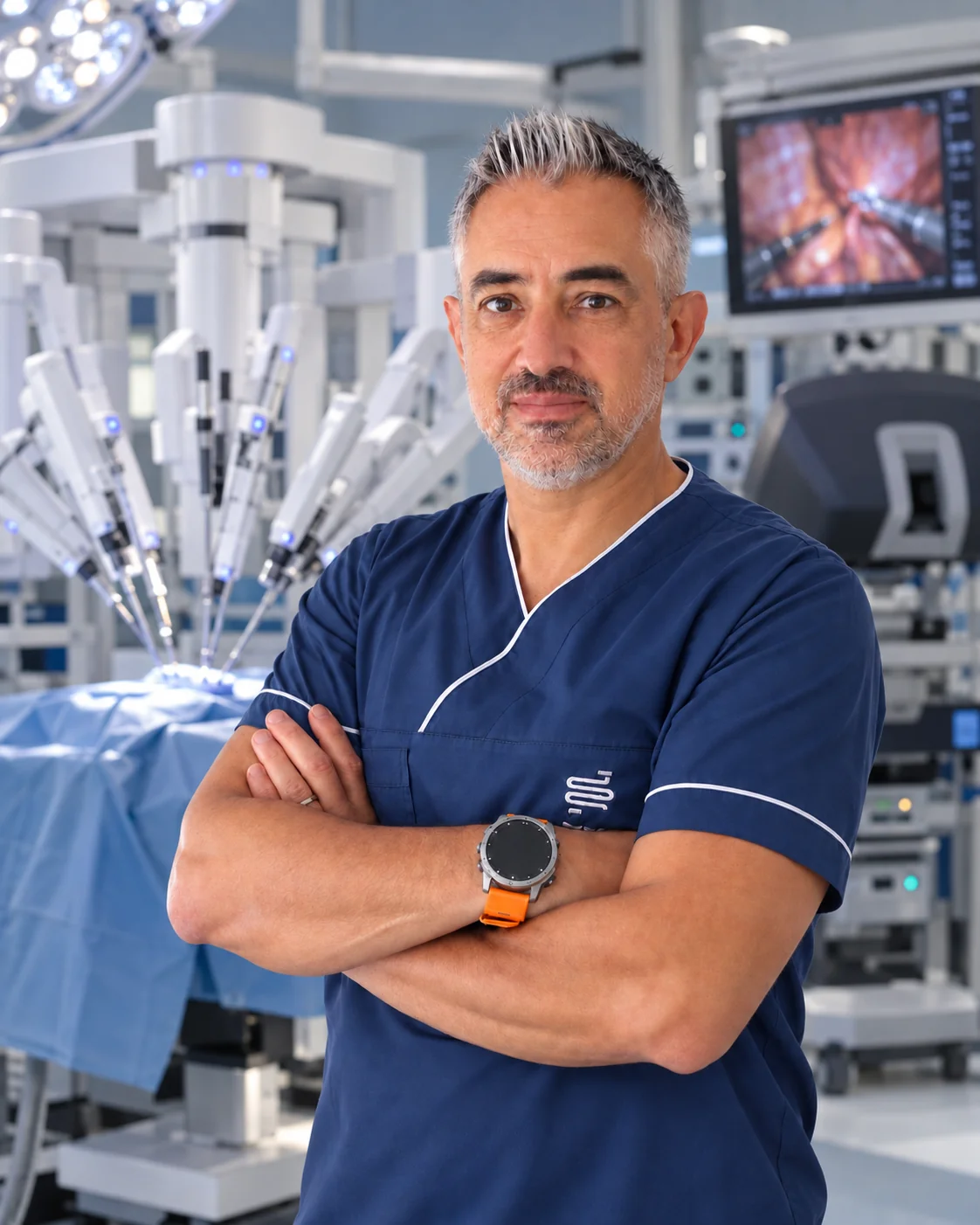
Surgical Treatment in Athens
Initial assessment and diagnostic planning can take place in Rhodes. When a specific minimally invasive surgical treatment is indicated, the procedure is organised at LEFKOS STAVROS – The Athens Clinic in Athens, home to a specialised Urology Centre and Centre of Robotic Excellence.
The choice of technique — robotic, 3D laparoscopic, or another approach — is individualised according to the condition, the patient's anatomy and their specific characteristics.
Available Technology
Da Vinci X
4th-Generation Robotic System
Edge Medical
Multi-Port Robotic System
3D/4K Imaging
Laparoscopic Technology
Learn More: Our Technology Pages
Each technology now has its own dedicated page with details on equipment, applications and frequently asked questions.

Da Vinci X – 4th-Generation Robotic Surgery
The 4th-generation Da Vinci X robotic system is installed in the operating theatres of LEFKOS STAVROS – The Athens Clinic. It provides three-dimensional, high-definition visualisation of the surgical field, with magnification of up to 15 times.
The robotic arms feature an articulated design (7 directions of movement, 540-degree range) that mimics the movement of the human wrist, offering greater flexibility and stability compared with conventional surgery.
The surgeon controls the system in real time from a dedicated console, without direct contact with the patient.
- 3D visualisation with up to 15x magnification
- Articulated arms with 7 directions of movement
- Surgeon console with full real-time control
- Minimally invasive access through small incisions
The da Vinci system does not operate autonomously. Every movement of the instruments is controlled in real time by the surgeon.
Edge Medical – Multi-Port Robotic System
The Edge robotic system is installed at LEFKOS STAVROS – The Athens Clinic and has been used in urological procedures, representing an additional modern robotic platform available at the clinic's Urology Centre.
- Multi-port robotic platform
- Master–slave surgeon-controlled movement
- Applied in minimally invasive urological procedures

Edge Medical Applications in Urology
Robotic Radical Prostatectomy
Minimally invasive treatment of localised prostate cancer.
Robotic Partial Nephrectomy
Removal of a kidney tumour with preservation of healthy kidney tissue, where feasible.
Robotic Pyeloplasty
Reconstructive treatment of ureteropelvic junction (UPJ) obstruction.
In 2026, LEFKOS STAVROS – The Athens Clinic performed Greece's first robotic telesurgery procedure (radical prostatectomy) using the Edge system. The operating surgeon was Professor of Urology and Head of our Urology Team, Prof. Evangelos Liatsikos, who controlled the system remotely from Wuhan, China — a technological milestone for international robotic surgery and telemedicine.
This was a demonstration of telesurgery capability, not a routine service offered to every patient. The fact that the system has been used for telesurgery does not mean that every RhodosUrology procedure is performed remotely.
Da Vinci X & Edge Medical
Both platforms are surgeon-controlled, multi-port robotic surgical systems.
| Da Vinci X | Edge Medical | |
|---|---|---|
| System type | Multi-port robotic surgical platform | Multi-port robotic surgical platform |
| Surgeon control | Yes | Yes |
| Minimally invasive | Yes | Yes |
| 3D visualisation | According to verified platform specification | According to verified platform specification |
| Urological use at Lefkos Stavros | Yes | Yes |
| Telesurgery capability/use | Not claimed unless specifically verified | Demonstrated in a 2026 telesurgery case |
Clinical outcomes depend primarily on the operation, indication, anatomy, surgeon/team experience and appropriate patient selection — not simply on the commercial name of the robotic platform.

3D / 4K Laparoscopic Imaging
The Laparoscopic Urology Unit at LEFKOS STAVROS is equipped with modern three-dimensional (3D) imaging technology displayed on ultra-high-definition (4K) screens.
3D visualisation restores the depth perception provided by natural vision, which conventional two-dimensional (2D) laparoscopy does not offer, while 4K resolution allows clearer distinction of anatomical structures during surgery.
Unlike robotic surgery, the 3D laparoscopic technique does not use a robotic interface — the surgeon directly manipulates the laparoscopic instruments.
- Three-dimensional (3D) depth perception
- Ultra-high-definition 4K resolution
- Direct instrument control by the surgeon
- Minimally invasive access
Robotic Surgery vs 3D Laparoscopic Surgery
Robotic Surgery
- Surgeon console
- Articulated robotic instruments
- Three-dimensional visualisation
- Robot-assisted manipulation
3D Laparoscopic Surgery
- Direct laparoscopic instrumentation
- Stereoscopic depth perception
- High-resolution (4K) visualisation, where available
- Minimally invasive approach without a robotic interface
The choice of technique is individualised according to the condition, the patient's anatomy, surgical history and specific characteristics.
Robotic & 3D Laparoscopic Procedures
Robotic Radical Prostatectomy
Minimally invasive surgical treatment of localised prostate cancer using a robot-assisted technique.
Robotic Partial Nephrectomy
Robot-assisted removal of a kidney tumour with preservation of healthy kidney tissue, where feasible.
3D Laparoscopic Radical Prostatectomy
Surgical treatment of prostate cancer using a three-dimensional laparoscopic technique, without a robotic interface.
From Diagnosis to Surgical Treatment
Assessment in Rhodes
Selection of the appropriate surgical technique
Scheduling the procedure in Athens
Post-operative follow-up