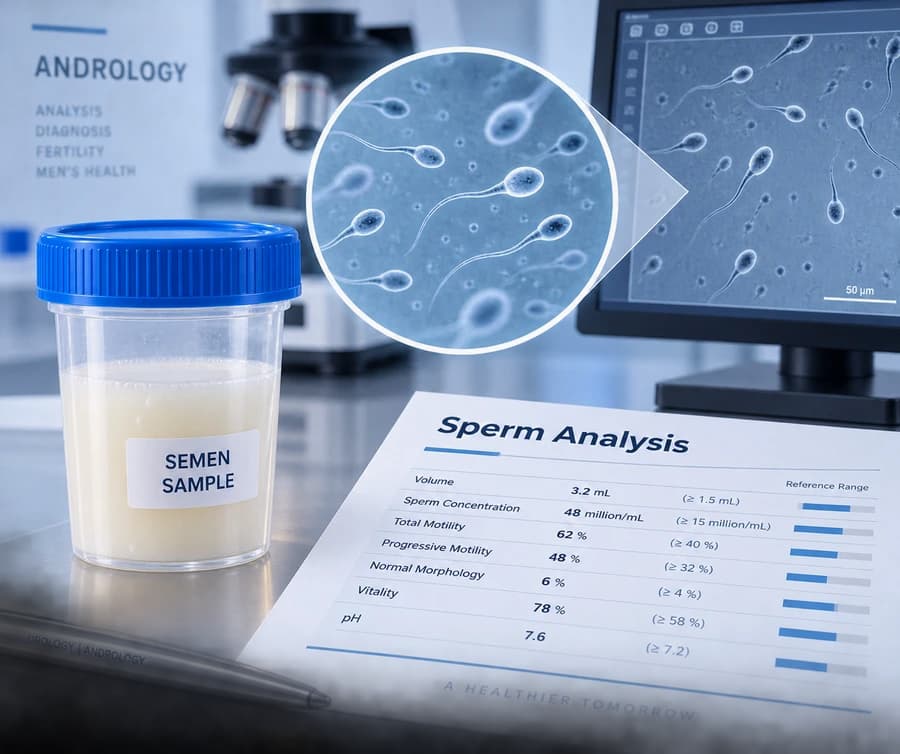
What semen analysis measures
Semen analysis (spermogram) examines two broad categories of parameters:
- Seminal fluid: volume, liquefaction, viscosity, pH.
- Sperm cells: concentration, total count, motility, progressive motility, morphology and, when needed, vitality.
Additional findings such as round cells, leukocytes, or agglutination may also be reported, without being routine tests on every sample. A semen analysis is a "snapshot" at one point in time — not a permanent statement about a man's fertility.
What the WHO reference values mean
The current reference is the WHO Laboratory Manual for the Examination and Processing of Human Semen, 6th edition. The lower reference limits correspond roughly to the bottom 5th percentile of men whose partners conceived naturally within 12 months. These values do not separate fertile from infertile men. A value below one reference limit does not mean inability to conceive, just as a value above all limits does not guarantee fertility.
WHO 6th edition — lower reference limits
Volume ≥1.4 ml • Total count ≥39 million/ejaculate • Concentration ≥16 million/ml • Total motility (PR+NP) ≥42% • Progressive motility (PR) ≥30% • Vitality ≥54% • Normal morphology ≥4%. These are reference limits, not fertility/infertility cut-offs.
Borderline picture
A small deviation in a single parameter, with no other finding, usually just requires repeat testing with correct preparation.
Persistent or combined abnormality
Persistent or multiple abnormalities point toward a more complete andrological work-up — not an automatic diagnosis of infertility.
Concentration vs. total sperm count
Two concepts that are often confused:
- Concentration = how many sperm are present per ml ("how many in 1 ml?").
- Total count = concentration × ejaculate volume, i.e. how many sperm are present in the entire sample ("how many in the whole ejaculate?").
The total count can give more diagnostic information than concentration alone, particularly when the sample volume deviates from normal.
Motility: progressive vs. total
Motility is classified as: progressive motility (sperm moving effectively forward), non-progressive motility (movement without effective forward progress), and immotility. Total motility includes progressive plus non-progressive movement and should not be confused with progressive motility alone — two different numbers with different clinical meaning.
Morphology: the "4%" is widely misunderstood
Morphology assesses the percentage of sperm meeting strict criteria for normal structure. The WHO 6th edition lower reference limit is approximately 4% normal forms. 4% does not mean the remaining 96% is "useless". The criteria are deliberately very strict, so low percentages are expected even in men with normal fertility. Morphology alone cannot diagnose infertility, and 3% versus 4% should not be read as "infertile versus fertile".
Vitality, pH, liquefaction, viscosity, leukocytes
- Vitality: percentage of live sperm; especially useful when motility is very low.
- pH: contributes to assessing accessory gland function, but on its own does not confirm prostatitis, infection, or ductal obstruction.
- Liquefaction/viscosity: ejaculate initially coagulates and normally liquefies; delayed liquefaction or increased viscosity can make laboratory assessment harder, without being on its own a diagnosis of infertility.
- Leukocytes: can be quantified, but leukocytes in semen do not automatically mean bacterial infection — they may reflect inflammation without a positive culture.
- Round cells: include leukocytes but also immature germ cells — not all "round cells" are pus cells.
- Agglutination: may be noted occasionally, without on its own proving the presence of antisperm antibodies.
Terminology: oligo-/astheno-/teratozoospermia
- Oligozoospermia: reduced sperm concentration below the reference limit — severity matters, and this is not equivalent to infertility.
- Asthenozoospermia: reduced motility, particularly progressive motility.
- Teratozoospermia: reduced percentage of normal morphology; isolated teratozoospermia has limited predictive value on its own.
- OAT (Oligoasthenoteratozoospermia): a combination of all three abnormalities — it describes a finding, not a cause. Severity and persistence over time determine whether further work-up is needed.
Azoospermia, cryptozoospermia, necrozoospermia, aspermia
- Azoospermia: absence of sperm in the ejaculate after appropriate laboratory examination (often including centrifugation) — a single "zero sperm" finding needs confirmation before being considered definitive.
- Obstructive vs. non-obstructive azoospermia: in obstructive azoospermia, sperm production may be preserved but the outflow tract is blocked, whereas in non-obstructive azoospermia production itself is impaired — this distinction is not made from semen analysis alone, but requires history, examination, hormones, and often genetic testing.
- Cryptozoospermia: a very small number of sperm detected only after specialized examination/centrifugation — different from complete azoospermia.
- Necrozoospermia: a high percentage of non-viable sperm; vitality testing helps distinguish "immotile" from "dead".
- Aspermia: absence of ejaculate — this is not the same as azoospermia, where ejaculate is present but no sperm are found.
Preparation: how many days of abstinence are needed
According to the WHO 6th edition, collection is usually done after 2–7 days of abstinence. Record the exact abstinence interval and try to keep it similar for any repeat tests, so results remain comparable. Excessively prolonged abstinence "to increase the count" is not recommended.
How to collect the sample correctly
Collection is usually by masturbation into a suitable sterile/non-toxic container. Key points:
- Collect the entire ejaculate and report any loss, especially of the first fraction — this often contains a large proportion of sperm, and losing it can produce a falsely abnormal result.
- Do not use a standard condom — most contain substances that affect sperm motility/viability; if condom collection is needed, only a special non-toxic collection condom recommended by the laboratory should be used.
- Avoid ordinary lubricants, unless the laboratory has explicitly approved a specific product as sperm-safe.
- Collection near the laboratory is preferred when feasible; if home collection is permitted, follow the laboratory's transport protocol precisely — in general, testing ideally begins around 30 minutes and no later than about 60 minutes after collection.
- Avoid extreme cooling or heating during transport; keep the sample close to body temperature as instructed by the laboratory.
Fever, medications, testosterone, and lifestyle
- Fever/illness: high fever or systemic illness can temporarily affect spermatogenesis; because sperm maturation takes weeks, the effect can persist even after recovery — report any recent fever, serious infection, or surgery before the test.
- Medications: certain treatments affect spermatogenesis. Do not stop prescribed medication on your own before a semen analysis.
- Exogenous testosterone/anabolic steroids: testosterone therapy can suppress intratesticular testosterone and sperm production, even leading to azoospermia; testosterone is not used as a treatment for male infertility. Anabolic steroids can suppress the hypothalamic-pituitary-gonadal axis, with variable recovery time.
- Lifestyle: smoking, excessive alcohol, substance use, obesity, repeated heat exposure, and occupational/environmental exposures may be associated with semen parameters, though there are no well-established improvement percentages from individual changes.
Why repeat testing is often needed
Semen parameters can vary considerably between samples due to abstinence, incomplete collection, recent illness, medications, lifestyle, and normal biological variability. An abnormal result should generally not be treated as a permanent diagnosis. If the initial result is normal by WHO criteria, one test is often sufficient; if abnormal, at least two consecutive semen analyses are usually recommended. The exact timing of the repeat test depends on the severity of the finding, a possible reversible cause, recent illness, clinical urgency, and partner age — there is no single interval for everyone.
Semen analysis is not a "fertility test"
Semen analysis evaluates aspects of male reproductive potential, but cannot directly measure fertilizing capacity in vivo, embryo development, or partner factors. Fertility is a property of the couple — not a single semen analysis number. When a couple has difficulty conceiving, the work-up usually proceeds in parallel for both partners, taking into account partner age, ovarian reserve, ovulation, tubal patency, and duration of attempts.
When male infertility is investigated
Investigation often begins after 12 months of regular, unprotected intercourse without conception. Earlier evaluation may be appropriate given partner age, a known male or female risk factor, a history of undescended testis, testicular surgery, chemotherapy, or a severe ejaculatory disorder — there is no single rule for every couple. A persistent semen analysis abnormality often leads to hormonal testing (FSH, LH, total testosterone and others as appropriate, not every hormone in every man), assessment for varicocele or a clinical picture consistent with orchitis/epididymitis, and a history of testicular cancer or undescended testis. A normal FSH does not guarantee normal spermatogenesis, just as an elevated FSH alone does not prove complete absence of sperm production.
Genetic testing and specialized tests
In persistent azoospermia or severe oligozoospermia, genetic testing may be needed (karyotype, Y-chromosome microdeletions, or CFTR testing in appropriate cases related to congenital absence of the vas deferens) — always based on the clinical picture, not for every abnormal result. Sperm DNA fragmentation (SDF) testing is a specialized test, not part of every basic semen analysis, and may be considered in selected situations such as recurrent miscarriage, failed assisted reproduction, or unexplained infertility — there is no single, universally accepted cut-off. Oxidative stress testing is not a routine part of the basic male infertility work-up.
Next steps after an abnormal result
One or more abnormal findings lead to a structured pathway, not automatic treatment: repeat testing → history/physical examination → hormonal testing → assessment for varicocele or another organic cause → genetic testing where indicated → targeted treatment. In confirmed non-obstructive azoospermia, micro-TESE may be discussed as a sperm retrieval option — not as an automatic next step for every man with azoospermia. In confirmed clinical varicocele with a consistent semen analysis abnormality, microsurgical varicocelectomy is one option, not mandatory for every varicocele. Men with low testosterone are evaluated for hypogonadism — without giving exogenous testosterone with the goal of improving fertility.
IUI, IVF, ICSI — a very brief comparison
- IUI: processed sperm is placed into the uterus.
- IVF: fertilization takes place outside the body.
- ICSI: a single sperm cell is injected directly into the egg.
Semen analysis contributes to planning assisted reproduction treatment, but a single parameter does not automatically determine the choice between IUI, IVF, or ICSI — this decision belongs to the specialized fertility team, in collaboration with the couple.
WHO values are not "targets" — nor a cliff edge
A common misconception: "16 million/ml is good, 15 million/ml means infertility". Reference distributions are continuous. A man at 15 and one at 16 million/ml are not biologically split into two different categories by a one-unit difference. A reference limit is not a biological cliff edge. The same applies to morphology: 3% versus 4% should not be read as "infertile versus fertile" — interpretation always happens in the context of the whole profile and the couple's history.


