My Clinical Approach
I always start with a systematic clinical assessment (ADAM, AMS questionnaires) and two morning testosterone measurements (8:00-11:00 a.m.) before establishing the diagnosis.
I distinguish primary from secondary hypogonadism by measuring FSH, LH, prolactin and estradiol. For high prolactin or low LH/FSH, I order a pituitary MRI.
For men with fertility intentions I never prescribe exogenous testosterone — I choose hCG + clomiphene/letrozole to preserve spermatogenesis.
What is Hypogonadism?
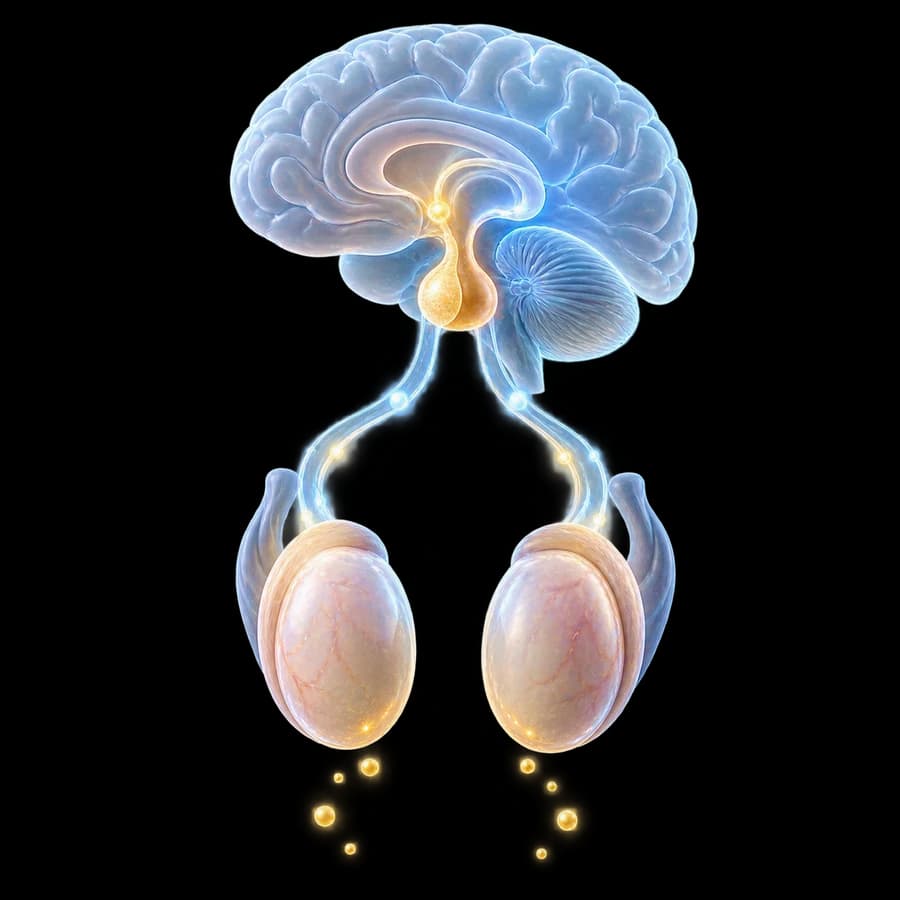
Hypogonadism is a clinical syndrome characterized by failure of the testes to produce adequate testosterone and/or sperm, due to testicular damage (primary) or damage to the hypothalamic-pituitary axis (secondary).
- Prevalence: 2-6% of men aged 40-70
- Most common after age 50 (late-onset hypogonadism)
- Obesity & type 2 diabetes increase risk
- Often underdiagnosed
Types of Hypogonadism
Primary (Hypergonadotropic)
Testicular damage — high FSH/LH, low testosterone. Causes: Klinefelter, post-torsion, chemo-/radiotherapy, orchitis, cryptorchidism, trauma.
Secondary (Hypogonadotropic)
Hypothalamic/pituitary damage — low FSH/LH and testosterone. Causes: Kallmann syndrome, pituitary adenoma, hyperprolactinemia, hemochromatosis, opioids.
Functional / Age-related
Obesity, diabetes mellitus, metabolic syndrome, chronic illness. Often reversible with lifestyle changes.
Mixed
Combination of primary and secondary (e.g. in elderly men).
Symptoms
- Reduced libido
- Erectile dysfunction
- Reduced morning erections
- Fatigue, low energy
- Depression, irritability
- Difficulty concentrating
- Reduced muscle mass & strength
- Increased visceral fat
- Gynecomastia
- Reduced body & beard hair
- Hot flashes
- Osteopenia/osteoporosis
- Anemia
Diagnosis
- Morning total testosterone (8-11 a.m.) on two measurements
- Free or bioavailable testosterone (if borderline total)
- SHBG, albumin
- FSH, LH (distinguish primary/secondary)
- Prolactin, estradiol, TSH
- Semen analysis (if fertility desired)
- PSA, hematocrit (before TRT)
- Pituitary MRI for secondary or hyperprolactinemia
- Karyotype if Klinefelter suspected
- Bone density measurement (DEXA)
Treatment (TRT)
Transdermal testosterone gel
Daily 1-2% gel application. Advantage: stable levels. Disadvantage: risk of transfer to women/children.
Long-acting injections
Testosterone undecanoate 1000 mg every 10-14 weeks (intramuscular). More stable levels, fewer injections.
Short-acting injections
Enanthate/cypionate every 1-2 weeks. Level fluctuations, more economical.
Subcutaneous pellets
Pellets every 4-6 months. Stable levels, good adherence.
Non-steroidal medications
Clomiphene citrate, anastrozole — to preserve spermatogenesis in secondary hypogonadism with fertility intentions.
TRT contraindications: prostate or breast cancer, severe untreated obstructive sleep apnea, hematocrit >54%, uncontrolled heart failure, fertility intentions.
Before considering TRT, it is worth investigating reversible factors (weight, sleep, lifestyle) — see our guide Low Testosterone: Natural Ways to Increase It.
Hypogonadism & Fertility
Exogenous testosterone suppresses FSH/LH secretion and spermatogenesis, with risk of azoospermia. For men with fertility intentions, the following are chosen:
- hCG (human chorionic gonadotropin) 1500-3000 IU 2-3 times/week
- rFSH (recombinant FSH) in secondary cases
- Clomiphene citrate 25-50 mg daily (off-label)
- Anastrozole/letrozole for high estradiol
- Discontinuation of exogenous testosterone & hormonal re-evaluation
Follow-up
- Testosterone check at 3 & 6 months, then annually
- PSA & digital rectal examination every 6-12 months
- Hematocrit (discontinue if >54%)
- Annual lipid profile
- Symptomatic assessment
- DEXA scan every 2 years in osteopenia
- Screening for obstructive sleep apnea
Frequently Asked Questions (FAQ)
When is testosterone considered low?
Total testosterone <300 ng/dL (10.4 nmol/L) on two morning measurements, combined with symptoms, establishes the diagnosis of hypogonadism (Endocrine Society 2018, EAU 2024).
Is testosterone therapy safe?
In properly selected patients with regular monitoring, therapy is safe. PSA, hematocrit, lipids and cardiovascular health are monitored.
Can I take testosterone if I want children?
NO. Exogenous testosterone suppresses spermatogenesis. For fertility intentions, hCG, clomiphene or anti-estrogens are used instead.
How long does treatment last?
In primary hypogonadism therapy is lifelong. In secondary or functional cases it may be discontinued once the cause is treated (e.g. weight loss, opioid cessation).
What forms of testosterone are available?
Available: injections (testosterone undecanoate every 10-14 weeks, enanthate/cypionate every 1-2 weeks), daily transdermal gel, subcutaneous pellets every 4-6 months, oral mucosal.
Book Your Appointment in Rhodes
Workup of male hypogonadism, hormonal evaluation, personalized testosterone replacement therapy (TRT) and fertility follow-up.
References – Sources
- Bhasin S, et al. Testosterone Therapy in Men With Hypogonadism: Endocrine Society Clinical Practice Guideline. JCEM 2018 — PMID: 29562364
- EAU Guidelines on Sexual and Reproductive Health 2024 — uroweb.org
- Mulhall JP, et al. Evaluation and Management of Testosterone Deficiency: AUA Guideline. J Urol 2018 — PMID: 29601923
- Lincoff AM, et al. TRAVERSE: Cardiovascular Safety of Testosterone-Replacement Therapy. NEJM 2023 — PMID: 37326322
Medical Review

Dr. Marinos Vasilas, Urologist – Andrologist
Dr. Marinos Vasilas runs a private urology practice in Rhodes specializing in andrology and testosterone replacement therapy.
View full CV


