My Clinical Approach
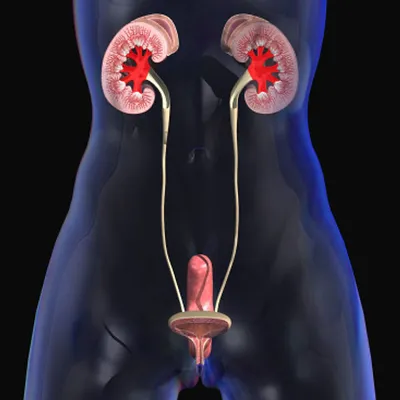
Ureteral cancer (UTUC) is rare but aggressive. Modern management is individualized based on EAU risk stratification — preserving renal function in low-risk patients with kidney-sparing, and radical therapy with adjuvant chemotherapy in high-risk patients.
According to EAU UTUC Guidelines 2024 and AUA Bladder Cancer 2024:
- Complete staging: CT urography + ureteroscopy + biopsy + cytology.
- Concurrent cystoscopy — 17% concurrent bladder cancer risk.
- EAU risk stratification for treatment selection.
- Kidney-sparing endoscopic therapy in low-risk patients.
- Robotic nephroureterectomy with bladder cuff in high-risk patients.
- Adjuvant cisplatin-based chemotherapy (POUT) in pT2-T4 or N+.
- Genetic counseling for Lynch syndrome in age <60 or positive family history.
What is UTUC
Upper Tract Urothelial Carcinoma (UTUC) is a malignancy of the upper urinary tract urothelium, affecting the renal pelvis and the ureter. The majority of cases (95%) are urothelial, with squamous cell carcinoma (5%) or adenocarcinoma (under 1%) occurring less commonly. It represents 5-7% of all urothelial cancers. Its incidence is 1-2 per 100,000 people per year, and the ratio of ureteral to renal pelvis tumours is approximately 1:3.
Important: UTUC coexists with bladder cancer in 17% concurrent and 22-47% after nephroureterectomy — lifelong cystoscopic surveillance is required.
Risk factors
Smoking
It is the most important modifiable risk factor, increasing risk by 3-7 times. Smoking cessation gradually reduces this risk.
Occupational exposure
Exposure to aromatic amines occurs in the dye, pigment, rubber and petrochemical industries. The latency period is typically 20-30 years.
Lynch syndrome (HNPCC)
This is caused by MMR gene mutations (MLH1, MSH2, MSH6, PMS2) and accounts for 5-20% of UTUC cases. Genetic testing is recommended if the patient is under 60 or has a family history of colorectal or endometrial cancer.
Analgesic nephropathy
This is caused by chronic phenacetin use, now withdrawn from the market, or excessive paracetamol use. It is rare in modern Western countries.
Aristolochic acid
This is found in Chinese herbal preparations containing Aristolochia species, and is associated with a characteristic TP53 mutation. It is linked to Balkan endemic nephropathy.
Others
Other recognised factors include chronic infection or lithiasis (associated with squamous cell carcinoma), renal transplantation and its associated immunosuppression, chronic hepatitis C, and high arsenic intake.
Symptoms & clinical presentation
Painless hematuria
This is the most common symptom, occurring in 70-80% of cases. It can be macroscopic or microscopic, and is usually intermittent, which means it may sometimes be ignored by patients.
Flank pain
This occurs in 20-40% of cases, due to obstruction by the tumour or a blood clot, hydronephrosis, or rapid mass growth. It may present as a dull ache or as colicky pain.
Systemic
Symptoms can include weight loss, cachexia, anorexia, and unexplained anaemia, especially in advanced disease.
Incidental finding
In 15% of cases, the condition is found incidentally as hydronephrosis or a mass on CT or ultrasound performed for other reasons. A palpable flank mass is rare.
Diagnosis & staging
CT urography (CTU)
Gold standard imaging. Sensitivity 96%, specificity 99%. Provides location, size, invasion, lymph nodes, metastases. Urographic phase shows complete distal field.
MR urography
Alternative in allergy or CKD (eGFR <30). Lower sensitivity for small lesions.
Cystoscopy
Mandatory — 17% concurrent bladder cancer. Allows inspection of external orifices + bladder wash cytology.
Ureteroscopy + biopsy
Diagnostic gold standard. Direct visual inspection + biopsy forceps + selective ureteral cytology. Determines grade and helps risk stratification.
Urine cytology
Sensitivity higher for high-grade (>80%). Adjuncts: BTA test, FISH (UroVysion).
Metastatic staging
Chest CT to rule out pulmonary metastases. Bone scan only if bone pain or elevated ALP.
EAU risk stratification
Low risk (all present)
- • Unifocal lesion
- • Size <2cm
- • Low-grade cytology
- • Low-grade biopsy
- • Papillary morphology
- • No invasion on CT
High risk (any)
- • Hydronephrosis
- • Size >2cm
- • High-grade cytology
- • High-grade biopsy
- • Multifocal
- • Prior radical cystectomy for CIS
- • Sessile / invasive morphology
Treatment (kidney-sparing & radical)
Low risk — Kidney-sparing
Endoscopic management: ureteroscopy + holmium laser ablation. Success 70-90% in papillary low-grade. Continuous surveillance every 3 months.
Segmental ureterectomy: for distal lesions — segmental excision + ureteral reimplantation. Selected cases: equivalent survival to nephroureterectomy.
Intraluminal therapy: mitomycin C (UGN-101 — Jelmyto) or BCG via retrograde infusion or directly into ureter through JJ stent.
High risk — Radical nephroureterectomy
Gold standard. Excision of kidney + entire ureter + bladder cuff (perimeatal bladder area). Laparoscopic or robotic approach comparable to open in oncologic outcomes.
Lymphadenectomy (template-based): for ≥cT2 — improves local control and staging.
Intravesical MMC: single dose of mitomycin C in bladder after nephroureterectomy reduces bladder recurrences (ODMIT-C trial).
Adjuvant chemotherapy (POUT 2020)
4 cycles of gemcitabine + cisplatin for pT2-T4 or N+ after nephroureterectomy. Improves 3-year DFS from 46% to 71% (HR 0.45). New standard of care per EAU 2024.
Metastatic disease
1st line: cisplatin-based (gemcitabine + cisplatin). 2nd line: pembrolizumab, enfortumab vedotin, FGFR3 inhibitor (erdafitinib) in FGFR3+. Modern clinical trials with checkpoint inhibitors.
Follow-up & prognosis
After nephroureterectomy:
- Cystoscopy + cytology every 3 months × 2 years, every 6 months to 5 years, then annually.
- CT thorax/abdomen/pelvis every 6 months × 2 years, then annually.
- eGFR monitoring + protection of contralateral kidney.
After kidney-sparing:
- Ureteroscopy + cytology every 3 months × 1 year, then every 6 months.
- CT urography annually.
5-year survival prognosis: Ta/T1 >80%, T2 60-70%, T3 30-50%, T4 <10%. Early diagnosis is critical.
Frequently Asked Questions (FAQ)
What is ureteral cancer?
Ureteral cancer is part of Upper Tract Urothelial Carcinoma (UTUC), originating from the urothelium of the ureter. More than 95% of cases are urothelial, with squamous cell carcinoma or adenocarcinoma occurring less commonly. It represents 5-7% of all urothelial cancers.
What are the risk factors?
Recognised risk factors include smoking (a 3-7x increase in risk), occupational exposure to aromatic amines (dyes, rubber industry), analgesic nephropathy from phenacetin, Balkan endemic nephropathy, and aristolochic acid found in some Chinese herbal preparations. Lynch syndrome (HNPCC) accounts for 5-20% of UTUC cases, which are more common between the ages of 70 and 90.
What are the symptoms?
The most common symptom is painless macroscopic hematuria, occurring in 70-80% of cases. Flank pain from obstruction or hydronephrosis occurs in 20-40%, and a palpable mass or rare paraneoplastic syndromes occur in around 10%. In 15% of cases the cancer is an incidental finding on imaging performed for another reason.
How is it diagnosed?
The gold-standard investigation is CT urography, with a sensitivity of 96% and a specificity of 99%. Ureteroscopy with biopsy and selective ureteral cytology is also used, along with cystoscopy to rule out concurrent bladder cancer, which is found in 17% of cases. Additional tests can include the BTA test and FISH cytology.
How is it staged & risk-stratified?
TNM staging ranges from Ta (non-invasive) and T1 (subepithelial) to T2-T3 (muscle or periureteral invasion) and T4 (invasion of adjacent organs). Under EAU risk stratification, low-risk tumours are unifocal, under 2cm, low-grade and papillary, while high-risk tumours are multifocal, over 2cm, high-grade, invasive, or associated with hydronephrosis.
What are treatment options for low risk?
Kidney-sparing therapy is the preferred approach, including endoscopic management with ureteroscopy and holmium laser ablation, or segmental ureterectomy for distal lesions, sometimes combined with intraluminal mitomycin C or BCG. Continuous surveillance ureteroscopy is performed every 3-6 months.
What is the high-risk treatment?
The gold-standard treatment is radical nephroureterectomy with bladder cuff excision of the perimeatal bladder area, performed via a laparoscopic or robotic approach. Adjuvant chemotherapy with a cisplatin regimen, based on the POUT trial, is given for pT2-T4 or N+ disease, and neoadjuvant chemotherapy is considered in selected patients.
What is the POUT trial?
The POUT trial was a Phase 3 RCT (Lancet 2020) showing that 4 cycles of adjuvant gemcitabine + cisplatin after nephroureterectomy, for pT2-T4 or N+ UTUC, improved 3-year disease-free survival from 46% to 71% (HR 0.45). This finding changed the standard of care, and adjuvant chemotherapy is now recommended.
What is the prognosis?
Prognosis depends on stage: 5-year survival exceeds 80% for Ta/T1, is 60-70% for T2, 30-50% for T3, and under 10% for T4. After nephroureterectomy there is a 22-47% risk of bladder cancer recurrence, so lifelong cystoscopic surveillance is required. Patients with Lynch syndrome also receive tailored genetic counseling.
Related topics
Suspected upper tract cancer?
Contact us for a full oncologic evaluation, including CT urography, ureteroscopy with biopsy, EAU risk stratification, and a personalised treatment plan ranging from kidney-sparing options to robotic nephroureterectomy.
Scientific literature
- EAU Guidelines on Upper Urinary Tract Urothelial Carcinoma (2024) — uroweb.org
- Birtle A, Johnson M, Chester J, et al. Adjuvant chemotherapy in upper tract urothelial carcinoma (the POUT trial): a phase 3, open-label, randomised controlled trial. Lancet 2020;395(10232):1268-1277 — pubmed.ncbi.nlm.nih.gov
- Rouprêt M, Babjuk M, Burger M, et al. European Association of Urology Guidelines on Upper Urinary Tract Urothelial Carcinoma: 2023 Update. Eur Urol 2023;84(1):49-64 — pubmed.ncbi.nlm.nih.gov
- Kleinmann N, Matin SF, Pierorazio PM, et al. Primary chemoablation of low-grade upper tract urothelial carcinoma using UGN-101 (OLYMPUS trial). Lancet Oncol 2020;21(6):776-785 — pubmed.ncbi.nlm.nih.gov
- Audenet F, Isharwal S, Cha EK, et al. Clonal Relatedness and Mutational Differences between Upper Tract and Bladder Urothelial Carcinoma. Clin Cancer Res 2019;25(3):967-976 — pubmed.ncbi.nlm.nih.gov
Medical Editorship

Dr. Marinos Vasilas, Urologist – Andrologist
Dr. Marinos Vasilas treats UTUC with modern multidisciplinary approach: from individualized EAU risk stratification, kidney-sparing endoscopic therapy (laser, UGN-101), to robotic nephroureterectomy with bladder cuff and adjuvant cisplatin (POUT) per EAU 2024.
View full profile


