My Clinical Approach
Bladder cancer is one of the most insidious urological malignancies — it often starts with a single self-limiting episode of haematuria. Early and complete work-up determines prognosis.
I follow the EAU Guidelines on NMIBC & MIBC 2026, the NCCN Guidelines and the AUA/SUO recommendations:
- Any painless haematuria → 2-week wait for cystoscopy + CTU.
- White-light + photodynamic / NBI cystoscopy for improved detection of CIS and flat tumours.
- High-quality TURBT: en-bloc where feasible, mandatory detrusor muscle in the specimen.
- Repeat TURBT at 4-6 weeks for high-risk NMIBC or incomplete first resection.
- Cisplatin-based neoadjuvant chemotherapy for all eligible MIBC patients with GFR >60.
- Radical cystectomy — open or robot-assisted (RARC) with intracorporeal urinary diversion when appropriate.
- Strong emphasis on smoking cessation — reduces recurrences and second primaries.
What is bladder cancer
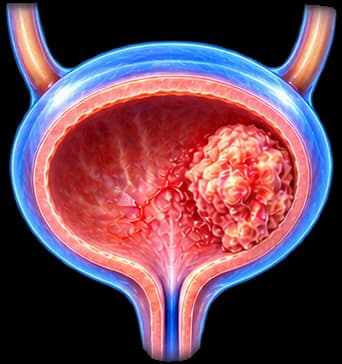
Bladder cancer arises predominantly from the urothelium — the epithelium lining the bladder, ureters and renal pelvis. Over 90% are urothelial (transitional cell) carcinomas. Rarer histologies include squamous cell (chronic catheter, schistosomiasis), adenocarcinoma (urachus), small-cell.
NMIBC (Non-Muscle Invasive)
~75% of diagnoses. Stages Ta, T1, CIS. High recurrence (50-70% at 5 years) but low mortality (<15%) when correctly managed.
MIBC (Muscle Invasive)
~25% of diagnoses. T2-T4. High metastatic potential — requires systemic therapy and radical cystectomy.
Risk factors
- Smoking — 50-65% of all cases. Risk ×4. Cessation gradually reduces risk.
- Occupational exposure to aromatic amines, dyes, rubber, textiles, petroleum, chemicals (exposure typically 20-30 years before diagnosis).
- Cyclophosphamide — dose-independent risk.
- Pelvic radiotherapy for prior malignancy (prostate, gynaecologic).
- Chronic irritation: long-term catheters (squamous cell), schistosomiasis (endemic regions).
- Age >55, male sex (3:1), Caucasian ethnicity.
- Family history — small predisposition (Lynch syndrome).
Symptoms & red flags
Main symptoms
Painless visible haematuria (80%), urgency/frequency (CIS), dysuria without infection.
Advanced disease
Flank pain (ureteric obstruction), lower-limb oedema, bone pain (metastases), weight loss, cachexia.
Pitfall: Self-resolving haematuria does not exclude cancer. Persistent microscopic haematuria (>3 RBC/HPF in 2 of 3 samples) also requires investigation in high-risk patients (>35 years, smokers).
Pitfall: A normal ultrasound does NOT exclude bladder cancer. Ultrasound can miss small, flat or CIS lesions. Cystoscopy remains mandatory when haematuria is present, regardless of ultrasound findings.
Diagnosis & staging
Cystoscopy (gold standard)
Flexible or rigid with white-light + NBI / PDD (hexaminolevulinate) for improved detection of flat tumours and CIS. Cystoscopy sees the lesion — it does not, by itself, provide grade or stage.
Urine cytology
High sensitivity for high-grade and CIS (~85%), low for low-grade. Useful complement — not a stand-alone test.
CT Urography (CTU)
Standard imaging for upper tract assessment + staging. Evaluates kidneys, ureters, lymph nodes, distant disease.
TURBT (Transurethral Resection)
Both diagnostic and therapeutic — TURBT with histology is what actually determines grade and stage. Mandatory detrusor muscle in the specimen for accurate staging. Single-shot intravesical chemo (mitomycin C) within 24 h for low-risk tumours.
Repeat TURBT (re-TURBT)
At 4-6 weeks for: T1, high-grade Ta, incomplete first TURBT, no detrusor in specimen. Upstages 25-50% of cases.
Pelvic MRI / PET-CT
In MIBC: multiparametric bladder MRI (VI-RADS) for depth of invasion and extension. PET-CT for distant metastases.
TNM staging
Ta (non-invasive papillary), Tis (CIS), T1 (subepithelial), T2 (muscle), T3 (perivesical fat), T4 (adjacent organs). N0-N3, M0/M1.
Risk stratification (EAU)
For NMIBC: low / intermediate / high / very high risk — based on T-stage, grade, size, number of tumours, recurrence, CIS, age. Drives therapy.
| NMIBC risk group | Definition (EAU) |
|---|---|
| Low risk | Single Ta, low-grade, <3 cm, no prior recurrence. |
| Intermediate risk | Multiple/recurrent Ta low-grade, or larger tumours not meeting high-risk criteria. |
| High risk | T1, high-grade Ta, CIS, or any combination of size >3 cm, multifocality, early recurrence. |
| Very high risk | T1 high-grade + CIS, multiple/large/recurrent T1 high-grade, BCG-unresponsive disease. |
Treatment of NMIBC
TURBT + single-shot intravesical chemotherapy
Complete endoscopic resection. Single instillation of mitomycin C or epirubicin within 24 h in low-risk disease — reduces recurrence by ~35%.
Intravesical BCG (high-risk & intermediate-risk)
Induction: 6 weekly instillations. Maintenance: 3 weekly instillations at 3 and 6 months, then every 6 months for 1-3 years (high-risk). Reduces recurrence by >50% and progression by ~25%. Side effects: cystitis, haematuria, rarely systemic BCG-osis.
Maintenance intravesical chemotherapy
Mitomycin C, epirubicin, gemcitabine — alternatives in intermediate-risk when BCG is contraindicated or in shortage. Newer options: device-assisted instillations (electromotive, hyperthermia / HIVEC).
BCG-unresponsive NMIBC
Options: early radical cystectomy (gold standard, best prognosis), pembrolizumab (FDA-approved for CIS), nadofaragene firadenovec (gene therapy), nogapendekin alfa, gemcitabine + docetaxel.
Treatment of MIBC
Neoadjuvant chemotherapy (NAC)
4 cycles of ddMVAC or cisplatin-gemcitabine before cystectomy. +5-8% 5-year survival (Lancet 2003 SWOG, EORTC 30994). Requires GFR >60. In eligible patients — mandatory.
Radical cystectomy with lymph-node dissection
Gold standard for organ-confined MIBC. Removal of bladder + prostate/seminal vesicles (men) or bladder + uterus/adnexa/anterior vaginal wall (women). Extended pelvic lymphadenectomy always included. Open or robotic (RARC).
Urinary diversion
Orthotopic neobladder from intestine — preserves natural voiding, higher quality of life, but requires good renal function and competent sphincter. Ileal conduit (Bricker) — simpler, with abdominal stoma. Choice is individualised.
Trimodal therapy (TMT) — bladder preservation
Complete TURBT + cisplatin chemotherapy + radiotherapy 60-66 Gy. Option for patients with small tumour, no CIS, good bladder function. Survival comparable to cystectomy in selected patients (RTOG, SWOG).
Adjuvant therapy
Adjuvant nivolumab (CheckMate 274) for high-risk patients after cystectomy — improves disease-free survival. Adjuvant cisplatin in those who did not receive NAC and have pT3+/N+ disease.
NIAGARA & Perioperative Durvalumab
The NIAGARA trial (Powles et al., NEJM 2024) evaluated perioperative durvalumab (a PD-L1 inhibitor) added to neoadjuvant cisplatin-gemcitabine chemotherapy, followed by adjuvant durvalumab after radical cystectomy, in cisplatin-eligible MIBC.
| Outcome | Result |
|---|---|
| Event-free survival (2 years) | 67.8% (durvalumab) vs 59.8% (chemotherapy alone). |
| Overall survival (2 years) | 82.2% vs 75.2%. |
| Pathologic complete response | Higher with durvalumab combination. |
| Regulatory status | FDA approval 2024; incorporated into EAU 2026 MIBC recommendations and NCCN guidelines. |
The EAU 2026 guidelines now recommend perioperative durvalumab as an option for eligible cisplatin-fit MIBC patients undergoing radical cystectomy, alongside the established neoadjuvant chemotherapy pathway.
Metastatic disease & immunotherapy
- 1st line: enfortumab vedotin + pembrolizumab (EV-302) — new gold standard, OS ~31.5 months vs 16 months with chemotherapy.
- Cisplatin-gemcitabine or ddMVAC for fit patients — now 2nd line after EV+pembro.
- Pembrolizumab / atezolizumab / avelumab — PD-(L)1 inhibitors, monotherapy or maintenance after chemotherapy (JAVELIN Bladder 100).
- Targeted therapies: erdafitinib for FGFR2/3 mutations, sacituzumab govitecan as ADC.
- Metastatic prognosis: 5-year survival 15-20% — improving rapidly with new combinations.
Follow-up & prognosis
NMIBC follow-up
Cystoscopy + cytology: at 3 months, then every 3-6 months for 2 years, annually for 5 years. CTU every 1-2 years in high-risk.
MIBC after cystectomy
CT chest/abdomen/pelvis every 3-6 months for 2 years, then annually. B12, electrolytes, renal function (after neobladder).
Prognosis: low-risk NMIBC 5-year CSS >95%. High-risk NMIBC 70-85%. Organ-confined MIBC 50-70%. Complete smoking cessation is critical — reduces recurrences by 30%.
The Patient Journey
- 1Haematuria or irritative urinary symptoms
- 2Clinical assessment + urine cytology
- 3Upper-tract imaging (CT urography, where indicated) + flexible cystoscopy
- 4Suspicious bladder lesion → TURBT
- 5Histology → grade + stage + muscle sampling
- 6Ta / T1 / CIS or T2+
- 7NMIBC risk stratification or MIBC staging
- 8Surveillance / intravesical therapy / BCG / re-TURBT, or neoadjuvant therapy + radical cystectomy / bladder preservation
- 9Long-term risk-adapted surveillance
Frequently Asked Questions (FAQ)
What is bladder cancer?
Bladder cancer is the 4th most common cancer in men worldwide. The vast majority (>90%) is urothelial (transitional cell) carcinoma. It is divided into non-muscle-invasive bladder cancer (NMIBC, ~75%) — superficial, highly recurrent — and muscle-invasive bladder cancer (MIBC, ~25%) with metastatic potential.
What is the difference between grade and stage?
Grade describes how abnormal the cancer cells look under the microscope (low-grade vs high-grade). Stage describes how deep the tumour has invaded the bladder wall (Ta, T1, CIS, T2+). A tumour can be high-grade without being muscle-invasive — the two concepts are independent and both determine risk and treatment.
What is the most important symptom?
Painless visible (gross) haematuria — present in about 80% of patients. It must always be fully investigated regardless of age or sex. Do not assume "cystitis" or "prostate" until proven otherwise, and a normal ultrasound does not exclude bladder cancer.
What are the main risk factors?
Smoking (50-65% of all cases), occupational exposure to aromatic amines (dyes, paints, rubber, chemical industry), cyclophosphamide, chronic irritation (long-term catheters, schistosomiasis), prior pelvic radiotherapy, age >55, male sex.
How is it diagnosed?
Cystoscopy (gold standard) + urine cytology + CT urography (CTU) for the upper urinary tract. Cystoscopy identifies the lesion, but only TURBT with histology confirms grade and stage. PET-CT/MRI (VI-RADS) for staging in suspected muscle-invasive disease.
What is the initial treatment?
TURBT — both diagnostic and therapeutic. In high-risk NMIBC: repeat TURBT at 4-6 weeks plus intravesical BCG (or mitomycin C). In MIBC: radical cystectomy with neobladder or ileal conduit, with or without neoadjuvant cisplatin-based chemotherapy.
What is intravesical BCG?
Live attenuated Calmette-Guerin mycobacteria are instilled into the bladder. They trigger a local immune response and reduce recurrence by over 50% in high-risk NMIBC. Standard schedule: 6 weekly induction instillations + maintenance for 1-3 years.
What happens if BCG stops working (BCG-unresponsive disease)?
Options include early radical cystectomy (best oncological outcome), pembrolizumab (FDA-approved for BCG-unresponsive CIS), nadofaragene firadenovec (intravesical gene therapy), nogapendekin alfa inbakicept combined with BCG, or gemcitabine + docetaxel.
When is radical cystectomy needed?
For muscle-invasive cancer (T2 or higher), for high-risk NMIBC unresponsive to BCG, for extensive CIS, or for large tumours that cannot be resected endoscopically. It is preceded by neoadjuvant cisplatin-based chemotherapy (4 cycles), which improves survival by 5-8%.
What is the difference between recurrence and progression?
Recurrence means the cancer comes back in the bladder, often at the same low stage/grade. Progression means the disease advances to a higher stage or grade (e.g. NMIBC becoming muscle-invasive). Progression is far more serious and is what intensive surveillance aims to catch early.
What is the prognosis?
Low-risk NMIBC: 5-year cancer-specific survival >95%. High-risk NMIBC: 70-85%. Organ-confined MIBC: 50-70% after cystectomy. Metastatic disease is improving rapidly with new combinations such as enfortumab vedotin + pembrolizumab and durvalumab-based perioperative therapy.
Related Topics
Bladder cancer: do not waste time
Contact us for prompt cystoscopy + CTU in cases of haematuria. Comprehensive oncological care: TURBT, intravesical BCG, radical cystectomy and multidisciplinary tumour board.
Scientific References
- EAU Guidelines on Non-muscle-invasive Bladder Cancer (TaT1 and CIS) 2026 — uroweb.org
- EAU Guidelines on Muscle-invasive and Metastatic Bladder Cancer 2026 — uroweb.org
- Powles T, Valderrama BP, Gupta S, et al. Enfortumab Vedotin and Pembrolizumab in Untreated Advanced Urothelial Cancer (EV-302). NEJM 2024;390(10):875-88 — pubmed.ncbi.nlm.nih.gov
- Powles T, Catto JWF, Galsky MD, et al. Perioperative Durvalumab with Neoadjuvant Chemotherapy in Muscle-Invasive Bladder Cancer (NIAGARA). NEJM 2024;391(19):1773-86 — pubmed.ncbi.nlm.nih.gov
- Bajorin DF, Witjes JA, Gschwend JE, et al. Adjuvant Nivolumab versus Placebo in Muscle-Invasive Urothelial Carcinoma (CheckMate 274). NEJM 2021;384(22):2102-14 — pubmed.ncbi.nlm.nih.gov
- Grossman HB, Natale RB, Tangen CM, et al. Neoadjuvant chemotherapy plus cystectomy compared with cystectomy alone for locally advanced bladder cancer. NEJM 2003;349(9):859-66 — pubmed.ncbi.nlm.nih.gov
Meet the Doctor

Dr. Marinos Vasilas, Urologist & Andrologist
Comprehensive bladder cancer care according to EAU 2026 & NCCN: prompt cystoscopy + CTU, high-quality TURBT, intravesical BCG, radical cystectomy with neobladder/ileal conduit, and connection with medical oncology and a multidisciplinary tumour board.
See full profile


