My Clinical Approach
VUR is one of the most common pediatric urologic disorders with significant long-term consequences — hypertension, chronic kidney disease, pregnancy complications. Modern management focuses on prevention of renal scarring with individualized choice of conservative or surgical treatment.
Per EAU Pediatric Urology 2024 and AUA VUR Guideline 2017:
- Comprehensive workup: VCUG for grading + US + DMSA for damage.
- Screen for bowel/bladder dysfunction (BBD) — worsens VUR.
- Conservative approach first: continuous antibiotic prophylaxis + treatment of constipation/voiding dysfunction.
- Follow-up with radionuclide cystography (RNC) — less radiation.
- Surgery only for prophylaxis failure or new DMSA scars.
- Robotic approach for reimplantation when indicated.
What is VUR
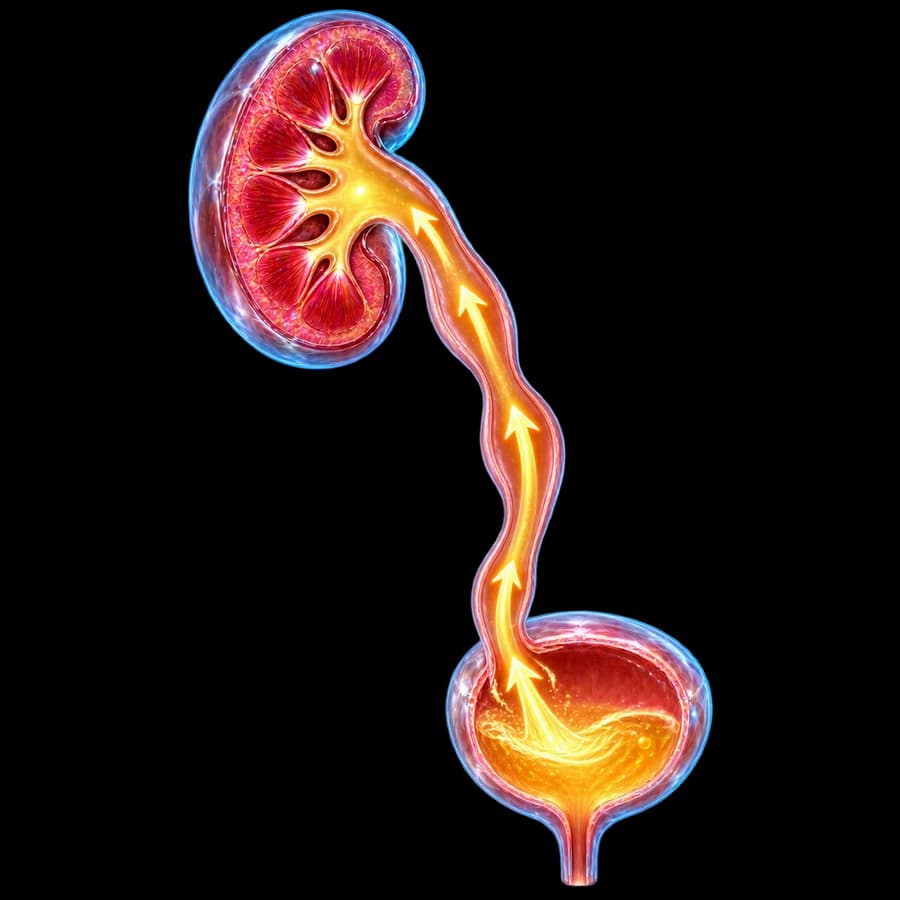
Vesicoureteral reflux is retrograde flow of urine from the bladder into the ureter and/or renal pelvis. Normally, the ureter traverses the bladder wall obliquely with a length-to-width ratio of 4:1 — this submucosal tunnel acts as a one-way valve. When the tunnel is inadequate (congenitally or due to high bladder pressure), reflux occurs.
Primary VUR
Congenital anomaly of the vesicoureteral valve — short or straight ureteral segment in bladder wall. Most common form. Familial in 30%.
Secondary VUR
Due to high intravesical pressure from: posterior urethral valves, neurogenic bladder, prune-belly syndrome, BBD, diverticula.
Classification (ICCS Grades I-V)
Per International Reflux Study Classification:
Grade I
Reflux into ureter only, no dilation. Spontaneous resolution 80-90%.
Grade II
Reflux into renal pelvis and calyces, no dilation. Spontaneous resolution 70-80%.
Grade III
Mild ureteral and pelvic dilation, slightly blunted calyces. Spontaneous resolution ~50%.
Grade IV
Moderate dilation and tortuous ureter, blunted calyces but preserved papillae. Spontaneous resolution 25-30%.
Grade V
Gross dilation + tortuous ureter, complete loss of papillary architecture, intrarenal reflux. Spontaneous resolution <10%.
Symptoms & clinical features
Neonates / infants
Febrile UTI, sepsis, irritability, failure to thrive, vomiting. Antenatal hydronephrosis on prenatal US.
Children
Recurrent UTIs, febrile cystitis, enuresis, voiding difficulty (target = high pressure), pyelonephritis episodes.
Adults
Usually undiagnosed childhood VUR. May present as: hypertension, CKD, febrile pyelonephritis in pregnancy, proteinuria.
Reflux nephropathy
DMSA scars, reduced renal function, hypertension. Responsible for 5-10% of pediatric ESRD.
Diagnosis (VCUG, DMSA)
Renal & bladder ultrasound
First-line. Detects hydronephrosis, kidney size, asymmetry, dysplastic features.
VCUG (voiding cystourethrogram)
Gold standard for diagnosis and grading I-V. Provides anatomic imaging during filling + voiding. Also rules out posterior urethral valves in boys.
Radionuclide cystography (RNC)
Less radiation (<1/100 of VCUG). Ideal for follow-up or sibling screening. Lacks detailed anatomic grading but detects reflux.
DMSA renal scan
Assessment of renal damage (scars, split function). Performed 6 months after acute pyelonephritis or at high-grade VUR diagnosis.
BBD evaluation (bowel/bladder dysfunction)
Voiding diary, Bristol Stool Chart, DVSS questionnaire. BBD is common and needs correction before surgery.
Urodynamics
When neurogenic bladder or severe voiding dysfunction suspected, or before surgery for secondary VUR.
Conservative management & prophylaxis
Conservative management is first-line in low grades (I-III) and selected grade IV without scars, especially in children <5 years.
Continuous antibiotic prophylaxis (CAP)
Trimethoprim 1-2 mg/kg/day or nitrofurantoin 1-2 mg/kg/day or cefaclor (infants <3 months). The RIVUR study (NEJM 2014) showed 50% reduction in febrile UTIs.
BBD correction
Constipation treatment (PEG, fiber-rich diet, water), timed voiding training, urotherapy/biofeedback. Improves natural history of VUR.
Follow-up & reassessment
Renal US every 6-12 months, RNC every 18-24 months, DMSA after new febrile UTI. Discontinue prophylaxis when: spontaneous resolution + BBD control + toilet trained.
Surgical options
Indications: recurrent febrile UTIs despite CAP, new DMSA scars, persistent high-grade VUR (IV-V), non-compliance.
1. Endoscopic Deflux injection (STING/HIT)
Injection of dextranomer/hyaluronic acid at ureteral base during cystoscopy. Creates "mound" that narrows the ostium. Success: grade I-III ~80-90%, grade IV ~60%, grade V ~40%. Day-case procedure.
2. Ureteral reimplantation (Cohen)
Transvesical approach. Ureter reimplanted into bladder with long submucosal tunnel (5:1 ratio). Success >95%. Most common technique for VUR surgery.
3. Lich-Gregoir (extravesical)
Extravesical reimplantation without bladder opening. Less postoperative pain, faster recovery. Ideal for robotic approach. Success >95%.
4. Robotic reimplantation
Modern evolution — minimally invasive approach with the advantage of precision. Less pain, shorter hospital stay. Success 90-95%.
Follow-up & prognosis
- Renal US at 1, 3, 12 months post-op.
- VCUG or RNC 3-6 months post-Deflux to confirm success.
- DMSA 12 months post-op for scar surveillance.
- Annual BP + creatinine + urine protein into adulthood.
Summary: With timely diagnosis, appropriate prophylaxis, and tailored treatment selection, most VUR cases have excellent prognosis. Spontaneous resolution is common, surgical procedures achieve >90% success, and renal scarring can be prevented.
Frequently Asked Questions
What is vesicoureteral reflux (VUR)?
Vesicoureteral reflux (VUR) is the retrograde flow of urine from the bladder back into the ureter and kidney. It is due to inadequate function of the vesicoureteral valve at the ureteral entry into the bladder.
Is it common in children?
Yes. Detected in 30-40% of children with febrile UTI. More common in girls. Primary VUR is congenital (abnormal ureteral tunnel in bladder wall), secondary is associated with voiding dysfunction or obstruction.
How is it classified?
Per International Reflux Study Classification (ICCS) Grades I-V: I reflux only into ureter, II up to renal pelvis without dilation, III mild dilation, IV moderate dilation + blunted calyces, V gross dilation + tortuous ureter + loss of papillary architecture.
How is it diagnosed?
Voiding cystourethrogram (VCUG) is gold standard — visualizes grade and laterality. Alternatives: radionuclide cystography (RNC) (less radiation, for follow-up). DMSA renal scan for renal damage assessment (scarring).
What are the symptoms?
In infants: febrile UTI or sepsis, anemia, failure to thrive. In older children: recurrent UTIs, enuresis, voiding dysfunction. In adults: usually asymptomatic or pyelonephritis/hypertension/CKD.
When does spontaneous resolution occur?
Spontaneous resolution is common in young children: Grade I-II ~80% by age 5, Grade III ~50%, Grade IV-V <30%. Conservative management with continuous antibiotic prophylaxis (trimethoprim 1-2 mg/kg or nitrofurantoin 1-2 mg/kg) is first-line in low grades.
When is surgery needed?
For recurrent febrile UTIs despite prophylaxis, new renal scars on DMSA, persistent high grade (IV-V), worsening renal function, non-compliance with prophylaxis.
What are the surgical options?
Endoscopic Deflux injection (dextranomer/hyaluronic acid) at ureteral base — minimally invasive, success 70-90% in grade I-III, lower in IV-V. Open/robotic ureteral reimplantation (Cohen, Lich-Gregoir, Politano-Leadbetter) — success >95%, gold standard for high grades.
What follow-up is needed after treatment?
Urine + renal US every 6-12 months, DMSA 6-12 months later for new scar assessment, VCUG or RNC if recurrence suspected. Blood pressure and renal function monitoring into adulthood — renal scarring may manifest years later.
Related Topics
Suspected VUR in your child?
Contact us for comprehensive pediatric urologic evaluation: VCUG, DMSA and individualized plan — from conservative prophylaxis to robotic reimplantation.
Scientific References
- EAU/ESPU Guidelines on Paediatric Urology (2024) — uroweb.org
- Peters CA, Skoog SJ, Arant BS Jr, et al. Summary of the AUA Guideline on Management of Primary Vesicoureteral Reflux in Children. J Urol 2010 (reaffirmed 2017) — auanet.org
- RIVUR Trial Investigators. Antimicrobial prophylaxis for children with vesicoureteral reflux. N Engl J Med 2014;370(25):2367-76 — pubmed.ncbi.nlm.nih.gov
- Elder JS, Diaz M, Caldamone AA, et al. Endoscopic therapy for vesicoureteral reflux: a meta-analysis. J Urol 2006;175(2):716-22 — pubmed.ncbi.nlm.nih.gov
- Tekgül S, Riedmiller H, Hoebeke P, et al. EAU guidelines on vesicoureteral reflux in children. Eur Urol 2012;62(3):534-42 — pubmed.ncbi.nlm.nih.gov
Meet the Doctor

Dr. Marinos Vasilas, Urologist – Andrologist
Dr. Marinos Vasilas treats VUR with modern stepwise approach: from continuous antibiotic prophylaxis and BBD correction, to endoscopic Deflux injection and robotic ureteral reimplantation (Cohen, Lich-Gregoir) per EAU 2024 and AUA 2017.
View full profile


