My clinical approach
Many young men present with significant anxiety, believing they have genital warts or a sexually transmitted infection. In most cases, the diagnosis is clear on inspection and my role is primarily reassurance and proper information.
According to the literature ( Sonnex Int J STD AIDS 1999, Aldahan Am J Mens Health 2018), my approach includes:
- Detailed clinical examination and confirmation of diagnosis (symmetrical circumferential arrangement).
- Dermoscopy in unclear cases.
- Differential diagnosis from genital warts — acetic acid test if needed.
- Reassurance: not an STI, not an infection, not a malignancy.
- Information on prevalence and benign nature.
- Discussion of cosmetic options only for persistent psychological distress.
- Avoidance of excessive therapeutic intervention in normal anatomy.
What are pearly penile papules
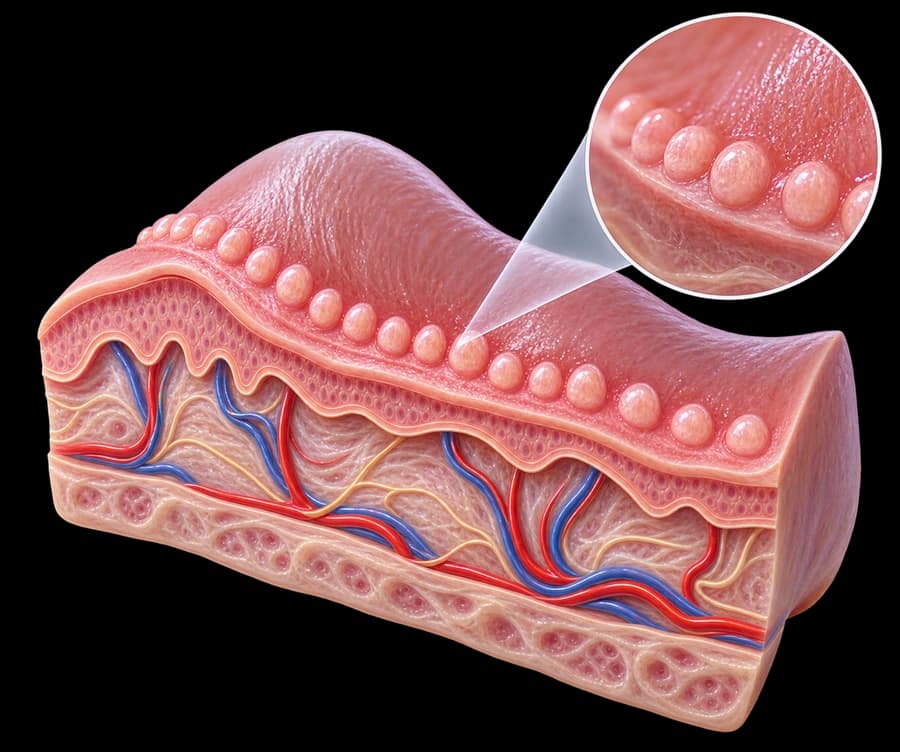
Pearly penile papules (PPP, hirsuties papillaris penis, hirsuties coronae glandis) are small benign papular lesions arranged circumferentially around the corona of the glans penis.
They constitute a normal anatomical variant — not a pathology, not an infection, not a sexually transmitted disease. Histologically they correspond to angiofibromas — benign connective tissue with increased vasculature.
First described in 1845 by Tilbury Fox. The terminology is internationally inconsistent — «pearly» due to the whitish, pearl-like appearance.
Epidemiology & etiology
- Prevalence: 14-48% of post-pubertal males (varies by study and population).
- More common in uncircumcised men (22-48%) than circumcised (7-19%).
- Onset usually in adolescence or young adulthood (15-25 years).
- May disappear or decrease in number with age.
- Not related to sexual activity, hygiene or partner gender.
- Etiology unknown — possible hyperplasia of vascular-connective tissue of the glans.
- NOT caused by HPV or other microorganism.
- Possible evolutionary role (analogous to other primates) not confirmed.
Clinical picture
Size
1-3 mm in diameter, small and uniform.
Shape
Dome-shaped, round or oval, smooth surface.
Color
Pearly white, cream, pink or skin-colored.
Arrangement
Symmetrical, circumferential, in 1-3 rows around the corona of the glans.
Characteristics:
- Completely asymptomatic — cause no pain, itching or discomfort.
- Do not change in size, color or shape over time.
- Do not bleed, do not ulcerate.
- Do not extend beyond the coronal sulcus.
- May become less prominent with age.
- Do not affect sexual function.
Differential diagnosis
Genital warts (HPV)
Exophytic, asymmetrical, in various locations (not only the corona). Acetowhitening positive. Contagious.
Molluscum contagiosum
Round papules with central umbilication. More scattered. Contagious.
Tyson glands
Sebaceous glands beneath the frenulum — not on the corona. Normal.
Fordyce spots
Ectopic sebaceous glands, whitish or yellow. More common on the scrotum and shaft. Normal.
Syringomas
Benign tumors of sweat glands. More extensive, skin-colored.
Lichen nitidus
Multiple small shiny papules, rare.
Bowenoid papulosis
Pigmented papules associated with high-risk HPV, premalignant. Biopsy required.
Diagnosis
Clinical examination
Inspection of the glans with good lighting. The symmetrical, circumferential arrangement in rows around the corona is pathognomonic.
Dermoscopy
Reveals characteristic whitish vessels on a pink background. Differentiates from genital warts (mosaic vascular pattern).
Acetic acid test (5%)
NO whitening of pearly penile papules (negative) — in contrast to genital warts which whiten.
Biopsy
Rarely needed — only for atypical or asymmetrical findings or for differential with bowenoid papulosis. Histology: angiofibromas.
Management & reassurance
No medical treatment is recommended — this is a benign, asymptomatic, normal anatomical variant.
Reassurance & education
Information that this is a normal finding, very common (up to 48% of men). NOT an STI, NOT an infection, NOT a malignancy. Does not affect fertility, sexual function or partner's health.
Cosmetic removal (selective)
In selected cases of severe psychological distress or aesthetic concern: CO₂ laser (most effective method, minimal scarring), electrodessication, cryotherapy. All performed under local anesthesia.
Complications of cosmetic removal
Possible: minor scarring, hypo-/hyperpigmentation, reduced glans sensitivity, recurrence. Discussion of realistic expectations is essential before any intervention on an asymptomatic normal finding.
Psychological support
In men with intense anxiety or body dysmorphia, proper information is usually sufficient. In cases where anxiety significantly affects quality of life, psychological referral may be needed.
Frequently asked questions (FAQ)
What are pearly penile papules?
Benign anatomical variant — small (1-3 mm) pearly white or skin-colored papules arranged circumferentially around the corona of the glans penis. NOT a sexually transmitted infection, NOT contagious.
How common are they?
Very common — present in 14-48% of post-pubertal males. More common in uncircumcised men and young adults. A completely normal anatomical finding.
Are they contagious or sexually transmitted?
NO. They are not transmitted through sexual contact, are not caused by a virus, and are not related to poor hygiene. They are a benign anatomical variant that develops naturally during puberty.
How is the diagnosis made?
Clinical, by inspection. Characteristic symmetrical, circumferential arrangement around the coronal sulcus in 1-3 rows. Dermoscopy can help in unclear cases. Biopsy rarely needed.
What can they be confused with?
Genital warts (exophytic, asymmetrical, outside the corona), molluscum contagiosum (central umbilication), Tyson glands (under the frenulum), Fordyce spots (sebaceous glands) and syringomas. The characteristic circumferential arrangement aids diagnosis.
Do they need treatment?
NO. They are benign, asymptomatic, do not progress and cause no complications. No medical treatment is recommended. Most important is correct information and reassurance.
Is there cosmetic removal?
In selected cases of severe psychological distress or aesthetic concern, removal can be performed with CO₂ laser, electrodessication or cryotherapy. However, there is risk of recurrence and minor scarring — discussion of realistic expectations is critical.
Do they recur after removal?
Yes, in some cases, since they are a normal anatomical structure. Recurrence is less likely than with genital warts but possible.
Related topics
Concerned about papules on the glans?
Contact us for accurate diagnosis and reassurance. In most cases this is a normal, benign finding requiring no treatment.
Scientific literature
- Sonnex C, Dockerty WG. Pearly penile papules: a common cause of concern. Int J STD AIDS 1999;10(11):726-7 — pubmed.ncbi.nlm.nih.gov
- Aldahan AS, Brah TK, Nouri K. Diagnosis and Management of Pearly Penile Papules. Am J Mens Health 2018;12(3):624-627 — pubmed.ncbi.nlm.nih.gov
- Agrawal SK, Bhattacharya SN, Singh N. Pearly penile papules: a review. Int J Dermatol 2004;43(3):199-201 — pubmed.ncbi.nlm.nih.gov
- Rehbein HM. Pearly penile papules: incidence. Cutis 1977;19(1):54-7 — pubmed.ncbi.nlm.nih.gov
- EAU Guidelines on Sexually Transmitted Infections (2024) — differential diagnosis section — uroweb.org
Meet the doctor

Dr. Marinos Vasilas, Urologist – Andrologist
Dr. Marinos Vasilas offers safe diagnosis and comprehensive information regarding pearly penile papules. Emphasis on proper information and avoiding excessive therapeutic intervention in a normal anatomical finding.
View full profile


