My clinical approach
In genital warts, treatment individualization is key. Number, size and location of lesions, patient compliance and recurrence history determine choice.
I follow the guidelines of EAU 2024, CDC STI 2021 and BASHH 2022:
- Complete genital and perianal examination — search for associated lesions.
- 5% acetowhitening to reveal subclinical lesions in unclear cases.
- Urethral meatus inspection — intraurethral warts require urethroscopy.
- Systematic screening for other STIs (HIV, syphilis, hepatitis, chlamydia, gonorrhea).
- Partner notification and referral for clinical evaluation.
- Discussion of Gardasil-9 vaccination for unvaccinated men up to 45 years.
- Smoking cessation to reduce recurrence risk.
What are genital warts
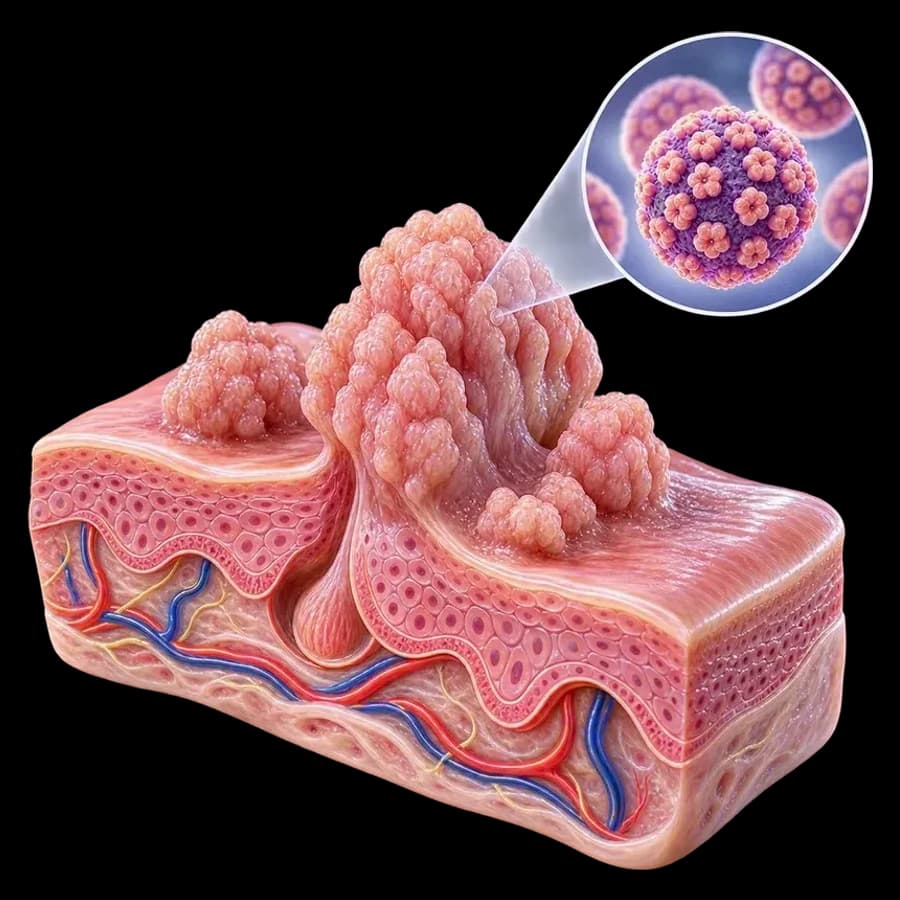
Condylomata acuminata (genital warts) are benign skin lesions caused by the human papillomavirus (HPV), mainly types 6 and 11 responsible for 90% of cases. These types are considered low oncogenic risk.
One of the most common sexually transmitted infections worldwide — estimated that 1% of the sexually active population has visible lesions, while 10-20% has subclinical infection.
Distinct from giant condylomata (Buschke-Löwenstein) — large tumors with potential for malignant transformation, and flat warts (more common on the cervix).
Transmission & epidemiology
- Transmission through direct skin contact during sexual intercourse (vaginal, anal, oral).
- Incubation period 3 weeks to 8 months (mean 2-3 months).
- Transmission probability from an infected partner: 60-70% in stable relationships.
- Rarely: vertical transmission from mother to newborn during delivery (juvenile respiratory papillomas).
- Non-sexual transmission (autoinoculation via fingers, towels) is rare but possible.
- Increased risk: multiple partners, young age, smoking, immunosuppression (HIV, transplant).
- Condoms: reduce but do not eliminate risk — transmission also from uncovered areas.
Clinical picture
Exophytic warts
Classic form — cauliflower-shaped lesions with multiple projections. Usually multiple, in clusters.
Flat warts
Smooth, slightly raised, skin-colored or brownish. Often subclinical — visible after acetowhitening.
Papular form
Smooth whitish or skin-colored papules, may be confused with pearly penile papules.
Buschke-Löwenstein (giant)
Rare, extremely large lesion with local aggressiveness and potential for malignant transformation to SCC.
Common locations in men:
- Glans, coronal sulcus, frenulum.
- Inner foreskin surface, penile shaft.
- Scrotum, perineal area.
- Perianal (more common in MSM).
- Intraurethral (1-25% — require urethroscopy).
- Anal canal (requires anoscopy in MSM and immunosuppressed).
Diagnosis
Clinical examination
Complete inspection of genitalia, perineum and perianal area with good lighting. Inguinal lymph node palpation.
Acetowhitening (5% acetic acid)
Application of gauze with 5% acetic acid for 5 minutes — HPV lesions appear white. Useful in subclinical lesions (not pathognomonic, low specificity).
Dermoscopy
Reveals characteristic vascular pattern (mosaic, glomerular). Increases diagnostic accuracy.
Urethroscopy / anoscopy
For lesions around the urethral meatus, hematuria or perineal/anal warts — exclude intraurethral or anal locations.
Biopsy
For unclear, pigmented (melanin), ulcerated, bleeding, recurrent lesions or in immunosuppressed — exclude Bowenoid papulosis, carcinoma in situ or SCC.
STI screening
Serological screening for HIV, syphilis, hepatitis B/C. Urethral PCR for chlamydia and gonorrhea. In female partners: Pap test.
Treatment
No therapy eradicates HPV from the body — treatment targets visible lesions and reduces transmissibility.
Patient-applied therapies
Imiquimod 5% cream (immunomodulator) — 3 times/week up to 16 weeks, clearance rate 35-50%. Podophyllotoxin 0.5% solution — 2 times/day × 3 days, 4-day pause, cycle up to 4 weeks, clearance 45-77%. Sinecatechins 15% (green tea) — 3 times/day up to 16 weeks, clearance 55%.
Clinician-applied destructive therapies
Cryotherapy (liquid nitrogen) — application every 1-2 weeks, clearance 60-90%, suitable for few-moderate lesions. TCA 80-90% — weekly chemical cauterization. Electrocautery / electrosurgery for hard lesions.
Surgical excision & CO₂ laser
Choice for extensive, recurrent, resistant or intraurethral lesions. CO₂ laser: precise vaporization with minimal scarring. Protective mask required (HPV in smoke). Clearance 60-90%.
Treatment selection by situation
Few small lesions: imiquimod or cryotherapy. Multiple lesions: combined approach (laser/surgery + imiquimod). Intraurethral: electroexcision/laser under cystoscopy. Pregnancy: ONLY cryotherapy/TCA/surgery (no imiquimod or podophyllotoxin).
Recurrence & follow-up
- Recurrence in 30-70% within 6 months after initial treatment.
- Reason: viral persistence in adjacent normal-appearing cells (latent infection).
- Reassessment after 4-6 weeks — response evaluation.
- Follow-up every 3 months for 6-12 months after healing.
- Risk factors for recurrence: immunosuppression, smoking, undiagnosed or resistant HPV type, non-compliance.
- Gardasil-9 vaccination after treatment may reduce recurrence.
- In repeated recurrences: biopsy to exclude malignancy, immune system check (HIV).
Prevention
- Gardasil-9 vaccination (9-valent) in boys and girls 9-14 years — >90% protection for types 6, 11, 16, 18.
- Catch-up vaccination up to 26 years (and up to 45 in selected cases).
- Condom use — reduces but does not eliminate risk.
- Limiting sexual partners.
- Smoking cessation — affects immune response.
- Pap test in female partners for cervical dysplasia detection.
- Immunosuppression: close follow-up and vaccination.
- Information and joint planning with partner.
Frequently asked questions (FAQ)
What are genital warts?
Benign skin lesions caused by the human papillomavirus (HPV), mainly low-risk types 6 and 11 (90% of cases). One of the most common sexually transmitted infections worldwide.
How are they transmitted?
Through sexual contact (vaginal, anal, oral) with skin-to-skin contact. Condoms reduce but do not eliminate risk, since HPV can be transmitted from uncovered areas. Incubation period 3 weeks to 8 months (mean 2-3 months).
How do they appear clinically?
Exophytic cauliflower-shaped lesions, skin-colored to pink or brown. Located on glans, foreskin, penile shaft, frenulum, scrotum, perineal and perianal area. Usually painless, sometimes itching or bleeding.
How is the diagnosis made?
Clinical examination (complete genital and anal inspection). 5% acetic acid test (acetowhitening) to highlight subclinical lesions. Dermoscopy. Biopsy for atypical, pigmented, ulcerated or recurrent lesions — to exclude Bowenoid papulosis or SCC.
What are the treatment options?
No therapy eradicates HPV — visible lesions are treated. Options: patient-applied (imiquimod 5% cream, podophyllotoxin 0.5%, sinecatechins 15%) or clinician-applied (cryotherapy with liquid nitrogen, TCA 80-90%, surgical excision, electrocautery, CO₂ laser).
Do they recur?
Yes, frequently. 30-70% of patients experience recurrence within 6 months after initial therapy, due to viral persistence in adjacent normal skin. Follow-up for 6-12 months recommended.
Are they associated with cancer?
Types 6 and 11 (causing classic genital warts) have low oncogenic potential. However, patients often co-carry high-risk HPV types (16, 18). Comprehensive evaluation and anorectal examination recommended in MSM, plus partner screening (Pap test).
How can they be prevented?
Vaccination with Gardasil-9 (9-valent) in boys and girls 9-14 years — >90% protection for types 6, 11, 16, 18. Condom use. Limiting sexual partners. Partner notification and screening. Smoking cessation (affects immune response).
Should I notify my partner?
Yes. Sexual partners from the past 6 months should be notified for clinical examination, even without visible lesions. Additionally, screening for other STIs (HIV, syphilis, hepatitis) and Pap test for female partners.
Related topics
Have genital warts? Discreet and effective treatment
Contact us for a personalized therapeutic approach using modern techniques (CO₂ laser, cryotherapy, immunomodulators) and complete STI screening.
Scientific literature
- EAU Guidelines on Sexually Transmitted Infections (2024) — uroweb.org
- Workowski KA, Bachmann LH, Chan PA, et al. Sexually Transmitted Infections Treatment Guidelines, 2021. CDC MMWR Recomm Rep 2021;70(4):1-187 — cdc.gov
- Gilson R, Nugent D, Werner RN, et al. 2019 IUSTI-Europe guideline for the management of anogenital warts. J Eur Acad Dermatol Venereol 2020;34(8):1644-1653 — pubmed.ncbi.nlm.nih.gov
- Garland SM, Steben M, Sings HL, et al. Quadrivalent HPV vaccine: 4-year end-of-study analysis. Lancet Infect Dis 2009;9(3):203-12 — pubmed.ncbi.nlm.nih.gov
- Lacey CJ, Woodhall SC, Wikstrom A, Ross J. 2012 European guideline for management of anogenital warts. J Eur Acad Dermatol Venereol 2013;27(3):e263-70 — pubmed.ncbi.nlm.nih.gov
Meet the doctor

Dr. Marinos Vasilas, Urologist – Andrologist
Dr. Marinos Vasilas offers personalized diagnosis and treatment of genital warts with modern techniques (CO₂ laser, cryotherapy, immunomodulators) and complete STI screening per EAU 2024 and CDC STI 2021 guidelines.
View full profile


