My Clinical Approach
Adult phimosis is one of the most frequently misunderstood urological conditions. Many patients live with it for years, considering it "normal", when it actually causes recurrent infections, sexual problems and — in some forms — increases oncological risk.
The first step in correct management is differential diagnosis: is this a simple inflammatory phimosis that will respond to topical steroids, or is it fibrotic phimosis from lichen sclerosus (BXO)? The distinction is critical because it entirely determines the therapeutic strategy.
In my practice I consistently apply the following principles, in line with the EAU Guidelines on Paediatric Urology 2024 and the BAUS / AUA Guidelines on Adult Circumcision:
- Detailed assessment of the type of phimosis (inflammatory vs fibrotic / BXO).
- Always trial conservative therapy 4–8 weeks with topical steroids before surgical indication.
- In suspicion of BXO: low threshold for biopsy and histological assessment after circumcision.
- In recurrent balanoposthitis + phimosis: circumcision solves both problems definitively.
- Full informed consent on the impact of surgery on sexual function (preserved or improved).
Correct classification and individualised therapy (conservative or surgical) provides patients with definitive symptom resolution with minimal complications.
What is phimosis?
Phimosis is defined as the inability to fully retract the foreskin (prepuce) over the glans of the penis. It is one of the most common clinical findings in male urology.
Two main clinical entities are distinguished:
- Physiological phimosis: in neonates and infants, due to preputial-glanular adhesions. Resolves spontaneously in > 95% by age 16.
- Pathological phimosis: in adults, due to chronic inflammation, fibrotic changes, lichen sclerosus (BXO) or trauma. Does not self-resolve and requires medical intervention.
Prevalence in the general adult male population is estimated at 1–2%, but with higher rates in diabetics and men with a history of recurrent balanoposthitis.
Important: phimosis must never be managed with forceful retraction of the foreskin — this causes fissures, fibrotic worsening and risk of paraphimosis (emergency). See: paraphimosis.
Causes and classification
Acquired inflammatory phimosis
The most common cause in adults. Due to recurrent balanoposthitis leading to fibrotic stenosis of the preputial ring. Usually responds to topical steroids.
Phimosis from lichen sclerosus (BXO)
Characterised by a white fibrotic ring at the tip of the foreskin. Autoimmune aetiology, poor response to steroids, and increased risk of penile cancer of ~5%. Mandates surgical management with histology.
Acquired post-traumatic phimosis
From forceful retraction, catheterisation, penile surgery or trauma. Creates fibrotic scars producing stenosis.
Phimosis in diabetics
Very common due to recurrent candidal balanoposthitis associated with hyperglycaemia. Diabetes control is critical for prevention.
Physiological childhood phimosis
Present in 96% of newborns, resolves in 92% by age 6–7 and in 99% by puberty. No intervention is required unless it causes symptoms (UTI, balanoposthitis, ballooning on voiding).
Kayaba clinical classification
- Type I: full retraction without difficulty.
- Type II: retraction with glans exposure but a tight ring.
- Type III: partial retraction, only urethral meatus exposed.
- Type IV: no retraction possible — absolute phimosis.
Symptoms and clinical picture
Phimosis can be asymptomatic in mild forms but usually presents with a spectrum of symptoms that significantly impair quality of life:
Local objective
- Tight preputial ring
- Reduced or absent retractability
- White fibrotic ring (BXO)
- Ballooning of foreskin during voiding
- Fissures or superficial ulcers
Sexual
- Pain on erection
- Pain or inability for intercourse (dyspareunia)
- Fissures during intercourse
- Psychological burden
- Avoidance of sexual activity
Functional / urological
- Dysuria (burning, pain)
- Intermittent or deviated urinary stream
- Ballooning beneath foreskin
- Urinary tract infections
- Meatal stenosis
Inflammatory / hygiene
- Recurrent balanoposthitis
- Malodour
- Smegma accumulation
- Difficulty cleaning
- Skin lesions
Red flags — immediate urological assessment
- Paraphimosis: inability to reduce the foreskin after retraction — emergency.
- White fibrotic ring in an older patient — suspicion of BXO and penile cancer risk.
- Palpable mass or ulcer on the glans in chronic phimosis — urgent biopsy.
- Complete inability to void — acute urinary retention.
- Severe inflammation with fever in a diabetic — suspicion of Fournier gangrene.
Diagnosis and assessment
The diagnosis of phimosis is essentially clinical. In adult patients a structured algorithm is followed for classification, search for associated conditions and treatment planning:
Detailed clinical examination
Assessment of the degree of stenosis (Kayaba I–IV), search for white fibrotic ring (BXO), fissures or inflammation, measurement of preputial opening diameter.
Differential diagnosis: phimosis ↔ adhesions ↔ short frenulum
Short frenulum can mimic phimosis and requires a different approach (frenuloplasty). See: short frenulum.
Search for underlying pathology
HbA1c and fasting glucose (exclude diabetes), search for associated balanitis or lichen sclerosus.
Biopsy (when indicated)
In suspicion of BXO, chronic white plaques, older patients with new-onset phimosis, or suspicious lesions on the glans. Biopsy is the only tool to exclude cancer.
Sexual function assessment
IIEF and focused history for pain/dyspareunia, to document pre-treatment baseline.
Common diagnostic pitfalls
The most common mistake is confusing inflammatory phimosis (responsive to steroids) with fibrotic phimosis from BXO (requiring circumcision). Empirical steroid use without differentiation delays definitive treatment and allows progression of any premalignant lesion.
Phimosis and lichen sclerosus
Penile lichen sclerosus (BXO, formerly Balanitis Xerotica Obliterans) is the most serious cause of adult phimosis, due to fibrotic progression and increased oncological risk.
- Clinical sign: white sclerotic fibrotic ring at the tip of the foreskin.
- Associated symptoms: meatal stenosis, white plaques on the glans, sclerosis.
- Response to topical steroids (clobetasol 0.05%): limited — < 30% complete remission.
- Risk of progression to penile cancer: ~5% in chronic untreated cases.
- Indication for definitive treatment: circumcision with histology of the specimen.
- Post-circumcision follow-up: annual clinical reassessment for recurrence or neoplastic progression.
Critical guidance: in any adult patient with phimosis and clinical signs of BXO, circumcision is not optional — it offers a dual benefit (therapeutic and diagnostic via histology). Related: lichen sclerosus and penile cancer.
Treatment
Topical corticosteroids — first-line in inflammatory phimosis
Betamethasone 0.05% or clobetasol 0.05% topically twice daily for 4–8 weeks, combined with gentle stretching exercises. Success in 65–95% of non-fibrotic forms. Reassessment at 4 weeks.
Stretching exercises
Gentle, gradual retraction of the foreskin to the limit of comfort, 5 minutes × 2 daily, combined with steroids. NEVER forceful.
Adult circumcision
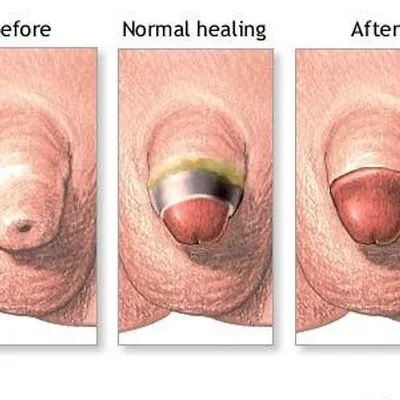
Definitive treatment. Indications: failure of conservative therapy, BXO, recurrent balanoposthitis, painful intercourse, meatal stenosis, psychological burden. Performed under local or regional anaesthesia, duration 30–45 minutes, recovery 2–4 weeks. See: adult circumcision.
Preputioplasty
Alternative option in selected cases: partial widening of the ring without complete removal of the foreskin. Not recommended in BXO.
Treatment of underlying factors
Strict glycaemic control, treatment of associated balanoposthitis, treatment of any STIs identified.
Prevention and daily care
- Daily meticulous hygiene under the foreskin with lukewarm water.
- Avoidance of perfumed soaps and antiseptic solutions.
- Never forceful retraction — particularly in children.
- Strict glycaemic control in diabetics.
- Prompt management of every balanoposthitis episode.
- Early urological consultation for retraction difficulty.
- Follow-up after paraphimosis episodes.
Follow-up and prognosis
Prognosis is excellent with the right individualised therapy. Inflammatory forms respond to steroids in > 80%. Circumcision offers definitive resolution with low complication rate (< 3%).
- Reassessment at 4 weeks after starting conservative therapy.
- After circumcision: review at 2 weeks, 3 months, 12 months.
- In patients with BXO: annual clinical follow-up for early detection of penile cancer.
- Patients who completed circumcision are recurrence-free in the majority of cases.
In summary: correct classification of phimosis and individualised therapy (conservative or surgical) provide patients with full symptom relief, restoration of sexual function and a safe long-term outcome.
Frequently asked questions (FAQ)
What exactly is phimosis?
Phimosis is the inability to fully retract the foreskin over the glans. It is divided into physiological (in children, usually self-resolving by puberty) and pathological (acquired in adults due to chronic inflammation, lichen sclerosus or trauma).
When is phimosis pathological in adults?
When it causes symptoms: pain on erection or intercourse, recurrent balanoposthitis, voiding difficulty, hygiene problems, or when accompanied by a fibrotic white ring (lichen sclerosus). In these cases active management is required.
Are all phimoses the same?
No. We distinguish: (1) physiological childhood phimosis, (2) acquired phimosis from chronic inflammation, (3) phimosis from lichen sclerosus (BXO) with the characteristic white fibrotic ring, and (4) phimosis after trauma or surgery. Each type has a different approach and prognosis.
Can it be treated without surgery?
Yes, in selected cases. Topical steroids (betamethasone 0.05% or clobetasol 0.05%) twice daily for 4–8 weeks, combined with gentle stretching exercises, achieve success in 65–95% of non-fibrotic forms. In phimosis from lichen sclerosus the response is significantly lower.
When is circumcision indicated?
In failure of conservative therapy, recurrent balanoposthitis, lichen sclerosus, dysuria from meatal stenosis, painful erections, and as prevention of penile cancer in chronic BXO. Adult circumcision under local or regional anaesthesia is safe and offers definitive resolution.
Does it affect sexual function?
Untreated phimosis can cause painful intercourse, dyspareunia, fissures and psychological burden. Adult circumcision does not impair erectile function or orgasmic experience — studies show preserved or improved sexual satisfaction.
Is phimosis related to penile cancer?
Chronic phimosis, particularly when associated with lichen sclerosus (BXO), significantly increases the risk of penile squamous cell carcinoma. New-onset phimosis in an older patient is a red flag and mandates biopsy.
What are the risks if left untreated?
Paraphimosis (urological emergency), recurrent infections, meatal stenosis, chronic pain, sexual dysfunction and — in chronic BXO — significantly increased risk of penile cancer.
Related Topics
Book your appointment in Rhodes
For phimosis causing pain, recurrent inflammation, sexual difficulty or suspicion of lichen sclerosus, correct clinical assessment and individualised therapy (conservative or circumcision) resolve the problem definitively.
Scientific References
- EAU Guidelines on Paediatric Urology (2024) — Phimosis — uroweb.org
- Moreno G, Corbalán J, Peñaloza B, Pantoja T. Topical corticosteroids for treating phimosis in boys. Cochrane Database Syst Rev 2014;9:CD008973 — pubmed.ncbi.nlm.nih.gov
- Kirtschig G, Becker K, Günthert A, et al. Evidence-based (S3) Guideline on (anogenital) Lichen sclerosus. J Eur Acad Dermatol Venereol 2015;29(10):e1-e43 — pubmed.ncbi.nlm.nih.gov
- Morris BJ, Krieger JN. Does male circumcision affect sexual function, sensitivity, or satisfaction? A systematic review. J Sex Med 2013;10(11):2644-2657 — pubmed.ncbi.nlm.nih.gov
Meet the Physician

Dr. Marinos Vasilas, Urology Surgeon – Andrologist
Dr. Marinos Vasilas runs a private urology practice in Rhodes with a particular focus on foreskin disorders and microsurgical adult circumcision. He guides patients through both the conservative and the surgical management of phimosis, based on the most recent international guidelines.
View full profile


