My clinical approach
Genital molluscum contagiosum in adults requires therapeutic intervention to prevent transmission to partners and autoinoculation.
Per the guidelines of EAU STI 2024, CDC STI 2021 and IUSTI 2020:
- Complete genital and perigenital inspection — search for all lesions.
- Dermoscopy in unclear or atypical cases.
- Differential from genital warts, pearly penile papules, basal cell carcinoma.
- Screening for other STIs (HIV, syphilis, hepatitis B/C, chlamydia, gonorrhea) — especially with multiple partners.
- In extensive or atypical lesions: assessment of immune status (HIV test).
- Partner notification and clinical examination.
- Counsel on avoidance of scratching and shaving the area.
What is molluscum contagiosum
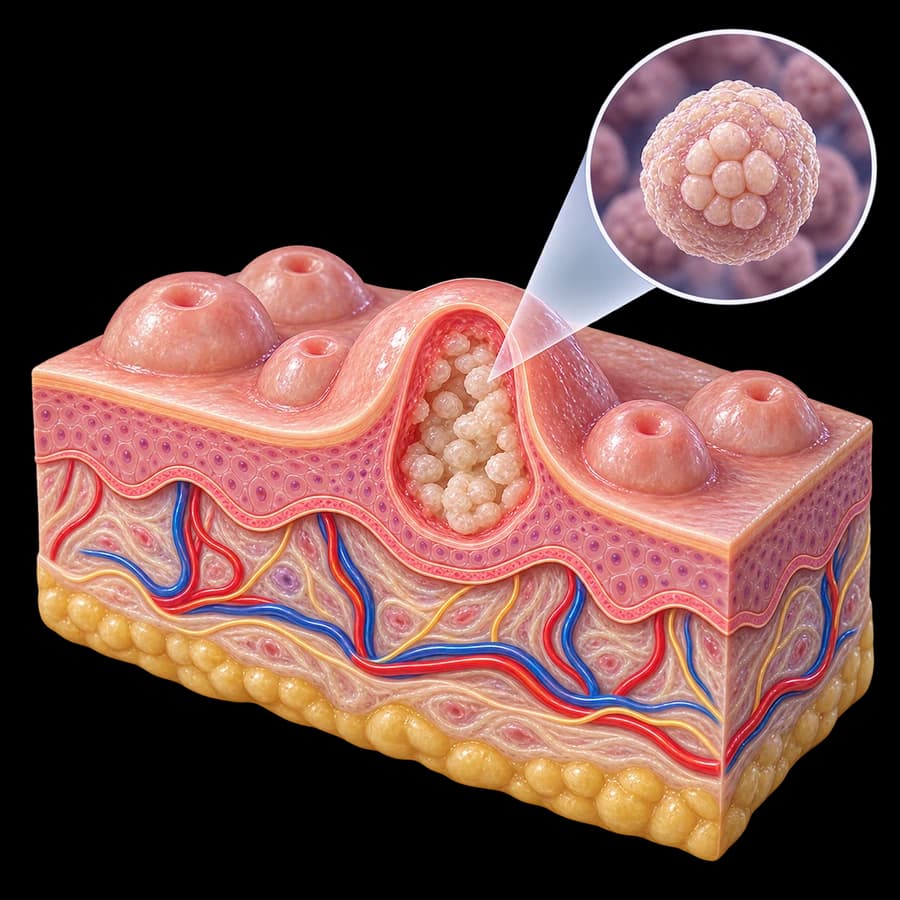
Molluscum contagiosum is a benign skin infection caused by molluscum contagiosum virus (MCV), a member of the Poxviridae family (DNA virus). The virus exclusively infects the epidermis.
There are 4 types (MCV-1 to MCV-4). MCV-1 is most common overall (mainly in children), MCV-2 mainly causes sexually transmitted infections in adults.
The disease is worldwide. Higher prevalence in children 1-10 years, sexually active adults and immunosuppressed individuals (HIV, transplant, chemotherapy).
Transmission & epidemiology
- Direct skin-to-skin contact — main mode of transmission.
- Sexual transmission in adults with genital location.
- Autoinoculation: spread by scratching or shaving the affected area.
- Indirect transmission: shared towels, sports equipment, sponges.
- Swimming pools, saunas, gyms — epidemiologically involved mainly in children.
- Incubation period 2 weeks - 6 months (mean 2-3 months).
- Duration of contagiousness: as long as visible lesions are present.
- Increased risk: atopic dermatitis (skin barrier), immunosuppression, sexually active.
Clinical picture
Size
2-5 mm in diameter. In immunosuppression may reach 10-15 mm (giant molluscum).
Shape
Round, dome-shaped papules with characteristic central umbilication (dell).
Color
White, cream or pink. Shiny surface.
Number
1-30 in immunocompetent, hundreds in immunosuppression.
Locations in adults:
- Penis (shaft, glans), scrotum.
- Pubis, thighs, lower abdomen.
- Perianal and anal area (often in MSM).
- Rarely in urethra or mouth.
- On face and eyelids — suspect advanced HIV infection.
Symptoms: usually asymptomatic. Rarely itching, eczematization around lesions (molluscum dermatitis), secondary bacterial infection from scratching.
Diagnosis
Clinical examination
Inspection of entire genital, pubic and perigenital area with good lighting. Search for characteristic umbilication.
Dermoscopy
Reveals central umbilication (corona of small vessels, "polylobed white structure") — highly sensitive and specific.
Differential diagnosis
From genital warts (exophytic, no umbilication), pearly penile papules (circumferential on corona), Fordyce spots, basal cell carcinoma.
Biopsy
Rarely needed — only for atypical, extensive or resistant lesions. Histology: Henderson-Patterson bodies (viral inclusions).
STI screening
Serological screening for HIV, syphilis, hepatitis B/C. Urethral PCR for chlamydia and gonorrhea.
HIV test
In extensive (>30 lesions), giant or resistant lesions, or facial location — strong suspicion of immunosuppression.
Treatment
In immunocompetent adults the disease is self-limiting (6-12 months), but treatment is recommended for genital location to prevent transmission.
Physical removal
Curettage — fast, effective (90-95%), local anesthesia. Cryotherapy with liquid nitrogen — application 6-10 sec per lesion, sessions every 2-3 weeks, clearance rate 70-90%. Electrodessication for resistant lesions.
Topical pharmacological therapies
Imiquimod 5% (off-label) — immunomodulator, 3 times/week up to 16 weeks. Podophyllotoxin 0.5% — 2 times/day × 3 days, 4-day pause. Cantharidin 0.7% (where available) — application by physician with cotton swab. Potassium hydroxide 5-10% — application 2 times/day, good efficacy.
CO₂ Laser
Choice for extensive, resistant or in immunosuppression. Precise vaporization with minimal scarring. Efficacy 80-95%.
Special situations
HIV/immunosuppression: numerous, resistant lesions — combined therapy (laser + imiquimod). Improvement with antiretroviral therapy. Pregnancy: avoid imiquimod and podophyllotoxin — only cryotherapy or curettage.
Prevention
- Avoid scratching lesions — autoinoculation risk.
- Avoid shaving the affected area.
- Condoms — reduce but do not eliminate transmission.
- Do not share towels, razors or other personal items.
- Cover lesions with waterproof tape at swimming pools/gyms.
- Partner notification and screening.
- Avoid sexual contact until complete clearance.
- Immune system support — smoking cessation, good nutrition.
Frequently asked questions (FAQ)
What is molluscum contagiosum?
A benign viral skin infection caused by molluscum contagiosum virus (MCV, Poxviridae family). Presents with characteristic papules with central umbilication. In adults it is often a sexually transmitted infection.
How is it transmitted?
By direct skin-to-skin contact (sexual contact in adults), autoinoculation (from scratching) and indirectly through shared items (towels, sports equipment). Incubation period 2 weeks to 6 months.
How does it appear clinically?
Small (2-5 mm) round papules, white-pink colored, with characteristic central umbilication (dell). In adults located mainly on the genital area, pubis, thighs and lower abdomen.
How is the diagnosis made?
Clinical, by inspection. In unclear cases: dermoscopy (reveals central umbilication and peripheral vessels). Biopsy rarely needed (Henderson-Patterson bodies on histology).
Is treatment needed?
In immunocompetent adults it is self-limiting (spontaneous resolution in 6-12 months). Treatment is recommended for genital location (avoid transmission), severe cosmetic concern, or in immunosuppression. Options: cryotherapy, curettage, electrodessication, imiquimod, podophyllotoxin.
Is it a sexually transmitted infection?
In adults with genital lesions it is considered an STI. Screening for other STIs (HIV, syphilis, hepatitis, chlamydia) and partner notification recommended. In children transmission is non-sexual (contact, play, swimming pools).
How common is recurrence?
Recurrence in 13-35% after treatment, due to autoinoculation or new exposure. In immunosuppression (HIV, chemotherapy) lesions are numerous, extensive and treatment-resistant.
How can transmission be prevented?
Avoid scratching (autoinoculation). Condoms reduce risk. Do not share towels, razors. Avoid shaving the affected area. Children: avoid shared towels at swimming pools.
Related topics
Suspicious lesions with central umbilication?
Contact us for accurate diagnosis and personalized therapeutic approach with modern techniques (curettage, cryotherapy, CO₂ laser) and complete STI screening.
Scientific literature
- EAU Guidelines on Sexually Transmitted Infections (2024) — uroweb.org
- Workowski KA, Bachmann LH, Chan PA, et al. CDC STI Treatment Guidelines, 2021. MMWR Recomm Rep 2021;70(4):1-187 — cdc.gov
- Edwards S, Boffa MJ, Janier M, et al. 2020 European guideline on the management of genital molluscum contagiosum. J Eur Acad Dermatol Venereol 2021;35(1):17-26 — pubmed.ncbi.nlm.nih.gov
- van der Wouden JC, van der Sande R, Kruithof EJ, et al. Interventions for cutaneous molluscum contagiosum. Cochrane Database Syst Rev 2017;5:CD004767 — pubmed.ncbi.nlm.nih.gov
- Chen X, Anstey AV, Bugert JJ. Molluscum contagiosum virus infection. Lancet Infect Dis 2013;13(10):877-88 — pubmed.ncbi.nlm.nih.gov
Meet the doctor

Dr. Marinos Vasilas, Urologist – Andrologist
Dr. Marinos Vasilas offers comprehensive diagnosis and treatment of molluscum contagiosum with modern techniques (curettage, cryotherapy, CO₂ laser, imiquimod) and complete STI screening per EAU 2024 and IUSTI 2020 guidelines.
View full profile


