The clinical approach
The assessment does not start with "let's do a penile Doppler." It always starts with questions that clarify exactly what is happening and which factors coexist:
- Is it a problem of achieving, maintaining, or hardness of erection?
- Is it constant or situational?
- Does it happen with every partner/situation or selectively?
- Are there spontaneous morning erections?
- Is sexual desire (libido) normal?
- Is there an ejaculation or orgasm problem?
- Is there curvature, a plaque, or pain on erection (Peyronie)?
- Is there diabetes, hypertension, dyslipidaemia, obesity, or smoking?
- Is there known cardiovascular disease?
- Is there neurological disease?
- Is there a history of radical prostatectomy, pelvic surgery, or radiotherapy?
- What medications is the patient taking?
- Is hypogonadism (low testosterone) suspected?
- Is there performance anxiety, depression, or relationship issues?
- What has the patient already tried, and how?
- Was any medication used correctly (dose, timing, stimulation)?
- What does the patient — and, where relevant, the partner — expect from treatment?
Before calling a treatment "failure", confirm that the diagnosis and the way the treatment was used were correct.
What is erectile dysfunction
Erectile dysfunction (ED) is defined as the persistent inability to attain and maintain an erection sufficient to permit satisfactory sexual performance. We do not keep an arbitrary fixed ≥3-month cutoff as a necessary diagnostic criterion — what matters is the persistence of the problem and the clinical context, not a specific number of calendar months. We do not tell a patient "you do not have ED because it has only been two months."
ED is a symptom, not one disease
Erectile dysfunction is often multifactorial. Possible mechanisms: vasculogenic, neurogenic, hormonal/endocrine, medication-related, postoperative/ post-radiotherapy, psychogenic/psychosexual, or mixed. We do not maintain the impression that "ED in men over 50 is basically vascular disease."
It becomes more common with age, but is not an inevitable consequence of ageing. This is more useful and less misleading than any fixed prevalence ratio by decade.
How an erection works
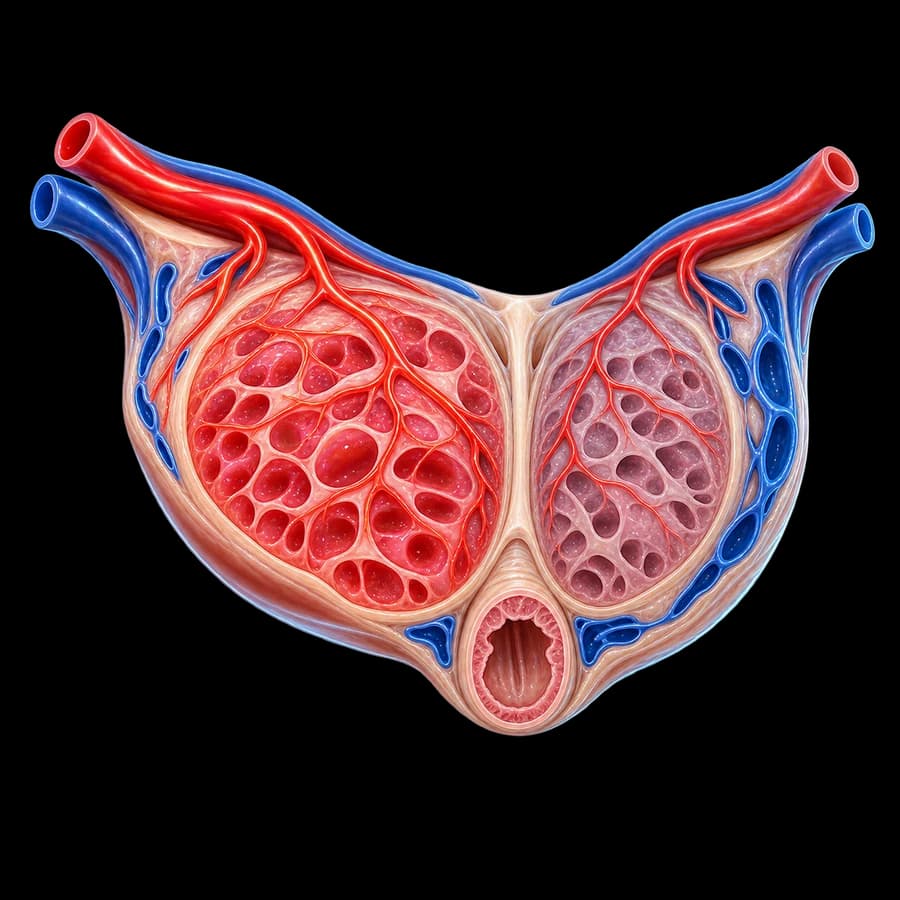
Erection is not simply a vascular phenomenon — it requires several systems working correctly together:
Sexual stimulation (brain/psychology) → neural signalling → release of nitric oxide (NO) → cGMP increase → smooth muscle relaxation → arterial inflow → cavernosal expansion → veno-occlusive mechanism → rigid erection.
Disruption at any of these stages — brain/psychological stimulus, nerves, hormones, vascular inflow, cavernosal tissue, or venous occlusion — can lead to ED. This is why assessment does not focus only on blood vessels.
Organic, psychosexual, or mixed aetiology
The old binary "organic versus psychogenic" is simplistic. Most cases have a mixed aetiology.
Organic contributors
These include vascular, neurological, hormonal, and structural causes (such as Peyronie disease), as well as medication-related factors.
Psychosexual contributors
These include performance anxiety, stress, depression, relationship issues, and personal sexual beliefs or expectations.
Psychological contribution does not mean the symptom is imaginary. Organic and psychosexual factors very often coexist in the same patient.
Preserved morning/nocturnal erections may provide useful clues, but they do not by themselves prove psychogenic ED, just as their absence does not alone prove organic ED. They are used as one part of the history, not as a binary test.
Desire, erection, ejaculation, orgasm
It is important to clearly separate these concepts:
- Libido: desire for sexual activity.
- Erection: the vascular/neuromuscular erectile response.
- Ejaculation: a separate mechanism from erection.
- Orgasm: a separate physical/sensory experience.
A man may have normal libido with ED, low libido without ED, ED with an ejaculation disorder, or a normal erection with an orgasmic disorder. See also our page on premature ejaculation.
Possible contributors
Vascular and metabolic factors are common contributors, particularly with ageing, diabetes, hypertension, dyslipidaemia, smoking and cardiovascular disease, but many patients have mixed aetiology. There is no single fixed distribution of causes that applies precisely to every population.
Vascular/metabolic
This group includes penile artery atherosclerosis, endothelial dysfunction, diabetes, hypertension, dyslipidaemia, smoking, obesity, and metabolic syndrome.
Neurological
This group includes diabetic neuropathy, multiple sclerosis, Parkinson disease, stroke, spinal cord injury, and penile trauma.
Hormonal/endocrine
This group includes hypogonadism, hyperprolactinaemia, and thyroid disorders, always combined with symptoms and a confirmed laboratory value, not suspicion alone.
Medication-related
This includes selected antidepressants, antipsychotics, antihypertensives, hormonal therapies, antiandrogens, and opioids. Medication review is always performed with the prescribing clinician, not by independent discontinuation.
Structural/postoperative
This group includes Peyronie disease, penile fracture, and ED after radical prostatectomy, radical cystectomy, or pelvic radiotherapy.
Psychosexual
This group includes performance anxiety, depression, relationship problems, and stress, often combined with organic factors rather than occurring alone.
ED and diabetes
In diabetes, ED may involve endothelial dysfunction, vascular disease, and neuropathy. We do not use unsupported statistics such as "75% of all diabetics develop ED" — good metabolic and cardiovascular risk management matters, but does not always fully reverse already-established ED.
IIEF / SHIM / EHS
Validated questionnaires such as the IIEF, SHIM/IIEF-5, and the Erectile Hardness Score (EHS) are used where appropriate, to objectify the severity of the symptom.
A questionnaire score does not replace diagnosis — it is one tool within the overall clinical picture, not the final conclusion.
Clinical examination
A focused clinical examination may include:
- Blood pressure and heart rate.
- BMI or waist circumference.
- Genital examination.
- Palpation for penile plaques/curvature (Peyronie).
- Testicular examination.
- Signs of hypogonadism where suspected.
- Vascular/neurological findings where clinically relevant.
We do not consider detailed inguinal artery palpation or extensive neurological testing mandatory in every patient, unless supported by guidelines for the specific clinical picture.
Basic laboratory work-up & testosterone
Basic metabolic/hormonal assessment, when not recently performed, typically includes:
- Fasting blood glucose or HbA1c.
- Lipid profile.
- Early morning, fasting, total testosterone (typically 07:00–10:00).
Not every man with ED needs the same hormone panel. Additional tests — calculated free testosterone/SHBG, LH, FSH, prolactin, PSA, TSH — are selected based on clinical context, not ordered routinely in every patient.
If a pathologically low value is found, a repeat measurement is required before diagnosing hypogonadism. Current guidance uses approximately <12 nmol/L in the appropriate symptomatic clinical context — not the older <3 ng/mL threshold as a universal cutoff.
Low testosterone can contribute particularly to low libido and reduced spontaneous erections, but many men with ED have normal testosterone. Testosterone should not be prescribed simply because erection quality is reduced — see the section on ED and low testosterone.
ED and cardiovascular health
ED and cardiovascular disease share common risk factors: diabetes, hypertension, dyslipidaemia, smoking, obesity, inactivity, and metabolic syndrome. Current guidelines consider ED an important marker/precursor of increased cardiovascular risk.
ED ≠ diagnosis of coronary artery disease
The correct response is risk assessment, not fear messaging. Per the Princeton IV Consensus (2024), men with ED are assessed for known cardiovascular disease, cardiovascular symptoms, blood pressure, diabetes, lipids, smoking, and overall cardiovascular risk.
The guideline explicitly notes that the Princeton algorithm should be adapted to the European setting, local expertise, availability, cost-effectiveness, and individual clinical profile — we do not hard-code an American risk calculator (ASCVD) without evaluating European applicability; where a European risk tool (e.g. SCORE2) is already used, that remains the reference framework.
In selected men with borderline/intermediate cardiovascular risk, coronary artery calcium (CAC) scoring may refine risk assessment — not every man with ED needs a cardiac CT or cardiology referral. The decision belongs to cardiovascular risk assessment, with low, indeterminate/ intermediate, and high-risk categories guiding whether sexual activity or ED therapy can resume, or whether cardiovascular evaluation/stabilisation is needed first in unstable/high-risk cardiac disease.
Dynamic penile Doppler (PDDU)
Most men with ED do not automatically need penile Doppler. Dynamic penile duplex ultrasound is a second-level diagnostic test, useful particularly when vasculogenic ED is suspected or when detailed haemodynamic information can influence management: diabetes, multiple cardiovascular risk factors, peripheral vascular disease, poor PDE5 response, selected pre-treatment planning, or a selected trauma/ revascularisation context.
Commonly used normal values are approximately PSV >30 cm/s, EDV <3 cm/s, and RI >0.8, but penile Doppler values must be interpreted in context, not as a three-number diagnosis. Known limitations include anxiety, inadequate pharmacological response, vasoactive-agent dose, lack of standardised metrics, and possible false-positive interpretation.
The term "venous leak" refers to failure to adequately maintain corporal pressure/venous occlusion — we avoid the oversimplified description "one vein is leaking and needs to be closed." The diagnostic assessment of venogenic ED has documented limitations, and venous ligation surgery is no longer recommended because of poor long-term results. Cavernosography/cavernosometry (DICC) is described as infrequently used, in highly selected diagnostic situations.
Penile revascularisation remains a highly selected treatment — mainly in younger men with focal arterial injury after pelvic/ perineal trauma and appropriate vascular confirmation, not a standard treatment for ordinary age-related vasculogenic ED.
NPTR / RigiScan
Nocturnal penile tumescence/rigidity testing (NPTR) can help in selected complex cases, but it is not routinely required. Limitations include sleep quality, age, depression, situational factors, and imperfect correlation with sexual erections. The older "stamp test" is no longer considered a modern clinical diagnostic method.
Principle of personalised treatment
Modern practice no longer frames treatment only as a rigid traditional first-line → second-line → third-line ladder. Treatment is chosen through a shared decision depending on:
- Aetiology and severity.
- Invasiveness and effectiveness.
- Tolerability and contraindications.
- Cost/access.
- Preference for spontaneity vs planning.
- Relationship context and patient preference.
PDE5 inhibitors remain guideline-recommended first-line therapy for most appropriate men, but other choices may be equally reasonable depending on informed patient preference.
Reversible contributors & lifestyle
Before or alongside ED-specific therapy, we address where relevant: diabetes, hypertension, dyslipidaemia, obesity, smoking, physical inactivity, medication effects, hypogonadism, and sleep/psychological factors.
Lifestyle modification complements ED treatment; it does not replace effective therapy when therapy is needed.
Medications affecting erection
Selected antidepressants, antipsychotics, antihypertensives, hormonal therapies, antiandrogens, and opioids may contribute to ED. Medication review should be performed with the prescribing clinician — we do not advise stopping medication independently.
PDE5 inhibitors
EMA-approved agents include sildenafil, tadalafil, vardenafil, and avanafil. PDE5 inhibitors remain first-line therapy. Choice depends on duration of action, spontaneity, frequency of sexual activity, adverse effects, previous experience, concomitant LUTS, and patient preference — no single agent is universally "best". Tadalafil 5 mg daily also has an established role in appropriately selected men with ED and concomitant LUTS/ benign prostatic hyperplasia, without treating the prostate enlargement itself.
They require sexual stimulation — they facilitate the physiological erectile response, they do not automatically create desire or a permanent erection without stimulation. A PDE5 inhibitor is not an aphrodisiac.
Before calling it a "failure"
We verify: correct drug, appropriate dose per prescription, correct timing, adequate sexual stimulation, food interaction where relevant, sufficient treatment attempts, absence of contraindicated co-medications, and hormonal/medical factors. Incorrect use is a common reason for apparent treatment failure. We do not provide a self-escalation protocol beyond the licensed dose.
PDE5 inhibitor + nitrate/nicorandil/poppers = DO NOT COMBINE
PDE5 inhibitors are absolutely contraindicated with organic nitrates, nitric oxide donors, and recreational nitrates ("poppers"), as well as with nicorandil because of its nitrate-like NO-donor activity. Combining can cause a dangerous drop in blood pressure. Do not independently stop cardiac medication to use an ED drug.
General avoidance of antihypertensives is not needed — combined blood-pressure reductions are usually small in appropriately selected patients, but specific interactions must always be checked individually.
Vacuum Erection Device (VED)
A non-pharmacological, non-invasive option, useful in selected men. Possible drawbacks: bruising, discomfort, numbness, interference with ejaculation, and its mechanical nature. Contraindications such as bleeding disorders/anticoagulation are checked before use; we do not state spectacular efficacy percentages without context.
Intracavernosal & intraurethral injections
Intracavernosal alprostadil therapy can be an alternative first-line therapy in well-informed patients, or a second-line therapy. It is effective, but requires patient education/training and carries possible penile pain, prolonged erection/priapism, fibrosis, and possible treatment discontinuation.
Priapism: a medical emergency
A prolonged, painful, rigid erection after vasoactive treatment requires urgent medical evaluation. We do not provide home aspiration/injection instructions here. See our page on priapism.
Intraurethral/topical alprostadil is an option in well-informed men who cannot or do not wish to take oral therapy or intracavernosal injections, without overstating its efficacy.
Low-intensity shockwave therapy (LI-SWT)
Evidence shows a mild average improvement in erectile function in selected vasculogenic patients — a weak recommendation, in: mild vasculogenic ED, men unwilling/unsuitable for oral therapy, or poor PDE5 responders with vasculogenic ED. LI-SWT is not a universal cure for ED.
An important distinction: the evidence is based largely on focused low-intensity shockwave therapy. A randomised trial of radial wave therapy did not show the same benefit — we do not use "radial pressure waves," "acoustic wave therapy," and "shockwave therapy" as interchangeable, equally evidence-based concepts.
PRP, stem cells, botulinum toxin, supplements
PRP ("P-Shot")
Intracavernosal PRP has shown some promising findings, but evidence remains insufficient to provide a recommendation for routine clinical use. We do not market it as established or regenerative therapy.
Stem cells
Current evidence remains insufficient for clinical recommendation; it remains an investigational approach.
Botulinum toxin (BoNT-A)
Emerging, limited evidence in refractory ED — not a standard therapeutic option.
Supplements
L-arginine and ginseng may produce at most a mild benefit in selected men with mild ED who decline pharmacological therapy. "Natural" does not automatically mean effective or interaction-free — we do not market herbal Viagra, testosterone boosters, or nitric oxide supplements.
Psychosexual therapy & partner involvement
Cognitive behavioural/psychological intervention, where indicated, is strongly supported — ideally combined with medical treatment where appropriate. This addresses performance anxiety, relationship context, depression, stress, and sexual beliefs/expectations. Psychosexual treatment and biological treatment are complementary, not competing explanations.
When the patient wishes, partner involvement can improve understanding, expectations, adherence, and sexual communication — it is not mandatory, and confidentiality and sexual orientation are always respected.
ED after pelvic surgery
ED is common after radical prostatectomy, radical cystectomy, or pelvic radiotherapy, through neural injury, vascular injury, tissue changes, or hormonal/systemic treatment.
No specific penile rehabilitation regimen has been proven to reliably restore spontaneous erectile function. Regular PDE5-based rehabilitation after radical prostatectomy has not been shown to increase spontaneous erectile-function recovery. Nonetheless, pro-erectile treatment should be discussed early after surgery according to individual goals. Nerve-sparing surgery does not guarantee erection recovery.
ED and Peyronie disease
When curvature, a plaque, shortening, pain, or a hinge deformity coexists, we assess for Peyronie disease, which can affect penetration, rigidity, and psychosexual function — details on the dedicated page.
ED and low testosterone
With ED plus low desire, fatigue, or reduced morning erections, we evaluate for possible hypogonadism — but ED is not automatically treated with testosterone. Exogenous testosterone suppresses spermatogenesis and is not recommended in men seeking fertility. Details on our page about low testosterone.
Penile prosthesis
A penile prosthesis is recommended when other treatments fail, or depending on informed patient preference — it is not simply a "last resort after everything else has failed", but a valid definitive mechanical treatment choice for an appropriately counselled patient. Types: inflatable (two- or three-piece) and malleable/semi-rigid — no single implant is universally superior.
It is surgical and involves infection risk, mechanical failure risk, revision possibility, and irreversible alteration of erectile mechanics. Where satisfaction/ durability rates are mentioned, they come from contemporary literature with a specified population, device, and follow-up — not undocumented personal clinic outcomes. Details on surgery, recovery, and complications on our penile prosthesis page.
Common misconceptions
"Viagra didn't work once, so it doesn't work for me"
One unsuccessful attempt does not establish treatment-resistant ED. Correct use is checked first.
"If I need a pill, I'll become dependent"
PDE5 inhibitors do not cause physiological addiction in the conventional sense, though psychological reliance/expectations may occur in some contexts.
"ED means low testosterone"
False. Many men with ED have normal testosterone; diagnosing hypogonadism requires compatible symptoms AND a repeated low measurement.
"I have morning erections, so nothing physical can be wrong"
False. Preserved spontaneous erections suggest a preserved erectile mechanism but do not exclude mixed/organic contributors.
"I'm young, so it must be psychological"
False. Younger men can have medication effects, hormonal disorders, diabetes/metabolic disease, trauma, vascular abnormalities, or mixed causes — not only psychological.
"I have ED, so my heart arteries must be blocked"
False. ED is associated with increased cardiovascular risk and can precede recognised CVD in some men, but it does not diagnose coronary artery obstruction.
"Shockwaves cure ED"
False. Current evidence suggests only mild average improvement in appropriately selected vasculogenic ED — no cure guarantee or permanent vascular regeneration claim.
"PRP regenerates the penis"
False. Current evidence remains insufficient for a routine clinical recommendation — we do not use regenerative marketing language.
The patient journey
- 1Difficulty achieving or maintaining an erection.
- 2Comprehensive medical, sexual, and psychosexual history.
- 3Validated questionnaire (IIEF/SHIM/EHS) where needed.
- 4Focused clinical examination.
- 5Basic work-up: blood pressure/metabolic risk, glucose or HbA1c, lipids, morning fasting testosterone.
- 6Identification of cardiovascular, endocrine, neurological, medication-related, structural, postoperative, or psychosexual contributors.
- 7Cardiovascular risk assessment where appropriate.
- 8Specialised penile haemodynamic testing only when it can change management.
- 9Shared decision among evidence-based treatment options.
- 10Verifying correct treatment use before declaring failure.
- 11Reassessing efficacy, safety, satisfaction, and patient/partner goals.
Frequently asked questions (FAQ)
What is erectile dysfunction (ED)?
The persistent inability to achieve or maintain an erection sufficient for satisfactory sexual performance. It is not one disease but a symptom that can have vascular, neurological, hormonal, medication-related, surgical, or psychosexual causes — often in combination.
Does it have to last 3 months to "count"?
Not necessarily as a strict cutoff. What matters is persistence and clinical context, not an arbitrary number of calendar months. A problem lasting a few weeks that concerns the patient is also worth assessing.
Is it a normal consequence of ageing?
It becomes more common with age, but it is not inevitable. Many men over 60-70 maintain good erectile function, especially without significant risk factors.
Is it always a vascular problem?
No. Vascular and metabolic factors (diabetes, hypertension, dyslipidaemia, smoking) are common contributors, particularly with ageing, but many patients have mixed aetiology — neurological, hormonal, medication-related, or psychosexual.
Is it always psychological?
No. A psychological contribution does not mean the symptom is imaginary. Most cases involve a combination of organic and psychosexual components.
Does it mean I have low testosterone?
Not necessarily. Many men with ED have normal testosterone. Diagnosing hypogonadism requires compatible symptoms AND a confirmed, repeated, morning fasting measurement.
Do I need a penile Doppler?
Not automatically. Dynamic penile Doppler ultrasound (PDDU) is a second-level test, useful in selected situations (e.g. suspected vascular cause, poor treatment response, planning before specific interventions) — not for every patient.
Does it mean I have heart disease?
ED can be associated with increased cardiovascular risk, but it is not a diagnosis of coronary artery disease. The correct response is cardiovascular risk assessment, not alarm.
What are the modern treatment options?
PDE5 inhibitors remain first-line therapy for most men. Other options (vacuum device, intracavernosal injections, intraurethral alprostadil, selected LI-SWT, penile prosthesis) are chosen individually based on aetiology, preference, and relevant contraindications — not in a rigid fixed order.
How do PDE5 inhibitors work?
They enhance the physiological erectile mechanism following sexual stimulation — they do not by themselves create desire or an erection without stimulation.
Why might a medication not have "worked"?
Before labelling a medication ineffective, we check: correct dose, correct timing, adequate stimulation, any food interaction, sufficient number of attempts, and hormonal/medical factors. Incorrect use is a common reason for apparent failure.
Can I take a PDE5 inhibitor with nitrates?
No — an absolute contraindication. Combining with nitrates, nicorandil, or recreational nitrates (poppers) can cause a dangerous drop in blood pressure.
What are intracavernosal injections?
A local injection of a vasoactive medication (e.g. alprostadil) directly into the corpus cavernosum — an alternative or second-line option in well-informed patients, with a possible side effect of prolonged erection.
Does low-intensity shockwave therapy (LI-SWT) help?
It can offer mild improvement in selected men with vasculogenic ED — it is not a permanent "miracle cure". Evidence relates mainly to focused shockwaves, not radial waves.
Has PRP ("P-Shot") been proven effective?
Not sufficiently. Current data are promising but insufficient for a general recommendation in routine clinical practice.
When is a penile prosthesis needed?
It is a valid definitive mechanical solution in appropriately informed patients when other treatments do not suit or do not suffice — not simply a "last resort after failure".
Related topics
Personalised Erectile Dysfunction Assessment
Investigating erectile dysfunction is not limited to prescribing one medication. Medical and sexual history, metabolic and cardiovascular risk factors, morning testosterone, and — only when there is a real indication — specialised tests such as dynamic penile Doppler help select the treatment that fits each man's needs and preferences.
Scientific literature
- EAU Guidelines on Sexual and Reproductive Health (2026) — Management of Erectile Dysfunction — uroweb.org
- EAU Guidelines on Male Hypogonadism (2026) — uroweb.org
- Nehra A, Jackson G, Miner M, et al. The Princeton IV Consensus recommendations for the management of erectile dysfunction and cardiovascular disease. Mayo Clin Proc 2024.
- Burnett AL, Nehra A, Breau RH, et al. Erectile Dysfunction: AUA Guideline. J Urol 2018;200(3):633-641 — auanet.org
- Sokolakis I, Hatzichristodoulou G. Clinical studies on low intensity extracorporeal shockwave therapy for erectile dysfunction: a systematic review and meta-analysis. Int J Impot Res 2019;31(3):177-194 — pubmed.ncbi.nlm.nih.gov
Meet the doctor

Dr. Marinos Vasilas, Urologist – Andrologist
Dr. Marinos Vasilas offers comprehensive, personalised assessment and treatment of erectile dysfunction — from the medical/sexual history and basic metabolic/hormonal work-up to modern treatment options, per the EAU 2026 guidelines.
View full profile


