My clinical approach
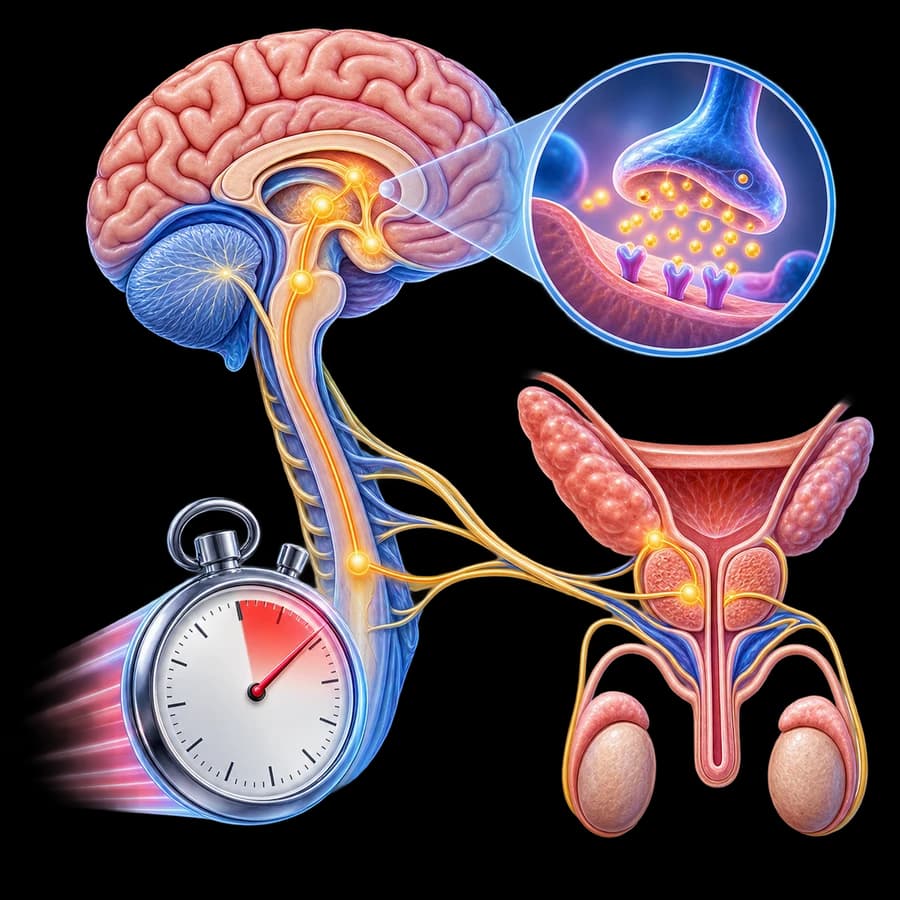
PE is mainly a penile sensory disorder with glandular hypersensitivity and neurobiological dysregulation of serotonergic pathways. The modern approach combines targeted pharmacotherapy (glandular relief + central regulation) with behavioral techniques.
Per the guidelines of EAU 2024 and AUA-SMSNA 2020:
- Detailed sexual history and symptom onset (lifelong vs acquired).
- Estimation of IELT (partner stopwatch or estimate).
- Completion of PEDT (Premature Ejaculation Diagnostic Tool).
- Assessment of IIEF-5 to exclude erectile dysfunction.
- Evaluation of partner and relationship (FSFI if feasible).
- Targeted examination: genitalia, penile and glans palpation.
- Targeted laboratory if suspected: TSH, PSA, urine culture (CPP).
- Discussion of pharmacotherapy and behavioral techniques.
What is premature ejaculation
ISSM 2014 definition (International Society for Sexual Medicine):
- Lifelong (primary) PE: ejaculation always or nearly always within 1 minute of penetration, from first sexual experience.
- Acquired (secondary) PE: clinically significant reduction in IELT, often to ≤3 minutes, after previous normal function.
- In all types: inability to delay ejaculation and negative personal consequences (stress, distress, sexual avoidance).
Prevalence: 20-30% worldwide — the most common male sexual dysfunction. Not associated with age, culture, ethnicity.
Penile sensory disorder — mechanism
Modern PE pathophysiology focuses on two axes:
1. Glandular hypersensitivity (peripheral)
Penile sensory disorder: increased density of nerve endings in penile glans or low perception threshold. Neurophysiological studies have shown low vibratory perception threshold in glans of patients with lifelong PE. This explains the efficacy of topical anesthetics (reduction of glandular input).
2. Serotonergic dysregulation (central)
In the spinal cord, serotonin (5-HT) regulates ejaculation. Stimulation of 5-HT2C receptors delays ejaculation. Stimulation of 5-HT1A receptors accelerates. In lifelong PE patients: hypersensitivity of 5-HT1A and hyposensitivity of 5-HT2C — basis for SSRI efficacy (increase in extracellular 5-HT).
3. Other factors
Genetic predisposition (5-HT transporter polymorphisms), psychological factors (performance anxiety), pelvic floor dysfunction, hormonal factors (hyperthyroidism), prostate inflammation (chronic prostatitis).
Classification (lifelong vs acquired)
Lifelong (Primary)
- • From first sexual experience
- • IELT <1 minute
- • Neurobiological/genetic basis
- • 5-HT hypersensitivity
- • Penile sensory hypersensitivity
- • Stable across all partners
Acquired (Secondary)
- • After normal function
- • IELT <3 minutes
- • Often coexists with ED
- • Chronic prostatitis
- • Hyperthyroidism
- • Psychosocial factors
Variable PE (physiological variant — occasional PE, no treatment required) and Subjective PE (normal IELT but subjective sensation of premature ejaculation — requires psychological support) are two distinct subtypes.
Diagnosis (IELT, PEDT)
History taking
PE onset (lifelong vs acquired), usual IELT, masturbation, sense of control, stress/relationship, presence of erectile dysfunction.
IELT timing
Stopwatch (by partner) or estimate. ≥4 intercourses for reliable mean. Lifelong: <1 min, Acquired: <3 min.
PEDT (Premature Ejaculation Diagnostic Tool)
5 questions, score 0-20. ≤8 no PE, 9-10 probable, ≥11 PE. Validated screening tool.
IIEF-5 to exclude concomitant ED
Up to 50% of ED patients have concomitant PE. In ED + PE: treat ED first.
Physical examination
Inspection/palpation of penis and glans, testes, prostate (DRE) in >40 or prostatitis suspicion.
Targeted laboratory
TSH if hyperthyroid suspicion, urine culture + EPS if chronic prostatitis, testosterone if associated symptoms.
Therapeutic approach
Per EAU 2024 and AUA-SMSNA 2020 — individualization based on subtype, severity and preference:
1. Dapoxetine — only approved pharmacotherapy
Dapoxetine 30-60 mg PRN 1-3 hours before intercourse. Short half-life SSRI specifically designed for on-demand use. IELT increase 2.5-3x. Side effects: nausea, dizziness, headache (usually mild). EAU 2024: strong recommendation for lifelong PE.
2. Topical anesthetics (glandular relief)
Lidocaine-Prilocaine cream/spray (EMLA) 10-15 minutes before intercourse. Fortacin spray (lidocaine 150 mg + prilocaine 50 mg) — approved formulation in EU. IELT increase 3-6x. Targets penile sensory hypersensitivity. Important: removal before intercourse or condom use to avoid anesthetic transfer to partner.
3. Off-label SSRIs (daily)
- • Paroxetine 20 mg/day — strongest IELT effect (8-9x).
- • Sertraline 50-100 mg/day.
- • Fluoxetine 20 mg/day.
- • Citalopram 20-40 mg/day.
Onset 1-2 weeks, full effect 3-4 weeks. Side effects: reduced libido, erection inversion, nausea. Off-label but widely used.
4. Tramadol PRN (off-label, alternative)
Tramadol 25-100 mg PRN 1-2 hours before. IELT increase 2-2.5x. Off-label — risk of dependence, avoid chronic use, serious interactions with SSRIs (serotonin syndrome).
5. PDE5 inhibitors in coexisting ED
In coexisting ED + PE: sildenafil or tadalafil — erection improvement reduces performance anxiety and often independently increases IELT. PDE5i + SSRI combination feasible in resistant cases.
6. Treatment of underlying cause (acquired PE)
Antibiotics for chronic prostatitis(fluoroquinolones 4-6 weeks). Antithyroid therapy for hyperthyroidism. Treatment of concomitant ED. Medication adjustment if culprit drugs.
Behavioral & lifestyle
- Stop-start technique (Semans): interrupt sexual stimulation before point of inevitability, 30-second pause, repeat 3-4 times before ejaculation.
- Squeeze technique (Masters-Johnson): partner compresses base of glans for 5-10 seconds at desired ejaculation point.
- Pelvic floor exercises (Kegel): bulbocavernosus muscle strengthening — 3 sets × 10 reps/day. IELT improvement up to 1.5x.
- Sex therapy / CBT for performance anxiety and relationship issues — always with partner.
- Female-on-top position can reduce stimulation.
- Double condom use or thicker type — reduces glandular stimulation.
- Masturbation 1-2 hours before — increases refractory period.
- Maintenance of cardiovascular health to avoid concomitant ED.
Frequently asked questions (FAQ)
What is premature ejaculation (PE)?
Per ISSM 2014 definition: ejaculation always or nearly always within 1 minute of penetration (lifelong PE) or a clinically significant and bothersome reduction in latency time often to ≤3 minutes (acquired PE), inability to delay, and negative personal consequences.
Is it very common?
It is the most common male sexual dysfunction — prevalence 20-30% worldwide, regardless of age, culture or ethnicity. Lifelong (primary) is more common in younger men.
What does IELT mean?
IELT = Intravaginal Ejaculatory Latency Time, the time from penetration to ejaculation. Normal 5-7 minutes. Lifelong PE: IELT <1 minute. Acquired PE: IELT <3 minutes (after previously normal function).
Is it a psychological problem?
Not exclusively. Lifelong PE is mainly considered a neurobiological disorder with serotonin (5-HT) receptor sensitivity and glandular hypersensitivity (penile sensory disorder). Acquired PE often accompanies erectile dysfunction, prostatitis or hyperthyroidism.
How is it diagnosed?
With targeted history, IELT estimation (partner stopwatch), PEDT (Premature Ejaculation Diagnostic Tool ≥11 = PE), IIEF-5 to exclude concomitant erectile dysfunction, and exclusion of prostatitis/hyperthyroidism.
What is the main pharmacotherapy?
First line: Dapoxetine 30-60 mg PRN 1-3 hours before intercourse — the only SSRI approved for PE with on-demand use. Topical anesthetics (lidocaine-prilocaine cream/spray) for glandular relief. Off-label: paroxetine, sertraline, fluoxetine daily.
How do topical anesthetics work?
They work by reducing glandular sensory hypersensitivity. Spray or cream (lidocaine 7.5% + prilocaine 2.5%) is applied to the glans 10-15 minutes before intercourse. Must be removed/covered with condom to avoid transfer to partner.
Do behavioral techniques help?
Yes, as part of combination therapy. Stop-start technique (Semans): interrupt stimulation before point of inevitability. Squeeze technique (Masters-Johnson): compress base of glans. Pelvic floor exercises (Kegel) — IELT improvement up to 1.5x.
Is PE associated with erectile dysfunction?
They often coexist (up to 50% of ED patients have PE). Fear of losing erection may accelerate ejaculation. In coexistence: first PDE5i for ED, then re-evaluate PE — often improves with PDE5i alone.
Related topics
Concerned about premature ejaculation?
Contact us for comprehensive evaluation with PEDT, IELT, IIEF-5 and individualized treatment — Dapoxetine, topical anesthetics and behavioral techniques tailored to your needs.
Scientific literature
- Serefoglu EC, McMahon CG, Waldinger MD, et al. An evidence-based unified definition of lifelong and acquired premature ejaculation: report of the second International Society for Sexual Medicine Ad Hoc Committee. J Sex Med 2014;11(6):1423-41 — pubmed.ncbi.nlm.nih.gov
- EAU Guidelines on Sexual and Reproductive Health (2024) — uroweb.org
- Shindel AW, Althof SE, Carrier S, et al. Disorders of Ejaculation: An AUA/SMSNA Guideline. J Urol 2022;207(3):504-512 — auanet.org
- Waldinger MD, Zwinderman AH, Schweitzer DH, Olivier B. Relevance of methodological design for the interpretation of efficacy of drug treatment of premature ejaculation: a systematic review and meta-analysis. Int J Impot Res 2004;16(4):369-81 — pubmed.ncbi.nlm.nih.gov
- Castiglione F, Albersen M, Hedlund P, et al. Current Pharmacological Management of Premature Ejaculation: A Systematic Review and Meta-analysis. Eur Urol 2016;69(5):904-16 — pubmed.ncbi.nlm.nih.gov
Meet the doctor

Dr. Marinos Vasilas, Urologist – Andrologist
Dr. Marinos Vasilas treats premature ejaculation with a comprehensive approach: PEDT, IELT, IIEF-5, exclusion of underlying cause (prostatitis, hyperthyroidism, concomitant ED), pharmacotherapy (Dapoxetine PRN, topical anesthetics Fortacin, off-label SSRIs) and behavioral techniques per EAU 2024 and AUA-SMSNA 2020.
View full profile


