My clinical approach
Penile Mondor's disease is a frequently underdiagnosed entity. Many patients present with intense anxiety believing they have Peyronie's or some serious condition. My goal is quick reassurance with a clear diagnosis and information.
In my practice I follow the EAU SRH 2024 guidelines for differential diagnosis and management:
- Clinical palpation and recognition of the characteristic hard cord.
- Confirmation with color penile Doppler — absence of flow in the vein.
- Differential diagnosis from Peyronie's disease and sclerosing lymphangitis.
- Conservative treatment — avoidance of unnecessary interventions.
- Hypercoagulability workup only for recurrence or atypical presentation.
- Reassurance and clear follow-up plan.
What is Mondor's disease
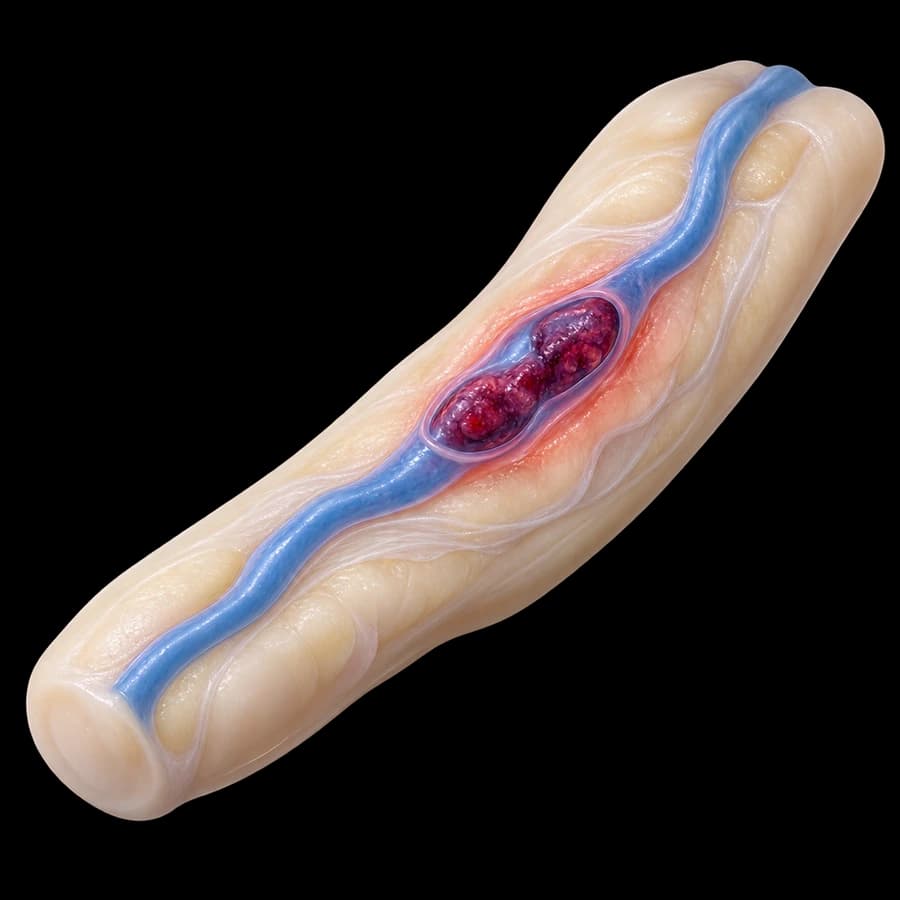
Mondor's disease is superficial thrombophlebitis, originally described by Henri Mondor in 1939 in veins of the chest wall. In the penis, it involves the superficial dorsal vein of the penis.
It is a rare entity — prevalence 1.4% in adult males. Usually presents in ages 20–40 years, with a history of vigorous or prolonged sexual activity. The course is self-limiting and prognosis is excellent.
Causes and risk factors
- Vigorous or prolonged sexual intercourse (most common cause).
- Prolonged sexual abstinence with sudden resumption.
- Penile trauma (mechanical, after manipulation).
- Iatrogenic: after penile biopsy, Doppler, catheterization.
- Infections (urethritis — rare).
- Pelvic or hypogastric surgery.
- Hypercoagulability (workup only for recurrence): factor V Leiden, antiphospholipid antibodies.
- Penile or lymphatic system neoplasms (rare).
Symptoms and clinical picture
- Palpable hard, cord-like swelling on the dorsal surface of the penis.
- Mild pain or discomfort (intense pain is unusual).
- Erythema or local warmth of the overlying skin.
- Discomfort during erection or sexual intercourse.
- Absence of systemic symptoms (fever, malaise).
- Onset often a few hours to days after vigorous intercourse.
- The cord is fixed, non-migratory, non-pulsatile.
Diagnosis
Detailed history
Onset of symptoms, relation to sexual activity/abstinence/trauma, prior episodes, history of thrombosis (DVT, pulmonary embolism), medications.
Physical examination
Palpation of the characteristic hard, cord-like swelling along the dorsal surface of the penis. Skin inspection, assessment of local inflammation.
Color penile Doppler
Diagnostic tool of choice. Confirms absence of flow in the superficial dorsal vein — thrombosis. Excludes Peyronie's disease or lymphangitis.
Hypercoagulability workup
Not needed for a single episode. Indicated only for recurrent disease or patients with history of other thrombotic events: factor V Leiden, prothrombin G20210A mutation, antithrombin III, proteins C/S, antiphospholipid antibodies.
Differential diagnosis
Peyronie's disease
Fibrous plaque in the tunica albuginea of the corpora cavernosa with penile curvature on erection. Not located along the vein.
Sclerosing lymphangitis
Lymphatic vessel swelling around the coronal sulcus, painless, self-limiting. Doppler shows lymph vessel, not vein.
Penile lymphocele
Lymphatic fluid collection after trauma or surgery. Soft palpable hernia, not a hard cord.
Urethritis
Urethral discharge, dysuria, burning. Does not produce a palpable cord on the dorsal surface.
Treatment
Management is conservative — the condition is self-limiting and usually resolves in 4–8 weeks:
- NSAIDs (ibuprofen 400–600 mg every 8 hours) for 7–14 days.
- Local warm compresses 2–3 times daily.
- Sexual abstinence for 4–6 weeks.
- Avoidance of vigorous physical activity in the acute phase.
- Anticoagulant therapy rarely — only for recurrence or documented hypercoagulability (superficial vein, low risk).
- Antibiotics only for clear infection (rare indication).
- Reassessment at 4 and 8 weeks — check for resolution.
- Hypercoagulability workup for recurrent episodes.
Prognosis and course
- Complete resolution in 4–8 weeks in the vast majority.
- Leaves no residual damage (curvature, erectile dysfunction).
- Sexual function returns fully.
- Does not increase risk of deep vein thrombosis or pulmonary embolism.
- Recurrence in <5% — hypercoagulability workup indicated.
- Excellent prognosis overall.
Frequently asked questions (FAQ)
What is Mondor's disease of the penis?
It is superficial thrombophlebitis of the dorsal penile vein. Presents as a palpable cord-like induration on the dorsal surface of the penis, with mild pain. It is a self-limiting condition, without systemic symptoms.
Is it a serious condition?
No. Mondor's disease is benign and self-limiting. It typically resolves within 4–8 weeks with conservative management. It does not increase the risk of systemic thrombosis or pulmonary embolism.
What are the causes?
Vigorous/prolonged sexual intercourse, prolonged sexual abstinence, penile trauma (after examination/biopsy/Doppler), rarely hypercoagulability. In a single episode, no extensive workup is required.
How is it differentiated from Peyronie's disease?
Mondor's disease produces a hard cord-like palpation along the dorsal vein, without penile curvature. Peyronie's disease produces a fibrous plaque in the tunica albuginea of the corpora cavernosa with curvature on erection. Penile Doppler confirms the absence of flow in the vein in Mondor's.
How is the diagnosis made?
Clinical examination (palpation of a hard, non-painful cord on the dorsal surface) and color Doppler ultrasound (absence of flow in the superficial dorsal vein). No further imaging required.
What is the treatment?
Conservative: NSAIDs (ibuprofen), local warm compresses, sexual abstinence 4–6 weeks. Anticoagulants are rarely needed. If recurrent or atypical, hypercoagulability workup is performed.
When should I see a urologist?
If a hard cord appears on the dorsal surface of the penis, persistent pain, recurrence, or no improvement after 6–8 weeks. Also for diagnostic confirmation with Doppler and exclusion of other causes.
Will my sexual life be affected long-term?
No. Mondor's disease leaves no residual damage. Sexual function fully returns after thrombophlebitis resolves. Temporary abstinence of 4–6 weeks is recommended to prevent worsening.
Related topics
Palpable cord on the penis?
Book an appointment for clinical examination and color penile Doppler. Early diagnosis provides reassurance and excludes more serious conditions.
Scientific literature
- EAU Guidelines on Sexual and Reproductive Health (2024) — uroweb.org
- Manimala NJ, Parker J. Evaluation and Treatment of Penile Thrombophlebitis (Mondor's Disease). Curr Urol Rep 2018;19(4):27 — pubmed.ncbi.nlm.nih.gov
- Conkbayir I, Yanik B, Keyik B, et al. Superficial dorsal penile vein thrombosis (penile Mondor's disease). J Clin Ultrasound 2010;38(3):158-60 — pubmed.ncbi.nlm.nih.gov
- Day S, Bingham JB. Mondor's disease of the penis. Indian J Urol 2010;26(3):443-5 — pubmed.ncbi.nlm.nih.gov
Meet the doctor

Dr. Marinos Vasilas, Urologist – Andrologist
Dr. Marinos Vasilas offers specialized examination and color penile Doppler for the diagnosis of Mondor's disease and differential diagnosis from other conditions, with conservative management and reassurance.
View full profile


