My clinical approach
Frenulum breve is one of the most under-diagnosed causes of sexual discomfort in young adults. It is often recognised only after a rupture episode with bleeding, or after recurrent fissures that lead to fibrosis. Many patients avoid sexual activity for years because of pain, unaware that the solution is a simple 30-minute procedure.
In my practice I follow the EAU Sexual & Reproductive Health guidelines and BAUS data:
- Differential diagnosis phimosis ↔ frenulum breve — the two require different procedures.
- Frenuloplasty with Z-plasty as the technique of choice (not simple transverse incision).
- Preservation of the foreskin when no concomitant phimosis exists — no automatic circumcision.
- Painless outpatient procedure under local anaesthesia (penile block).
- Clear postoperative guidance: 3–4 weeks abstinence for safe healing.
- Patient education: pain is not "normal" and need not be tolerated.
With correct technique, patients return to normal pain-free sexual life with full preservation of glans sensitivity.
What is frenulum breve?
The preputial frenulum (frenulum preputii) is a thin band of tissue connecting the foreskin to the underside of the glans, just behind the external urethral meatus. It carries the frenular artery and plays a role in the mechanical movement of the foreskin during erection and intercourse.
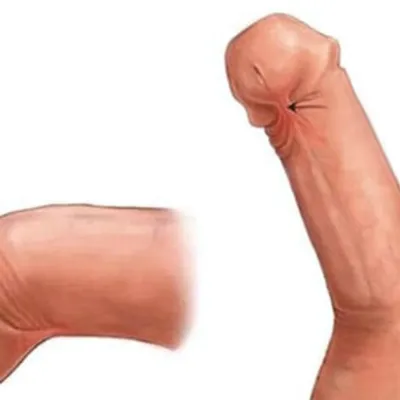
When the frenulum is excessively short or inelastic (frenulum breve), retraction is possible but creates:
- Significant traction during erection.
- Ventral curvature of the glans.
- Recurrent micro-fissures at the insertion point.
- Chronic fibrosis with progressive worsening.
- Possible frenular rupture during intercourse with bleeding.
It is important to differentiate frenulum breve from phimosis, where the problem is the tight foreskin ring. The two can coexist but require different surgical approaches.
Causes and predisposing factors
Congenital (main cause)
Anatomical variant — the frenulum develops naturally short. Usually recognised after the start of sexual activity.
Acquired — post-fibrotic
Recurrent fissures with fibrotic healing lead to progressive frenular tightening — a vicious cycle.
Concomitant phimosis or lichen sclerosus
Lichen sclerosus (BXO) can affect the frenulum, leading to sclerosis and shortening. See: lichen sclerosus.
Iatrogenic
After incomplete circumcision or inadequate frenuloplasty with fibrotic re-tightening.
Symptoms and clinical picture
Symptoms during erection
- Traction and pain at the base of the glans
- Ventral curvature of the glans
- Difficulty achieving full extension
- Discomfort during foreskin retraction
Symptoms during intercourse
- Pain on penetration
- Small fissures with bleeding
- Frenular rupture (heavy bleeding)
- Secondary premature ejaculation
- Anxiety, sexual avoidance
Psychosexual impact
Many patients develop secondary erectile dysfunction or premature ejaculation due to pain anxiety, or avoid sexual activity for years. Recognition and definitive treatment have an immediate positive impact on quality of life.
Diagnosis and differential
Diagnosis is clinical. No imaging is required. In my practice I follow:
Detailed sexual history
Pain, curvature, fissures, bleeding during erection or intercourse. Symptom duration, psychosexual impact.
Clinical examination at rest
Frenular length measurement, search for fibrotic or hard areas, signs of previous fissures or BXO.
Foreskin retraction test
Visible ventral glans curvature, frenular traction — distinguishes from pure phimosis.
Assessment for concomitant phimosis or BXO
Inspect the foreskin ring for stenosis, white sclerotic ring (BXO).
Psychosexual assessment
IIEF-5 and questions about anxiety, sexual avoidance, secondary ED or PE.
Common diagnostic pitfalls
Confusion with phimosis (the patient retracts but has pain → frenuloplasty, not circumcision). Missing concomitant BXO requiring full circumcision with histology. Underestimating psychosexual impact.
Treatment — frenuloplasty
Definitive treatment is surgical. There are no effective conservative options (gradual "stretching" does not work as it does in phimosis).
1. Frenuloplasty with Z-plasty (technique of choice)
Z-shaped incision on the frenulum, transposition of flaps and suture with absorbable 5/0 sutures. Lengthens the frenulum by 30–50% and minimises fibrotic recurrence. 20–30 minute procedure under local anaesthesia (penile block).
2. YV-plasty
Alternative technique with similar results. Chosen according to anatomy and fibrosis.
3. Combined with circumcision
When concomitant phimosis or BXO exists. In this case full adult circumcision addresses both problems.
4. Simple transverse incision — discouraged
Older technique with higher recurrence rate (15–25%) due to fibrotic re-tightening. No longer recommended as first-line.
Postoperative care and recovery
- Days 1–3: Analgesics (paracetamol ± ibuprofen), local cold compress, rest.
- Days 1–7: Gentle hygiene with lukewarm water and mild soap, pat dry.
- Days 7–10: Absorbable sutures fall off, mild oedema reduction.
- Weeks 1–4: Abstinence from intercourse, masturbation and heavy physical strain.
- Week 4: Reassessment and clearance to resume sexual activity.
- Week 6: Full healing, no further restrictions.
When to seek urgent reassessment
- Heavy or recurrent bleeding.
- Fever > 38°C or signs of infection (marked erythema, pus).
- Suture dehiscence.
- Severe pain not relieved by analgesics.
Complication prevention
- Recognition and surgical management before recurrent fissures (fibrosis prevention).
- Choice of Z- or YV-plasty over simple incision (recurrence reduction).
- Strict adherence to 4 weeks postoperative abstinence.
- Adequate lubrication during intercourse to avoid new fissures.
- Identification and treatment of concomitant skin disease (BXO, psoriasis).
Follow-up and prognosis
With correct technique the prognosis is excellent. Recurrence rates < 5% for Z-plasty, patient satisfaction > 95% in postoperative studies. Glans sensitivity is fully preserved, since the procedure does not remove neural tissue.
- Reassessment 4 weeks after the procedure — healing check, clearance to resume.
- Reassessment at 3 months — sexual function evaluation, IIEF-5.
- For concomitant BXO: annual clinical follow-up to detect recurrence or malignant transformation.
In summary: Frenulum breve is a treatable condition with a brief, painless procedure. Timely treatment restores normal sexual function and quality of life.
Frequently asked questions (FAQ)
What is frenulum breve?
Frenulum breve (short frenulum) is an anatomical condition in which the frenulum of the prepuce — the small band connecting the foreskin to the underside of the glans — is excessively short or inelastic, preventing full retraction of the foreskin or causing pain and ventral curvature of the penis during erection.
How is it differentiated from phimosis?
In phimosis the problem is the tight ring of the foreskin preventing retraction. In frenulum breve the foreskin retracts normally, but the frenulum pulls the glans downward, causing pain, fissures or ventral curvature on erection. The two can coexist.
What are the main symptoms?
Pain or marked traction during intercourse, small fissures or bleeding at the frenulum, downward curvature of the glans on erection, secondary premature ejaculation, avoidance of sexual activity due to anxiety.
Is frenular rupture dangerous?
Not life-threatening, but it can cause significant bleeding (the frenular artery is sizeable), painful injuries, and recurrent fissures with fibrosis. Each rupture warrants clinical evaluation and — usually — definitive frenuloplasty.
What is the treatment?
Treatment is mainly surgical: frenuloplasty — a simple, brief outpatient procedure under local anaesthesia, with Z-plasty or YV-plasty. Recovery is rapid. In selected cases it is combined with circumcision.
How long does recovery take?
The procedure lasts 15–30 minutes under local anaesthesia. Return to daily activities within 24–48 hours. Sexual abstinence for 3–4 weeks to allow healing without suture disruption.
Is there recurrence after frenuloplasty?
With proper technique (Z-plasty or YV-plasty), recurrence is very rare (< 5%). Simple transverse incision without plastic technique has higher rates of fibrotic re-tightening.
Does it affect fertility or sensitivity?
No. Frenuloplasty does not affect fertility, and glans sensitivity is fully preserved. On the contrary, it removes the pain and restores normal sexual function.
Related topics
Book an appointment in Rhodes
If you experience pain or curvature on erection, evaluation and — if needed — frenuloplasty can restore normal sexual function quickly and safely.
Scientific literature
- EAU Guidelines on Sexual and Reproductive Health (2024) — Penile anatomical conditions — uroweb.org
- Dockray J, Finlayson A, Muir GH. Penile frenuloplasty: a simple and effective treatment for frenular pain or scarring. BJU Int 2012;109(10):1546-50 — pubmed.ncbi.nlm.nih.gov
- Gallo L. The prevalence of an excessive prepuce and the effects of distal circumcision on premature ejaculation. Arab J Urol 2017;15(2):140-147 — pubmed.ncbi.nlm.nih.gov
- BAUS Patient Information — Frenuloplasty — baus.org.uk
Meet the doctor

Dr. Marinos Vasilas, Urologist – Andrologist
Dr. Marinos Vasilas performs frenuloplasty using microsurgical Z-plasty technique, ensuring excellent healing, minimal recurrence and full preservation of normal sensitivity.
See full profile


