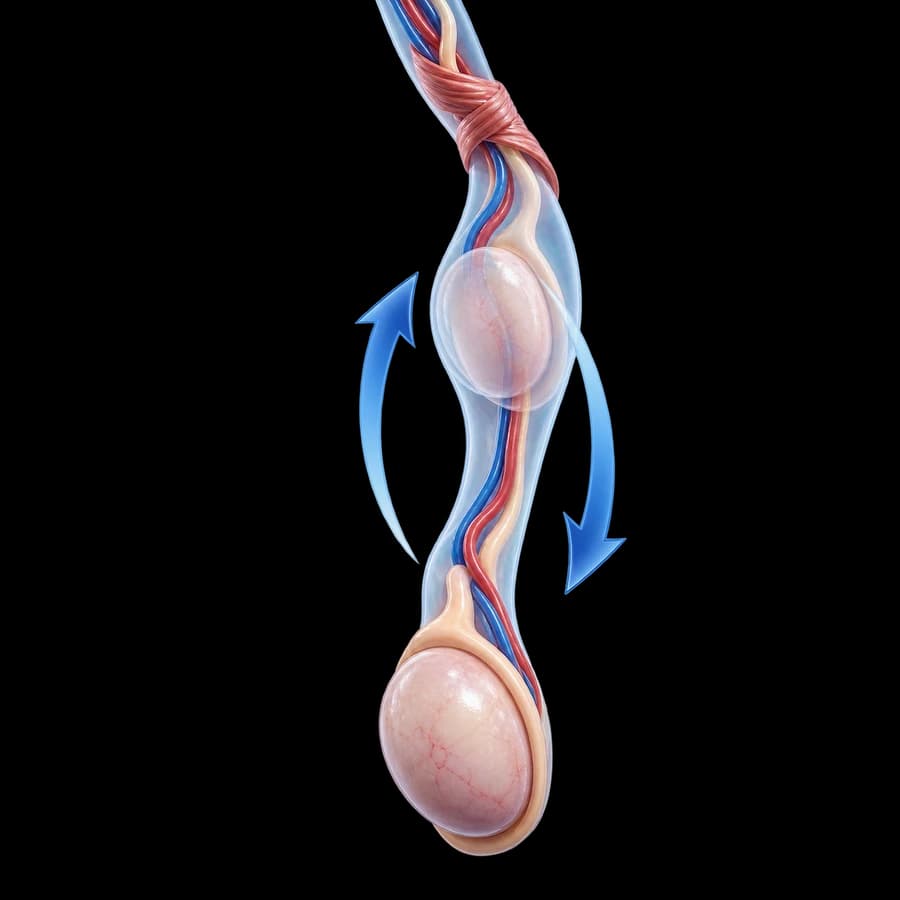
My Clinical Approach
In clinical practice, I first differentiate retractile testis from true cryptorchidism with careful clinical examination. Correct diagnosis is critical because management differs entirely.
I recommend annual follow-up with clinical examination and testicular ultrasound until puberty, monitoring growth and position.
For acquired cryptorchidism (ascending testis), I propose surgical management with orchiopexy.
What is Retractile Testis?
Retractile testis is a testis that:
- Has descended normally into the scrotum
- Has normal growth and dimensions
- Can be manually brought into the scrotum and remains there
- Often "ascends" due to overactive cremaster reflex
- Frequency: 1-3% of boys aged 5-12 years
- The vast majority normalizes after puberty
Differential Diagnosis
Retractile Testis
- • Normal position & size
- • Brought into scrotum and stays
- • No surgery needed
- • Follow-up only
Ascending Testis (Acquired Cryptorchidism)
- • Had descended but "ascended" with age
- • Does not stay in scrotum after release
- • Requires orchiopexy
True Cryptorchidism
- • Has never descended into scrotum
- • Often hypoplastic testis
- • Surgical management at 6-18 months
Symptoms
- Testis sometimes visible/palpable in scrotum, sometimes not
- "Disappearance" of testis in cold water, anxiety, physical activity
- Reappearance during warm bath, sleep, relaxation
- No pain
- Normal scrotal development
- Frequent observation by parents during bathing
Diagnosis
- Clinical examination in warm environment
- Standing or sitting cross-legged position
- Child relaxation
- Gentle manual maneuver: testis brought into scrotum
- Persistence in scrotum after release (diagnostic)
- Size/symmetry assessment
- Testicular ultrasound (dimensions, echotexture)
- Exclusion of cryptorchidism/ectopia
Management
In most cases, no treatment is required. Recommended:
- Follow-up every 6-12 months
- Parental reassurance
- No hormonal therapy administration
- Testicular size monitoring (if decreasing, intervention needed)
- Clinical re-evaluation until puberty
Follow-up
- Annual clinical examination
- Testicular ultrasound every 1-2 years
- Size comparison with contralateral testis
- Surveillance for development of acquired cryptorchidism
- Follow-up until age 14-15
- Parental counseling for home monitoring
When Surgery is Needed
Surgical management (orchiopexy) is indicated when:
- Evolution to acquired cryptorchidism (ascending testis)
- Asymmetric testicular growth (size reduction >20%)
- Testis does not remain in scrotum after release
- Symptoms (rare)
- Concomitant inguinal hernia
Although retractile testis is usually a benign condition, 30-50% may evolve into ascending testis requiring orchiopexy. Annual follow-up is therefore essential.
Frequently Asked Questions (FAQ)
Is retractile testis the same as cryptorchidism?
No. In retractile testis, the testis lies normally in the scrotum but temporarily "ascends" due to overactive cremasteric muscle. In cryptorchidism, the testis has never descended into the scrotum.
Does it require surgery?
In most cases no. Retractile testis is a normal variant. However, annual follow-up is needed because 30-50% may evolve into ascending testis (acquired undescended) requiring orchiopexy.
At what age does it appear?
Usually between 5-12 years. Rarely after puberty as the cremasteric reflex weakens.
Does it affect fertility?
Retractile testis itself does not affect fertility. However, if it evolves into ascending testis, prolonged extra-scrotal position at higher temperature may impair spermatogenesis.
How is it differentiated?
By clinical examination in a warm environment, sitting cross-legged or standing. Retractile testis can be manually brought into the scrotum and remains there after release. Undescended testis cannot be brought down.
Book Your Appointment in Rhodes
Differential diagnosis of retractile testis, monitoring and timely surgical management when indicated.
References – Sources
- EAU/ESPU Guidelines on Paediatric Urology, 2024 update — uroweb.org
- Agarwal PK, et al. Retractile testis: is it really a normal variant? J Urol 2006 — PMID: 16952684
- Hack WW, et al. Natural course of acquired undescended testis. Br J Surg 2003 — PMID: 12740885
Medical Review

Dr. Marinos Vasilas, Urologist – Andrologist
Dr. Marinos Vasilas runs a private urology practice in Rhodes specializing in paediatric urological conditions and differential diagnosis of testicular disorders.
View full CV


