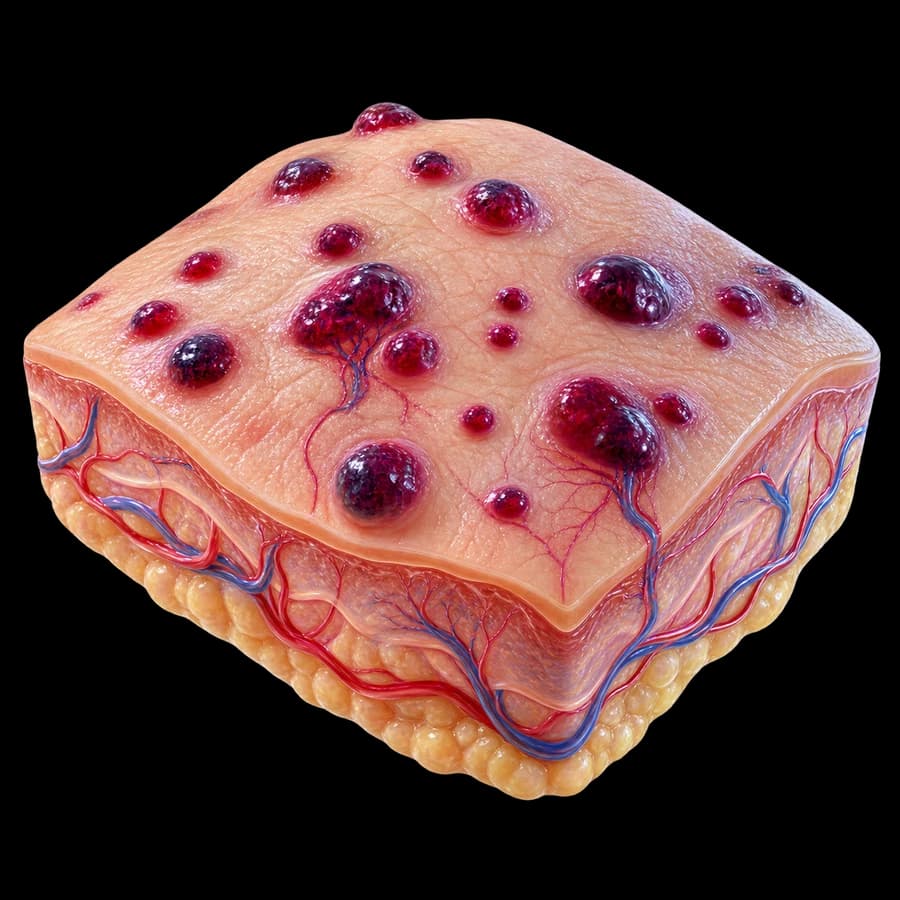
My Clinical Approach
For scrotal angiokeratomas I take a reassuring approach, since these are benign lesions. I always explain that they are not STDs nor cancer.
In young patients with multiple lesions or involvement of other areas (buttocks, thighs), I consider Fabry disease and refer for genetic testing.
I always investigate for coexisting varicocele or liver disease, which may increase venous pressure and predispose to new lesions.
What is Scrotal Angiokeratoma?
Fordyce angiokeratoma is a small (1-4 mm) red or dark purple papule on the scrotal skin. It consists of dilated capillaries in the papillary dermis covered by hyperkeratotic epithelium.
- Frequency: up to 16% in men >50 years
- Rare before age 30
- Usually multiple lesions
- Benign condition
- Not sexually transmitted
- Not caused by HPV
Causes & Risk Factors
- Increasing age (>40 years)
- Varicocele
- Chronic liver disease
- Portal hypertension
- Hemorrhoids
- Chronic intra-abdominal pressure
- Hereditary predisposition
- Fabry disease (rare)
Symptoms
- Red-purple papules 1-4 mm on scrotal skin
- Usually multiple
- Asymptomatic
- Rarely itching
- Sometimes bleeding after rubbing
- Cosmetic concern
- No pain
Diagnosis
- Clinical examination: characteristic appearance
- Dermoscopy (if needed)
- Biopsy for atypical lesions or suspicion of malignancy
- Scrotal ultrasound: rule out varicocele
- Liver disease workup for extensive lesions
- Genetic testing for Fabry in suspicious cases
Treatment
Observation
For asymptomatic lesions without bleeding or cosmetic concern. No treatment needed.
CO2 or pulsed-dye laser
Gold standard. Excellent cosmetic results. Requires 1-3 sessions.
Electrocautery
Effective, low cost. Possible scarring in larger lesions.
Cryotherapy
With liquid nitrogen. Simple technique, satisfactory results.
Surgical Excision
For large or suspicious lesions with histologic examination.
Differential Diagnosis & Fabry Disease
Fabry disease is a hereditary storage disorder (X-linked) with deficiency of the enzyme α-galactosidase A. It presents with multiple angiokeratomas from a young age.
- Angiokeratomas in the «swimsuit» area (scrotum, buttocks, thighs, umbilicus)
- Neuropathic pain in extremities
- Reduced sweating
- Renal and cardiac involvement
- Diagnosis: α-galA measurement, genetic testing (GLA gene)
- Treatment: enzyme replacement (agalsidase)
For a young patient with multiple angiokeratomas and other systemic symptoms, referral to a geneticist to rule out Fabry disease.
Complications
- Bleeding after trauma/rubbing
- Treatment complications: scarring, hyperpigmentation
- Recurrence/new lesions
- Psychological burden (cosmetic)
- Risk of malignant transformation: zero
Frequently Asked Questions (FAQ)
Is scrotal angiokeratoma dangerous?
Fordyce angiokeratoma is a benign lesion and is not associated with risk of malignancy. The main concerns are cosmetic and the rare bleeding episode.
What is the cause?
The exact cause is unknown. It is associated with increased venous pressure in the scrotum (varicocele, liver disease, increased intra-abdominal pressure) and with age.
Is treatment needed?
Treatment is offered when there is bleeding, cosmetic concern, or suspicion of malignancy. Methods include CO2 laser, electrocautery, and cryotherapy.
Is it associated with Fabry disease?
Multiple angiokeratomas on the trunk and scrotum at a young age may be part of Fabry disease (a hereditary storage disorder). Genetic testing is performed if suspected.
Can it recur after treatment?
Yes, new lesions may appear over time, especially if the underlying cause persists (varicocele, increased venous pressure).
Book Your Appointment in Rhodes
Diagnosis of scrotal angiokeratoma, exclusion of varicocele and underlying pathology, and cosmetic management.
References – Sources
- Schiller PI, Itin PH. Angiokeratomas: an update. Dermatology 1996 — PMID: 8829392
- Erkek E, et al. Fordyce angiokeratomas as clues to local venous hypertension. Arch Dermatol 2005 — PMID: 16365275
- Germain DP. Fabry disease. Orphanet J Rare Dis 2010 — PMID: 21092187
Medical Review

Dr. Marinos Vasilas, Urologist – Andrologist
Dr. Marinos Vasilas runs a private urology practice in Rhodes specializing in conditions of the scrotum and testis.
View full CV


