My Clinical Approach
In daily practice, a diagnosis of "seminoma" is often accompanied by the most reassuring conversation I can have with a young cancer patient: the prognosis is among the best in all of oncology. The modern goal is not just cure — which is essentially a given — but avoiding overtreatment and its long-term consequences.
For most stage I cases, I recommend active surveillance rather than reflex adjuvant chemotherapy or radiotherapy. The 2024 EAU and ESMO guidelines agree: overall survival is equivalent, while toxicity and the risk of second malignancies are avoided.
Sperm cryopreservation before orchiectomy is offered to all patients of reproductive age, even when only surveillance is planned.
What Is Seminoma?
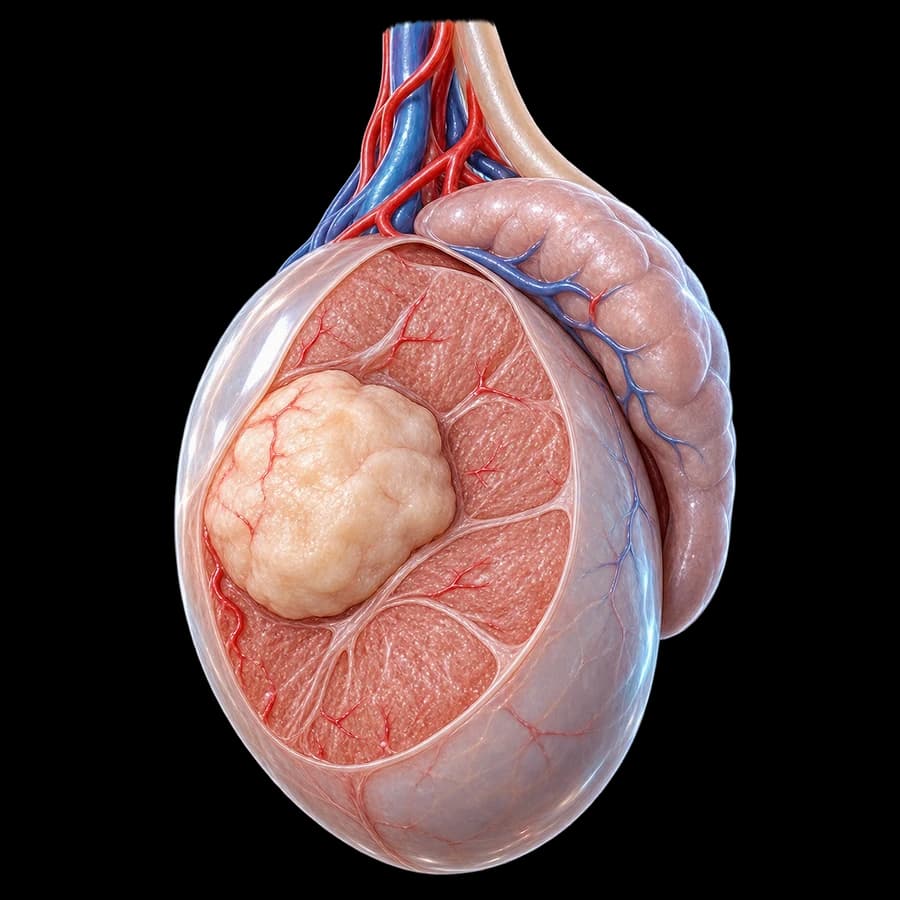
Seminoma is a malignant tumor arising from germ cells of the testis and accounts for approximately 50 percent of all germ cell tumors (GCT). The 2022 WHO classification distinguishes:
- Classic seminoma (>95%) — the typical form
- Spermatocytic tumor (formerly "spermatocytic seminoma") — a separate WHO 2022 entity, occurring in older men, with excellent prognosis
Distinction from NSGCT
The histologic distinction seminoma vs NSGCT is the decisive factor guiding treatment, staging and follow-up. When both components coexist on pathology, the tumor is treated as non-seminomatous.
Epidemiology
Seminoma occurs predominantly between 30 and 45 years. According to the 2024 EAU guidelines, its incidence in Europe follows the overall rising trend of testicular tumors.
Symptoms
The most typical symptom is a painless, firm enlargement of the testicle, usually noticed on self-examination. Other signs include:
- Sensation of heaviness or fullness in the scrotum
- Asymmetric increase in testicular size
- Dull groin discomfort
- Less common: symptoms of metastases (back pain from retroperitoneal nodes)
- Rare: gynecomastia (when beta-hCG is elevated)
Immediate Urological Evaluation
Any new testicular mass — even completely painless — must be evaluated with scrotal ultrasound within a few days. Do not delay out of fear or embarrassment.
Risk Factors
Risk factors are shared with other germ cell tumors:
- Cryptorchidism (undescended testes) — the strongest factor
- Family history of testicular cancer
- Previous cancer in the contralateral testis
- Klinefelter syndrome
- Infertility and abnormal semen analysis
- GCNIS (Germ Cell Neoplasia In Situ)
Specific to Seminoma
For classic seminoma, the median age at diagnosis is a few years older than for NSGCT, with peak incidence between 30 and 40 — a useful clue in the differential diagnosis.
Diagnosis & Staging
The diagnostic workup mirrors that of germ cell tumors in general:
High-resolution scrotal ultrasound
Seminoma typically appears as a homogeneous, hypoechoic intratesticular mass with increased vascularity. It does not replace pathological confirmation.
Serum tumor markers
AFP: normal — elevation excludes pure seminoma. Beta-hCG: mildly elevated in ~15–20%. LDH: correlates with tumor burden. Always rechecked after orchiectomy according to half-life kinetics.
Radical inguinal orchiectomy
Both diagnostic and therapeutic. Transscrotal biopsy is contraindicated.
Chest, abdomen and pelvis CT
For staging of retroperitoneal nodes and pulmonary metastases.
EAU Stages
- Stage I: tumor confined to the testis, negative markers after orchiectomy
- Stage II: retroperitoneal lymph node involvement (IIA <2cm, IIB 2–5cm, IIC >5cm)
- Stage III: nodes above the diaphragm or distant metastases
Treatment by Stage
Stage I — Active Surveillance (preferred)
After orchiectomy with negative markers, the EAU recommends active surveillance as the first option. The overall relapse risk is approximately 15–20%, but cure rates at relapse approach 100%.
- Alternative: 1 cycle of carboplatin AUC 7 (only in selected high-risk cases)
- Older retroperitoneal radiotherapy is now used progressively less
Stage IIA / IIB
Two options with equivalent survival: radiotherapy to retroperitoneal nodes or chemotherapy (3 cycles of BEP or 4 cycles of EP). Modern trend: chemotherapy is preferred due to lower long-term risk of second malignancies. Newer data from the SAKK 01/10 trial support a combination of reduced-dose chemotherapy with focused radiotherapy.
Stage IIC / III — Advanced Disease
Cisplatin-based systemic chemotherapy: 3 cycles of BEP for the IGCCCG good prognosis group, or 4 cycles of BEP/VIP for the intermediate prognosisgroup. Seminoma is never classified as poor prognosis in IGCCCG.
Residual Masses After Chemotherapy
For residual masses >3 cm after chemotherapy, FDG-PET/CT is recommended at least 6 weeks after completion. Negative — surveillance. Positive — biopsy or surgical resection.
Modern Trends
Contemporary efforts (SEMITEP, SAKK trials) aim to de-escalate treatment burden while preserving cure rates. Long-term cardiovascular and oncological surveillance is gaining importance.
Fertility & Hormonal Function
The EAU recommends sperm cryopreservation BEFORE any treatment. Even when only orchiectomy with surveillance is planned, cryopreservation is the safety net should later relapse require chemotherapy.
- Cisplatin can cause transient or permanent azoospermia
- Nodal radiotherapy causes transient sperm suppression — recovery typically within 1 to 3 years
- In young patients losing the second testis or developing post-treatment hypogonadism, hormone replacement is considered
- Removal of one testicle usually leaves adequate hormonal function
Follow-up & Prognosis
Surveillance is designed to detect rare relapses early and to recognize long-term effects. In seminoma, relapses can occur later than in NSGCT.
Years 1 to 2
Clinical exam plus markers every 3 to 4 months, abdominal CT every 6 months, chest evaluation.
Years 3 to 5
Visit every 6 to 12 months with markers and selected imaging.
Beyond 5 years
Annual or biennial follow-up. Screening for second malignancies and cardiovascular surveillance.
Prognosis: Stage I > 99% cure. Stage II ~95%. Advanced disease (IGCCCG good prognosis) ~95%, intermediate prognosis ~80%.
Frequently Asked Questions (FAQ)
At what age does seminoma typically occur?
Seminoma usually occurs between ages 30 and 45 — slightly later than non-seminomatous germ cell tumors, which typically present between 20 and 30. It is the most common single histologic subtype of germ cell tumor.
Is seminoma a "better" testicular tumor?
It carries an excellent prognosis — 5-year survival in localized disease exceeds 99 percent and remains high even in advanced stages. It is exquisitely sensitive to cisplatin-based chemotherapy and to radiotherapy.
Does seminoma elevate tumor markers?
Almost never AFP — an elevated AFP rules out a pure seminoma diagnosis. Beta-hCG can be mildly elevated in approximately 15 to 20 percent of cases. LDH rises in advanced disease.
Do I need chemotherapy after orchiectomy in stage I?
Not automatically. In stage I, active surveillance is the preferred strategy for the vast majority of patients. Adjuvant treatment (1 cycle of carboplatin) is considered only in selected high-risk cases.
Is radiotherapy still an option?
Retroperitoneal lymph node radiotherapy is used much less today due to the long-term risk of second malignancies. It retains a role in selected stage IIA/IIB cases where chemotherapy is contraindicated.
Book Your Appointment in Rhodes
If you have been diagnosed with seminoma or need a second opinion on your treatment plan, specialized urological assessment is decisive. The goal is cure without overtreatment.
References
- EAU Guidelines on Testicular Cancer, 2024 update — uroweb.org
- ESMO Clinical Practice Guidelines: Testicular seminoma, 2022 — esmo.org
- WHO Classification of Tumours of the Urinary System and Male Genital Organs, 5th Edition (2022)
- SAKK 01/10 trial — Reduced-dose chemo-radiotherapy in stage IIA/B seminoma — pubmed.ncbi.nlm.nih.gov
Medical Review

Dr. Marinos Vasilas, Urologist – Andrologist
Dr. Marinos Vasilas runs a private urology practice in Rhodes, with particular focus on testicular uro-oncology, staging, and collaboration with reference oncology centers for germ cell tumors.
See full biography


