My Clinical Approach
With NSGCT, speed is everything. Unlike seminoma, NSGCT can double in size in weeks. Once suspicion arises (testicular mass plus suspicious markers), radical inguinal orchiectomy is scheduled within days.
In my routine practice, I never start treatment without first discussing sperm cryopreservation. In young men this is critical — NSGCT often requires 3 or 4 BEP cycles that can affect spermatogenesis.
Collaboration with a reference oncology center is essential. In stage IIB+ cases and especially when post-chemotherapy RPLND is needed, surgical expertise determines both oncological and functional outcome.
What Are NSGCT?
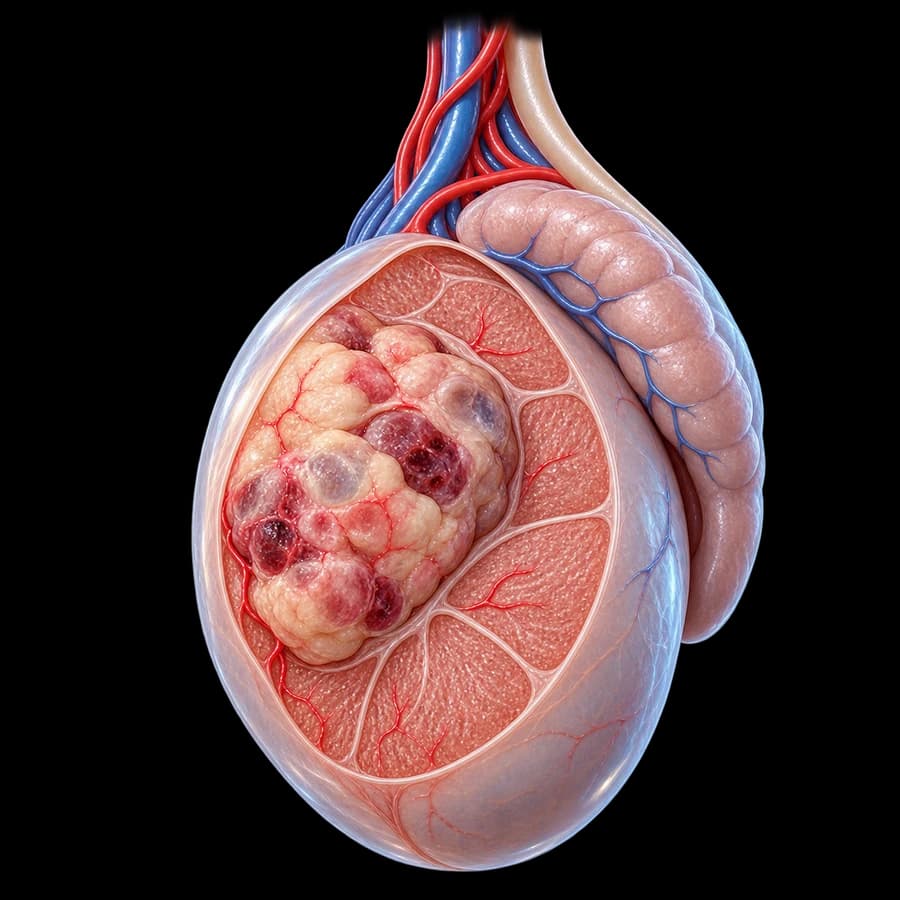
Non-seminomatous germ cell tumors describe a heterogeneous group of testicular malignancies arising from germ cells that includes:
- Embryonal carcinoma — often the most aggressive subtype
- Yolk sac tumor — produces AFP
- Choriocarcinoma — high beta-hCG, rare but aggressive
- Teratoma — may be mature or immature, chemoresistant
- Mixed tumors — the most common form in practice
Important Rule
When pathology shows any non-seminomatous component coexisting with seminoma, the tumor is classified and treated as non-seminomatous.
Epidemiology
NSGCT account for approximately 50 percent of testicular germ cell tumors. They are the most common solid malignancy in men aged 15–35 (EAU 2024).
Symptoms
Symptoms typically include:
- Painless, firm testicular enlargement (the most common finding)
- Heaviness in the scrotum
- Pain or tenderness in rapidly growing masses (more common than in seminoma)
- Back or abdominal pain (from retroperitoneal nodes)
- Shortness of breath or cough (pulmonary metastases)
- Gynecomastia or decreased libido (elevated beta-hCG)
Urgent Evaluation
NSGCT can double in size in weeks. A new palpable testicular mass in a young man requires scrotal ultrasound within days — not weeks or months.
Risk Factors
- Cryptorchidism — increases the risk 4 to 8 times
- Family history of testicular cancer
- Previous tumor in the contralateral testis
- Klinefelter syndrome
- Infertility and abnormal semen analysis
- GCNIS (Germ Cell Neoplasia In Situ) in the contralateral testis
- Caucasian race — clearly higher incidence
Important: In NSGCT, the median age at diagnosis is several years younger than in seminoma. Rapid changes in testicular size in a young man should always prompt evaluation.
Diagnosis & Staging
Scrotal ultrasound
First-line investigation. NSGCT typically appear as heterogeneous, hypoechoic or mixed intratesticular masses, often with microcalcifications or cystic components.
Serum tumor markers (AFP, beta-hCG, LDH)
Decisive for both diagnosis and for staging (S-stage) and prognosis (IGCCCG). AFP > 10,000 or beta-hCG > 50,000 or LDH > 10× ULN automatically classify the patient as poor prognosis.
Radical inguinal orchiectomy
Diagnostic and therapeutic step. Transscrotal approach is absolutely contraindicated. In selected advanced cases with life-threatening symptoms, chemotherapy may precede orchiectomy.
Chest, abdomen and pelvis CT
Mandatory staging. Brain MRI in cases of high markers or clinical suspicion.
Stages & IGCCCG
- Stage I: tumor confined to the testis, negative markers after orchiectomy
- Stage II: retroperitoneal lymph node involvement (IIA <2cm, IIB 2–5cm, IIC >5cm)
- Stage III: nodes above the diaphragm or visceral metastases
- IGCCCG: good / intermediate / poor prognosis based on markers, primary site and visceral metastases
Treatment by Stage
Stage I — Risk Stratification
After orchiectomy, relapse risk is estimated by the presence of lymphovascular invasion (LVI) and the predominance of embryonal carcinoma.
- Low risk (LVI–): active surveillance (preferred)
- High risk (LVI+): active surveillance or 1 cycle of BEP
- Rare: nerve-sparing RPLND in selected cases
Stage IIA / IIB
With positive markers: 3 cycles of BEP. With negative markers: choices between primary RPLND or 3 cycles of BEP, depending on histology and patient preference.
Advanced Disease (IIC / III)
Cisplatin-based systemic chemotherapy: 3 cycles of BEP in IGCCCG good prognosis, 4 cycles of BEP or 4×VIP in intermediate or poor prognosis. The goal is complete marker response and biological clearance of disease.
Post-chemotherapy RPLND
For residual masses >1 cm after chemotherapy with normal markers, surgical resection is indicated. In 40% pathology shows necrotic tissue, in 40–45% teratoma, and in 10–15% viable tumor — this guides further treatment.
Salvage Therapy
In case of relapse after first-line chemotherapy, TIP regimens (paclitaxel, ifosfamide, cisplatin) or high-dose chemotherapy with autologous bone marrow transplant (HDCT) are available for selected cases, with cure rates of 25–50%.
Fertility & Hormonal Function
Sperm cryopreservation BEFORE any treatment is non-negotiable. Up to 50% of NSGCT patients already have impaired spermatogenesis at diagnosis.
- BEP/EP regimens cause transient or permanent infertility
- Non-nerve-sparing RPLND can cause retrograde ejaculation — hence nerve-sparing technique is standard
- Hormonal monitoring (testosterone, LH, FSH) after treatment is essential
- Hypogonadism after follow-up completion may require testosterone replacement
Follow-up & Prognosis
Unlike seminoma, NSGCT relapses occur primarily in the first 2 years. Intensive surveillance focuses on this period.
Years 1 to 2
Exam plus markers every 2 to 3 months, abdominal CT every 4 to 6 months, chest X-ray/CT.
Years 3 to 5
Visit every 6 to 12 months with markers and selected imaging.
Beyond 5 years
Annual visit emphasizing hormonal function, cardiovascular health and second malignancies.
Prognosis: Stage I >98% cure. IGCCCG good prognosis ~92%, intermediate ~80%, poor ~50%. Overall cure rates remain among the highest in solid oncology.
Frequently Asked Questions (FAQ)
What does "non-seminomatous" testicular tumor mean?
It refers to the group of germ cell tumors (NSGCT) that includes embryonal carcinoma, teratoma, choriocarcinoma, yolk sac tumor, or mixed forms. When seminomatous elements coexist with any non-seminomatous component, the tumor is treated as non-seminomatous.
At what age do they appear?
Usually between ages 15 and 35 — considerably earlier than classic seminoma. NSGCT is the most common solid malignancy in young men in this age group.
How sensitive are they to chemotherapy?
Extremely sensitive to the BEP regimen (bleomycin, etoposide, cisplatin). Even in advanced disease, cure rates remain high (~80–90 percent in IGCCCG good prognosis).
What is RPLND?
Retroperitoneal Lymph Node Dissection is a specialized surgery used in selected NSGCT cases for diagnosis/staging or removal of residual masses after chemotherapy.
Is fertility affected?
Yes — both before treatment (the tumor itself often impairs spermatogenesis) and after (chemotherapy or RPLND). Sperm cryopreservation is mandatory before initiating any treatment.
Book Your Appointment in Rhodes
With suspected NSGCT, speed is critical. Start with scrotal ultrasound and tumor markers within days — and proceed promptly to specialized urological evaluation.
References
- EAU Guidelines on Testicular Cancer, 2024 update — uroweb.org
- ESMO Clinical Practice Guidelines: Testicular non-seminoma, 2022 — esmo.org
- NCCN Guidelines: Testicular Cancer, v2.2024 — nccn.org
- IGCCCG Update Consortium. J Clin Oncol 2021 — PMID: 33729863
Medical Review

Dr. Marinos Vasilas, Urologist – Andrologist
Dr. Marinos Vasilas runs a private urology practice in Rhodes, with expertise in testicular uro-oncology and collaboration with reference oncology centers for germ cell tumors.
See full biography


