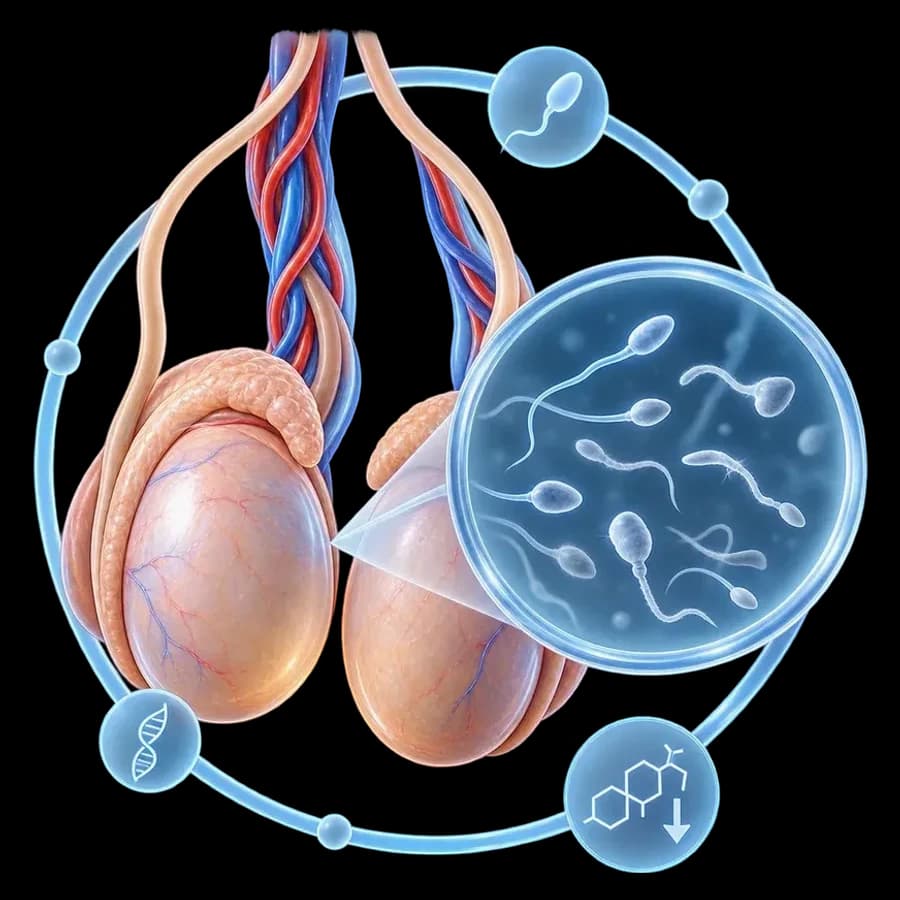
My Clinical Approach
For male infertility I follow a structured EAU 2024 protocol: detailed history, scrotal examination, two semen analyses (≥3-week interval) and full hormone profile.
First-line treatment: reversible causes (varicocele, infections, hormonal disorders, anabolics, obesity). For azoospermia I proceed with genetic testing (karyotype, Y-chromosome microdeletions, CFTR).
I work closely with the assisted reproduction center for micro-TESE, IVF/ICSI and sperm cryopreservation.
What is Male Infertility?
Defined as the inability to achieve pregnancy after 12 months of regular unprotected intercourse, with male responsibility alone or in combination. Affects 7% of men worldwide.
- Primary: never achieved a pregnancy
- Secondary: previous pregnancy achieved
- ~50% purely male factor
- ~30% combined (male + female)
- In 25% of couples the cause remains unexplained
Causes
Pre-testicular
Hypogonadotropic hypogonadism, hyperprolactinemia, Kallmann syndrome, anabolic steroid use, opioids, pituitary disease.
Testicular
Varicocele (most common correctable cause), cryptorchidism, Klinefelter syndrome (47,XXY), Y-chromosome microdeletions (AZF), mumps orchitis, chemo-/radiotherapy, trauma, torsion.
Post-testicular (obstructive)
CBAVD (congenital bilateral absence of vas deferens — CFTR), post-epididymitis, post-vasectomy, iatrogenic injury, retrograde ejaculation.
Functional / sexual
Erectile dysfunction, ejaculation disorders, premature/delayed ejaculation.
Idiopathic
Up to 30% of cases — semen abnormalities without identified cause.
Diagnostic Workup
- Detailed history (reproductive, medical, surgical, medications)
- Physical examination: testicular volume, varicocele, vas deferens
- Two semen analyses per WHO 2021 (≥3-week interval)
- Hormone profile: FSH, LH, total testosterone, prolactin, estradiol, TSH
- Scrotal Doppler ultrasound
- Transrectal ultrasound (TRUS) if obstruction suspected
- Karyotype + Y-chromosome microdeletions in severe oligozoospermia/azoospermia
- CFTR mutation in CBAVD
- Semen culture if elevated leukocytes
- Sperm DNA fragmentation in recurrent miscarriages/IVF failures
Semen Analysis (WHO 2021 – Lower Reference Limits)
- Volume: ≥1.4 mL
- Concentration: ≥16 million/mL
- Total count: ≥39 million/ejaculate
- Total motility: ≥42%
- Progressive motility: ≥30%
- Vitality: ≥54%
- Normal forms: ≥4%
- pH: ≥7.2
- Leukocytes: <1 million/mL
Terminology
- Azoospermia: absence of sperm
- Oligozoospermia: <16 million/mL
- Asthenozoospermia: motility <42%
- Teratozoospermia: morphology <4%
- Necrozoospermia: vitality <54%
Azoospermia Classification
- Obstructive (OA): normal testicular volume & FSH
- Non-obstructive (NOA): reduced volume, elevated FSH
Treatment
Varicocele repair
Microsurgical subinguinal varicocelectomy — improves semen analysis in 60-70% and pregnancy rates by 30-35%.
Hormonal therapy
For hypogonadotropic hypogonadism: hCG 1500-3000 IU 2-3×/week ± rFSH. Clomiphene/letrozole (off-label) in idiopathic oligozoospermia.
Treatment of infections
Targeted antibiotics for leukospermia/MAGI (epididymitis, orchitis, prostatitis).
Surgical reconstruction of obstruction
Vasoepididymostomy, vasectomy reversal (vasovasostomy), TURED for ejaculatory duct obstruction.
Sperm retrieval
Obstructive: PESA, MESA. Non-obstructive: micro-TESE (Schlegel) — 40-60% retrieval success, even in Klinefelter.
Antioxidants
Supplements (zinc, selenium, vitamin C/E, CoQ10, carnitine) for elevated DNA fragmentation — marginal clinical evidence.
Assisted Reproduction (ART)
- IUI (intrauterine insemination): mild male infertility + normal tubes
- IVF (in vitro fertilization): moderate male infertility or coexisting female factor
- ICSI: severe oligo-/astheno-/teratozoospermia, azoospermia after TESE/MESA
- PGT: preimplantation genetic testing for genetic syndromes
- Sperm donation: non-retrievable azoospermia or severe genetic disease
- Sperm cryopreservation: before chemo-/radiotherapy or surgery
Lifestyle & Prevention
- Maintain normal weight (BMI 20-25)
- Smoking cessation
- Limit alcohol <14 units/week
- Avoid anabolic steroids & exogenous testosterone
- Avoid scrotal hyperthermia (sauna, jacuzzi, tight underwear, laptop on lap)
- Mediterranean diet rich in antioxidants
- Regular exercise (avoid extreme endurance)
- Stress management, adequate sleep
- Intercourse every 2-3 days during the fertile window
- Check occupational exposures (pesticides, heavy metals, high temperatures)
Male infertility may be a marker of overall health — associated with increased risk of testicular cancer, cardiovascular disease and early mortality. Comprehensive health screening is recommended.
Frequently Asked Questions (FAQ)
When is a couple considered infertile?
When pregnancy is not achieved after 12 months of regular unprotected intercourse (or 6 months if the partner is >35 years). In ~50% of cases there is a male factor.
What does the male fertility workup include?
History, physical examination, two semen analyses per WHO 2021, hormone profile (FSH, LH, testosterone, prolactin, estradiol), scrotal Doppler ultrasound and, if needed, genetic testing.
Is azoospermia reversible?
It depends on the type. In obstructive azoospermia (normal testes, FSH) surgical reconstruction or sperm retrieval (TESE/MESA) achieves pregnancy with ICSI. In non-obstructive, micro-TESE retrieves sperm in 40-60%.
Does lifestyle affect fertility?
Yes. Obesity, smoking, alcohol, scrotal hyperthermia, drugs, anabolic steroids and certain medications reduce sperm quality. Lifestyle improvements may increase parameters within 3 months.
What is ICSI?
Intracytoplasmic Sperm Injection (ICSI) is an IVF technique where a single sperm is injected directly into the oocyte. Indicated for severe oligo-/astheno-/teratozoospermia or sperm retrieved after TESE.
Book Your Appointment in Rhodes
Comprehensive male infertility workup, semen analysis, hormonal profile, microsurgical varicocelectomy & collaboration with IVF/ICSI centers.
References – Sources
- EAU Guidelines on Sexual and Reproductive Health 2024 — uroweb.org
- WHO laboratory manual for the examination and processing of human semen, 6th ed., 2021 — who.int
- Schlegel PN, et al. Diagnosis and Treatment of Infertility in Men: AUA/ASRM Guideline. J Urol 2021 — PMID: 33295257
- Salonia A, et al. European Association of Urology Guidelines on Male Sexual and Reproductive Health. Eur Urol 2021 — PMID: 34303533
Medical Review

Dr. Marinos Vasilas, Urologist – Andrologist
Dr. Marinos Vasilas runs a private urology practice in Rhodes specializing in male infertility, microsurgical varicocelectomy and sperm retrieval.
View full CV


