Clinical Experience: The Importance of Prompt Intervention
“A prostate abscess should always be considered in our differential diagnosis when a man with infection does not improve as expected with treatment. This is not a condition we simply ‘monitor.’ Experience shows that early detection through ultrasound and prompt drainage (when indicated) provide immediate relief to the patient and prevent extremely dangerous systemic complications, such as urosepsis.”
What is a prostate abscess and what causes it?
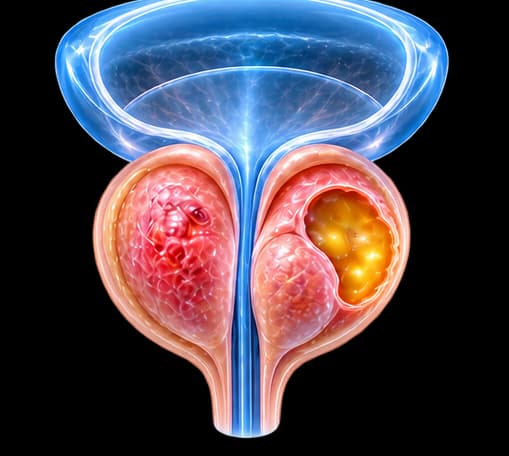
When a bacterial infection of the lower urinary tract is not adequately controlled, a pus-filled cavity forms within the gland. This condition can be unilocular (a single pocket) or multiloculated (with multiple compartments) and may be located centrally or peripherally.
What causes it?
The most commonly isolated organisms are Gram-negative bacteria, such as E. coli, Klebsiella, and Pseudomonas, while in some cases Staphylococcus aureus may also be involved.
Risk Factors: Who is most at risk?
Men with specific vulnerabilities have an increased risk of developing a prostate abscess:
- Patients with diabetes mellitus or immunosuppression.
- Men with an indwelling urinary catheter.
- History of recent prostate biopsy or other urological instrumentation.
- Urinary obstruction due to benign prostatic hyperplasia.
- History of chronic urinary tract infections.
Symptoms: When is immediate medical evaluation needed?
Symptoms often resemble those of acute prostatitis, but are more severe. They include:
- High fever (often accompanied by severe chills).
- Pain in the perineum, pelvis, or lower abdomen.
- Dysuria (severe burning during urination).
- Frequency, urgency, and a very weak urinary stream.
- General malaise or exhaustion.
Emergency Warning
Seek immediate evaluation by a urologist or emergency department if you experience inability to urinate (urinary retention), blood in the urine, confusion, or if the infection shows no signs of improvement with initial antibiotics.
How is it diagnosed?
Diagnosis is based on a combination of medical history, clinical examination, laboratory tests, and imaging, strictly following the European Association of Urology (EAU) guidelines.
Important: The EAU explicitly states that vigorous prostatic massage must not be performed during the acute phase, due to the risk of bacteraemia.
1. Clinical Examination
Assessment of symptoms and careful digital rectal examination. Palpation may reveal a tender, swollen area or a fluctuant collection.
2. Laboratory Tests
Urinalysis and urine culture, blood tests (white blood cells, CRP), and blood cultures in severe cases.
3. Transrectal Ultrasound (TRUS)
This is the most useful first-line examination for detecting an intraprostatic collection. It shows the location, size, and whether the collection is unilocular or multiloculated. It is also used to guide drainage procedures.
4. CT / MRI
These are used when the diagnosis is unclear or there is suspicion of extra-prostatic extension of the infection.
Prostate Abscess Treatment
Treatment is individualized based on the size of the abscess (unilocular or multiloculated), the patient's general condition, and the response to medication.
1. Antibiotic Therapy
Antibiotics are absolutely essential. The choice is based on the clinical picture and culture results. In more severe cases, intravenous therapy is initiated. In very small abscesses and patients with a good clinical condition, antibiotics (with close monitoring) may suffice.
2. Abscess Drainage
In many patients, removal of pus is the key step to healing. Techniques include:
- Transrectal or transperineal aspiration (under TRUS guidance). These have an excellent safety profile.
- Transurethral incision / drainage (preferred for more complex or multiloculated abscesses).
3. Supportive Care
This includes hospitalization, hydration, pain and fever management, and management of urinary retention (e.g., suprapubic catheter placement if urethral catheterization is contraindicated).
Recovery, Follow-up & Potential Complications
The patient requires close monitoring until clinical improvement, normalization of inflammatory markers, and imaging confirmation that the abscess has resolved.
If not managed properly, the condition may lead to:
- Urosepsis (systemic infection — life-threatening).
- Extension of infection to adjacent organs.
- Abscess recurrence or prolonged symptoms.
Frequently Asked Questions about Prostate Abscess
Is a prostate abscess the same as prostatitis?
No. Prostatitis is inflammation of the prostate gland. An abscess is the formation of a pus-filled cavity within the prostate, usually as a complication of acute bacterial prostatitis.
Can it resolve with antibiotics alone?
Some small, carefully selected collections may respond to antibiotics alone. However, many cases require interventional drainage. The decision is made after ultrasound evaluation.
Which examination best detects a prostate abscess?
Transrectal ultrasound (TRUS) is the most useful first-line examination. If there is any doubt or suspicion of extra-prostatic extension, CT or MRI is used.
Is it an emergency?
Yes. Especially when high fever, urinary retention or signs of exhaustion are present, the risk of urosepsis is real and immediate urological evaluation is required.
Book Your Appointment in Rhodes
The key to managing a prostate abscess is rapid clinical suspicion. If you are suffering from a urological infection that is not improving, contact us immediately for a thorough evaluation.
References
- EAU Guidelines on Urological Infections — uroweb.org
- PubMed (NIH): Prostatic Abscess – Diagnosis and Management — pubmed.ncbi.nlm.nih.gov
Meet the Doctor

Dr. Marinos Vasilas, Urologist & Andrologist
Dr. Marinos Vasilas runs a state-of-the-art urology practice in Rhodes, providing specialized management of acute urological cases and urinary tract infections. His clinical approach is strictly based on the latest European Association of Urology (EAU) guidelines.
Read full biography


