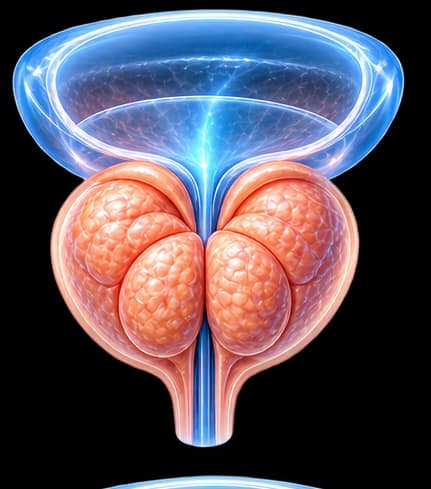
1. My Clinical Approach to BPH
Benign Prostatic Hyperplasia is one of the most common conditions I treat at my urology practice in Rhodes. Many men live for years with urinary symptoms, believing it is “just something that comes with age.” Nocturia that disrupts sleep, a weak stream, and urgency significantly affect quality of life — and in the large majority of cases can be effectively treated.
In practice, I always:
- Quantify symptoms with the IPSS questionnaire.
- Rule out prostate cancer before attributing symptoms solely to BPH.
- Perform uroflowmetry and measure post-void residual urine before any treatment decision.
- Individualise treatment choice — from monitoring to surgical treatment.
2. What Is Benign Prostatic Hyperplasia?
The prostate is a gland located below the bladder that surrounds the urethra. With age, the tissue of the transitional zone of the prostate can increase in size (hyperplasia), compressing the urethra and making it harder for urine to flow from the bladder.
Modern terminology distinguishes between several related terms that describe different aspects of the same condition:
Benign Prostatic Hyperplasia — the histological enlargement of prostate tissue.
Benign Prostatic Enlargement — the clinically detected enlargement of the gland.
Benign Prostatic Obstruction — the bladder outlet obstruction caused by the enlargement.
Lower Urinary Tract Symptoms — the symptoms the patient actually experiences.
3. What Are the Symptoms of Prostate Enlargement?
A. Voiding Symptoms
- Difficulty starting urination
- Weak urine stream
- Intermittent stream
- Need to strain to urinate
- Prolonged urination
- Dribbling after urination
- Sensation of incomplete emptying
B. Storage Symptoms
- Frequent urination
- Urgency
- Nocturia
- Urgency incontinence in some patients
4. When Is Urgent Urological Evaluation Needed?
Contact a urologist immediately if you have:
- Complete inability to urinate (acute retention).
- Blood in the urine.
- Fever together with urinary symptoms.
- Recurrent urinary tract infections.
- Severe pain.
- Worsening kidney function.
- Significant urinary tract dilation, if already diagnosed.
5. Is Benign Prostatic Hyperplasia Cancer?
No.
BPH and prostate cancer are two entirely different medical conditions. However, they can coexist in the same gland, and their symptoms can be similar — which is why diagnosis cannot be based on symptoms alone, but requires clinical evaluation, PSA testing, and a digital rectal examination.
6. How Is BPH Diagnosed?
Medical history
Recording symptoms, duration, medications, and coexisting conditions.
Symptom assessment & IPSS
Quantifying symptom severity with the IPSS questionnaire.
Clinical examination
General assessment of the patient’s health status.
Digital rectal examination
Assessment of prostate size, consistency, and smoothness.
Urinalysis
Ruling out infection or hematuria.
PSA, where indicated
To assess the risk of coexisting prostate cancer.
Urinary tract ultrasound & prostate size measurement
Assessment of the bladder, prostate, and, where indicated, the upper urinary tract.
Post-void residual (PVR) measurement
Non-invasive measurement of the urine remaining in the bladder after voiding.
Uroflowmetry
Objective recording of the urine flow.
Kidney function testing, where required
In patients with evidence of impact on kidney function.
Cystoscopy, in selected patients
Before certain procedures or when other findings are present.
Other specialised testing
When there is a specific clinical indication.
Uroflowmetry
This is a non-invasive test performed in the office that measures urine flow, assessing parameters such as maximum flow rate (Qmax). It helps with objective assessment of urination, but is not on its own a test that diagnoses BPH — it is always interpreted together with the rest of the clinical picture.
Ultrasound and Post-Void Residual Measurement
Ultrasound assesses the bladder, measures the post-void residual (PVR) urine, and evaluates prostate size. Where indicated, it can also include assessment of the upper urinary tract.
Flexible Cystoscopy
In selected cases, direct endoscopic assessment of the urethra, the prostatic urethra, the bladder neck, and the bladder may be needed — particularly before certain procedures or when other clinical findings are present. Flexible cystoscopy is not a 3D examination.
More about Flexible Cystoscopy7. IPSS — How Severe Are My Symptoms?
The International Prostate Symptom Score (IPSS) is the internationally established questionnaire that assesses the intensity of urinary symptoms and their impact on quality of life.
| IPSS | Severity |
|---|---|
| 0–7 | Mild |
| 8–19 | Moderate |
| 20–35 | Severe |
Two patients with the same IPSS score may experience very different impact on their daily life — the impact on quality of life is always considered together with the numerical score.
8. Does Every Enlarged Prostate Need Treatment?
No. Prostate size alone does not determine the need for treatment. The choice is based on a combination of factors:
Symptoms
Quality of life
Degree of obstruction
Residual urine
Complications
Prostate size & anatomy
Patient preferences
9. Monitoring and Lifestyle Changes
In patients with mild symptoms, simple monitoring combined with lifestyle measures may be sufficient:
- Limiting excessive fluid intake before bedtime.
- Limiting caffeine/alcohol when they worsen symptoms.
- Regular urination.
- Reviewing medications that may affect urination.
- Managing constipation.
- Regular monitoring of symptoms.
Lifestyle measures are not a treatment for significant obstruction — in these cases more complete medical management is needed.
10. Medical Therapy for Benign Prostatic Hyperplasia
A. Alpha-1 Blockers
Relax the smooth muscle fibers of the prostate and bladder neck, providing relatively fast symptom improvement. They do not substantially reduce prostate size.
B. 5-Alpha Reductase Inhibitors (5-ARIs)
Can gradually reduce prostate volume, with a slower onset of action. Mainly chosen when prostate size is suitable or there is a risk of progression.
C. Combination Therapy
Combination of an alpha-blocker and a 5-ARI, in suitably selected patients.
D. PDE5 Inhibitor (Tadalafil)
Used in appropriate cases, particularly when erectile dysfunction is also present.
E. Medications for Storage Symptoms
Antimuscarinics or beta-3 agonists, in selected patients with predominant storage symptoms.
11. When Is Surgical Treatment Needed?
Surgical treatment is considered in cases such as:
- Significant, bothersome symptoms despite treatment.
- Recurrent urinary retention.
- Repeated urinary tract infections related to obstruction.
- Bladder stones.
- Recurrent hematuria related to BPH.
- Significant obstruction.
- Worsening kidney function related to obstruction.
- A large amount of residual urine in the appropriate clinical context.
The indication for surgical treatment is always individualised for each patient.
12. Modern Interventional Treatments for BPH
No treatment is the “best” for every patient — the right choice depends on anatomy, prostate size, general health, and the priorities of each case.
TURP / TURiS — Transurethral Resection of the Prostate
An endoscopic procedure through the urethra, removing the obstructing prostate tissue, without an external surgical incision.
HoLEP — Holmium Laser Enucleation of the Prostate
Laser enucleation of the obstructing adenoma using a holmium laser, with the ability to be applied even to large prostates, depending on the clinical case.
Aquablation
A treatment that uses a controlled, high-velocity water jet with image-guided planning to remove selected prostate tissue, without the use of thermal energy during the main tissue-removal stage.
Learn more about AquablationRez\u016bm — Water Vapor Therapy
A minimally invasive treatment that uses thermal energy from water vapor to gradually reduce the obstructing tissue. Suitability depends on prostate volume and anatomy, the presence of a median lobe, symptoms, and patient priorities.
UroLift
Mechanical lifting/retraction of the prostate lobes away from the urethra, without removal of a large volume of tissue. Suitability depends on prostate anatomy.
TUIP — Transurethral Incision of the Prostate
May be suitable for specific patients with a smaller prostate gland and appropriate anatomy.
Adenomectomy for a Very Large Prostate
In selected patients with a very large adenoma, laparoscopic, robotic, or open simple prostatectomy may be considered, depending on the case and available technology. This is not the same as a “radical prostatectomy.”
Dedicated English-language pages are available for HoLEP, Rezūm, TURiS, and laparoscopic adenomectomy. Pages for TURP, UroLift, and TUIP are not yet available in English — see the Greek-language pages, or contact our practice for details.
13. Which BPH Treatment Is Right for Me?
| Treatment | Type | Thermal Energy | Prostate Size | Anesthesia | Ejaculation |
|---|---|---|---|---|---|
| TURP / TURiS | Tissue removal | Yes | Small to large prostates | General/spinal | Often retrograde ejaculation |
| HoLEP | Tissue removal (enucleation) | Yes (laser) | All sizes, depending on the case | General/spinal | Often retrograde ejaculation |
| Aquablation | Tissue removal | Not in the main stage | Depending on anatomy | General/spinal | Often preserved in suitable candidates |
| Rezūm | Tissue remodeling | Yes (water vapor) | Depending on volume/anatomy, ± median lobe | Local/light sedation | Often preserved |
| UroLift | Remodeling (lift/retraction) | No | Selected anatomy, usually without a large median lobe | Local/light sedation | Often preserved |
This table is indicative. The final choice always depends on each patient\u2019s individual case, in consultation with the urologist.
14. Does Prostate Treatment Affect Sexual Function?
It is important to distinguish three separate aspects of sexual function:
Erection
Ejaculation
Retrograde ejaculation
Different techniques have a different profile regarding ejaculation — no treatment can guarantee preservation of ejaculation with certainty. The choice of treatment should always take the patient\u2019s priorities regarding sexual function into account.
15. Urinary Retention and Catheter
In some men, BPH can lead to acute or chronic urinary retention. In this case:
- A urinary catheter is placed to immediately empty the bladder.
- Where appropriate, a trial without catheter may be attempted.
- Evaluation for definitive treatment follows when required.
The catheter is not a definitive treatment, but a temporary measure until proper evaluation.
16. Does Prostate Size Play a Role in Treatment Choice?
Yes, but it is not the only factor. The choice also depends on:
Prostate morphology
Presence of a median lobe
Degree of obstruction
Symptoms
Residual urine
Coexisting conditions
Anticoagulant/antiplatelet therapy
Priorities regarding sexual function
Previous treatments
17. Treatment Is Not the Same for Everyone
Modern management of Benign Prostatic Hyperplasia is not based on prostate size alone. Choosing the right treatment comes from a combination of:
18. BPH Evaluation at Our Practice

At our urology practice in Rhodes, BPH evaluation is performed in a single visit, including:
- Ultrasound examination of the urinary tract and prostate.
- Post-void residual urine measurement.
- Uroflowmetry.
- Flexible cystoscopy, when indicated.
Patients can be fully evaluated at our urology practice in Rhodes, with access to modern diagnostic equipment.
Visit Our Practice19. The Doctor

Dr. Marinos Vasilas, Urologist – Andrologist
Dr. Marinos Vasilas applies modern diagnostic and treatment approaches for Benign Prostatic Hyperplasia, with a particular interest in endourology, minimally invasive techniques, and the management of prostate conditions, following the guidelines of the European Association of Urology (EAU).
Meet the Doctor20. Frequently Asked Questions (FAQ)
What is Benign Prostatic Hyperplasia?
It is a non-cancerous (benign) increase in the size of the prostate that often occurs with age. It can compress the urethra and affect urination, without this meaning cancer.
What are the first symptoms of an enlarged prostate?
They usually start with a weak urine stream, difficulty starting urination, nocturia (waking at night to urinate), and a sensation of incomplete bladder emptying.
Can prostate enlargement turn into cancer?
No. BPH and prostate cancer are different medical conditions, and one does not develop into the other. However, they can coexist in the same gland, which is why evaluation with PSA and a digital rectal exam remains necessary.
When does BPH need treatment?
Not every enlarged prostate needs treatment. The decision is based on symptom severity, impact on quality of life, degree of obstruction, and residual urine — not on gland size alone.
What medications are used for prostate enlargement?
Mainly alpha-1 blockers (muscle relaxation, faster action), 5-alpha reductase inhibitors (gradual reduction of prostate volume), tadalafil in selected patients, and medications for storage symptoms where indicated.
When is surgery needed?
When symptoms remain significant and bothersome despite medication, or when complications occur such as recurrent urinary retention, bladder stones, repeated infections, or worsening kidney function.
What is the best procedure for a large prostate?
There is no single "best" procedure for everyone. The choice is individualised based on prostate size and anatomy, general health, available technology, and patient priorities, in consultation with the urologist.
What is HoLEP?
It is enucleation of the obstructing prostate tissue using a holmium laser (Holmium Laser Enucleation of the Prostate), a technique that can also be applied to large prostates, depending on the clinical case.
What is Aquablation?
It is a treatment that removes selected prostate tissue using a controlled, high-velocity water jet, with image-guided planning, without the use of thermal energy during the main tissue-removal stage.
What is the difference between TURP and TURiS?
Both are endoscopic (transurethral) resections of obstructing prostate tissue, without an external incision. They mainly differ in the energy technology used — the choice is made by the surgeon depending on the available equipment and the case.
Can prostate surgery affect ejaculation?
Yes, some techniques are more often associated with retrograde ejaculation, while others affect it less frequently. This is discussed before the procedure, so the choice takes the patient’s priorities into account.
Can BPH cause complete urinary retention?
Yes, in some men BPH can lead to acute or chronic urinary retention, which requires immediate catheter placement and subsequent evaluation for definitive treatment.
Related Topics
Book a Consultation in Rhodes
Urinary symptoms affecting your sleep or daily life? Specialised urological evaluation with IPSS, uroflowmetry, post-void residual measurement, and PSA at our practice in Rhodes.
References & Sources
- EAU Guidelines on the Management of Non-neurogenic Male LUTS. European Association of Urology — uroweb.org
- International Continence Society (ICS): Standardisation of Terminology of Lower Urinary Tract Function — ics.org
- NIDDK: Prostate Enlargement (Benign Prostatic Hyperplasia) — niddk.nih.gov
The content on this page is for informational purposes only and does not replace an individualised urological evaluation. Treatment choice for BPH depends on symptoms, anatomy, test results, and each patient’s priorities. Medically reviewed by Dr. Marinos Vasilas.


