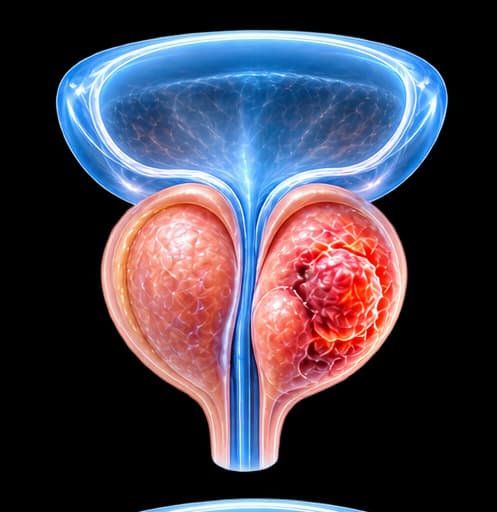
1. My Clinical Approach to Prostate Cancer
In my practice in Rhodes, the goal is not simply to “find” any cancer, but to identify clinically significant cancer that genuinely needs treatment — following the clinical guidelines of the European Association of Urology (EAU).
In practice, I always:
- Interpret PSA in combination with age, prostate volume, trend over time, and clinical picture — never in isolation.
- Use multiparametric MRI before biopsy, where supported by current guidelines.
- Clearly explain the difference between localised, locally advanced, and metastatic disease.
- Openly discuss active surveillance as an active treatment strategy, not as "no treatment".
- Individualise the comparison of surgery, radiotherapy, and systemic therapies depending on the case.
2. What Is Prostate Cancer
The prostate is a chestnut-sized gland below the bladder, surrounding the urethra, that contributes to the production of seminal fluid. Prostate cancer develops when prostate cells undergo malignant transformation — the vast majority of cases are adenocarcinoma.
Biological behaviour varies significantly: some tumours progress very slowly and may never threaten life, while others are clinically significant, aggressive tumours that need prompt treatment. This is why not every prostate cancer needs the same treatment.
3. How Common It Is & Risk Factors
Prostate cancer is one of the most frequently diagnosed cancers in men in Europe, according to data from international cancer registries (GLOBOCAN, European Cancer Information System). Its incidence increases significantly with age.
Risk Factors
Age — rare before 50, with a significant increase in incidence afterward
Family history of prostate cancer in a first-degree relative
BRCA2, and to a lesser extent BRCA1, mutations
HOXB13 mutations in selected families
Ancestry/ethnicity — some populations show a higher incidence and more aggressive disease, according to epidemiological data
Possible, less well-established influence of metabolic/lifestyle factors
Hereditary Risk & Genetic Testing
In selected patients — depending on age at diagnosis, family history, presence of metastatic disease, or specific tumour characteristics — there may be an indication for germline genetic testing of genes such as BRCA1/BRCA2 and other DNA repair genes. Universal genetic testing for every patient without a corresponding clinical indication is not recommended.
4. Symptoms & BPH vs Prostate Cancer
Localised prostate cancer often causes no symptoms at all.
Symptoms such as frequency, nocturia, or a weak urinary stream are much more often the result of benign prostatic hyperplasia (BPH) than of cancer.
BPH vs Prostate Cancer
Benign Prostatic Hyperplasia (BPH)
Not malignant, often causes lower urinary tract symptoms (LUTS), increases in frequency with age.
Prostate Cancer
A malignancy, can be entirely asymptomatic in early stages, can coexist with BPH in the same patient.
The severity of urinary symptoms does not reliably predict the presence of cancer.
Possible Symptoms of Advanced Disease
In more advanced disease, depending on the clinical context, the following may occur:
Haematuria
Bone pain
Unexplained weight loss
Weakness
Ureteral obstruction
Rarely, neurological symptoms from spinal cord compression in advanced disease
These are not typical early symptoms.
5. PSA, PSA Density & PSA Velocity
PSA (Prostate-Specific Antigen) is specific to the prostate, not specific to cancer. It can be elevated due to BPH, prostatitis, urinary retention, recent catheterisation/procedures, or other factors.
There is no single universal “normal” PSA threshold that absolutely separates the presence or absence of cancer. Interpretation depends on age, prostate volume, the trend over time, PSA density, MRI findings, and the overall clinical picture — not a simple comparison with a single number.
PSA Density
Calculated as PSA divided by prostate volume, helping with risk stratification, particularly combined with MRI/PI-RADS findings. Any cited thresholds must be understood in the correct clinical context, not treated as an absolute, universal cut-off.
PSA Velocity
The change in PSA over time can add information, but should not, on its own, be an automatic reason for biopsy without an overall assessment of all risk factors.
6. Multiparametric MRI & PI-RADS
Multiparametric prostate MRI (mpMRI) is used to identify suspicious lesions, provide a PI-RADS score, plan targeted biopsy, and, in selected cases, contribute to local staging.
MRI does not confirm cancer histologically. It remains an imaging tool that guides subsequent decisions.
PI-RADS 1–2
Lower likelihood of clinically significant cancer.
PI-RADS 3
Equivocal finding.
PI-RADS 4–5
Increasing likelihood of clinically significant cancer.
A PI-RADS 5 does not mean 100% cancer — it remains a high imaging suspicion, not certainty.
Full PI-RADS Guide7. When a Biopsy Is Needed & Biopsy Types
The need for a biopsy is assessed through a combination of PSA, PSA density, MRI/PI-RADS findings, digital rectal examination, age, family history, previous biopsies, and overall estimated risk — not a single threshold.
MRI Fusion Biopsy
MRI images are registered with real-time ultrasound, allowing targeted sampling of PI-RADS lesions — often combined with systematic sampling.
MRI Fusion Prostate BiopsyTransrectal Biopsy
An ultrasound-guided procedure to take samples through the rectum. It remains a widely used technique at many centres.
Transrectal Prostate Biopsy8. Gleason, ISUP Grade Group & Staging
The definitive diagnosis is based on histological examination. The pathologist assesses the presence of cancer, histological type, the Gleason pattern (primary + secondary, e.g., 3+4 versus 4+3 — two distinct clinical entities despite the same sum), and the extent of tumour involvement in the cores.
| ISUP Grade Group | Usual Gleason Correspondence |
|---|---|
| Grade Group 1 | Gleason 6 (3+3) |
| Grade Group 2 | Gleason 7 (3+4) |
| Grade Group 3 | Gleason 7 (4+3) |
| Grade Group 4 | Gleason 8 |
| Grade Group 5 | Gleason 9–10 |
In general, a higher Grade Group means more aggressive biological behaviour — it does not, on its own, determine treatment.
How Staging Is Done
Staging uses the TNM system: T expresses the local extent of the tumour within or beyond the prostate, N the possible involvement of lymph nodes, and M the presence or absence of distant metastases.
9. Localised, Locally Advanced & Metastatic Cancer
Localised Cancer
The tumour is confined within the prostate, at a stage that can be treated with curative intent. Localised disease does not automatically mean low-risk disease — it can include more aggressive tumours as well.
Locally Advanced Cancer
There is extension beyond the prostate capsule or involvement of adjacent structures according to TNM, without necessarily distant metastases. This often requires a multimodal approach.
Metastatic Cancer
The cancer has spread mainly to lymph nodes or bones, more rarely to other organs. It is not a single condition — it is conceptually distinguished into metastatic hormone-sensitive disease (mHSPC) and castration-resistant disease (mCRPC), with different treatment approaches.
10. PSMA PET/CT & Other Imaging
PSMA PET/CT is used in selected cases — such as staging in unfavourable intermediate or high-risk disease, or investigation of biochemical recurrence — to identify possible metastatic disease, depending on risk and the relevant clinical indication. It is not needed for every new diagnosis of prostate cancer.
Conventional bone scintigraphy and CT are still used in specific clinical settings. The choice of imaging modality depends on the risk group, PSA, Grade Group, symptoms, availability, and the centre’s protocol.
11. Risk Categories
Localised and locally advanced disease is classified into risk categories based on PSA, Grade Group, and clinical stage:
Very low / low risk
Intermediate risk — with a distinction between favourable and unfavourable
High risk
Locally advanced / very high-risk disease
12. How Treatment Is Chosen
Treatment is not determined by a single PSA or Gleason number. The choice depends on a combination of factors:
PSA & PSA density
ISUP Grade Group
TNM stage
MRI findings
Estimated disease volume
Age & life expectancy
Comorbidities
Baseline urinary & erectile function
Patient preferences
| Clinical Situation | Possible Strategies |
|---|---|
| Very low / low risk | Active surveillance in appropriate patients |
| Localised, clinically significant disease | Surgery or radiotherapy, case by case |
| High risk / locally advanced | Multimodal approach |
| Metastatic hormone-sensitive (mHSPC) | ADT ± treatment intensification |
| Castration-resistant (mCRPC) | Systemic therapy based on prior treatment/molecular profile |
This table is indicative, based on general principles of current clinical guidelines, and is not an individualised medical recommendation or treatment prescription.
13. Active Surveillance vs Watchful Waiting
Active surveillance is an organised monitoring strategy — not indifference or “no treatment”. It may include regular PSA, MRI, clinical reassessment, and repeat biopsy where indicated, according to the monitoring protocol. It applies to appropriately selected low-risk and certain favourable intermediate-risk patients.
Active Surveillance
Curative treatment remains an available option if the disease progresses during monitoring.
Watchful Waiting
A symptom-directed approach, mainly for patients for whom curative treatment is no longer the main goal.
14. Radical Prostatectomy
Radical prostatectomy removes the entire prostate and seminal vesicles, with or without pelvic lymph-node dissection depending on the indication.
It is clearly a different procedure from operations for benign prostatic hyperplasia, such as HoLEP or TURis, which remove only the obstructing tissue and are not a treatment for cancer.
15. Robotic vs Laparoscopic vs Open Approach
Robotic Radical Prostatectomy
A minimally invasive approach with magnified 3D vision, articulated instruments, and precise dissection.
Robotic Radical Prostatectomy3D Laparoscopic Radical Prostatectomy
A minimally invasive laparoscopic approach with 3D visualisation, following the same oncological principles as radical surgery.
3D Laparoscopic Radical ProstatectomyRobotic, laparoscopic, and open approaches follow shared oncological principles and differ mainly in access, visualisation, and instrumentation. The experience of the surgical team is a key factor in outcomes — not just the platform. No technique is presented here as universally superior without adequate evidence.
16. Nerve-Sparing, Continence & Erectile Function
Nerve-Sparing
Nerve-sparing can be attempted when it is oncologically safe, depending on tumour location, MRI findings, clinical stage, Grade Group, and baseline erectile function. It is not a guarantee of normal erectile function after surgery.
Urinary Continence After Radical Prostatectomy
Recovery of continence is gradual. The degree depends on the definition used, age, surgical technique, and individual factors. Pelvic floor rehabilitation can help recovery.
Erectile Dysfunction
Recovery of erectile function depends on age, baseline erectile function, whether bilateral or unilateral nerve sparing was performed, vascular factors, tumour characteristics, and recovery time. A specific outcome cannot be promised.
17. Ejaculation & Fertility After Radical Prostatectomy
After radical prostatectomy there is no longer antegrade ejaculation of semen, and natural fertility through sexual intercourse is no longer possible — since the prostate and seminal vesicles are removed.
Orgasm can be preserved, although without ejaculation. For younger patients wishing to have children in the future, sperm banking before treatment can be discussed as an option.
18. Radiotherapy & Comparison with Surgery
Radiotherapy includes modern image-guided external beam radiotherapy (EBRT), hypofractionation schedules where supported by current guidelines, and brachytherapy in selected patients. It can be used as primary treatment with curative intent, or as a postoperative salvage/adjuvant strategy in selected cases.
Surgery vs Radiotherapy
The two approaches differ in the treatment process, availability of a pathology specimen, urinary effects, sexual function, bowel effects, recovery time, salvage options in case of recurrence, and patient age, comorbidities, and tumour risk. Neither method is presented here as universally superior.
19. Hormone Therapy (ADT)
Prostate cancer often depends on androgen signalling. Androgen deprivation therapy (ADT) can be used together with radiotherapy in specific risk groups, in metastatic disease, or in recurrent/advanced disease. It is not a curative monotherapy for localised disease.
Possible Side Effects of ADT
Hot flashes
Reduced libido
Erectile dysfunction
Loss of muscle mass
Increased body fat
Loss of bone density
Metabolic changes
Cardiovascular factors requiring monitoring
20. Metastatic Disease & Systemic Therapies
In metastatic hormone-sensitive prostate cancer (mHSPC), modern practice is often based on treatment intensification beyond ADT alone, in appropriate patients — the exact choice of combination is individualised based on current clinical guidelines and is not presented here as a universally appropriate regimen.
Castration-resistant prostate cancer (mCRPC) refers to disease progression despite castrate testosterone levels, and may be non-metastatic or metastatic. Multiple systemic options exist depending on prior therapy, molecular profile, and disease characteristics.
Depending on stage and molecular profile, modern classes of systemic therapy include androgen receptor pathway inhibitors (ARPIs), chemotherapy, PARP inhibitors in molecularly selected disease, and PSMA-targeted radioligand therapy in appropriate indications. This page is not a prescribing guide — no dosages are given, and treatment selection is always made by the treating oncologist/urologist based on current guidelines.
21. Bone Metastases & Red Flags
Bone metastases can cause bone pain and an increased risk of fracture. Management includes appropriate imaging, systemic therapy, selective use of bone-targeting agents, and palliative radiotherapy where indicated.
Urgent Evaluation
New, severe back pain with weakness, sensory changes, or new problems with urination or bowel control requires immediate medical evaluation — a possible sign of spinal cord compression, a rare but urgent condition in advanced disease.
22. What a Rising PSA After Treatment Means (Biochemical Recurrence)
PSA behaviour after treatment differs depending on whether radical prostatectomy or radiotherapy was performed, and the definitions of biochemical recurrence differ accordingly between the two — the exact thresholds should always be confirmed by the treating physician based on current guidelines.
In selected patients with rising PSA after treatment, PSMA PET/CT can help locate the site of recurrence and influence the planning of subsequent treatment — but it is not positive at every PSA level.
23. Prognosis — Can Prostate Cancer Be Cured?
Many localised prostate cancers are potentially curable, and low-risk disease often has an excellent long-term prognosis. Even advanced disease can today be controlled for a significant period with modern therapies. Prognosis always depends on stage, Grade Group, PSA, disease burden, and response to treatment.
“How many years will someone live?” An exact prognosis cannot be given from PSA alone. Survival statistics apply to populations — not to an individual patient. Stage, Grade Group, any metastases, molecular profile, and response to treatment matter greatly. We do not give a blanket survival guarantee here.
24. Prevention & When PSA Screening Should Start
Prostate cancer cannot be fully prevented. General healthy lifestyle principles — maintaining a healthy body weight, regular exercise, a balanced diet, and avoiding smoking — relate to overall health, without constituting guaranteed prevention of prostate cancer.
For early detection, the modern European approach recommends individualised, risk-adapted PSA testing with shared decision-making between physician and patient, rather than a single age rule for everyone. The starting point differs depending on whether a man is at average risk, has a family history, or carries BRCA2 or another strong hereditary risk factor — the exact starting age should be discussed individually with the urologist, based on current European recommendations.
25. The Diagnostic Journey
26. Diagnosis & Treatment — Full Guide
Prostate Cancer Diagnosis
Prostate Cancer Treatment
27. The Doctor

Dr. Marinos Vasilas, Urologist – Andrologist
Dr. Marinos Vasilas specialises in the diagnosis and treatment of prostate cancer, following the clinical guidelines of the European Association of Urology (EAU). He provides initial urological evaluation in Rhodes, with access to a full diagnostic and treatment workup depending on the case.
Meet the Doctor28. Frequently Asked Questions
What are the first symptoms of prostate cancer?
In its early, potentially curable stages, prostate cancer usually causes no symptoms at all. This is why early detection relies on individualised PSA testing rather than waiting for symptoms to appear.
Can there be cancer without any symptoms?
Yes, and this is in fact the most common picture in early-stage disease. Urinary symptoms, when present, are much more often caused by benign prostatic hyperplasia than by cancer.
Does an elevated PSA always mean cancer?
No. PSA is specific to the prostate, not specific to cancer. It can be elevated due to benign prostatic hyperplasia, prostatitis, urinary retention, or recent procedures. Interpretation is always made in combination with other data.
What PSA level is considered dangerous?
There is no single universal cut-off that absolutely separates the presence or absence of cancer. Interpretation depends on age, prostate volume, the trend over time, PSA density, MRI findings, and the overall clinical picture.
Can there be cancer with a normal or low PSA?
Yes, although less commonly. PSA does not have 100% sensitivity, and some tumour subtypes may be associated with relatively lower PSA. This is why the digital rectal examination and overall clinical picture remain important.
What does PI-RADS 4 or 5 mean on MRI?
It means an increasing likelihood of clinically significant cancer on imaging. However, it is not, on its own, a histological diagnosis — it remains an imaging finding that guides the biopsy.
When is a prostate biopsy needed?
The decision is based on a combination of PSA, PSA density, MRI/PI-RADS findings, digital rectal examination, age, family history, previous biopsies, and overall estimated risk — not a single threshold.
What does the Gleason score mean?
It is the histological grading system based on the sum of a primary and a secondary growth pattern (e.g., 3+4 or 4+3). This combination, together with other data, determines the ISUP Grade Group.
What is the ISUP Grade Group?
It is a simplified scale from 1 (lower risk) to 5 (higher risk) corresponding to specific Gleason combinations. In general, a higher Grade Group means more aggressive biological behaviour.
When is surgery needed?
Radical prostatectomy is considered mainly for localised or selected locally advanced disease in patients with an appropriate life expectancy. The decision is not based on a single PSA or Gleason number, but on the combination of stage, Grade Group, age, comorbidities, and patient priorities.
What is active surveillance?
It is an organised monitoring strategy (PSA, MRI, repeat biopsy where indicated) for appropriately selected low-risk and certain favourable intermediate-risk patients — not the absence of treatment. Curative treatment remains available if the disease progresses.
Robotic or laparoscopic prostatectomy?
Both follow the same oncological principles through a minimally invasive approach. The experience of the surgical team plays a decisive role in the outcome, not just the platform itself.
Is erectile function affected after surgery?
Possibly, to a degree that depends on age, pre-existing erectile function, whether nerve-sparing was possible, and vascular factors. There is no guarantee of a specific outcome.
Is there incontinence after radical prostatectomy?
Recovery of continence is gradual. The degree depends on the definition used, age, surgical technique, and individual factors. Pelvic floor rehabilitation can help.
Can metastatic prostate cancer be cured?
Metastatic disease is not usually considered curable in the sense of complete elimination, but it can today be controlled for a significant period with modern systemic therapies. Prognosis depends on the extent of disease, molecular profile, and response to treatment.
Related Topics
Book an Appointment in Rhodes
Elevated PSA, a suspicious MRI, PI-RADS 3–5, a positive biopsy, a recent diagnosis, or the need for a second opinion? Prostate cancer diagnosis and treatment are individualised. The decision is based on PSA, MRI, biopsy, Gleason/ISUP grade, disease stage, age, and your priorities.
Scientific References
- EAU-EANM-ESTRO-ESUR-ISUP-SIOG Guidelines on Prostate Cancer. European Association of Urology — uroweb.org
- ESMO Clinical Practice Guidelines: Prostate Cancer. European Society for Medical Oncology — esmo.org
- AUA/ASTRO/SUO Guideline: Clinically Localized Prostate Cancer. American Urological Association — auanet.org
- Epstein JI, et al. The 2014 International Society of Urological Pathology (ISUP) Consensus Conference on Gleason Grading of Prostatic Carcinoma. Am J Surg Pathol 2016;40:244–252.
- Turkbey B, et al. Prostate Imaging Reporting and Data System Version 2.1 (PI-RADS v2.1). Eur Urol 2019;76:340–351.
- Global Cancer Observatory (GLOBOCAN). International Agency for Research on Cancer, WHO — gco.iarc.who.int
The content of this page is for informational purposes only and does not replace an individualised urological or oncological evaluation. Treatment depends on the stage, Grade Group, PSA, life expectancy, and priorities of the patient. Therapeutic recommendations continually evolve and must always be based on current clinical guidelines and the judgement of the treating physician. Medical review by Dr. Marinos Vasilas.


