1. My Clinical Approach to TURiS
TURiS is an established option for the surgical treatment of obstructive BPH in my practice in Rhodes, for adenomas of appropriate size and anatomy. Bipolar technology in saline makes it a safer choice compared with classic monopolar TURP, particularly in patients with cardiovascular or renal comorbidities.
Correct patient selection is decisive. Adenoma volume, anatomy, bladder function, bleeding risk, and overall health status together determine whether TURiS, HoLEP, Aquablation, or another technique is the most appropriate choice.
In practice, I always:
- Rule out prostate cancer before any surgical treatment of BPH.
- Clearly explain that TURiS does not remove the entire prostate.
- Clearly inform patients about the possibility of retrograde ejaculation before the procedure.
- Individualise the comparison with HoLEP, Aquablation, Rezūm, and UroLift depending on the case.
2. What Is TURiS
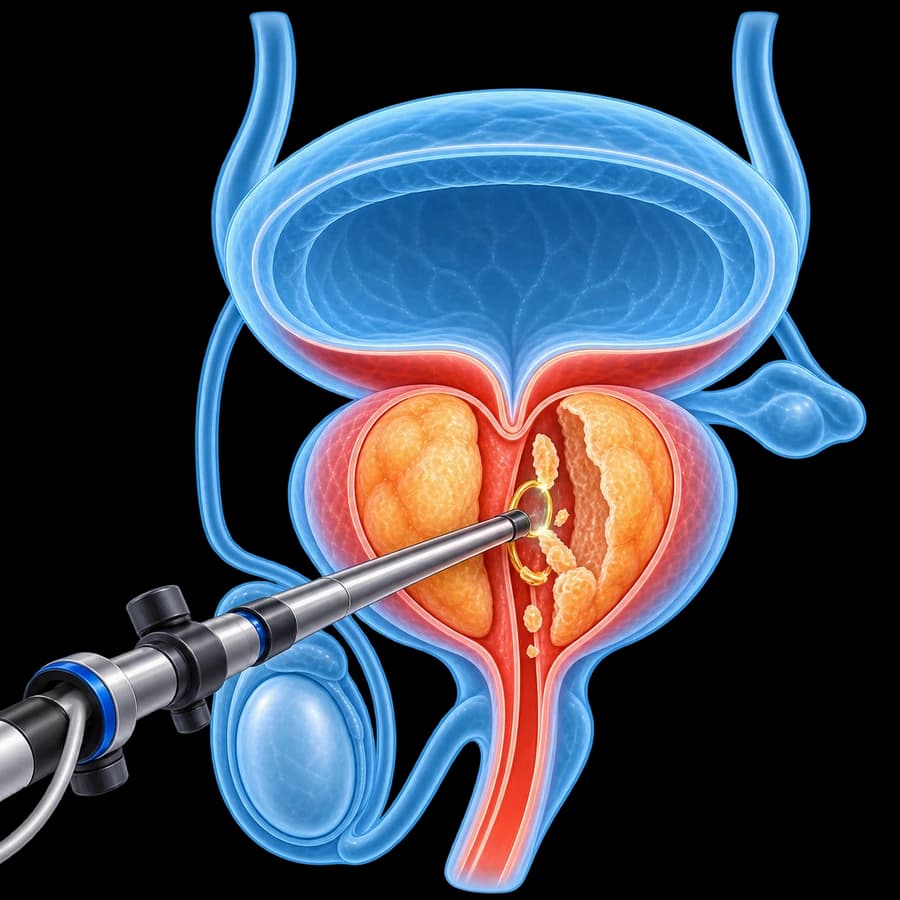
TURiS (Transurethral Resection in Saline) is the bipolar variant of classic transurethral resection of the prostate (TURP). A resectoscope is introduced through the urethra, and the obstructing adenomatous tissue is removed gradually using bipolar electrosurgical energy, under continuous irrigation with normal saline (0.9% NaCl) that maintains visibility and flushes away blood and tissue.
The key technological difference from monopolar TURP lies in the electrical circuit. In bipolar technology, both poles are located at the tip of the electrode itself, so a non-conductive irrigation fluid is not required. This allows the use of normal saline instead of deionised water or glycine.
TURiS is essentially a form of bipolar TURP. The term “TURiS” refers to the use of normal saline as the irrigation fluid, made possible by bipolar technology.
3. TURiS vs Classic (Monopolar) TURP
Monopolar TURP
Uses monopolar electrosurgical energy and requires a non-conductive (hypotonic) irrigation fluid, such as deionised water or glycine, so that the electric current does not disperse into the fluid.
TURiS / Bipolar TURP
Uses bipolar energy and allows irrigation with normal saline (0.9% NaCl), through a different electrosurgical circuit design.
The use of isotonic saline instead of a hypotonic irrigation fluid substantially reduces the risk of hypotonic fluid absorption and the classic “TUR syndrome” associated with it. This does not mean that fluid absorption or related complications are eliminated entirely. According to systematic reviews and comparative studies, bipolar TURP/TURiS has comparable efficacy to monopolar TURP, with a more favourable safety profile regarding TUR syndrome.
4. What Is Removed — Not a Radical Prostatectomy
TURiS does not remove the entire prostate.
The obstructing hyperplastic tissue surrounding the prostatic urethra is removed gradually, in chips. The peripheral zone of the gland and the surgical capsule remain in place.
TURiS Treats Benign Obstruction, Not Cancer
This is fundamentally different from radical prostatectomy (robotic or laparoscopic), which removes the entire prostate as a treatment for prostate cancer. TURiS treats benign prostatic obstruction and is not a treatment for cancer.
5. How the Procedure Is Performed
Endoscopic Access
The resectoscope is introduced through the urethra, without any external incision.
Anatomical Assessment
The surgeon identifies the prostatic lobes, the bladder neck, and key anatomical landmarks.
Bipolar Resection
The obstructing tissue is removed gradually with a bipolar loop, under continuous saline irrigation.
Haemostasis
Bleeding vessels are controlled electrosurgically throughout the resection.
Tissue Chip Removal
Prostate tissue chips are flushed out and removed from the bladder.
Histological Examination
The removed tissue is sent for pathological analysis.
Catheter
A temporary urinary catheter is placed, often allowing bladder irrigation where needed.
6. Histology & Prostate Cancer
The prostate tissue removed with TURiS is sent for histological examination — an advantage compared with some techniques that do not directly remove tissue. This does not replace appropriate preoperative investigation for cancer when suspicious findings are present, and in a small number of samples an incidental finding of prostate cancer may rarely be detected.
7. Who Is a Candidate for TURiS
TURiS is considered in men with significant lower urinary tract symptoms (LUTS) due to BPH, such as:
Weak urinary flow
Difficulty initiating urination
Intermittent stream
Prolonged voiding
Sensation of incomplete emptying
Large post-void residual
Recurrent acute urinary retention
Recurrent infections related to obstruction, in the appropriate context
Bladder stones together with obstruction
Renal impairment from chronic obstruction, where relevant
Failure of or intolerance to medical therapy
Ruling Out Cancer Before Attributing Symptoms to BPH
Before any surgical treatment of BPH, a full urological evaluation is required — including PSA and digital rectal examination — to rule out prostate cancer, as urinary symptoms of BPH and cancer can overlap.
8. What Prostate Size Is TURiS Used For?
TURP/TURiS has traditionally been used mainly for small-to-moderate sized glands. There is no arbitrary, universally accepted cubic-centimetre cut-off above which the technique is excluded — suitability depends on adenoma volume and anatomy, operative time, surgeon experience, and bleeding risk.
For substantially larger glands, techniques such as HoLEP, endoscopic enucleation more broadly, adenomectomy, or, in appropriately selected cases, Aquablation may be more appropriate alternatives, depending on volume, anatomy, surgeon expertise, and patient preferences.
TURiS and the Median Lobe
An obstructing median lobe can be addressed during TURiS, depending on the anatomy and the surgical technique selected.
9. TURiS and Urinary Retention
In men with an indwelling catheter, recurrent urinary retention, or a significant post-void residual, TURiS can address the prostatic obstruction.
The ability to void independently after the procedure also depends on detrusor (bladder muscle) function, the chronic duration of the obstruction, any neurological conditions, and overall bladder function — TURiS cannot guarantee a catheter-free outcome for every patient.
10. Preoperative Evaluation
Preoperative evaluation is individualised — not every test is mandatory in every case:
Medical history
IPSS
Uroflowmetry
Post-void residual (PVR) measurement
PSA
Digital rectal examination
Ultrasound / prostate volume
Urinalysis / urine culture
Full blood count
Renal function tests
Coagulation assessment
Anticoagulant / antiplatelet review
Cystoscopy, where indicated
Urodynamic testing, in selected cases only
11. Anaesthesia, Catheter & Hospital Stay
Anaesthesia
TURiS can be performed under spinal/regional or general anaesthesia, depending on patient factors, the anaesthesiologist’s assessment, the surgical plan, and the centre’s protocol.
How Long Does the Catheter Stay In After TURiS?
The urinary catheter is used temporarily, for urine drainage, monitoring of possible haematuria, and bladder irrigation where needed. Its duration depends on the extent of the procedure, bleeding, prostate size, and the postoperative course.
Hospital Stay
Hospital stay is usually short, but depends on haematuria, catheter removal, comorbidities, age, gland size, and the centre’s protocol. A specific discharge day cannot be promised for every patient.
12. Recovery & When Urination Improves
Possible early discomforts after TURiS include:
Haematuria
Small clots
Burning on urination
Frequency
Urgency
Nocturia
Temporary difficulty urinating
Transient leakage in some patients
Irritative symptoms may take time to settle. Many patients notice improved flow relatively soon after catheter removal, but urgency/frequency may persist temporarily, and chronic bladder dysfunction may limit the final outcome — recovery varies from patient to patient.
These are only general recovery principles, not a strict timeline — the exact course is determined by the surgeon and the centre’s protocol.
13. Does TURiS Affect Ejaculation and Erectile Function?
Ejaculation
Retrograde ejaculation (or absence of antegrade ejaculation) is common after TURP/TURiS. We do not hide this fact.
- Semen is directed toward the bladder instead of outward during ejaculation.
- It does not usually mean loss of orgasm.
- It matters for fertility — a relevant consideration for younger men wishing to have children.
- It is a separate issue from erectile dysfunction.
Erectile Function
Most men do not experience significant deterioration of erectile function as a direct result of TURiS, though this is not an absolute assurance for every patient. Pre-existing erectile function, age, and vascular factors play a role in the final outcome.
14. Bleeding & Anticoagulant Therapy
Some degree of haematuria is expected postoperatively. Bipolar technology provides effective haemostasis during resection, but significant bleeding or the need for transfusion, though less common, remain possible — TURiS is not a “bloodless” procedure.
Managing anticoagulant and antiplatelet medications requires an individualised approach, weighing thrombotic risk against bleeding risk. Patients should not stop these medications on their own — the decision is made in coordination with the surgeon, cardiologist, or haematologist, as appropriate.
15. TUR Syndrome
Classic “TUR syndrome” was first described in the context of monopolar TURP and relates to the absorption of hypotonic irrigation fluid (deionised water or glycine) through the open venous channels of the prostate during resection. It can cause electrolyte dilution (mainly hyponatraemia) and, in more severe cases, neurological or cardiovascular manifestations.
Because TURiS uses isotonic normal saline instead of a hypotonic fluid, the risk of the classic, hyponatraemic TUR syndrome is significantly reduced. This does not mean there is no risk whatsoever from fluid absorption — careful monitoring during and after the procedure remains necessary.
16. Other Possible Complications
TURiS generally has a favourable safety profile, though it is not free of complications:
Urinary tract infection
Bleeding / clot retention
Temporary dysuria
Acute urinary retention
Urethral stricture
Bladder neck contracture
Temporary incontinence
Less commonly, persistent urinary symptoms
Need for retreatment
17. Long-term Outcomes & Retreatment
TURP/TURiS has a very mature and long-term evidence base, with consistent improvement in urinary symptoms, flow, and quality of life in most patients, according to systematic reviews and clinical guidelines.
Could I Need Another Procedure?
Yes, a small proportion of patients may need a further intervention in the future. Possible causes include residual or regrown adenoma, bladder neck contracture, urethral stricture, or new obstruction over time. TURiS does not guarantee that the prostate will never enlarge again.
18. TURiS vs HoLEP vs Aquablation
The choice between TURiS, HoLEP, Aquablation, and other techniques depends on prostate size and anatomy, bladder function, comorbidities, and patient priorities. No technique is a universal winner.
| Feature | TURiS | HoLEP | Aquablation |
|---|---|---|---|
| Mechanism | Bipolar electrosurgical resection in saline | Laser enucleation of the adenoma | Image-guided, controlled waterjet |
| Tissue removal | Resection into chips | En-bloc enucleation + morcellation | Waterjet tissue ablation |
| Prostate size | Traditionally small-to-moderate glands | Not significantly limited by size | Depends on anatomy, in selected patients |
| Irrigation fluid | Normal saline (0.9% NaCl) | Normal saline | Normal saline |
| Bleeding | Good profile, still possible | Often very good profile | Often low, in appropriately selected patients |
| Ejaculation | Retrograde ejaculation common | Retrograde ejaculation common | More often preserved, in selected patients |
| Histology | Yes | Yes | Yes |
| Catheter | Temporary | Temporary | Temporary |
| Long-term data | Very mature, long-term literature | Extensive, many years of follow-up | Newer technology, growing data |
| Retreatment | Low but non-zero rate | Generally low rate | Growing long-term data |
| Learning curve | Usually shorter, well-established training | Demanding, longer than other techniques | Standardised imaging-based planning |
This table is indicative only and is not an individualised medical recommendation.
19. TURiS vs Rezūm, UroLift, and Adenomectomy
TURiS vs Rezūm
TURiS directly removes the obstructing tissue by electrosurgical resection. Rezūm causes thermal tissue ablation using water vapour, and the adenoma volume decreases gradually over the following weeks. They also differ in invasiveness, need for anaesthesia, catheter duration, speed of symptom improvement, suitability by prostate size, and retreatment rate.
Rezūm Water Vapor TherapyTURiS vs UroLift
UroLift does not remove tissue — it mechanically retracts the prostatic lobes using implants. TURiS removes the obstructing tissue by electrosurgical resection. These are techniques with different indications and different durability profiles.
TURiS vs Adenomectomy
For very large prostates, TURiS is not presented as ideal for every adenoma volume. Alternatives more often considered include HoLEP, endoscopic enucleation more broadly, laparoscopic/robotic adenomectomy, or, in appropriately selected cases, Aquablation.
3D Laparoscopic Prostate Adenomectomy20. The Patient Journey
21. The Doctor

Dr. Marinos Vasilas, Urologist – Andrologist
Dr. Marinos Vasilas specialises in endourology and the surgical treatment of benign prostatic hyperplasia, following the clinical guidelines of the European Association of Urology (EAU).
Meet the Doctor22. Frequently Asked Questions
What is TURiS?
TURiS (Transurethral Resection in Saline) is the bipolar variant of transurethral resection of the prostate (TURP). The obstructing adenomatous tissue is removed through the urethra using bipolar electrosurgical energy in a normal saline environment, without any external incision.
What is the difference between TURiS and classic (monopolar) TURP?
Classic monopolar TURP requires a non-conductive irrigation fluid (deionised water or glycine), whose absorption can cause TUR syndrome. TURiS uses bipolar technology that allows irrigation with normal saline (0.9% NaCl), substantially reducing — not eliminating — the risk of that syndrome.
Is the entire prostate removed with TURiS?
No. The obstructing adenomatous tissue surrounding the prostatic urethra is removed gradually. The peripheral zone of the gland remains in place. TURiS is not a radical prostatectomy and is not a treatment for prostate cancer.
What prostate size is TURiS suitable for?
TURP/TURiS has traditionally been used mainly for small-to-moderate sized glands. There is no universally accepted, rigid cubic-centimetre cut-off — suitability depends on gland volume, anatomy, surgeon experience, and bleeding risk. For substantially larger glands, alternatives such as HoLEP, adenomectomy, or, in appropriately selected cases, Aquablation are more often considered.
Is a catheter needed after TURiS?
Yes, a temporary urinary catheter is placed for urine drainage, monitoring of haematuria, and bladder irrigation where needed. The exact duration depends on the extent of the procedure, bleeding, prostate size, and the postoperative course — it is not the same for every patient.
How many days of hospital stay are needed?
Hospital stay is usually relatively short, but the exact duration depends on haematuria, catheter removal, comorbidities, age, gland size, and the centre’s protocol. No single discharge day can be promised for every patient.
When does urination improve after TURiS?
Many patients notice improved flow relatively soon after catheter removal. However, urgency and frequency may persist temporarily, and the final outcome also depends on pre-existing bladder function — recovery varies from patient to patient.
Does TURiS affect ejaculation?
Yes, retrograde ejaculation (or absence of antegrade ejaculation) is common after TURP/TURiS. It does not usually mean loss of orgasm, but it matters for fertility and is a separate issue from erectile function.
Does TURiS affect erectile function?
Most men do not experience significant deterioration of erectile function as a direct result of TURiS, though this is not an absolute guarantee for every patient. Pre-existing erectile function, age, and vascular factors play a role.
TURiS or HoLEP?
Both techniques treat obstructive BPH endoscopically, using different mechanisms. HoLEP is not significantly limited by prostate size, while TURiS is traditionally applied mainly to smaller-to-moderate glands. The choice depends on gland volume, anatomy, available surgical expertise, and patient priorities.
TURiS or Aquablation?
TURiS is bipolar electrosurgical resection with a very mature, long-term evidence base. Aquablation uses an image-guided waterjet and, in selected patients, has been associated with better preservation of ejaculation. Neither technique is universally superior — the choice is individualised.
Could I need another procedure after TURiS?
Yes, a small proportion of patients may need a further intervention in the future, usually due to residual or regrown adenoma, bladder neck contracture, urethral stricture, or new obstruction. TURiS does not guarantee that the prostate will never enlarge again.
Related Topics
Book an Appointment in Rhodes
Significant BPH, large post-void residual, recurrent retention, an indwelling catheter, or insufficient response to medication? The choice between TURiS, HoLEP, Aquablation, and other procedures depends on prostate size and anatomy, bladder function, comorbidities, and your priorities — discuss your options at our practice in Rhodes.
Scientific References
- EAU Guidelines on the Management of Non-neurogenic Male LUTS. European Association of Urology — uroweb.org
- AUA Guideline on the Surgical Management of Lower Urinary Tract Symptoms/Benign Prostatic Hyperplasia (BPH). American Urological Association — auanet.org
- Cornu JN, et al. A Systematic Review and Meta-analysis of Functional Outcomes and Complications Following Transurethral Procedures for Lower Urinary Tract Symptoms Resulting from Benign Prostatic Obstruction. Eur Urol 2015;67:1066–1096.
- Omar MI, et al. Systematic Review and Meta-analysis of the Clinical Effectiveness of Bipolar Compared with Monopolar Transurethral Resection of the Prostate (TURP). BJU Int 2014;113:24–35.
- Mamoulakis C, et al. Bipolar versus Monopolar Transurethral Resection of the Prostate: Evaluation of a Long-term Follow-up. Eur Urol 2009;56:508–514.
The content of this page is for informational purposes only and does not replace an individualised urological evaluation. TURiS is not suitable for every patient — the choice of procedure depends on prostate volume and anatomy, bladder function, bleeding risk, comorbidities, and patient priorities. Medical review by Dr. Marinos Vasilas.


