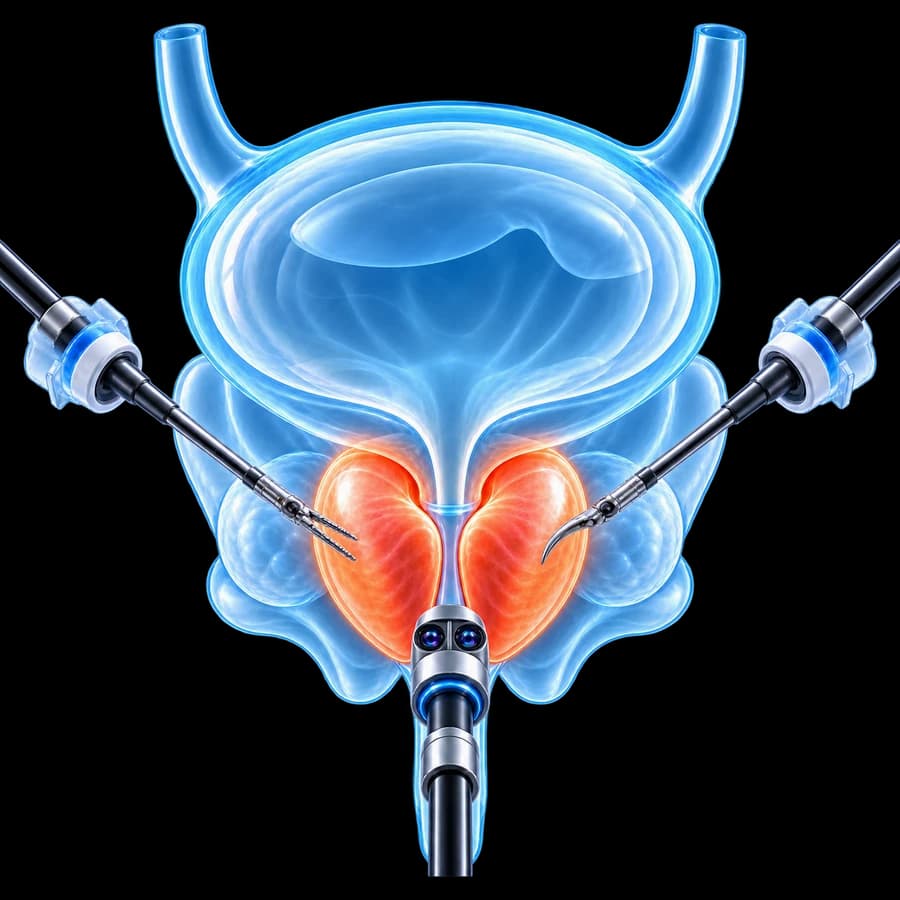
1. My Clinical Approach to Laparoscopic Radical Prostatectomy
3D laparoscopic radical prostatectomy is the technique that established minimally invasive prostate cancer surgery before the wide adoption of robotics. It remains an excellent option — the quality of the outcome depends primarily on the stage of disease, the patient’s anatomy, and the experience of the surgical team.
My role is to explain, based on the European Association of Urology (EAU) guidelines, what the procedure can realistically offer a specific patient — without exaggeration and without hiding possible complications.
In practice, I always:
- Obtain full staging (PSA, Gleason/ISUP grade, mpMRI, clinical stage) before any discussion of treatment.
- Present all treatment alternatives — active surveillance, radiotherapy, surgery — with their real-world data.
- Give clear information about the factors affecting continence and erectile function, without promises.
- Individualise the decision on nerve-sparing technique and lymph node dissection based on oncological risk.
This guide is based on the EAU guidelines on prostate cancer and published clinical literature — not on marketing material.
2. What Is Laparoscopic Radical Prostatectomy
Laparoscopic radical prostatectomy is a minimally invasive surgical procedure for the treatment of prostate cancer. It is performed through small incisions in the abdomen, through which the laparoscopic camera, surgical instruments, and ports/trocars are introduced.
The surgeon performs the procedure viewing the surgical field in high resolution, manipulating the laparoscopic instruments directly at the operating table — unlike robotic technique, where the surgeon sits at a console. In 3D laparoscopy, stereoscopic depth perception is added.
- Removal of the prostate and seminal vesicles.
- Restoration of urinary tract continuity with vesicourethral anastomosis.
- Possible pelvic lymph node dissection, depending on oncological risk — not in every case.
3. 3D Laparoscopic Radical Prostatectomy

Modern 3D laparoscopic technology offers the surgeon three-dimensional visualization of the surgical field on ultra-high-definition (4K) screens, restoring the depth perception provided by natural vision — something conventional two-dimensional (2D) laparoscopy does not offer.
- Stereoscopic depth perception.
- High-resolution (4K) imaging and magnification of the surgical field.
- More precise identification of anatomical structures.
- Fine surgical manipulation around the prostate, urethra, bladder, and neurovascular bundles.
Unlike robotic surgery, 3D laparoscopic technique does not use a robotic interface — the surgeon directly manipulates the laparoscopic instruments.
4. When Laparoscopic Radical Prostatectomy Is Indicated
The choice is individualised and may mainly concern localized prostate cancer or, in selected cases, locally advanced disease. The decision takes into account:
Age & general health status
Life expectancy
PSA
Prostate MRI
Biopsy results
Gleason score / ISUP Grade Group
Clinical stage
Likelihood of lymph node involvement
Radical Prostatectomy Is Not the Only Option
For prostate cancer, treatment choice is individualised. In low-risk disease, active surveillance may be the first option. Radiotherapy is also an effective, well-documented treatment for selected patients.
5. Pre-operative Evaluation
Imaging & Staging
mpMRI of the prostate for local staging. Additional imaging (e.g. bone scan, CT, or PSMA-PET/CT) is considered in intermediate/high-risk patients, not in every case.
General Pre-operative Assessment
Urological and anaesthetic assessment, blood tests, cardiovascular risk evaluation where needed.
Anticoagulant Therapy
Management of anticoagulant/antiplatelet medication is individualised, in consultation with the treating physician — patients should not stop these medications on their own.
Nerve-Sparing Discussion
Depending on stage, MRI anatomy, and pre-operative erectile function, the possibility of unilateral or bilateral nerve-sparing technique is discussed.
6. How the Procedure Works
General Anaesthesia
The procedure is performed under general anaesthesia, with the patient in a specific position.
Small Laparoscopic Incisions
4–5 small incisions in the abdomen, through which the trocars are introduced.
Insertion of Camera & Surgical Instruments
Insertion of the 3D laparoscopic camera and laparoscopic instruments. Creation of pneumoperitoneum with CO2.
Identification of Anatomical Structures
Identification of the prostate and surrounding anatomical structures (urethra, bladder, neurovascular bundles).
Dissection & Removal of the Prostate
Dissection and removal of the prostate and seminal vesicles, with precision aided by 3D magnification.
Nerve-Sparing Technique, Where Indicated
When oncologically appropriate, preservation of the neurovascular bundles is attempted.
Pelvic Lymph Node Dissection, If Indicated
In intermediate/high-risk patients, pelvic lymph nodes are removed for staging.
Vesicourethral Anastomosis
The urethra is sutured to the bladder, aiming for a sealed, tension-free anastomosis.
Catheter Placement
A urinary catheter is placed for the period needed to allow the anastomosis to heal.
Removal of the Surgical Specimen
The specimen is removed through a small incision, and the incisions are closed.
The exact course varies per patient, depending on anatomy and the surgical finding.
7. Nerve-Sparing Technique in Laparoscopic Prostatectomy
The neurovascular bundles that contribute to erectile function lie very close to the prostate. In appropriately selected patients, the following may be performed:
Unilateral Nerve-Sparing
Preservation of the neurovascular bundle on one side only, when there is evidence of disease on the other side.
Bilateral Nerve-Sparing
Preservation of both bundles, when anatomy and stage allow this safely.
The feasibility of nerve-sparing depends on tumour location and extent (based on MRI and biopsy), pre-operative erectile function, age, and above all, oncological safety. In higher-risk disease, nerve-sparing technique may be limited or not possible.
No one can promise preservation of erections in advance — nerve-sparing technique increases the likelihood, without guaranteeing it. Oncological safety always takes priority.
8. Laparoscopic vs Open Radical Prostatectomy
| Feature | Laparoscopic (3D) | Open |
|---|---|---|
| Incisions | 4–5 small incisions (≤12mm) | Single lower-abdominal incision ~10–15 cm |
| Blood loss | Usually lower | Usually higher |
| Surgical trauma | Smaller | Larger |
| Visualisation | Three-dimensional, magnified | Direct surgeon vision |
| Mobilisation | Often faster | Often slower |
| Post-operative pain | Usually lower | Usually higher |
| Oncological outcomes | Depend mainly on stage & surgeon experience | Depend mainly on stage & surgeon experience |
In suitable patients, the laparoscopic approach may offer smaller incisions, lower blood loss, and often a faster return to daily activities. Long-term oncological outcomes depend mainly on the stage of disease and the quality of the surgery — not solely on the surgical access approach.
9. Laparoscopic or Robotic Radical Prostatectomy?
Both techniques are minimally invasive approaches for the treatment of prostate cancer. Neither is universally superior to the other.
Robotic
- Surgeon console
- Articulated robotic instruments
- Three-dimensional visualization
- Filtering of natural hand tremor
3D Laparoscopic
- Surgeon directly manipulates the laparoscopic instruments
- Three-dimensional visualization
- High precision
- Minimally invasive access, without a robotic interface
The quality of the oncological and functional outcome does not depend exclusively on the technology, but also on the experience of the surgical team, the patient’s anatomy, and the characteristics of the disease.
For information about the Da Vinci technique, see the page on Robotic Radical Prostatectomy.
10. Urinary Continence After Radical Prostatectomy
After catheter removal, some degree of temporary incontinence is possible. Function usually improves gradually.
- Pelvic floor rehabilitation (Kegel exercises) is recommended and can start early, even before surgery.
- Most patients notice gradual improvement in the first months after catheter removal.
- Factors such as age, pre-operative function, anatomy, surgical technique, and sphincter function affect the speed of recovery.
No absolute recovery rates are given here — the course varies significantly by patient.
11. Erectile Function After the Procedure
Even with nerve-sparing technique, a period of neuropraxia (temporary nerve dysfunction due to surgical trauma) is common, with gradual recovery of function over months, where it occurs.
- Age and pre-operative erectile function (baseline function) are among the most important prognostic factors.
- The extent of nerve-sparing technique and the extent of disease affect the likelihood of recovery.
- “Penile rehabilitation” — e.g. early use of PDE5 inhibitors after medical advice — is considered in selected patients.
For patients who do not achieve satisfactory recovery, further options exist: PDE5 inhibitors, a vacuum erection device, intracavernosal injections, and, in selected cases, a penile prosthesis.
12. Oncological Control After Radical Prostatectomy
The final outcome is assessed by the pathological examination of the specimen, which determines:
Pathological stage (pT)
Gleason score / ISUP Grade Group
Surgical margin status
Extracapsular extension
Seminal vesicle invasion
Lymph node status, if removed
PSA follow-up is performed after the procedure. Following complete removal of the prostate, PSA is expected to fall to very low / undetectable levels — without this being an absolute guarantee for every patient.
13. Possible Complications
As with any surgical procedure, laparoscopic radical prostatectomy carries possible complications, which are always discussed before surgery:
- Bleeding, rarely requiring transfusion.
- Infection.
- Deep vein thrombosis — reduced with anticoagulant prophylaxis and early mobilisation.
- Injury to adjacent organs.
- Leakage from the vesicourethral anastomosis.
- Anastomotic stricture, rarely, at a later stage.
- Temporary, or more rarely persistent, urinary incontinence.
- Erectile dysfunction, with variable chance of recovery.
- Lymphocele, if lymph node dissection was performed.
14. Hospital Stay and Recovery
There is no single universal timeline for hospital stay or catheter removal that applies to every patient — the course is individualised by the surgeon.
15. Follow-up After Radical Prostatectomy
After the procedure, the pathology result, surgical margins, PSA, continence, and erectile function are assessed. In selected patients, depending on the pathological and oncological findings, the following may be required:
- Adjuvant radiotherapy
- Salvage radiotherapy
- Hormone therapy, in selected high-risk cases
16. The Doctor

Dr. Marinos Vasilas, Urologist – Andrologist
Dr. Marinos Vasilas is a specialist urologist and andrologist, holding an MD and currently a PhD candidate (PhDc), following the guidelines of the European Association of Urology (EAU). He specialises in endourology, 3D-4K laparoscopic surgery, and robotic surgery, with a clinical focus on urological oncology (prostate, kidney, bladder).
Meet the Doctor17. Surgical Team
Laparoscopic radical prostatectomy is performed in collaboration with a specialised surgical centre and urology team, ensuring access to modern laparoscopic infrastructure.
Meet Our Team18. Frequently Asked Questions (FAQ)
What is laparoscopic radical prostatectomy?
It is the complete surgical removal of the prostate and seminal vesicles to treat prostate cancer, through small abdominal incisions, using a laparoscopic camera and three-dimensional (3D) visualization.
What is the difference from open prostatectomy?
The laparoscopic technique is performed through several small incisions instead of one large incision. In suitable patients this may involve less blood loss, less surgical trauma, and faster mobilisation. This does not mean that the oncological outcome differs.
What is the difference between laparoscopic and robotic prostatectomy?
Both are minimally invasive approaches. In robotic surgery, the surgeon sits at a console and controls articulated robotic instruments. In 3D laparoscopic surgery, the surgeon directly manipulates the laparoscopic instruments at the operating table, with three-dimensional visualization. The quality of the outcome depends mainly on the surgeon’s experience and the characteristics of the disease, not solely on the technology used.
What does 3D laparoscopy offer?
Three-dimensional visualization restores the depth perception provided by natural vision — something conventional two-dimensional (2D) laparoscopy does not offer — helping with more precise identification of the anatomical structures around the prostate.
When is the catheter removed?
The urinary catheter remains in place until healing of the vesicourethral anastomosis is confirmed, either clinically or with a cystogram. The exact duration is individualised and not the same for every patient.
When can I return to daily activities?
Return to light activities usually happens gradually over the first weeks. The exact timing depends on the type of work, the patient’s general condition, and the course of recovery — it is determined individually by the surgeon.
Will there be incontinence after the surgery?
Some degree of temporary incontinence after catheter removal is common. It usually improves gradually over the following months, especially with pelvic floor exercise. Full recovery is not guaranteed for every patient and depends on several factors.
Can erectile function be preserved?
This depends mainly on whether — and to what extent — nerve-sparing technique was possible, as well as age and pre-operative erectile function. Any recovery is gradual, over a period of months — no one can promise it in advance.
What is nerve-sparing prostatectomy?
It is the attempt to preserve the neurovascular bundles that lie close to the prostate and are associated with erectile function, provided this is considered oncologically safe based on the stage and location of the tumour.
Is lymph node removal always needed?
No. Extended pelvic lymph node dissection is mainly recommended for patients with intermediate or high oncological risk, not for every case of localized prostate cancer.
Related Topics
MRI fusion biopsy is discussed for comparison purposes throughout this article. A dedicated English-language page for transperineal prostate biopsy is not yet available — see the Greek-language page, or contact our practice for details.
Book a Consultation in Rhodes
Newly diagnosed with prostate cancer and looking for personalised advice on treatment options? Complete evaluation with PSA, mpMRI, Gleason/ISUP grade, and staging at our urology practice in Rhodes.
References & Sources
- EAU-EANM-ESTRO-ESUR-ISUP-SIOG Guidelines on Prostate Cancer 2026 — uroweb.org
- Stolzenburg JU, et al. Endoscopic Extraperitoneal Radical Prostatectomy: Initial Experience after 70 Procedures. J Urol 2003;169:2066–2071.
- Ficarra V, et al. Systematic Review and Meta-analysis: Oncological Outcomes After Radical Prostatectomy. Eur Urol 2012;62:382–404.
- Porpiglia F, et al. Randomized Controlled Trial Comparing Laparoscopic and Robot-Assisted Radical Prostatectomy. Eur Urol 2013;63:606–614.
Medical Review

Dr. Marinos Vasilas, Urologist – Andrologist
Dr. Marinos Vasilas applies modern techniques for the surgical treatment of prostate cancer, including 3D laparoscopic radical prostatectomy, following EAU guidelines.
Full profileThe content on this page is for informational purposes only and does not replace an individualised urological/oncological evaluation. Treatment choice for prostate cancer depends on stage, Gleason/ISUP grade, age, comorbidities, and each patient’s priorities.


