1. My Clinical Approach to Rezūm
Rezūm is one of the minimally invasive options for treating BPH in my practice in Rhodes, for appropriately selected patients. I never present it as a solution for everyone — the choice depends on prostate volume and anatomy, the severity of obstruction, bladder function, and each patient’s priorities, particularly regarding sexual function.
In practice, I always:
- Explain that Rezūm is not a laser and does not have an immediate mechanical effect.
- Rule out prostate cancer before any treatment for BPH.
- Clearly inform patients that preservation of ejaculation is not guaranteed.
- Individualise the comparison with TURis, HoLEP, Aquablation, and UroLift depending on the case.
2. What Is Rezūm
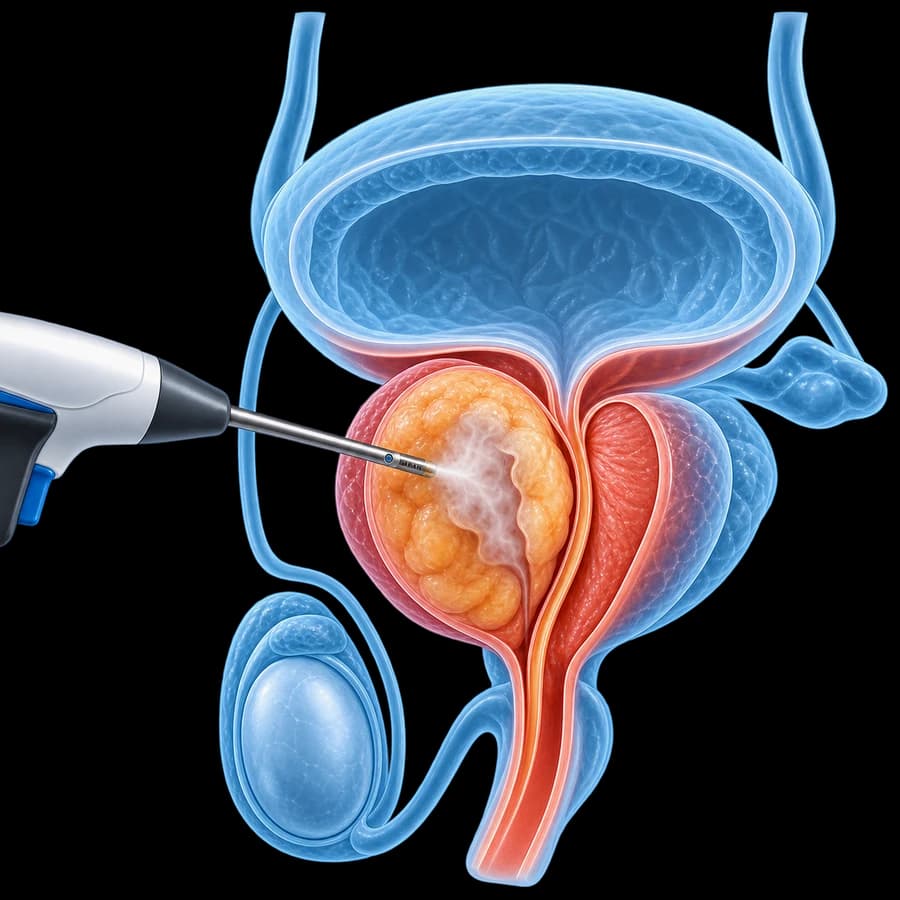
Rezūm is a minimally invasive surgical therapy (MIST) for BPH. It is performed transurethrally: a thin system is introduced through the urethra and delivers controlled injections of water vapor directly into the hyperplastic tissue. The thermal energy is transferred by a convective mechanism (heat diffusing through the vapor between cells) and causes controlled cell destruction in the treated area. The treated tissue is gradually absorbed by the body over the following weeks to months.
The Rezūm system (Boston Scientific) is mentioned here strictly as a technical/equipment reference, with no promotional intent.
Tissue is not removed immediately as with TURis or HoLEP. Rezūm is not a laser — it uses water vapor and convective thermal energy, a different mechanism from laser techniques such as HoLEP or GreenLight.
3. How the Treatment Is Performed
Endoscopic Access
The system is introduced through the urethra, without any external incision.
Anatomical Assessment
The urologist evaluates the prostatic lobes and the area of obstruction.
Water Vapor Delivery
A controlled amount of water vapor is injected at selected points in the hyperplastic tissue.
Thermal Effect
The energy of the vapor causes controlled destruction of the hyperplastic tissue in the treated area.
Gradual Shrinkage
The body gradually absorbs the treated tissue over the following weeks to months.
Urethral Improvement
As the tissue volume decreases, the prostatic obstruction is gradually reduced.
4. Why It Does Not Work Immediately
Rezūm does not mechanically and immediately “open up” the prostate by removing a large volume of tissue, as TURis or HoLEP do.
Improvement is gradual, because it requires an inflammatory response, necrosis of the treated tissue, and then resorption and volume reduction — a process that takes weeks to months.
When Does Urination Improve After Rezūm?
In the first days, there may be a temporary worsening of irritative symptoms. Improvement begins gradually and may continue for weeks or months — not every patient sees results on the same timeline.
In the first days after Rezūm, frequency, urgency, or burning on urination may temporarily increase. This does not necessarily mean the treatment has failed.
5. Who Is a Candidate
Rezūm may be considered in men with:
Bothersome BPH symptoms (LUTS)
Inadequate response to medical therapy
Intolerance to medical therapy
A desire for minimally invasive treatment
A priority on preserving ejaculatory function
Rezūm is not suitable for every patient with BPH. A very large adenoma volume, specific anatomy, or the need for immediate, extensive decompression may shift the choice toward another technique.
6. Prostate Size & Median Lobe
Prostate volume is an important factor in choosing a technique. There is no universally accepted, rigid cubic-centimetre cut-off — suitability depends on volume, anatomy, and the overall clinical picture.
For substantially larger glands, techniques that directly remove a greater volume of tissue — such as HoLEP, Aquablation in appropriate cases, or open/laparoscopic adenomectomy — may have advantages, depending on anatomy and clinical context. Rezūm is not presented as independent of prostate size.
Rezūm and the Median Lobe
The technology can be used for a suitable obstructing median lobe, when supported by the indication and the patient’s anatomy — not every median lobe is equally suited to Rezūm treatment.
7. Preoperative Evaluation
Evaluation before treatment is individualised — not every test is mandatory in every case:
Medical history
IPSS
Uroflowmetry
Post-void residual (PVR) measurement
PSA
Digital rectal examination
Prostate volume (ultrasound)
Urinalysis / urine culture
Assessment of median lobe and anatomy
Bladder function assessment
Flexible cystoscopy, where indicated
Anticoagulant / antiplatelet review
8. Anaesthesia & Procedure Duration
What Anaesthesia Is Needed?
Depending on the centre’s protocol, patient preference, tolerance, and the extent of treatment, local anaesthesia, sedation, or another appropriate anaesthetic approach may be used. It cannot be promised that “no anaesthesia at all” will be needed.
How Long Does the Procedure Take?
This is a relatively short, minimally invasive procedure. The time of the individual vapor injections should not be confused with the total procedure time, which also includes preparation, anaesthesia, and endoscopic assessment. A fixed number of minutes cannot be given for every patient.
9. Is a Catheter Needed After Rezūm?
Many patients need a temporary urinary catheter after treatment. This is related to the oedema caused by the thermal effect on the tissue, which can temporarily make urination more difficult. Catheter duration is individualised, depending on:
Prostate volume
Pre-existing obstruction/retention
The extent of treatment
Bladder function
It cannot be promised that “no catheter” will be needed — it is a common, expected part of recovery.
10. Rezūm in Patients with a Catheter or Retention
There is data on the use of Rezūm in selected patients with an indwelling catheter or urinary retention. This, however, is not a guarantee of catheter freedom.
Detrusor (bladder muscle) function is very important for the final outcome. Chronic urinary retention needs particular, individualised evaluation before the decision for treatment.
11. Hospital Stay
In many settings, Rezūm can be performed as an outpatient procedure or with a short stay, but this depends on anaesthesia, patient risk, the likelihood of urinary retention, and the centre’s protocol. Same-day discharge cannot be promised for every patient.
12. Recovery
Possible temporary symptoms after Rezūm include:
Dysuria
Frequency
Urgency
Haematuria
Pelvic/perineal discomfort
Urinary retention
Temporary worsening of BPH symptoms
These usually subside gradually, as the treated tissue heals and shrinks.
13. Ejaculation & Fertility
Does Rezūm Affect Ejaculation?
One of the key features of the technique is the lower likelihood of new ejaculatory dysfunction compared with classic tissue-resecting procedures, such as TURis, in appropriately selected patients.
- Preservation is not 100% — some patients may experience a change in ejaculation.
- Anatomy and the extent of treatment matter.
- It should not be assumed guaranteed — patients are clearly informed before treatment.
Fertility
Preservation of antegrade ejaculation can matter for men interested in fertility. However, preservation of ejaculation does not equal guaranteed fertility — any man with an active reproductive plan needs an individualised discussion with the urologist.
14. Does Rezūm Affect Erectile Function?
Available data generally show a low impact on erectile function, though without an absolute guarantee for every patient. Pre-existing erectile function and comorbidities (e.g., vascular disease, diabetes) play a role in the final outcome.
15. Histology & Prostate Cancer
Unlike TURis or HoLEP, Rezūm does not remove prostate tissue in the same way for routine histopathological examination.
Therefore, appropriate assessment for possible prostate cancer must have been carried out beforehand, when there is a relevant clinical indication.
Rezūm Treats Benign Obstruction — Not Cancer
If there is an elevated PSA, a suspicious digital rectal examination, a suspicious MRI, or a PI-RADS finding, appropriate cancer assessment must be carried out before BPH treatment, depending on the clinical context.
16. Advantages & Limitations
Possible Advantages
- Minimally invasive, without external incision
- Relatively short procedure
- Gradual improvement of BPH symptoms
- Lower risk of ejaculatory dysfunction than many tissue-resecting techniques
- Limited impact on erectile function, in available data
- Ability to treat a suitable median lobe
- Often a lighter procedural burden than TURP/HoLEP
Limitations
- Delayed improvement — not an immediate result
- Temporary irritative symptoms
- Possible need for a temporary catheter
- Risk of urinary retention / UTI / haematuria
- Need for retreatment in some patients
- Not suitable for every anatomy or prostate size
- Does not offer the immediate, extensive tissue removal of HoLEP/TURP
17. Possible Complications & Red Flags
Dysuria
Haematuria
Urgency
Frequency
Urinary retention
Urinary tract infection
Pelvic discomfort
Temporary worsening of BPH symptoms
Rarer complications, according to current literature
Seek Immediate Medical Evaluation If You Develop:
18. Prostate Medications & Anticoagulants
Prostate Medications
Continuing or stopping alpha-blockers, 5-alpha-reductase inhibitors, or other LUTS medications is individualised, in coordination with the urologist — not all medications are automatically stopped immediately after treatment.
Anticoagulants / Antiplatelet Medication
Do not stop anticoagulant or antiplatelet medication without medical instruction. The strategy depends on the medication, its indication, thrombotic risk, procedural bleeding risk, and anaesthesia, and is decided in coordination with the urologist and, where needed, the cardiologist or haematologist.
19. Long-term Outcomes & Retreatment
There is multi-year follow-up data for Rezūm, with consistent improvement in urinary symptoms and flow in many patients, according to the most recent published studies.
Could I Need a Second Treatment?
Yes, some patients may need additional medical or interventional treatment in the future. Rezūm is not presented as a guaranteed permanent solution.
20. Rezūm vs TURis, HoLEP, Aquablation, UroLift
The choice of Rezūm depends on prostate size and anatomy, the severity of obstruction, bladder function, and the patient’s priorities regarding effectiveness, recovery, and sexual function. No technique is a universal winner.
| Feature | Rezūm | TURis | HoLEP | Aquablation | UroLift |
|---|---|---|---|---|---|
| Mechanism | Water vapor thermal energy | Bipolar electrosurgical resection | Laser enucleation | Image-guided waterjet | Mechanical retraction (implants) |
| Tissue removal | Not immediate — gradual shrinkage | Immediate, in chips | Immediate, en bloc | Immediate | None |
| Prostate size | Depends on volume/anatomy | Traditionally small/moderate glands | Not significantly limited | Depends on anatomy, selected patients | Usually smaller glands |
| Median lobe | Possible in suitable cases | Possible | Possible | Depends on anatomy | Usually not indicated |
| Anaesthesia | Local/sedation, often without general | Spinal or general | Spinal or general | Spinal or general | Local/sedation |
| Catheter | Often temporary, depends on oedema | Temporary | Temporary | Temporary | Often shorter duration |
| Speed of improvement | Gradual, weeks–months | Relatively fast | Relatively fast | Relatively fast | Relatively fast |
| Ejaculation | Often preserved | Retrograde ejaculation common | Retrograde ejaculation common | More often preserved, selected patients | Often preserved |
| Histology | Not in the same way | Yes | Yes | Yes | No |
| Retreatment | Non-zero probability | Low but non-zero rate | Generally low rate | Growing long-term data | Non-zero probability |
This table is indicative only and is not an individualised medical recommendation.
Rezūm vs TURis
TURis directly removes the obstructing tissue by bipolar electrosurgical resection, often with faster mechanical decompression but more frequent retrograde ejaculation. Rezūm offers gradual improvement with a higher likelihood of preserving ejaculation.
TURiSRezūm vs HoLEP
HoLEP enucleates and immediately removes a larger volume of tissue with laser, without significant limitation from prostate size, but with frequent retrograde ejaculation and a longer learning curve. Rezūm offers a less invasive alternative with delayed action.
HoLEPRezūm vs Aquablation
Aquablation uses a robotically image-guided waterjet for immediate tissue removal in an operating-room setting, with a different profile of prostate size and effectiveness. Rezūm is less invasive but with a delayed result.
AquablationRezūm vs UroLift
Rezūm controllably destroys hyperplastic tissue with water vapor, which is then absorbed. UroLift does not destroy or remove tissue — it uses permanent implants for mechanical retraction of the prostatic lobes. They differ in anatomical suitability (e.g., median lobe), durability of result, need for retreatment, and any future MRI compatibility considerations, where these are actually documented.
21. The Patient Journey
22. The Doctor

Dr. Marinos Vasilas, Urologist – Andrologist
Dr. Marinos Vasilas specialises in minimally invasive techniques for the treatment of benign prostatic hyperplasia, following the clinical guidelines of the European Association of Urology (EAU).
Meet the Doctor23. Frequently Asked Questions
What is Rezūm therapy?
Rezūm is a minimally invasive therapy for benign prostatic hyperplasia (BPH), in which small amounts of water vapor are delivered through a needle into the hyperplastic prostate tissue. The thermal energy of the vapor causes controlled destruction of the tissue, which then gradually decreases in volume.
Is Rezūm a laser?
No. Rezūm is not a laser. It uses water vapor and convective thermal energy, a different mechanism from laser techniques such as HoLEP or GreenLight.
What prostate size is Rezūm used for?
Prostate size is an important factor in choosing a technique. There is no universally accepted, rigid cubic-centimetre cut-off — suitability depends on volume, anatomy, and the overall clinical picture. For substantially larger glands, techniques that remove a greater volume of tissue (e.g., HoLEP, Aquablation in appropriate cases) may have advantages.
Can Rezūm treat a median lobe?
The technology can be used for a suitable obstructing median lobe when supported by the indication and anatomy — not every median lobe is equally suited to Rezūm.
Does the Rezūm procedure hurt?
Appropriate anaesthesia or analgesia is used, depending on the centre’s protocol and the extent of treatment — local anaesthesia, sedation, or, less commonly, another approach. It cannot be promised that "no anaesthesia" will be needed.
Is a catheter needed after Rezūm?
Yes, many patients need a temporary urinary catheter after treatment, due to the oedema caused by the thermal effect. The duration is individualised, depending on prostate volume, pre-existing obstruction, and bladder function.
When does urination improve after Rezūm?
Improvement is not immediate. In the first days, there may be a temporary worsening of irritative symptoms, as the treated tissue becomes inflamed and then gradually shrinks over weeks to months.
Does Rezūm affect ejaculation?
The likelihood of preserving ejaculation is generally higher compared with classic tissue-resecting procedures such as TURis, but it is not guaranteed for every patient. Anatomy and the extent of treatment play a role.
Does Rezūm affect erectile function?
Available data generally show a low impact on erectile function, though without an absolute guarantee for every patient. Pre-existing erectile function and comorbidities play a role.
Rezūm or TURis?
TURis directly removes the obstructing tissue by electrosurgical resection, often with faster mechanical decompression but more frequent retrograde ejaculation. Rezūm causes gradual shrinkage with a generally higher chance of preserving ejaculation. The choice is individualised.
Rezūm or Aquablation/HoLEP?
HoLEP and Aquablation directly remove a larger volume of tissue and may be more suitable for larger glands. Rezūm offers a less invasive alternative with an emphasis on preserving ejaculation, in appropriately selected patients. No technique is universally superior.
Could I need treatment again after Rezūm?
Yes, some patients may need additional medical or interventional treatment in the future. It is not a guaranteed permanent solution.
Related Topics
Book an Appointment in Rhodes
Bothersome BPH symptoms, inadequate response to medication, a desire for minimally invasive treatment, or the need to compare Rezūm with UroLift, TURis, HoLEP, or Aquablation? The choice of Rezūm depends on prostate size and anatomy, the severity of obstruction, bladder function, and your priorities — discuss your options at our practice in Rhodes.
Scientific References
- EAU Guidelines on the Management of Non-neurogenic Male LUTS. European Association of Urology — uroweb.org
- AUA Guideline on the Surgical Management of Lower Urinary Tract Symptoms/Benign Prostatic Hyperplasia (BPH). American Urological Association — auanet.org
- McVary KT, et al. Final 5-Year Outcomes of the Multicenter Randomized Sham-Controlled Trial of Convective Water Vapor Energy for Treatment of Lower Urinary Tract Symptoms Due to Benign Prostatic Hyperplasia. J Urol 2021;206:715–724.
- Mynderse LA, et al. Rezūm System Water Vapor Treatment for Lower Urinary Tract Symptoms/Benign Prostatic Hyperplasia: Validation of Convective Thermal Energy Transfer. Urology 2015;86:122–127.
- Dixon CM, et al. Two-Year Results After Convective Radiofrequency Water Vapor Thermal Therapy for LUTS Due to BPH. Can J Urol 2016;23:8371–8377.
The content of this page is for informational purposes only and does not replace an individualised urological evaluation. Rezūm is not suitable for every patient — the choice of treatment must be made after urological evaluation, taking into account prostate volume and anatomy, bladder function, and patient priorities. Anticoagulants and medication should not be modified without medical instruction. Medical review by Dr. Marinos Vasilas.


