My Clinical Experience with Laparoscopic Adenomectomy
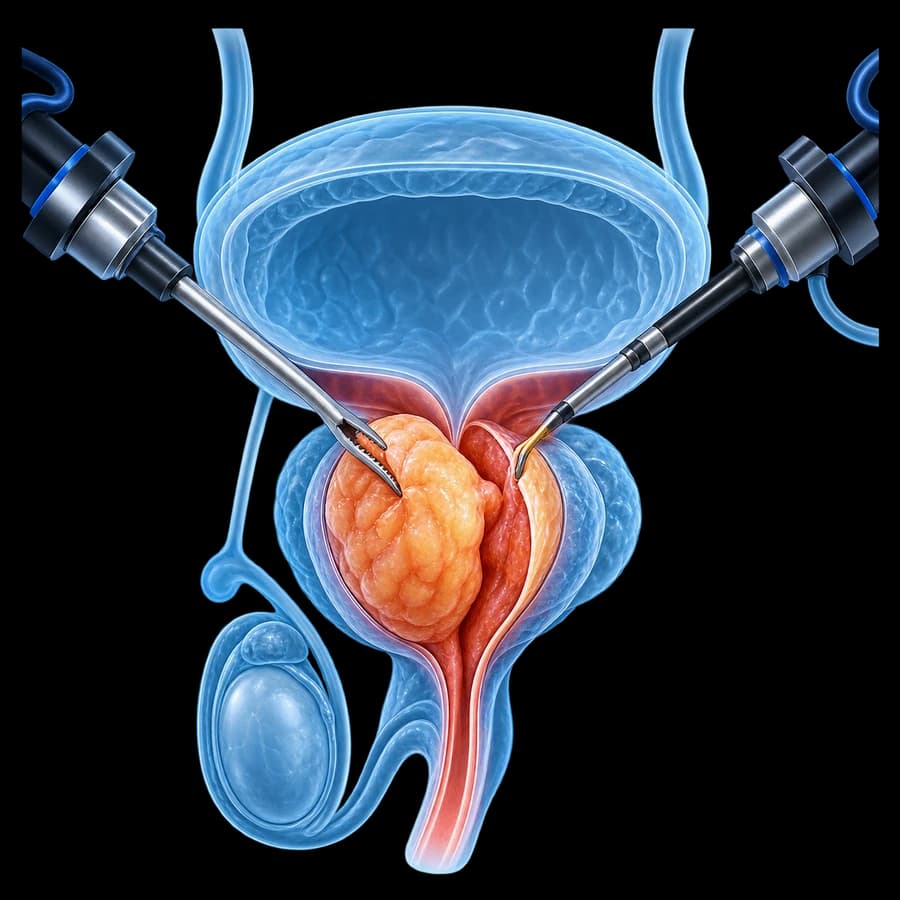
Laparoscopic simple prostatectomy is the operation of choice for patients with very large prostatic adenoma (>80–100 mL) where endoscopic techniques such as TURiS are not feasible, and where HoLEP expertise or equipment is not available. It reproduces open adenomectomy results through small laparoscopic ports.
At my practice in Rhodes, I offer this procedure using 3D laparoscopic technology, which provides excellent visualization for the transcapsular dissection and hemostasis required in large adenoma surgery.
- Indicated for prostates >80–100 mL.
- Complete adenoma removal — equivalent to open adenomectomy, no residual tissue.
- Less blood loss than open surgery (200–400 mL vs 500–1000 mL).
- Hospital stay 2–4 days; catheter 3–5 days.
What Is 3D Laparoscopic Simple Prostatectomy
Laparoscopic simple prostatectomy (adenomectomy) is the surgical removal of the prostatic adenoma (transition zone) through the prostatic capsule, performed laparoscopically via 4–5 small abdominal ports. It is indicated for benign prostatic hyperplasia (BPH) — not prostate cancer.
Unlike endoscopic procedures (TURiS, HoLEP) which work transurethrally, laparoscopic adenomectomy uses a transperitoneal or extraperitoneal approach with a small incision in the anterior prostatic capsule (transcapsular approach) or through the bladder neck (transvesical approach) to enucleate the adenoma.
Indications & Patient Selection
Large Prostatic Adenoma (>80–100 mL)
Primary indication. TURiS has technical limitations above 80 mL due to operative time and fluid absorption risk. HoLEP is the preferred alternative, but laparoscopic adenomectomy is equally valid — especially where HoLEP expertise is not available.
Very Large Adenoma (>150–200 mL)
For extremely large glands, some centers prefer laparoscopic adenomectomy over HoLEP due to simpler hemostasis and no need for a morcellator.
Concurrent Bladder Pathology
If bladder diverticulum or bladder stones require simultaneous treatment, the transvesical approach allows concurrent management.
Failure of Medical Therapy
Patients who have failed alpha-blockers and/or 5-alpha reductase inhibitors with large-volume adenoma and severe LUTS.
Prostate Cancer Must Be Excluded Before BPH Surgery
Even with clearly benign-appearing large adenoma, complete evaluation (PSA, digital rectal examination, and mpMRI where indicated) is mandatory before laparoscopic adenomectomy to exclude prostate cancer. All removed tissue is sent for pathological examination.
Pre-operative Preparation
Adenoma Volume Assessment
TRUS or suprapubic ultrasound to confirm volume >80–100 mL. Uroflowmetry + post-void residual. PSA, blood count, coagulation, renal function, urine culture.
Cancer Exclusion
PSA, DRE, and mpMRI if indicated. Biopsy if PSA density or mpMRI findings suggest significant cancer risk.
Medication Adjustments
Stop antiplatelet agents 5–7 days before. Anticoagulants: discuss bridging with cardiologist. Bowel preparation the evening before.
Antibiotic Prophylaxis
3rd-generation cephalosporin or fluoroquinolone 60 minutes before incision.
How Laparoscopic Adenomectomy Works — 3 Steps
Port Placement & Exploration
Patient supine with slight Trendelenburg. 4–5 laparoscopic ports placed. Peritoneum or extraperitoneal space developed. The anterior surface of the prostate and bladder neck identified.
Transcapsular Adenoma Removal
A transverse incision made on the anterior prostatic capsule or through the bladder neck. The adenoma (transition zone) is manually enucleated along the surgical capsule plane. The adenoma is removed in a specimen bag. The urethra and external sphincter are carefully preserved.
Hemostasis & Closure
Careful hemostasis of the prostatic bed with bipolar coagulation and sutures. Continuous reconstruction of the prostatic capsule. Triple-lumen catheter placed for continuous irrigation. A pelvic drain placed and removed on day 2–3. Catheter removed day 3–5 post-operatively.
Anesthesia, Duration & Hospital Stay
Recovery & Outcomes
Days 1–5 (in hospital)
Continuous bladder irrigation for 24–48h. Progressive mobilization. Drain removal day 2–3. Catheter removed day 3–5. Discharge when urine is clear and patient is independently mobile.
Weeks 1–4
Mild hematuria may persist for 1–2 weeks. Avoid heavy lifting and strenuous exercise for 4 weeks. Return to desk work in 2–3 weeks.
1–3 months
IPSS score typically improves 70–80% from baseline. Urinary flow (Qmax) increases significantly. Mild urgency may persist during the first 4–6 weeks as the bladder adjusts.
Advantages & Comparison
Complete Adenoma Removal
Unlike TURiS (which removes tissue in fragments), laparoscopic adenomectomy removes the entire adenoma, virtually eliminating adenoma regrowth. Reoperation rate <3% at 5 years.
Superior to Open Surgery
Blood loss significantly reduced (200–400 mL vs 500–1000 mL). Hospital stay 2–4 days vs 5–7 days for open. No large abdominal incision.
Suitable for Very Large Glands
There is practically no upper size limit for laparoscopic adenomectomy. Even prostates exceeding 200 mL can be treated with this technique in expert hands.
Compared to HoLEP
HoLEP is entirely endoscopic (transurethral) — no ports, catheter for only 24h, discharge in 1–2 days. Laparoscopic adenomectomy requires abdominal ports, catheter 3–5 days, and 2–4 day hospital stay — but may be preferred where HoLEP expertise is not available.
Possible Complications
Bleeding / Hematuria
ExpectedMild to moderate hematuria is expected for 1–3 weeks. Severe hemorrhage requiring transfusion: <3%.
Retrograde ejaculation (70–90%)
ExpectedSemen directed into bladder during orgasm. Does not affect erection or sexual pleasure. Same rate as TURiS or HoLEP.
Urinary incontinence (transient 5–15%)
TransientUsually urgency incontinence due to bladder adjustment. Resolves in 1–3 months. Severe permanent incontinence is very rare (<1%).
UTI / Urethral stricture (2–5%)
ManageableTreated with antibiotics or urethrotomy respectively.
Frequently Asked Questions (FAQ)
What prostate size requires laparoscopic adenomectomy instead of TURiS or HoLEP?
As a general guideline, prostates >80–100 mL are best treated with laparoscopic adenomectomy or HoLEP. TURiS is limited to approximately 30–80 mL. For very large glands (>150–200 mL), laparoscopic adenomectomy may be preferred over HoLEP in some centers.
What is the difference between laparoscopic adenomectomy and HoLEP?
Both treat large adenoma (>80 mL) and achieve equivalent results. HoLEP is endoscopic (transurethral) — no abdominal incision, catheter removed in 24h, hospital stay 1–2 days. Laparoscopic adenomectomy requires abdominal ports and involves a small prostatic capsule incision; catheter stays 3–5 days, hospital stay 2–4 days. The choice depends on available expertise and patient factors.
How many days will I be in hospital after laparoscopic adenomectomy?
Typically 2–4 days. The catheter is removed 3–5 days post-operatively once urine is clear. This is longer than HoLEP but significantly shorter than open adenomectomy (5–7 days).
Is hematuria (blood in urine) after surgery normal?
Yes — mild to moderate hematuria is expected for 1–3 weeks post-operatively. Continuous bladder irrigation via triple-lumen catheter is used in the first 24–48 hours to keep urine clear. Severe or prolonged bleeding should be reported to your surgeon.
Is laparoscopic adenomectomy better than open adenomectomy?
Laparoscopic adenomectomy achieves identical adenoma removal to open surgery but with: significantly less blood loss (200–400 mL vs 500–1000 mL open), shorter hospital stay (2–4 vs 5–7 days), and faster recovery. Oncological and functional outcomes are equivalent. For patients with very large prostates (>200 mL) or previous pelvic surgery, open may still be preferred in select cases.
Will I have retrograde ejaculation after laparoscopic adenomectomy?
Yes — retrograde ejaculation (semen directed into the bladder during orgasm) occurs in 70–90% of patients after any surgical treatment of large BPH adenoma. This is expected and does not affect erectile function or sexual pleasure. It is important to know this before the procedure.
Should prostate cancer be excluded before laparoscopic adenomectomy?
Absolutely. Before scheduling any BPH surgery — including laparoscopic adenomectomy — PSA, digital rectal examination, and when indicated mpMRI are mandatory to exclude prostate cancer. All removed tissue is sent for pathological analysis after the procedure.
How much will my urinary symptoms (IPSS) improve?
Laparoscopic simple prostatectomy delivers one of the most significant IPSS improvements of any BPH procedure: typically 70–80% improvement in IPSS score and marked increase in urinary flow rate (Qmax). Results are durable: reoperation rate <3% at 5 years.
Related Topics
Book an Appointment in Rhodes
Large prostatic adenoma with failed medical treatment? Full assessment with ultrasound, uroflowmetry, and individualized treatment planning at our urology practice in Rhodes.
References & Sources
- EAU Guidelines on Non-neurogenic Male LUTS 2024 — uroweb.org
- Sotelo R, et al. Laparoscopic Adenomectomy: Two Distinct Transperitoneal Approaches. Urology 2008;72:278–283.
- Autorino R, et al. Perioperative Outcomes of Robotic and Laparoscopic Simple Prostatectomy: A European–American Multi-institutional Analysis. Eur Urol 2015;68:86–94.
- Gratzke C, et al. EAU Guidelines on the Assessment of Non-neurogenic Male Lower Urinary Tract Symptoms 2024. Eur Urol 2024.
Medical Review

Dr. Marinos Vasilas, Urologist – Andrologist
Dr. Marinos Vasilas performs laparoscopic simple prostatectomy and HoLEP for large BPH adenoma according to EAU 2024 guidelines, tailoring the surgical approach to each patient’s anatomy and clinical needs.
Full profile


