My Clinical Approach
Erectile dysfunction is first managed with less invasive methods — addressing risk factors, PDE5 inhibitors, intracavernosal injections, or a vacuum erection device. A penile prosthesis enters the discussion when these are not sufficient, not well tolerated, or not suitable for the particular patient.
The process before a prosthesis includes multiple counselling sessions with the patient — and, whenever feasible, their partner. It is not a light decision: placing cylinders requires permanent surgical modification of the corpora cavernosa and requires realistic expectations.
- Documented failure, intolerance, or contraindication of less invasive treatments before any decision.
- Full discussion of expectations: length, sensation, orgasm, ejaculation, appearance.
- Assessment of risk factors (diabetes, infection, previous pelvic surgery).
- Information on device types (three-piece, two-piece, malleable) based on anatomy and preference.
- Clear information that the procedure is essentially not reversible.
Key message: a penile prosthesis offers mechanical rigidity for sexual intercourse when other erectile dysfunction treatments are not sufficient or not suitable.
What Is a Penile Prosthesis
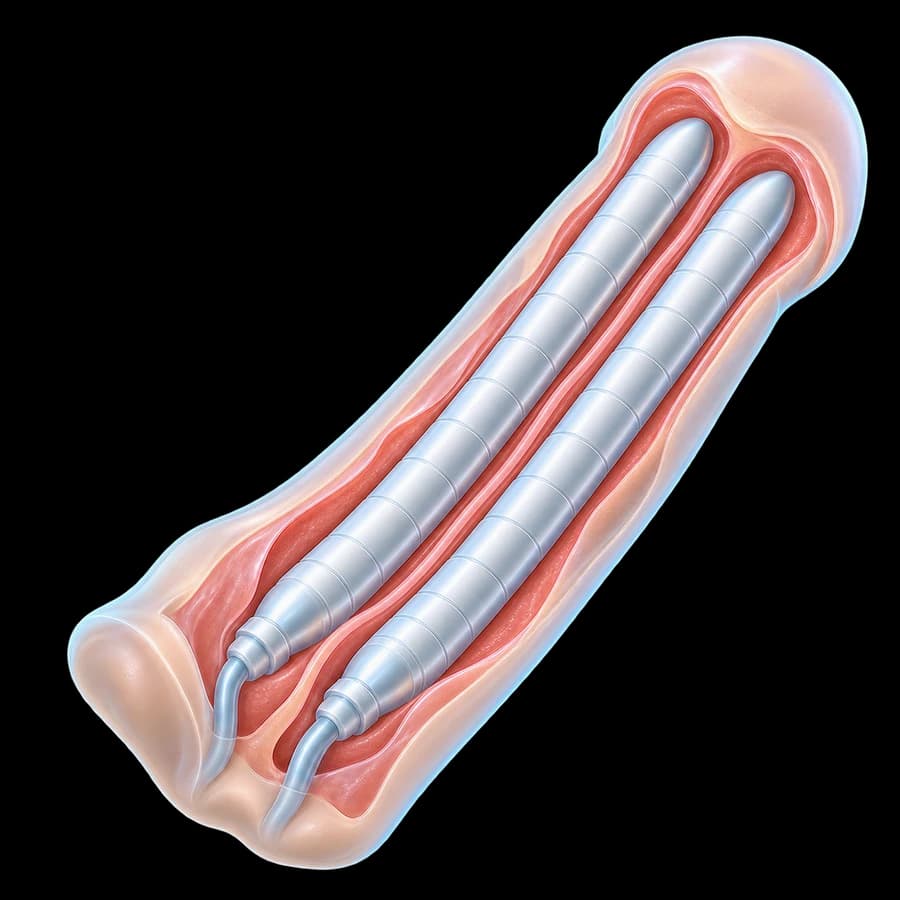
A penile prosthesis (penile implant) is a surgically placed device inside the corpora cavernosa of the penis, allowing a man to achieve rigidity sufficient for sexual intercourse, regardless of the underlying cause of erectile dysfunction.
A penile prosthesis is not a penile enlargement procedure. It does not increase length or girth — the goal is exclusively to restore rigidity.
It does not increase sexual desire and does not "cure" the underlying vascular or neurological cause of ED. Its role is to provide mechanically reliable rigidity for penetration.
The procedure addresses only the function of rigidity. For the causes, diagnosis, and non-surgical treatments of erectile dysfunction, see the detailed page on erectile dysfunction.
When Is a Penile Prosthesis Considered
A penile prosthesis is not an automatic first-line treatment for every man with erectile dysfunction. It may be considered in persistent ED when:
Treatment Pathway
The treatment sequence can be individualised through shared decision-making between patient and surgeon — it is not mandatorily linear for every patient.
Types of Penile Prosthesis
There are three main categories. No type is suitable for every patient — the choice is individualised.
1. Three-Piece Inflatable Prosthesis
Consists of two cylinders inside the corpora cavernosa, a pump in the scrotum, and a fluid reservoir. Pressing the pump transfers fluid into the cylinders, creating rigidity; deflating returns the penis to a more relaxed state.
What does "three-piece" mean?
The term refers to the functional components of the system — not to three external parts. All components are internal.
Where is the pump?
Inside the scrotum, so the patient can operate it discreetly. There is no external pump.
Where is the reservoir?
Placed internally in the pelvic/abdominal wall area, according to surgical anatomy. In men with previous pelvic surgery (e.g. radical prostatectomy, cystectomy, hernia mesh surgery), an alternative reservoir placement may be needed.
2. Two-Piece Inflatable Prosthesis
Combines the reservoir function with another component, without needing a separate abdominal reservoir. It may have a role in selected anatomical/surgical circumstances (e.g. extensive pelvic surgical history), but it is not equivalent or identical to the three-piece system — it has its own advantages and limitations.
3. Malleable / Semi-Rigid Prosthesis
Consists of two semi-rigid rods that stay fixed inside the corpora cavernosa. They can be positioned upward for intercourse and downward for daily life. It has no pump or reservoir — a simpler system, without activation.
Inflatable vs Malleable Prosthesis
| Inflatable Prosthesis | Malleable Prosthesis | |
|---|---|---|
| Flaccid state | More natural appearance when deflated | Stays semi-rigid at all times |
| Activation | By pump pressure | Manual positioning |
| Components | Cylinders, pump, reservoir | Two rods — simpler system |
| Handling | Requires manual dexterity | Simpler handling |
| Mechanical complexity | Greater — more moving parts | Lower |
| Concealment | Usually better when flaccid | Different — stays semi-rigid |
| Choice | Patient/anatomy-dependent | Patient/anatomy-dependent |
Which Prosthesis Is Better?
There is no single type of prosthesis that is better for everyone. The choice is individualised and based on a discussion between patient and surgeon, taking into account:
Penile Prosthesis After Radical Prostatectomy
After robotic, laparoscopic or open radical prostatectomy for prostate cancer, erectile dysfunction may persist due to:
In persistent ED despite rehabilitation or other treatments, a penile prosthesis is an established option.
There is no universal fixed waiting period after prostatectomy. Timing depends on nerve-sparing status, baseline erectile function, oncological course, recovery, response to PDE5/injections, and patient preference.
Penile Prosthesis and Peyronie's Disease
In men with significant curvature/deformity from Peyronie's disease and ED not responding adequately to medical treatment, a penile prosthesis can address rigidity and form the basis for correcting the deformity.
In selected cases, cylinder placement alone may improve curvature. However, persistent deformity may need additional manoeuvres, such as modelling, plication, or grafting, in selected cases — without this meaning they are always required.
Does a Penile Prosthesis Make the Penis Bigger?
No. A penile prosthesis is not a lengthening or girth-enhancement procedure. The goal is exclusively to restore rigidity.
Perceived changes in length after implantation can be influenced by pre-existing ED, prostatectomy, Peyronie's disease, corporal fibrosis, obesity/suprapubic fat, or long-standing absence of erections — not necessarily by the prosthesis itself. The prosthesis cannot guarantee a return to the length a patient remembers from a younger age or before years of ED.
The appropriate cylinder size is determined intraoperatively, according to the patient's actual corporal anatomy — a larger prosthesis is not arbitrarily chosen for enlargement purposes.
Glans engorgement: the prosthesis provides rigidity mainly through the corpora cavernosa. This does not mean the glans always engorges to the same degree, or that natural engorgement is fully restored in everyone — preserved natural glans engorgement may occur depending on the patient's vascular/ neurological function.
Common Misconceptions
"Will it be visible that I have a prosthesis?"
With an inflatable prosthesis, when deflated, the goal is as natural an appearance as possible, with all components internal (the pump sits inside the scrotum). No one can promise it is never palpable or that no one could ever notice it under any circumstance.
Libido (sexual desire)
A penile prosthesis does not create sexual desire. Libido depends on hormones, psychological factors, the relationship, general health and medications. If there is testosterone deficiency, it is managed separately.
Orgasm
The prosthesis does not by itself remove the mechanisms of orgasm. A patient can have an orgasm as long as the nerve pathways, sensation and other factors allow it — previous surgery or neurological disease may nonetheless affect the outcome.
Ejaculation
A penile prosthesis alone does not determine ejaculation. If a patient has already undergone radical prostatectomy, there is no normal seminal ejaculation after prostatectomy, regardless of the implant — the prosthesis does not restore ejaculation after radical prostatectomy.
Fertility
A penile prosthesis does not improve spermatogenesis and is not a fertility treatment. In a man with an intact reproductive tract, fertility depends on other factors — erectile rigidity should not be confused with fertility.
Urination
The implant sits in the corpora cavernosa, not inside the urethra. It usually does not change the normal path of urination; urinary symptoms need a separate evaluation.
Before the Penile Prosthesis
Confirmation of erectile dysfunction
And documentation that less invasive treatments have been tried, failed, or are not suitable.
Patient expectations
Detailed discussion of what the prosthesis can realistically offer and what it cannot.
Genital examination
Looking for curvature/deformity (Peyronie’s disease), previous scarring, or anatomical particularities.
Previous pelvic/penile surgery
Radical prostatectomy, cystectomy, hernia mesh surgery — these affect surgical planning.
Diabetes mellitus
Assessment of glycaemic control as part of overall preoperative optimisation.
Active infection
Exclusion of systemic, urinary, or local genital infection before a planned procedure.
Urinary symptoms
Assessment of any urinary symptoms before the procedure.
Medications, anticoagulants/antiplatelets
Recording all medications — their management is individualised, see the callout below.
Manual dexterity
An important factor in choosing between inflatable and malleable prostheses.
Partner counselling
Where desired by the patient, involving the partner in the discussion helps set realistic expectations.
Expectation Counselling
Before surgery, the following must be clearly explained:
- Realistic expected penile length
- Prosthesis rigidity versus natural erection
- Glans behaviour
- Pump use
- Permanent surgical implantation in the corpora
- Infection risk
- Revision risk
- Possibility of mechanical failure
- The course of sexual recovery
This discussion is critical for long-term patient satisfaction.
Essentially not reversible: placing cylinders requires permanent surgical modification of the corpora cavernosa. If the prosthesis is removed in the future, spontaneous erectile function should usually not be expected to return to the preoperative state.
Diabetes mellitus is associated both with ED and with a potentially increased risk of infection and wound-healing issues. Appropriate glycaemic control before surgery is important, without a single universal HbA1c cutoff applying to every patient. Diabetes alone does not exclude a patient from having a prosthesis.
Do not stop anticoagulants or antiplatelets on your own. Perioperative management is individualised according to thrombotic risk, bleeding risk, the indication for the medication, and the surgical/anaesthetic plan.
Anaesthesia & The Procedure
Penile prosthesis implantation is performed in an operating-room environment, with general or regional anaesthesia depending on the patient and protocol — it is not a simple office procedure.
Common surgical approaches include the penoscrotal and infrapubic routes, with neither being universally superior — the choice depends on anatomy, prosthesis type, previous surgical history, and surgeon experience/preference.
Some modern implants feature an antibiotic coating or hydrophilic surface technology, as part of an overall infection-prevention strategy. This does not eliminate infection risk or guarantee sterility — it is one additional element of a broader strategy.
Penile Prosthesis Infection
Infection is a significant but relatively uncommon complication. Potential signs include:
Prompt specialist evaluation is needed.
What happens if it gets infected?
Prosthesis infection often requires surgical assessment, removal of the device or a salvage strategy in selected cases, and antimicrobial treatment — depending on severity, timing, and patient factors. Antibiotics alone are not considered reliably sufficient for an established prosthetic infection.
Salvage / immediate reimplantation
In specialised hands, selected patients can undergo immediate salvage/reimplantation protocols. The exact technique is individualised by the surgical team.
Can the Prosthesis Fail?
Yes. Like any mechanical implant, it can develop cylinder failure, pump malfunction, a tubing/reservoir problem, or fluid leakage over time, and may need revision or replacement surgery.
Modern implants can function for many years, but there is no guaranteed lifetime. The risk of failure accumulates gradually with duration of use.
Revision surgery
May be needed due to mechanical failure, infection, erosion, or a device-positioning issue. Revision surgery is usually more complex than the original implantation.
Erosion
A rare complication where a component erodes through corporal tissue, the urethra, or the skin. Risk is influenced by selected clinical factors. Requires urgent specialist assessment.
Urethral injury
A rare, intraoperative complication that may be mentioned in selected cases.
Haematoma / swelling
Swelling, bruising and discomfort are expected in the early postoperative period. A significantly expanding haematoma or severe symptoms need evaluation — not every bruise is a complication.
Recovery & Activation
Wound care, swelling, analgesia. The device is initially left according to the surgeon’s protocol.
Gradual decrease in swelling/bruising. Wound review.
Training in pump use. Cycling (inflation/deflation) once authorised by the surgeon.
Begins after adequate healing and medical clearance.
Sensing & operating the pump
After the healing period, the patient should be able to locate the pump in the scrotum and operate inflation/deflation. Training is provided by the surgical team, individualised by device model.
When is the prosthesis activated?
There is no fixed, universal activation day. Timing depends on healing, swelling, the device, and the surgeon's protocol. The patient activates/cycles the device according to individualised postoperative instructions.
When Can I Have Sex?
Sexual activity begins only after adequate healing and once the surgeon confirms that safe use of the device is possible — there is no single fixed date for all patients.
Work
Return depends on the type of work, discomfort, swelling, and wound healing. Office work is usually permitted sooner than heavy manual work.
Gym / cycling
Gradual return. Activities causing pressure on the perineum/scrotum, heavy lifting, or vigorous activity may require a longer wait.
Satisfaction & Natural Erection vs Prosthesis
Penile prostheses have generally been reported with high patient and partner satisfaction in appropriately selected and counselled patients. Device satisfaction is a different thing from "perfect" sexual function — it depends on:
Natural erection
A vascular/neurological event, with variable rigidity, dependent on arousal and physiology.
Inflatable prosthesis
Mechanical cylinder inflation, predictable rigidity, activated manually. Libido and orgasm remain separate physiological processes.
An inflatable prosthesis allows the patient to create mechanical rigidity "whenever desired" by activating the device, without depending directly on PDE5 response or penile blood flow to the corpora — sexual desire/arousal remain an independent process. It is, however, not identical to a natural erection.
Practical Questions
MRI / airport security screening
MRI compatibility depends on the specific device model. The patient should keep the implant card/documentation, and the imaging team must verify the exact specifications before the scan. For security screening, no one can promise the device will never be detected or will never raise a question.
Prosthesis and the prostate
A penile prosthesis is not a treatment for benign prostatic hyperplasia or prostate cancer, and does not automatically prevent future urological evaluation. Prior prostate surgery is taken into account in surgical planning.
Prosthesis and future imaging (CT/MRI)
For CT scans, there may generally be metallic artefact considerations around the device, without this being a contraindication. For MRI, compatibility of the specific model must always be verified.
When to Seek Urgent Assessment
Urgent medical assessment is needed for:
The Patient Journey
This journey is educational and not a rigid mandatory sequence for every patient.
Frequently Asked Questions (FAQ)
What is a penile prosthesis?
It is a surgically implantable device placed inside the corpora cavernosa of the penis, providing the rigidity needed for sexual intercourse in men with severe erectile dysfunction, when other treatments are not effective, tolerated, or suitable.
When is a penile prosthesis needed?
When persistent erectile dysfunction does not respond adequately to PDE5 inhibitors, intracavernosal injections or a vacuum erection device, or when these treatments are contraindicated or not acceptable to the patient.
Is a penile prosthesis the last resort for erectile dysfunction?
It is usually considered after less invasive treatments have been tried or excluded. It is not a first-line treatment for every case of ED, but it is a reliable definitive option when other methods are not sufficient.
What types of penile prosthesis are there?
Mainly three categories: a three-piece inflatable prosthesis, a two-piece inflatable prosthesis (in selected cases), and a malleable/semi-rigid prosthesis. Each type has different advantages.
What is the difference between inflatable and malleable prostheses?
The inflatable type is activated by pump pressure and returns to a more natural flaccid state when not in use. The malleable type stays semi-rigid at all times and is manually positioned up or down, without a pump.
What is a three-piece prosthesis?
This refers to the three functional components of the system: two cylinders inside the corpora cavernosa, a pump in the scrotum, and a fluid reservoir. All components are internal — nothing is external.
Is the prosthesis visible from the outside?
With an inflatable prosthesis, when deflated the goal is as natural an appearance as possible, with all components internal. No one can promise that it is never palpable or that no one could ever notice it under any circumstance.
How is an erection created with the prosthesis?
With an inflatable prosthesis, the patient presses the pump in the scrotum; fluid is transferred to the cylinders and rigidity is created. Deflating returns the penis to a more relaxed state. With a malleable device, the rods are manually positioned upward.
Does a penile prosthesis make the penis bigger?
No. A penile prosthesis is not a lengthening or girth-enhancement procedure. The goal is to restore rigidity, not to change size.
Can length be lost after a prosthesis?
Perceived changes in length can be related to pre-existing ED, prostatectomy, Peyronie’s disease, corporal fibrosis, or prolonged absence of erections — not necessarily to the prosthesis itself. The prosthesis cannot guarantee a return to the length a patient remembers from a younger age.
Is sensation in the penis affected?
The prosthesis is placed inside the corpora cavernosa and does not target the sensory nerves. Sensation is usually preserved, but previous surgery, neuropathy, or other factors can affect it independently of the prosthesis.
Can I have an orgasm with a penile prosthesis?
The prosthesis does not target the mechanisms of orgasm. Many men retain the ability to reach orgasm as long as the nerve pathways and sensation allow it, independent of the prosthesis’s function.
Is ejaculation affected?
The prosthesis alone does not determine ejaculation. If a patient has already undergone radical prostatectomy, there is no normal seminal ejaculation regardless of the prosthesis — the prosthesis does not restore ejaculation.
What happens after radical prostatectomy?
For persistent erectile dysfunction after radical prostatectomy (robotic, laparoscopic or open) that does not improve with rehabilitation/other treatments, a penile prosthesis is an established option.
Can it be used in Peyronie’s disease?
Yes. In men with significant curvature and ED that does not respond adequately to medical treatment, the prosthesis can address rigidity and form the basis for correcting the deformity, possibly with additional techniques.
How long does recovery take?
It varies by patient and prosthesis type. It includes initial wound healing, gradual reduction of swelling, device-use training and, finally, return to sexual activity once cleared by the surgeon.
When can I have sex after the prosthesis?
Only after adequate healing and once the surgeon confirms safe use of the device is possible. There is no single fixed date for all patients.
Can the prosthesis get infected?
Yes, infection is a significant but not inevitable complication. Modern surgical protocols and device technologies aim to reduce the risk. An established infection usually requires surgical management.
Can the prosthesis fail?
Yes. Like any mechanical implant, it can develop cylinder, pump, tubing or reservoir problems over time, and may need revision surgery or replacement.
How many years does a penile prosthesis last?
Modern implants can function for many years, but there is no guaranteed lifetime. The risk of failure accumulates gradually with duration of use, as with any mechanical device.
Can the prosthesis be replaced?
Yes, in case of mechanical failure, infection or another problem, revision or replacement surgery can be performed, usually more complex than the original implantation.
Can I have an MRI after the prosthesis?
MRI compatibility depends on the specific device model. The patient should keep the implant card/documentation, and the imaging team must verify the exact specifications before the scan.
Penile Prosthesis Evaluation
The choice of a penile prosthesis is made after a full assessment of the cause of erectile dysfunction, previous treatments, anatomy, and patient expectations. Correct preoperative counselling on prosthesis type, expected length, method of use, and possible complications is just as important as the procedure itself.
References
- AUA Guideline on Erectile Dysfunction (Amended) — auanet.org
- EAU Guidelines on Sexual and Reproductive Health — uroweb.org
- Mulhall JP et al. Patient and partner satisfaction and sexual function outcomes of penile prosthesis surgery. J Sex Med. 2013;10(6):1587–1596.
- Mulcahy JJ. The prevention and management of noninfectious complications of penile implants. Sex Med Rev. 2015;3(4):203–213.
Medical Disclaimer
The content of this page is informational and does not replace a personalised andrological assessment. Device choice is not the same for every patient, surgical risks vary, active infection may affect timing, anticoagulants require individual management, and MRI compatibility must always be checked against the exact implanted device.
Medical Review

Dr. Marinos Vasilas, Urologist – Andrologist
Dr. Vasilas assesses and implants penile prostheses with full preoperative counselling for the patient and partner, an individualised surgical plan, and individualised postoperative follow-up.
Full Profile

