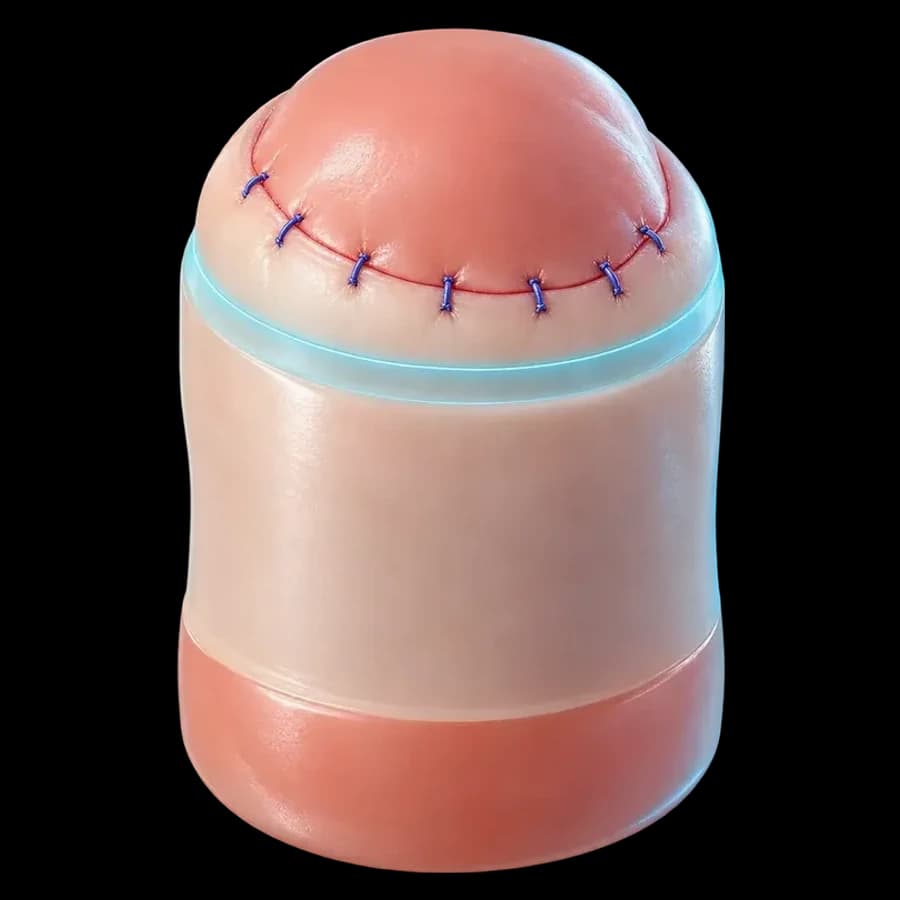
My Clinical Approach
Penile cancer is rare, but its management requires specialised knowledge, because the clinical picture varies widely — from superficial lesions treated with organ preservation, to extensive tumours requiring total penectomy. No two patients are the same.
The strategy I follow gives first priority to organ-preserving surgery when it is oncologically safe, and proceeds to penectomy when it is not. Psychological support and clear information about the consequences — both urological and sexual — are an integral part of care.
- Histological confirmation (biopsy) always precedes any definitive treatment.
- Clinical examination and, where indicated, imaging to assess local extent.
- Separate assessment of the inguinal lymph nodes — not replaced by surgery on the primary tumour.
- A multidisciplinary approach in more complex cases (pathologist, radiologist, oncologist, plastic surgeon).
- Discussion of sperm cryopreservation where relevant, before definitive treatment.
Key message: penile cancer does not automatically mean penectomy — in suitable early tumours, organ-preserving options can be available.
What Is Penectomy
Penectomy is the surgical removal of the penis — partially or totally. It is used for localised penile cancer when organ-preserving methods cannot offer safe oncological control.
Partial penectomy
Removal of the segment of the penis carrying the tumour, aiming for negative histological margins and preservation of as much functional length as possible. May be considered for tumours of the glans or shaft.
Total penectomy
Removal of the entire penis, with creation of a perineal urethrostomy. Considered when partial removal cannot ensure safe margins or a functional result.
In very early, superficial disease, organ-preserving options are considered first (local excision, glansectomy, laser, radiotherapy in selected cases). Penectomy is considered when these are not suitable or safe.
Can the Penis Be Preserved?
One of the most important points I discuss with every patient is this: not every penile cancer requires penectomy. In selected, early/localised disease, current guidance places emphasis on organ-preserving options, when they can offer equally safe oncological control.
Local excision
Removal of just the lesion with a margin of healthy tissue, for very superficial/limited lesions.
Glansectomy
Removal of the glans with preservation of the shaft — see the next section.
Laser or local destructive treatment
For very selected, superficial lesions, under close follow-up.
Radiotherapy
An organ-preserving alternative in specific cases, discussed individually.
Organ preservation is usually accompanied by closer follow-up, since the risk of local recurrence must be carefully weighed against the benefit of preserved function. The choice is always individualised, never automatic.
Glansectomy
Glansectomy is a different procedure from partial penectomy and is often confused with it. It removes the glans, usually preserving the shaft of the penis, and may be combined with reconstruction of the tip of the penis (e.g. with a skin graft). It may be a suitable option for tumours confined to the glans, when oncological safety allows.
Do not confuse glansectomy with partial penectomy — the extent of removal, recovery and functional outcome differ. The right choice depends on the exact location and extent of the tumour.
Penile Cancer: The Basics
Penile cancer is relatively rare in Western countries. The most common histological type is squamous cell carcinoma.
Risk factors
HPV (human papillomavirus) infection, phimosis, chronic inflammation/irritation, lichen sclerosus, smoking, poor local hygiene.
Common locations
The glans, foreskin, and less often the shaft of the penis or the frenulum. Most tumours begin on the surface of the glans or the inner lining of the foreskin.
Early symptoms
A non-healing lesion, plaque, ulceration or discolouration on the penis. Any suspicious, persistent lesion should be assessed and, where needed, biopsied.
Lichen sclerosus and phimosis are associated with increased risk; treating them early is part of prevention.
Partial vs. Total Penectomy
| Parameter | Partial | Total |
|---|---|---|
| Extent of removal | The segment of the penis carrying the tumour | The entire penis |
| Urination | Often standing, depending on remaining length | Sitting, via perineal urethrostomy |
| Sexual function | Potentially preserved in selected patients | Penetration is no longer possible |
| Local recurrence | Monitored closely; depends on margins and stage | Lower risk of local recurrence due to more extensive removal |
| Psychological impact | Significant | Significant to very significant — psychological support always recommended |
There are no precise, universal recurrence or survival rates that apply equally to every patient — these depend on the individual stage, margins and lymph node status, and are discussed individually.
Stage & Choice of Procedure
The choice between organ preservation, partial and total penectomy is based on the stage of the tumour (depth of invasion, location, extent), not on a single criterion:
Superficial disease
Without invasion into deeper layers — organ-preserving options are considered first.
Disease with subepithelial invasion
The choice is individualised; partial penectomy or glansectomy may be required, depending on extent.
Invasion of the corpora
Usually requires partial or, depending on extent, total penectomy.
Invasion of the urethra or base of the penis
Often requires total penectomy with perineal urethrostomy.
Invasion of adjacent structures
Total penectomy, possibly with extended local excision, depending on anatomical spread.
The goal of the surgical margin is a negative histological margin, not a fixed distance in centimetres. The exact approach is individualised to the tumour and confirmed histologically after surgery.
Before Penectomy
Histological confirmation (biopsy)
Almost always required before any definitive oncological procedure, to confirm the type and grade of the tumour.
Clinical examination & imaging
Assessment of the local extent of the tumour and, where indicated, imaging to plan the procedure.
Assessment of inguinal lymph nodes
A separate, equally important step — see the next section.
Discussion of sperm cryopreservation
Suggested where relevant, before definitive treatment, so the patient has all options.
Information on urination, sexual function & psychological support
Discussed in detail before the procedure, so the patient knows what to expect.
Inguinal Lymph Nodes: A Separate Question
Managing penile cancer involves two separate oncological questions: removal of the primary tumour (penectomy or an organ-preserving procedure) and management of the inguinal lymph nodes. Penectomy addresses the first; it does not replace the second.
Lymph node status is a decisive factor for overall prognosis, so its assessment should never be omitted, regardless of the extent of surgery on the penis. See more in the Lymphadenectomy section.
The Procedure Step by Step
The description broadly refers to partial penectomy — the exact steps are adapted to each case.
In total penectomy, removal extends to the entire shaft of the penis down to its base. The urethra is repositioned towards the perineum and a permanent perineal urethrostomy is created — see the next section.
Perineal Urethrostomy
After total penectomy, the urethra is repositioned and opens into a new stoma in the skin of the perineum (between the thighs, behind the scrotum). The patient urinates sitting down, with urine exiting through this new opening.
Important clarification: perineal urethrostomy is not the same as an abdominal urostomy. The bladder stays in its normal place and continues to function normally; no urine bag on the abdomen or external collection device is needed in typical cases.
Patients are informed in detail before the procedure about how they will urinate, so there is no confusion or surprise afterwards. Some patients may occasionally need dilation of the stoma if stenosis develops.
Lymphadenectomy
Management of the inguinal lymph nodes is a separate, equally important issue from removal of the primary tumour, and significantly affects overall prognosis.
Sentinel Lymph Node Biopsy (SLN)
In selected patients with clinically negative inguinal lymph nodes, this can be used to identify the first "sentinel" node, avoiding full lymphadenectomy when it is negative.
Radical Inguinal Lymphadenectomy
Performed for proven or high-risk positive lymph nodes. In more extensive lymph node disease, systemic treatment before surgery may be discussed.
Pelvic Lymphadenectomy
Considered in selected patients with extensive inguinal lymph node disease, as part of the oncological strategy.
Any lymphoedema of the lower limbs comes from the lymphadenectomy, not from the penectomy itself. It is managed with lymphoedema physiotherapy and compression where needed.
Recovery
The length of hospital stay, catheter duration and pace of return to daily activities vary considerably depending on the extent of surgery (partial vs total), any accompanying lymphadenectomy, and the patient's general condition — the treating surgeon provides individualised guidance.
Wound care
Cleaning the area as instructed, monitoring for signs of infection or delayed healing.
Urinary catheter
Stays in place for a number of days to allow the new urethral opening to heal, with a duration that is individualised.
Activity & work
Gradual return to daily activities; return to manual work or vigorous exercise takes place more gradually than office work.
Sexual activity
Resumed only with the surgeon’s approval, once healing is complete.
Psychological support: penectomy has a profound effect on body image and sexual identity. Psychological/sexual counselling is recommended before, during and after the procedure — both for the patient and their partner. See Psychological & Sexual Support below.
Urination After Penectomy
After partial penectomy
Many patients can urinate standing, depending on remaining length and the configuration of the new opening. The stream may change direction or force. Standing urination cannot be promised in every case.
After total penectomy
The patient urinates sitting via a perineal urethrostomy. The bladder functions normally; a urostomy bag is not usually needed.
If the new opening narrows (reduced flow, split stream, difficulty starting to urinate), re-evaluation by the surgeon is needed — dilation or minor revision may be required.
Sexual Function
After partial penectomy
In selected patients with sufficient remaining length and functioning nerve supply, erection, orgasm and sexual activity may remain feasible. The outcome varies considerably between patients and cannot be promised in advance.
After total penectomy
Penetrative intercourse is no longer possible. Sexual desire, intimacy and, depending on individual anatomy, orgasmic experience through other stimulation may remain relevant for many patients.
Sexuality should not automatically be considered "finished" after total penectomy. Sexual counselling can help the patient and their partner adapt and explore new ways of intimacy.
Testosterone & Fertility
Important clarification: penectomy does not remove the testicles and is not equivalent to orchiectomy or androgen deprivation. Testosterone production is not affected by the procedure itself.
Regarding fertility, penectomy can affect the ability to conceive naturally due to loss of penetrative capacity, independent of hormonal function. Sperm cryopreservation before the procedure, where relevant, preserves future family-building options.
Psychological & Sexual Support
Penectomy affects body image, male identity and intimate relationships in profound ways. Psycho-oncological and sexual support is not a luxury — it is an essential part of overall care, both for the patient and their partner.
- Information before the procedure about what to expect, to reduce uncertainty-related anxiety.
- Referral to a psychologist/psycho-oncologist where needed, especially where anxiety or depression appears.
- Sexual counselling for the patient and their partner, at their own pace.
- Support groups or contact with other patients, where available and desired.
Reconstruction
In selected patients, especially after glansectomy or partial penectomy, local reconstruction (e.g. skin grafting) may be considered to improve function and appearance. Reconstruction is not always a suitable or available option and is discussed individually, without promising a specific aesthetic or functional outcome.
Possible Complications
During or after the procedure. Rarely requires re-operation for haemostasis.
Treated with antibiotics. Increased risk in immunosuppressed patients.
May require dilation or minor surgical revision.
More common in smokers or patients with diabetes.
Monitored with regular visits. Management is individualised depending on extent.
Only if lymphadenectomy has been performed — not from the penectomy itself.
Almost always present to some degree. Psychological/sexual support is necessary, not optional.
Contact your surgeon immediately in case of fever, heavy bleeding, inability to urinate, or signs of wound infection.
Follow-up
The follow-up schedule is individualised according to pathological stage, grade, surgical margins and lymph node status — there is no single schedule for every patient. It usually includes:
- Regular clinical examination of the surgical site, for early detection of local recurrence.
- Assessment of the inguinal lymph nodes at each visit.
- Imaging where clinically necessary, based on the individual risk profile.
- Discussion of urological, sexual and psychological issues at every visit — not only oncological ones.
Overall prognosis depends mainly on stage and, in particular, on lymph node status. Penectomy can offer effective local control, without this meaning a "guaranteed" cure in every case.
Second Opinion & Multidisciplinary Team
Given the seriousness and rarity of penile cancer, a second opinion or discussion of the case by a multidisciplinary team (urologist, pathologist, radiologist, oncologist, plastic surgeon, psychologist) can help confirm the best strategy, especially before total penectomy.
Frequently Asked Questions (FAQ)
What is penectomy and when is it performed?
Penectomy is the surgical removal of part (partial) or, where necessary, all (total) of the penis for penile cancer. It is performed when the disease cannot be safely treated with organ-preserving methods, depending on stage, location and extent.
Does every penile cancer mean penectomy?
No. In selected early/localised tumours, organ-preserving options can be considered (local excision, glansectomy, laser, radiotherapy in selected cases). Penectomy is considered when these are not suitable or safe.
What is the difference between partial and total penectomy?
In partial penectomy, the segment of the penis carrying the tumour is removed, aiming to preserve as much functional length as possible where oncologically safe. In total penectomy, the entire penile shaft is removed, when organ preservation is not safely feasible.
What is glansectomy?
It is a different procedure from partial penectomy: it removes the glans, usually preserving the shaft of the penis, and may be combined with reconstruction. It may be suitable for selected tumours confined to the glans.
Can the penis be preserved?
In selected early/localised disease, yes — current guidance emphasises organ-preserving treatment when it is oncologically safe. In more extensive disease, the attempt to preserve the organ must not compromise oncological safety.
How is the surgical margin decided?
The modern goal is a negative histological margin, with an effort to preserve functional tissue where safe — not a fixed distance in centimetres for every case. The exact approach is individualised to the tumour.
Is a biopsy needed before penectomy?
Yes, almost always. Histological confirmation precedes any major definitive oncological procedure, except in exceptional clinical circumstances. The biopsy determines the histological type, grade, and, depending on the sample, features of invasion.
Is lymph node assessment needed?
Yes. Managing penile cancer involves two separate oncological questions: the primary tumour and the inguinal lymph nodes. Penectomy addresses the primary tumour but does not replace appropriate lymph node assessment/treatment.
How does someone urinate after partial penectomy?
Depending on the remaining length and anatomy, many patients can urinate standing, although the stream may change. Standing urination cannot be promised in every case.
How does someone urinate after total penectomy?
Usually through a perineal urethrostomy — the patient urinates sitting, from a new opening in the perineum. The bladder continues to function normally.
What is a perineal urethrostomy?
It is the repositioning of the urethra so that urine exits through a new opening between the thighs, after total penectomy. It is not the same as a ureterostomy or ileal conduit urostomy with an abdominal bag.
Do I need a urine bag after total penectomy?
No, in typical cases. The bladder stays in its normal place and urine exits through the perineal urethrostomy, without an abdominal urostomy, unless an entirely different, specific surgical situation applies.
Can there be sexual activity after partial penectomy?
In selected patients with sufficient remaining length and function, erection and sexual activity may remain feasible, without this being promised to everyone.
What happens to sexual life after total penectomy?
Penetrative intercourse is no longer possible. However sexual desire, intimacy and, depending on individual anatomy/nerve supply, orgasmic experience through other stimulation may remain relevant — sexuality should not automatically be considered "finished".
Is testosterone affected?
Not by the penectomy itself, since the testicles are not removed as part of the procedure. Penectomy is not equivalent to orchiectomy or androgen deprivation.
What are the possible complications?
These include bleeding, infection, delayed healing, changes in urinary stream, stenosis of the urethrostomy/meatus, pain and psychosexual impact. If lymphadenectomy is combined, related complications may be added (e.g. lymphoedema) — these do not come from the penectomy itself.
How long does recovery take?
It varies considerably depending on the extent of surgery, any accompanying lymphadenectomy, and the patient’s general condition. The treating surgeon provides individualised guidance.
Is psychological support needed?
Often, yes. Penectomy can affect body image, sexual identity and relationships. Psycho-oncological support and sexual counselling are an essential, not secondary, part of care.
What follow-up is needed after the procedure?
It is individualised according to pathological stage, grade, margins and lymph node status. It usually includes clinical examination, assessment of inguinal lymph nodes and, where indicated, imaging — not a single schedule for everyone.
If I have penectomy, will I be cured?
Penectomy can offer effective local control and, in localised disease, can be a curative procedure. However overall prognosis depends mainly on stage and, in particular, lymph node status — it cannot be promised as a "guaranteed cure".
Specialised Care in Rhodes
If you have a non-healing lesion on the penis or have received a diagnosis of penile cancer, contact us directly for an evaluation.
References
- EAU Guidelines on Penile Cancer 2024 — uroweb.org
- NCCN Clinical Practice Guidelines in Oncology: Penile Cancer — nccn.org
- Minhas S et al. European Association of Urology Guidelines on Penis Cancer: 2021 Update. Eur Urol. 2021;80(1):24–35.
- Hakenberg OW et al. EAU guidelines on penile cancer. Eur Urol. 2015;67(1):142–150.
Medical Review

Dr. Marinos Vasilas, Urologist – Andrologist
Dr. Vasilas manages penile cancer giving first priority to organ-preserving methods when they are oncologically safe. In cases requiring penectomy, he provides full preoperative counselling, psychological support and individualised postoperative follow-up.
Full Profile

