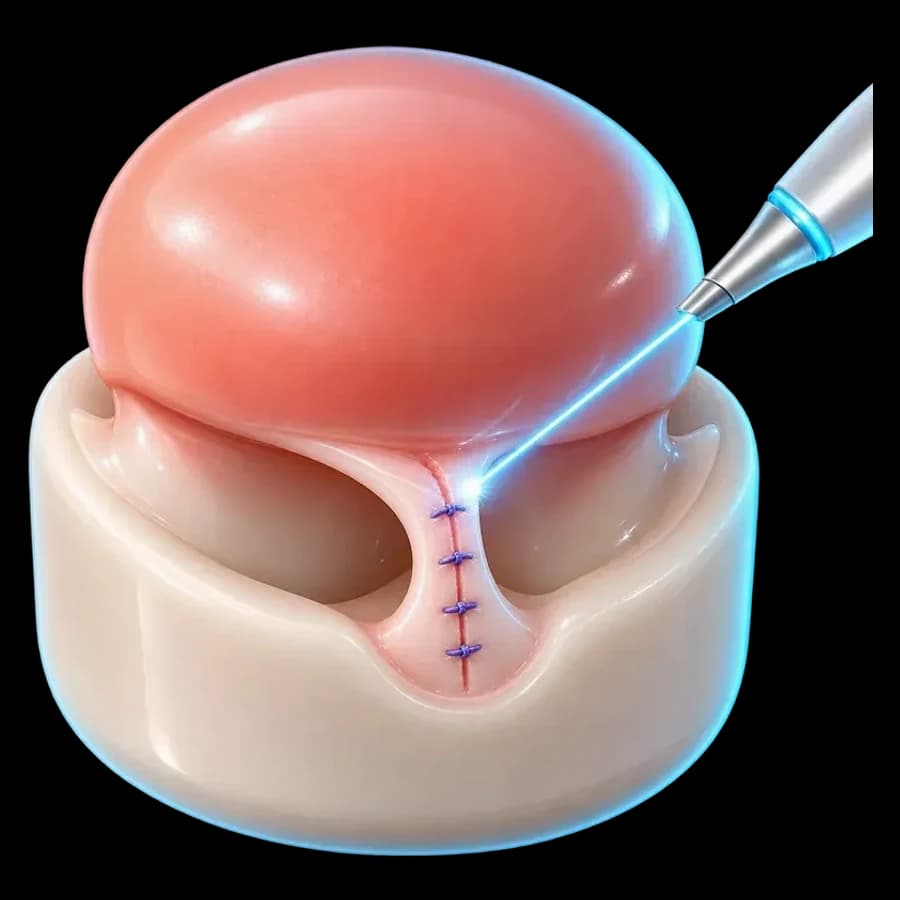
Our Clinical Approach
Frenulum breve is a condition that is often underdiagnosed — and often wrongly attributed to other causes (e.g. “phimosis”). Men who experience pain or tearing during intercourse avoid mentioning it, so the problem often remains unaddressed for years.
Diagnosis is made with simple clinical examination: on full retraction of the foreskin, the frenulum stretches and pulls the glans downward — this is the characteristic finding. When the patient confirms the same thing happens during intercourse, the indication for surgery is clearer.
- Diagnosis is clinical — no imaging is needed.
- If phimosis coexists, both conditions are assessed separately.
- The exact technique (frenulotomy or frenuloplasty) is decided on a case-by-case basis.
- The procedure is relatively short, with minimal expected recovery.
Key message: Frenulum breve ≠ phimosis. A man can have a normally mobile foreskin but a short frenulum.
Anatomy of the Frenulum
The penile frenulum is located on the ventral (underside) surface of the glans and connects the foreskin to the glans area, allowing normal mobility of the foreskin during retraction and erection. It is an area with significant innervation and blood supply, which is why injury to it can be painful and bleed noticeably.
How Do I Know I Have a Short Frenulum?
Typical clues that lead to evaluation:
These findings are not a self-diagnosis. The definitive distinction from phimosis or another cause is always made by clinical examination.
What Is Frenulum Breve
The frenulum is a small elastic band of connective tissue on the underside of the penis, joining the glans to the inner layer of the foreskin.
In frenulum breve, this band is congenitally or acquiredly short, limiting full retraction of the foreskin. During erection or intercourse, the short frenulum stretches excessively, causing pain, ventral deflection of the glans, or a tear with bleeding.
Difference from phimosis
Phimosis involves narrowing of the foreskin opening. Frenulum breve involves the connective band on the underside. They can coexist.
Prevalence
Frenulum breve is relatively common — it is estimated to affect a meaningful proportion of men presenting with dyspareunia, though prevalence has not been well established in epidemiological studies.
Short Frenulum or Phimosis?
The correct diagnosis prevents a circumcision when the real problem is only the frenulum.
| Short Frenulum | Phimosis | |
|---|---|---|
| Main problem | Short/inelastic frenulum | Narrow foreskin ring |
| Foreskin retracts | Often normally | May not retract |
| Pain on erection | Common | May occur |
| Glans traction | Characteristic finding | Not a core finding |
| Treatment | Frenulotomy / frenuloplasty | Conservative treatment or circumcision, depending on cause |
| Circumcision needed? | Not necessarily | May be needed |
The correct diagnosis avoids a circumcision when the real problem is only the frenulum.
Diagnostic Pathway
An educational overview, not a self-diagnosis tool:
Yes — glans pulled downward
Possible short frenulum — evaluate for frenulotomy/frenuloplasty
No — is there a narrow/scarred foreskin ring?
Evaluate for phimosis — conservative treatment or circumcision depending on pathology
Short Frenulum and Circumcision
Circumcision is not a mandatory treatment for isolated frenulum breve. If the foreskin is otherwise normal, a simple frenulotomy or frenuloplasty may be sufficient.
However, if there is coexisting pathological phimosis, significant scarring, lichen sclerosus or recurrent balanoposthitis, a different or combined treatment strategy may be needed, which may include circumcision. Frenuloplasty alone does not treat pathological phimosis or extensive lichen sclerosus.
The Frenulum Tore — What Does That Mean?
When an inelastic frenulum is stretched beyond its limits, it can tear, causing sudden pain and usually some bleeding. The frenular area has significant blood supply, so even a minor tear can bleed noticeably.
Minor bleeding after a superficial tear usually stops on its own, often with gentle local pressure. Persistent or significant bleeding needs medical assessment.
Does it heal on its own? A single minor tear can heal. However, repeated injury often leads to scar tissue and reduced elasticity. If the frenulum remains too short, spontaneous healing does not always fix the mechanical problem.
When Is Surgery Needed
Surgery is considered when frenulum breve causes:
Surgery is considered only when the short frenulum is clearly the main cause of symptoms and the anatomy is clearly restrictive. It is not mandatory for every asymptomatic short frenulum. If phimosis coexists, the need for circumcision is assessed in parallel.
Is There a Conservative Treatment?
In selected, mild cases without scarring, a conservative approach may be considered by the treating clinician on a case-by-case basis.
Forceful stretching of the frenulum is not recommended, due to the risk of tearing, bleeding and scarring. A conservative programme is not suitable for every scarred or extensive case — suitability is judged clinically.
Frenulotomy or Frenuloplasty?
The terms frenulotomy, frenuloplasty and frenectomy are not absolute synonyms. The exact technique depends on anatomy, degree of shortening, presence of scarring, surgeon preference, and the need for lengthening/reconstruction of the tissue.
Frenulotomy
Surgical division of the short frenulum to release the tension. Depending on the technique, it may be followed by controlled suturing for lengthening of the tissue.
Frenuloplasty
Aims to lengthen and reshape the frenulum, allowing greater mobility without excessive tension. May involve division, rearrangement/reconstruction and suturing depending on technique.
In everyday language, patients often refer to the procedure generally as “frenulum surgery”. The exact technique is decided clinically/intraoperatively based on anatomy, with no technique considered universally superior.
Frenuloplasty vs Circumcision
| Frenuloplasty | Circumcision | |
|---|---|---|
| What it corrects | Short frenulum | Pathological foreskin/phimosis |
| Removes foreskin | Not usually | Yes |
| Preserves foreskin | Yes | No |
| Suitable for isolated short frenulum | Often | Not necessarily |
| Suitable for scarred phimosis | Not on its own | Often relevant |
The final treatment is individualised based on the clinical picture — no single option is generally superior.
Preoperative Assessment
Preparation for frenulotomy/frenuloplasty is straightforward.
Clinical examination
Confirms the short frenulum as the main cause. Checks for coexisting phimosis, lichen sclerosus, balanitis or other lesions.
Basic blood tests
Full blood count and clotting where clinically appropriate — not every patient needs extensive testing.
Anticoagulants/antiplatelets
Patients must never stop anticoagulant or antiplatelet medication on their own. Management is individualised based on bleeding/thrombotic risk and the indication for the medication, together with the treating physician.
No fasting
Under local anaesthesia, fasting is not usually required.
The Procedure Step by Step
This is a general overview of one type of technique, not an operative manual.
Anaesthesia & Duration
Anaesthesia
Almost always local anaesthesia. The patient remains awake. The local injection may cause a brief sting — the procedure should not be presented as entirely painless.
Duration
Usually a relatively short procedure, though duration varies with anatomy and technique.
Hospital stay
Typically an office- or day-case procedure. Discharge within a short period for most patients.
Catheter
Not required. The procedure does not affect urination.
Recovery
Mild discomfort and swelling are expected. Appropriate analgesia as advised. Avoid direct cold/hot applications to the area.
Office work is feasible for most, depending on discomfort. Gentle activity (walking).
Sutures gradually resolve. Avoid vigorous exercise, cycling and swimming/sea.
Healing has usually progressed significantly, but the exact timing varies by patient. Sexual activity is permitted only after confirmation at your follow-up visit — not based on the calendar alone.
Wound care: Gentle washing with lukewarm water only once your surgeon confirms it is appropriate, gentle drying, avoiding friction or tight underwear in the first weeks. Do not use random antiseptic creams without a specific indication — follow your individual postoperative instructions.
Is Swelling After Frenuloplasty Normal?
Mild swelling and bruising may appear. It does not automatically mean a complication. Worsening swelling with severe pain, bleeding, fever or wound separation needs evaluation.
Erections After the Procedure
Spontaneous erections are normal and may cause pulling/discomfort at the sutures in the first weeks. This does not mean the procedure failed. Significant bleeding or wound separation needs evaluation.
When Can I Have Sex After Frenuloplasty?
Sexual intercourse should be avoided until the wound has healed sufficiently and the sutures/incision are stable, with pain and swelling largely resolved. As a general guide this may take around 4 weeks, but the exact timing is confirmed at your follow-up visit — clinical healing takes priority over the calendar.
Early intercourse increases the risk of bleeding, pain, wound dehiscence, delayed healing and scarring.
Masturbation: the same principle applies — only after adequate healing, without traction on the incision area, as confirmed by your surgeon.
Sexual Function After Frenuloplasty
The frenular area is sensitive. After the procedure there may temporarily be altered sensation, hypersensitivity, or reduced sensitivity due to swelling/healing. Long-term experience varies between men — no one can promise greater or lesser sensitivity, or better sex, for everyone.
Erectile function
The procedure does not target the corporal bodies and is not a treatment for erectile dysfunction. Frenulum breve is not usually an organic cause of erectile dysfunction, though pain or anxiety around tearing can affect arousal and confidence in individual cases. The procedure may improve comfort during intercourse when pain, traction or fear of tearing were previously present — this does not mean a direct enhancement of erection itself.
Premature ejaculation
Frenulotomy or frenuloplasty is not an established treatment for premature ejaculation. Any related literature on frenular sensitivity should be interpreted cautiously and is not a basis for a marketing claim.
When to Seek Urgent Care
Medical assessment is needed for:
- Persistent or significant bleeding
- Rapidly worsening swelling
- Worsening, uncontrolled pain
- Fever
- Purulent discharge
- Significant wound separation
- Inability to urinate
- Concerning discoloration or loss of tissue viability
Possible Complications
Frenulotomy/frenuloplasty is a relatively safe procedure. Serious complications are uncommon, though this does not mean zero risk.
Usually self-limiting with gentle pressure. Rarely requires re-intervention.
Uncommon. Managed with appropriate treatment when needed.
The area adapts gradually during healing.
Can occur in selected patients, especially after repeated injury. Rarely needs reassessment/revision.
Asymmetry or scarring — can be addressed with revision if needed.
For many patients with recurrent tearing or persistent pain, the risk of the intervention must be weighed against the risk of continuing without treatment (repeated tears, chronic discomfort) — a decision made on an individual basis.
Frequently Asked Questions
What is frenulum breve?
Frenulum breve is a condition in which the elastic band on the underside of the glans is relatively short or inelastic, causing tension when the foreskin retracts or when the penis is erect.
How do I know if I have a short frenulum?
Typical findings include pain on full foreskin retraction or erection, ventral traction of the glans, tearing during intercourse or masturbation, recurrent bleeding, and scarring at the frenulum. A definitive diagnosis requires clinical examination, not self-diagnosis.
What is the difference from phimosis?
Phimosis involves narrowing of the foreskin opening that prevents retraction. Frenulum breve specifically involves the connective band on the underside — the foreskin may retract normally. The two conditions can coexist, but treatment differs.
Why does the glans pull downward?
When the frenulum is short, it does not lengthen enough during erection and pulls the glans downward (ventral traction). This is a different mechanism from Peyronie’s disease or congenital curvature and should not be confused with them.
Why does the frenulum tear during sex?
When an inelastic frenulum is stretched beyond its limit during intercourse, it can tear, causing sudden pain and usually some bleeding. Repeated tearing can lead to scarring and further shortening.
Is frenular bleeding dangerous?
The frenular area has a significant blood supply, so even a small tear can bleed noticeably. It usually stops with gentle pressure. Persistent or significant bleeding needs medical assessment.
Can it heal on its own?
A single minor tear can heal. However, repeated injury often leads to scar tissue and reduced elasticity. If the underlying frenulum remains too short, spontaneous healing does not always correct the mechanical problem.
Do I need circumcision?
Not necessarily. In an isolated short frenulum with an otherwise normal foreskin, frenulotomy or frenuloplasty alone may be sufficient. Circumcision is considered only when there is additional foreskin pathology (phimosis, scarring, lichen sclerosus).
What is frenulotomy?
It is the surgical division of the short frenulum to release the tension. Depending on the technique, it may be followed by suturing for controlled lengthening of the tissue.
What is frenuloplasty?
It is the procedure aimed at lengthening and reshaping the frenulum, allowing greater mobility without excessive tension, usually through incision and controlled closure.
Does the procedure hurt?
Local anaesthesia is used during the procedure. Some postoperative discomfort is expected and is managed with appropriate analgesia.
What anaesthesia is used?
Almost always local anaesthesia (injection around the frenulum). General anaesthesia and fasting are not usually required.
Are stitches needed?
Absorbable sutures are often used, which gradually loosen and dissolve. The exact timing varies between patients.
How long does healing take?
Initial healing usually progresses over a few weeks, but the exact timing varies depending on the patient and the extent of the procedure. Full scar maturation takes longer.
When can I have sex?
Only once the wound has healed sufficiently, as confirmed at your follow-up visit — not based on the calendar alone. Early intercourse increases the risk of bleeding and wound disruption.
When can I masturbate?
The same logic as intercourse applies: only after adequate healing, without traction on the area, as confirmed by your surgeon.
Is sensation or erection affected?
The procedure does not target the corporal bodies or the nerves responsible for erection. The frenular area is sensitive and sensation may temporarily change during healing. Long-term experience varies between men.
Does frenuloplasty treat premature ejaculation?
No. Frenulotomy or frenuloplasty is not an established treatment for premature ejaculation. Any related literature on frenular sensitivity should be interpreted cautiously and is not a basis for a marketing claim.
Assessment in Rhodes
The correct distinction between a short frenulum and phimosis matters, because treatment differs. When the problem is limited to the frenulum and the foreskin is normal, frenulotomy or frenuloplasty can address the tension without necessarily requiring circumcision.
References
- EAU Guidelines on Male Sexual and Reproductive Health 2024 — uroweb.org
- Oster J. Further fate of the foreskin. Arch Dis Child. 1968;43(228):200–203.
- Dockray J et al. The effect of circumcision on male sexual experience. BJU Int. 2012;109(11):1686–1690.
- Whelan PC. Male dyspareunia due to short frenulum: an indication for adult circumcision. Br Med J. 1977;2(6094):1102–1103.
Medical Review

Dr. Marinos Vasilas, Urologist – Andrologist
Dr. Vasilas treats frenulum breve with frenulotomy or frenuloplasty under local anaesthesia. Every case is assessed individually to select the appropriate technique, aiming to minimise the risk of recurrence.
Full Profile

