My Clinical Approach
Laparoscopic adrenalectomy is one of the oldest and best-documented minimally invasive techniques in urological/endocrine surgery — and remains an established choice for many patients today.
The core message I always give: the laparoscopic approach is not “inferior” or “outdated” simply because robotic surgery also exists — it is a different, equally valid minimally invasive technique. Correct patient and approach selection matters more than the name of the technology.
- I do not recommend surgery for every adrenal incidentaloma.
- I always screen for pheochromocytoma before any invasive action.
- I do not choose the laparoscopic approach when oncological safety rules it out.
- I explain clearly that 3D laparoscopy is not robotic surgery.
- I do not promise lifelong steroids, or their absence, in advance — it depends on the case.
What Are the Adrenal Glands
There are two adrenal glands, located next to the upper pole of each kidney. They consist of a cortex and medulla, and produce important hormones such as cortisol, aldosterone, and catecholamines.
This page focuses on the surgical procedure of laparoscopic adrenalectomy — it is not a complete endocrinology textbook.
What Laparoscopic Adrenalectomy Means
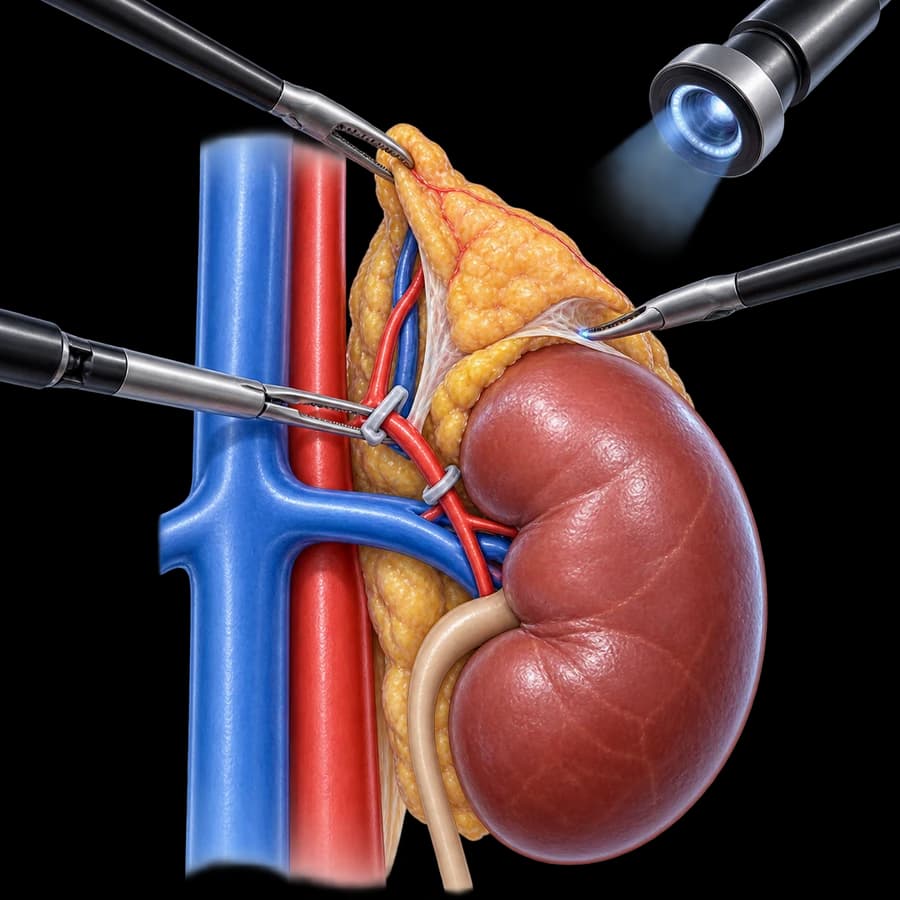
The procedure is performed through small skin incisions, ports, a camera, and specialised laparoscopic instruments — not through one large open incision.
The surgeon handles the instruments directly, by hand, standing next to the operating table and viewing the image on a screen.
Laparoscopic ≠ Robotic
Laparoscopic
The surgeon directly handles long laparoscopic instruments, without a console.
Robotic
The surgeon handles robotic articulated instruments through a console.
Both are minimally invasive, are fully controlled by the surgeon, and can be appropriate in selected adrenal surgery.
2D vs 3D Laparoscopy
The 3D/4K laparoscopic technology used in our practice offers stereoscopic depth perception, improved spatial orientation, and more precise tissue dissection compared with conventional 2D laparoscopy.
3D laparoscopy does not make the procedure autonomous, nor does it guarantee a better clinical outcome by itself. It remains conventional laparoscopy with directly handled instruments — simply with improved visual imaging.
When Is Removal of the Adrenal Gland Needed?
Potential indications, according to current guidance:
- Pheochromocytoma.
- Aldosterone-producing adenoma / selected unilateral primary aldosteronism.
- Clinically relevant cortisol-producing lesion.
- Lesion suspicious for malignancy.
- Selected enlarging/indeterminate lesion in the appropriate context.
- Selected adrenal metastasis.
- Selected symptomatic benign lesion.
There is no rule of “above X cm → surgery”. Size is always assessed together with hormonal activity, imaging, growth over time, and patient characteristics.
I Found a Nodule – Does It Always Need Surgery?
Not necessarily.
Many adrenal incidentalomas are benign, non-functioning, and can be safely monitored without surgery.
The decision must answer:
- 1.Does it produce hormones?
- 2.Is it benign or suspicious on imaging?
- 3.Is there growth/change?
- 4.Does it cause symptoms?
- 5.Is there oncological concern?
- 6.What is the overall patient context?
Functional vs Non-Functional Lesion
Functional lesion
Produces hormones that may cause hypertension, hypokalaemia, cortisol excess, or catecholamine symptoms.
Non-functional lesion
Does not show clinically significant hormone excess.
Hormonal evaluation is a necessary part of preoperative assessment.
Laparoscopic Adrenalectomy for Pheochromocytoma
Surgical removal of pheochromocytoma requires special preoperative preparation due to catecholamine secretion and the risk of significant changes in blood pressure and heart rate.
Coordinated endocrine preparation, surgical planning, and anaesthetic planning are required.
Preoperative Adrenergic Preparation
In pheochromocytoma, appropriate preoperative adrenergic blockade is usually required, according to current endocrine guidance.
Beta-blockade should not begin arbitrarily before adequate alpha-blockade. We do not give drug names, dosing, or exact days here — these are determined individually by the treating endocrinologist/anaesthesiologist.
Adrenalectomy & Primary Aldosteronism
Unilateral aldosterone overproduction ( Conn’s syndrome) can be managed surgically.
A CT finding alone does not prove that this is the source of aldosterone excess.
In appropriate patients, Adrenal Vein Sampling (AVS) may be required, according to current guidance.
What Is Adrenal Vein Sampling (AVS)
AVS compares hormone secretion from the two adrenal glands and helps with “lateralisation” — identifying which side is the source of overproduction.
It is not mandatory for all patients. Selection and exceptions are determined by current guidance.
Autonomous Cortisol Secretion
There is not just a simple distinction of “ Cushing’s syndrome or not”. The surgical decision depends on:
- Biochemical degree.
- Hypertension.
- Diabetes/metabolic comorbidity.
- Age.
- Overall health.
- Patient preference.
- Lesion features.
Postoperative Adrenal Insufficiency
In cortisol-producing lesions, temporary glucocorticoid replacement and endocrine follow-up may be needed.
We do not give fixed doses or a taper schedule here.
Suspected or Confirmed Adrenal Cancer
In suspected adrenocortical carcinoma (ACC), the goal is complete oncological resection without tumour rupture or spillage.
The laparoscopic approach should not be chosen only because it is minimally invasive — it must be oncologically appropriate. In suspected local invasion, a very large/complex suspicious tumour, or need for en-bloc resection, open surgery may be preferred.
A Smaller Incision Does Not Override Oncology
A smaller incision is not more important than oncological safety.
In suspected malignancy, complete resection, tumour integrity, appropriate margins, and avoidance of rupture take priority.
Open Surgery for Suspected Malignancy
Open surgery may be preferable when:
- Local invasion is suspected.
- En-bloc resection may be required.
- Tumour manipulation/rupture risk is a concern.
- Oncologic exposure is important.
Open surgery is not an outdated technique — it remains the standard in selected suspected-ACC cases, according to current literature.
Adrenal Metastasis
Adrenal metastasectomy has a place only in carefully selected oncological patients.
The decision depends on the primary malignancy, systemic disease status, resectability, disease distribution, performance status, and multidisciplinary team (MDT) assessment.
Adrenal Myelolipoma & Cyst
Most myelolipomas and adrenal cysts do not automatically require surgery.
Surgery may be considered based on symptoms, growth, haemorrhage risk, diagnostic uncertainty, or clinical context — without a universal size cutoff.
What Testing Is Needed Before Surgery
Depending on the clinical context, evaluation may be required for:
- Catecholamine excess.
- Autonomous cortisol secretion.
- Aldosterone excess.
- Selected androgen/sex-steroid secretion.
There is no one-size-fits-all hormonal panel.
Excluding Pheochromocytoma Before Any Invasive Procedure
A biopsy of an adrenal mass should not be planned before pheochromocytoma has been appropriately assessed, where relevant suspicion exists.
Is a Biopsy Needed Before Surgery?
Usually not for a typical primary adrenal tumour.
Biopsy may be used in selected cases, e.g. suspected metastatic disease, when the result would change management.
How the Lesion Is Characterised Before Surgery (CT/MRI)
CT can assess size, homogeneity, unenhanced attenuation, enhancement, invasion, and relation to adjacent structures. MRI can add information in selected lesions.
We do not quote fixed Hounsfield units, washout percentages, or MRI thresholds here — these are interpreted in the context of the overall clinical picture, according to current ESE (2023) guidance.
How the Procedure Is Performed
This description is deliberately kept at a general level — it is not a surgical manual with port coordinates or a vessel-division sequence.
Specimen Handling
In tumour surgery, oncologically appropriate specimen handling is followed: avoiding rupture/spillage and using a retrieval bag where appropriate. We do not provide extraction technique instructions here.
Transperitoneal Laparoscopic Approach
The transperitoneal approach accesses the adrenal gland through the abdominal cavity, providing a broad working space and familiar anatomical landmarks.
We do not provide a surgical manual here.
Retroperitoneoscopic Approach
The retroperitoneal approach accesses the adrenal gland directly from the retroperitoneal space, avoiding entry into the peritoneal cavity — it may have value in selected cases.
The choice depends on:
- Surgeon expertise.
- Prior abdominal surgery.
- Tumour anatomy/size.
- Body habitus.
- Bilateral surgery.
- Patient factors.
Which Approach Is Better?
There is no universally superior approach.
Systematic reviews comparing retroperitoneoscopic with transperitoneal laparoscopic adrenalectomy do not consistently show one approach superior across all outcomes — the choice is individualised.
Right vs Left Adrenalectomy & Adrenal Vein
Right adrenal gland
Close relationship to the liver and the inferior vena cava (IVC).
Left adrenal gland
Close relationship to the spleen, pancreas, kidney, and renal vessels.
The right adrenal vein is often short and drains toward the IVC; left-sided venous anatomy differs. We do not provide a clipping/division sequence here.
Laparoscopic vs Robotic Adrenalectomy
| Laparoscopic | Robotic | |
|---|---|---|
| Minimally invasive | Yes | Yes |
| Instrument control | Direct laparoscopic instruments | Console-controlled articulated instruments |
| 3D vision | Depends on the system | Standard robotic architecture |
| Articulation | Limited in standard tools | Greater |
| Clinical outcome | Depends heavily on case/team | Depends heavily on case/team |
| Recovery | Often broadly similar | Often broadly similar |
| Best choice | Individualised | Individualised |
We do not claim either technique is universally superior. Meta-analyses vary in their findings on hospital stay/blood loss, often with study heterogeneity and retrospective design — the surgical team’s experience in minimally invasive adrenal surgery matters more than choosing a technology based on marketing alone. See the page robotic adrenalectomy for full information on the robotic technique.
Laparoscopic vs Open Adrenalectomy
Laparoscopic
- • Small incisions
- • Selected suitable tumours
- • Generally faster functional recovery
- • Minimally invasive
Open
- • Larger incision
- • May provide optimal exposure in selected invasive/complex malignancies
- • Allows en-bloc extended resection when necessary
We do not undervalue open surgery.
Partial or Total Adrenalectomy?
Total adrenalectomy
Removal of the entire affected gland.
Partial / cortical-sparing
Preserves functional adrenal cortex in selected patients.
Partial adrenalectomy may have particular value in bilateral tumours, hereditary syndromes, a solitary functional adrenal gland, and selected small benign functional tumours — with the aim of reducing the risk of permanent adrenal insufficiency.
Partial adrenalectomy is not presented as a standard option for suspected invasive ACC.
Hereditary/Bilateral Pheochromocytoma & Cortical-Sparing Surgery
In selected hereditary syndromes or bilateral pheochromocytoma, cortical-sparing surgery may be discussed in a specialist context, aiming to preserve adrenal function and avoid lifelong hormone replacement, depending on current guidance and an individualised risk/benefit assessment.
Do I Need Both Adrenal Glands?
Usually not — a normally functioning contralateral adrenal gland usually covers basic hormonal needs after unilateral adrenalectomy.
Cortisol-producing lesions, bilateral disease, previous contralateral surgery, or adrenal insufficiency can change postoperative management.
When Is Lifelong Hormone Replacement Needed
Bilateral total adrenalectomy or severe bilateral adrenal dysfunction may require lifelong replacement. Unilateral adrenalectomy usually does not, except in temporary/selected endocrine circumstances. We do not give dosing regimens here.
Preoperative Assessment
- Hormonal work-up.
- Imaging review.
- Blood count/biochemical tests as indicated.
- Renal function.
- Electrolytes.
- Blood pressure.
- Medication review.
- Anticoagulants/antiplatelets.
- Anaesthetic evaluation.
- Prior abdominal surgery.
- Cardiometabolic comorbidities.
- Pathology/oncology review if suspicious.
The patient does not stop anticoagulants or antiplatelets on their own.
The plan is individualised based on bleeding risk, thrombotic risk, indication, medication, and surgical plan.
Anaesthesia
Laparoscopic adrenalectomy is performed under general anaesthesia. Functional adrenal tumours may need specialised perioperative monitoring.
Manipulation of pheochromocytoma can cause haemodynamic instability. We do not give an anaesthetic or drug protocol here — management requires an experienced team.
How Long Does the Procedure Take
There is no universal duration. It depends on side, tumour size, pathology, prior surgery, adhesions, anatomy, body weight, partial vs total resection, transperitoneal vs retroperitoneal approach, and intraoperative findings.
Hospital Stay
Length of stay is variable, depending on complexity, the functional tumour type, blood pressure/electrolytes, pain, oral intake, and any complications. We do not guarantee next-day discharge.
Pain, Incisions & Return to Activity
Postoperative pain may relate to port incisions, the abdominal wall, and in selected cases temporary shoulder-tip discomfort due to residual CO₂ after transperitoneal laparoscopy. We do not describe this as “painless” surgery.
Small incisions do not mean “scarless surgery” — a scar remains possible, as do infection or port-site hernia, and the cosmetic result varies.
Return to walking, office work, driving, physical work, and exercise depends on recovery and the operation performed — we do not give a fixed universal day/week without individualisation.
Recovery Timeline
Immediate postoperative period
Monitoring, pain control, mobilisation, endocrine/BP monitoring when needed.
Early recovery
Incisions heal, activity progressively increases, pathology awaited.
Follow-up
Wound review, pathology, hormonal re-evaluation.
Return to normal activity
Individualised according to recovery.
Blood Pressure, Potassium & Cortisol After Surgery
In pheochromocytoma, aldosteronism, or cortisol excess, blood pressure may change significantly after surgery. Existing medication may need medical reassessment — the patient does not stop medication independently.
After removal of a Conn adenoma, potassium and blood pressure require monitoring.
In cortisol-producing lesions, profound weakness, hypotension, nausea/vomiting, or significant malaise may warrant prompt medical assessment for adrenal insufficiency.
What Does the Histology Show
It establishes the exact lesion type, benign vs malignant nature, tumour size, invasion, margins, and relevant tumour-specific features. Final pathology determines follow-up.
Is Follow-Up Needed After Surgery?
Benign non-functional lesion
Clinical follow-up according to the final diagnosis.
Functional tumour
Endocrine reassessment.
Pheochromocytoma
Biochemical surveillance ± genetic assessment.
ACC/malignant
Structured oncological surveillance.
There is no universal CT schedule.
Genetic Testing
May be relevant in selected patients with pheochromocytoma/paraganglioma, young age, bilateral/multifocal disease, family history, or syndromic features, according to current guidance. It is not recommended for every incidentaloma.
Possible Complications
Bleeding
Uncommon but significant, due to proximity to major vessels.
Transfusion in selected cases
Rare, depending on the course.
Injury to adjacent organs
Liver, spleen, pancreas, kidney, depending on side — rare.
Vascular injury
Rare, serious complication.
Infection
Requires assessment and targeted treatment.
Conversion to open surgery
A safety decision, not a failure.
Thromboembolic events
Rare, depending on risk factors.
Anaesthetic complications
Rare, depending on the patient.
Adrenal insufficiency
Particularly with bilateral surgery or cortisol-producing lesions.
Haemodynamic instability
Particularly in pheochromocytoma.
Port-site hernia/wound problem
Rare with a minimally invasive approach.
Recurrence depending on pathology
Depends on the tumour type.
We do not present complications as common, nor do we quote unsourced percentages. Laparoscopy may reduce surgical trauma in suitable cases, but significant bleeding remains a recognised risk — we do not promise “minimal blood loss” as a guarantee.
Conversion to Open Surgery
Conversion to open surgery is a safety decision, not a surgical failure.
It may occur because of bleeding, unexpected invasion, difficult anatomy, adhesions, oncological concerns, or patient safety.
Risk of Adrenal Insufficiency
Particularly relevant with bilateral adrenal surgery, cortisol-producing lesions, and pre-existing adrenal dysfunction. Treatment/monitoring must be endocrine-guided.
Red Flags After Surgery
Needs prompt evaluation
- High/persistent fever.
- Worsening abdominal/flank pain.
- Persistent vomiting.
- Inability to tolerate fluids.
- Fainting/severe dizziness.
- Marked hypotension symptoms.
- Shortness of breath.
- Chest pain.
- Significant wound bleeding.
- Acute deterioration.
The Patient Journey
Key Questions in Plain Language
Does Every Adrenal Nodule Need Surgery?
No. The decision is based on hormonal testing, imaging characteristics, and the overall clinical context.
Laparoscopic or Robotic Adrenalectomy?
Both are modern minimally invasive approaches. The choice depends more on the anatomy of the lesion, the clinical context, and the experience of the team than on the name of the technology.
When Is Open Surgery Preferred?
For invasive malignancy, involvement of adjacent organs, need for en-bloc resection, or other complex oncological circumstances.
Can I Live Normally With One Adrenal Gland?
Usually yes, if the contralateral gland is healthy. Cortisol-producing or bilateral disease may require special endocrine management.
Will I Need Steroids Afterwards?
Not everyone. It depends on cortisol production, HPA-axis suppression, bilateral disease, and contralateral function.
How Many Incisions Are Needed?
There is no single universal number. It depends on the approach, anatomy, equipment, and the surgeon’s strategy. Several small laparoscopic ports are typically used.
Is 3D Laparoscopy the Same as the Robot?
No. 3D laparoscopy is stereoscopic imaging used with conventional laparoscopic instruments. Robotic surgery is a robotic platform with console-controlled articulated instruments.
Frequently Asked Questions (FAQ)
What is laparoscopic adrenalectomy?
It is a minimally invasive surgical procedure to remove the adrenal gland. A small camera and specialised laparoscopic instruments, directly handled by the surgeon, are introduced through small incisions, avoiding the large incision of classic open surgery.
Does every adrenal nodule need surgery?
No. Many adrenal incidentalomas are benign, non-functioning, and can be safely monitored without surgery, depending on their hormonal and imaging characteristics.
When is removal of the adrenal gland needed?
Examples include hormonally active tumours, pheochromocytoma, selected unilateral primary aldosteronism, clinically relevant cortisol-producing lesions, a lesion suspicious for malignancy, selected metastasis, or selected symptomatic benign lesions.
What hormonal testing is done beforehand?
Depending on the case, this may include testing for catecholamine excess, autonomous cortisol secretion, aldosterone excess in hypertensive/hypokalaemic patients, and selected androgen/sex-steroid secretion in suspicious tumours.
What happens if it is pheochromocytoma?
Special preoperative endocrine and anaesthetic preparation is required, due to catecholamine secretion and the risk of significant changes in blood pressure/heart rate during surgical manipulation.
What is AVS?
Adrenal vein sampling (AVS) compares hormone secretion from the two adrenal glands and can help identify unilateral aldosterone overproduction in appropriate patients, according to current guidance.
When is primary aldosteronism treated surgically?
In selected patients with documented unilateral aldosterone overproduction. A CT finding alone does not prove which side is the source of overproduction.
What happens with autonomous cortisol secretion?
There are degrees of autonomous cortisol secretion, not just a binary "Cushing or not" distinction. The decision for surgery takes into account biochemical findings, comorbidities, age, and patient preference.
Laparoscopic or robotic surgery?
Both are modern minimally invasive techniques. The choice depends more on the anatomy of the lesion, the clinical context, and the experience of the team than on the name of the technology.
What is the difference with 3D laparoscopy?
3D laparoscopy offers stereoscopic depth perception with the same, directly handled instruments as conventional laparoscopy. It is not a robotic system, and it does not by itself guarantee a better outcome.
When is open surgery preferred?
When there is suspicion of invasive malignancy, need for en-bloc resection, or when tumour manipulation/rupture risk raises oncological concern, the open approach may be preferable.
Transperitoneal or retroperitoneal approach?
Neither is universally better. The choice is individualised based on anatomy, prior abdominal surgery, body habitus, bilateral disease, and surgeon experience.
Total or partial adrenalectomy?
Total removes the entire affected gland. Partial (cortical-sparing) preserves functional tissue in selected cases, such as bilateral disease or hereditary syndromes. It is not suitable for every tumour.
Can I live with one adrenal gland?
Usually yes, provided the other adrenal gland functions normally. Special situations such as bilateral disease or cortisol-producing lesions may require different management.
Do I need steroids afterwards?
Not everyone. It depends on preoperative cortisol secretion, contralateral gland function, whether bilateral surgery was performed, and postoperative hormonal findings.
Is a biopsy needed beforehand?
Usually not for a typical primary adrenal tumour. Biopsy has limited indications, and pheochromocytoma must be appropriately excluded before any invasive procedure, where relevant suspicion exists.
What anaesthesia is needed?
General anaesthesia, in an operating theatre. Hormonally active tumours require individualised anaesthetic planning, particularly pheochromocytoma.
How long is the hospital stay?
It varies according to the tumour, hormonal status, complexity of surgery, recovery course, and any need for endocrine monitoring.
When can I return to work?
It depends on the type of work, healing course, and the surgery performed. Desk-based work usually allows a faster return than manual work.
What are the possible complications?
These include bleeding, injury to adjacent organs, infection, conversion to open surgery, thromboembolic events, adrenal insufficiency, and haemodynamic instability in functional tumours.
What happens if conversion to open surgery is needed?
It is a safety decision, not a surgical failure. It may happen because of bleeding, unexpected invasion, difficult anatomy, adhesions, oncological concerns, or patient safety.
What follow-up is needed?
It depends on the final pathology: benign non-functioning lesion, functioning tumour, pheochromocytoma, or malignancy each need a different surveillance strategy.
Related Topics
Evaluation for Laparoscopic Adrenalectomy in Rhodes
The decision for laparoscopic adrenalectomy should be made after determining whether the lesion is hormone-producing, whether it has suspicious imaging characteristics, and whether a minimally invasive approach is safe. The choice between laparoscopic, robotic, and open surgery should be adapted to the specific tumour, not based on technology alone.
Scientific References
- Fassnacht M, et al. European Society of Endocrinology clinical practice guidelines on the management of adrenal incidentalomas, in collaboration with ENSAT. Eur J Endocrinol. 2023;189(1):G1–G42.
- Ball MW, Hemal AK, Allaf ME. International Consultation on Urological Diseases and EAU International Consultation on Minimally Invasive Surgery in Urology: laparoscopic and robotic adrenalectomy. BJU Int. 2017;119(1):13–21.
- Gavriilidis P, Camenzuli C, Paspala A, Di Marco AN, Palazzo FF. Posterior retroperitoneoscopic versus laparoscopic transperitoneal adrenalectomy: a systematic review by an updated meta-analysis. World J Surg. 2021;45(1):168–179.
- Colleselli D, Janetschek G. Current trends in partial adrenalectomy. Curr Opin Urol. 2015;25(2):89–94.
- Xu K, et al. PRAP study – partial versus radical adrenalectomy in hereditary pheochromocytomas. Eur J Endocrinol. 2024;191(3):345–353.
- Buller DM, Hennessey AM, Ristau BT. Open versus minimally invasive surgery for suspected adrenocortical carcinoma. Transl Androl Urol. 2021;10(5):2246–2263.
Meet the Doctor

Dr. Marinos Vasilas, Urologist – Andrologist
Dr. Marinos Vasilas specialises in 3D laparoscopic and robotic surgery, with emphasis on clearly informing every patient about hormonal evaluation, oncological safety, and the real choices available before adrenal surgery.
Full ProfileSurgical Team
Laparoscopic adrenalectomy is performed in collaboration with a specialised surgical centre and urology team, ensuring access to modern 3D/4K laparoscopic infrastructure.
Meet Our TeamThe content on this page is informational and does not replace individualised endocrine, urological, or surgical assessment. Adrenal masses require appropriate biochemical and imaging evaluation before any decision. Not every incidentaloma needs surgery. Functional tumours need special preparation. Suspected malignancy may require open surgery. Steroid replacement is individualised. No surgical approach is universally best for everyone.
