My Clinical Approach
Adrenal adenomas are one of the most frequent incidental findings in modern abdominal imaging. With CT and MRI used so widely, more and more patients arrive with the same anxious question: "I have something on my adrenal gland — is it cancer?" The honest answer in the great majority of cases is no — but only after a proper workup.
In my practice I follow three rules:
- Every adrenal incidentaloma deserves a complete hormonal workup, even if asymptomatic.
- Imaging characterisation is essential — unenhanced CT density and washout often distinguish benign from suspicious lesions without further invasive tests.
- Surgical decisions follow the international ESE/ENSAT criteria, not anxiety. Surgery is offered only when clearly indicated.
Close collaboration with an endocrinologist is essential, particularly when MACS or borderline hormonal results require shared decision-making.
What Is an Adrenal Adenoma?
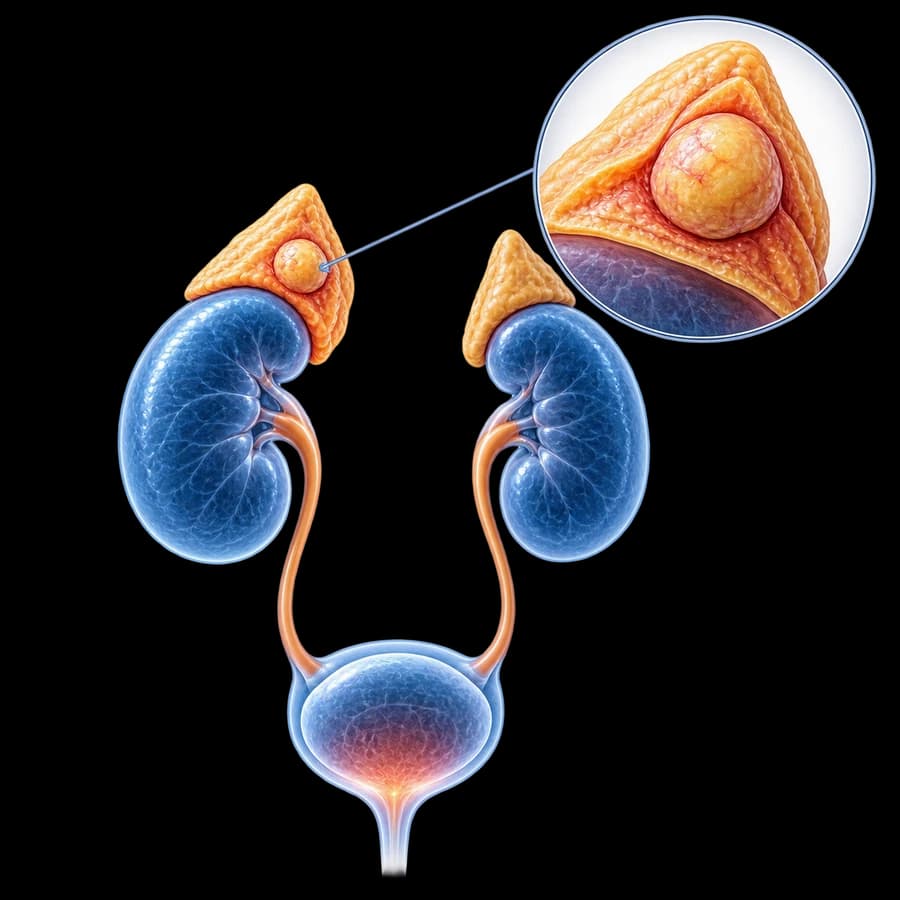
An adrenal adenoma is a benign tumour arising from the cortex of the adrenal gland. The adrenal cortex normally produces three classes of hormones: glucocorticoids (cortisol), mineralocorticoids (aldosterone), and androgens. Most adenomas (~85%) are non-functioning. The rest may secrete excess hormones, producing distinct clinical syndromes.
Non-functioning
No hormonal hypersecretion. Most common. Detected incidentally.
Cortisol-secreting
Causes overt Cushing's syndrome or MACS (mild autonomous cortisol secretion).
Aldosterone-secreting
Conn's syndrome — primary hyperaldosteronism with hypertension and often hypokalemia.
How Common Are They?
Adrenal incidentalomas are detected in 4–7% of abdominal CT scans across all age groups, and in up to 10% of adults over the age of 70. The wide use of cross-sectional imaging means most adrenal adenomas are now diagnosed in asymptomatic patients investigated for unrelated reasons.
In large prospective series, the breakdown is roughly: ~80% benign non-functioning adenomas, ~5–10% functional adenomas, ~5% pheochromocytomas, ~5% metastases or other lesions, and < 5% adrenocortical carcinomas.
Symptoms and Hormonal Activity
Most adenomas cause no symptoms. When present, they reflect the specific hormonal profile:
- Cushing's syndrome: weight gain, moon face, central obesity, easy bruising, purple striae, hypertension, diabetes, osteoporosis.
- MACS: subtle metabolic effects — hypertension, type 2 diabetes, osteoporosis, increased cardiovascular risk and mortality.
- Conn's syndrome: resistant hypertension, hypokalemia, muscle weakness, polyuria.
- Androgen excess (rare in benign adenomas — raises suspicion of carcinoma): hirsutism, virilisation, menstrual irregularity in women.
- Mass effect (very rare in adenomas): flank discomfort.
Red Flags Suggesting a Non-Adenoma
- Size > 4 cm, especially > 6 cm.
- Unenhanced CT density > 20 HU with poor washout.
- Heterogeneous appearance with necrosis or haemorrhage.
- Rapid growth on follow-up imaging.
- Combined cortisol + androgen excess (suspicious for carcinoma).
- Hypertensive crises during imaging or procedures (suggests pheochromocytoma).
Workup of an Adrenal Incidentaloma
According to the 2023 ESE/ENSAT guidelines, the workup answers two questions: is it benign? and is it functional?
1 mg Overnight Dexamethasone Suppression Test
Cortisol > 1.8 μg/dL after 1 mg dexamethasone at bedtime suggests autonomous cortisol secretion. Cortisol > 5 μg/dL is overt hypercortisolism; 1.8–5 μg/dL is MACS.
Plasma Free Metanephrines or 24h Urine Metanephrines
Mandatory in every adrenal incidentaloma to exclude pheochromocytoma — even when imaging looks reassuring. Biopsy of any adrenal lesion without prior exclusion of pheochromocytoma is contraindicated.
Aldosterone / Renin Ratio (ARR)
In hypertensive or hypokalemic patients, to screen for primary aldosteronism (Conn's syndrome).
Androgens / Oestrogens
Required when carcinoma is suspected (large, heterogeneous, suspicious imaging).
Imaging Characteristics
Imaging is decisive in distinguishing benign adenomas from suspicious lesions:
Unenhanced CT
Density ≤ 10 HU is highly specific for a lipid-rich benign adenoma — no further imaging is required if size is < 4 cm. Density > 10 HU mandates further evaluation with washout protocol or MRI.
Contrast Washout CT
Absolute washout > 60% or relative washout > 40% at 15 minutes supports a benign lipid-poor adenoma. Poor washout is suspicious.
MRI Chemical Shift
Loss of signal on out-of-phase imaging confirms intracellular lipid — benign adenoma.
FDG-PET/CT
Reserved for indeterminate lesions or suspected malignancy. Adrenal/liver SUV ratio > 1.5 is suspicious.
Management and Surgery
Most adenomas require no treatment — only confirmation of benign nature and reassurance. Indications for surgery:
- Functional adenoma with overt syndrome (Cushing's, Conn's, pheochromocytoma).
- MACS in selected patients with significant cardio-metabolic comorbidities.
- Lesions > 4 cm with suspicious imaging features.
- Indeterminate lesions where malignancy cannot be excluded.
- Growth > 5 mm/year on follow-up imaging.
Laparoscopic adrenalectomy is the gold standard for benign adrenal tumours. Robotic adrenalectomy is an option in specialised centres. Open surgery is reserved for very large, suspicious or invasive masses.
Follow-up Strategy
For non-functioning, benign-appearing adenomas (≤ 4 cm, < 10 HU): no further imaging is required per the 2023 ESE/ENSAT guidelines. For indeterminate lesions or those not fully characterised: repeat imaging at 6–12 months. Hormonal reassessment is suggested after 3–5 years or if new symptoms arise.
In summary: Adrenal adenomas are common and the vast majority are entirely benign. A structured workup, modern imaging characterisation, and careful surgical selection ensure optimal outcomes.
Frequently Asked Questions (FAQ)
What is an adrenal adenoma?
An adrenal adenoma is a benign (non-cancerous) tumour of the adrenal cortex. Most are small (< 4 cm) and non-functioning, found incidentally on imaging — so-called "incidentalomas". A minority secrete hormones (cortisol, aldosterone, androgens) and require further evaluation and treatment.
How common are adrenal adenomas?
Very common. Cross-sectional imaging detects adrenal incidentalomas in up to 4–7% of adults, rising to ~10% over the age of 70. The vast majority are benign, non-functioning adenomas.
Are adrenal adenomas cancerous?
No, by definition adenomas are benign. The differential diagnosis includes adrenocortical carcinoma, pheochromocytoma, metastases and myelolipomas. Imaging features (size, density, washout) and hormonal workup distinguish benign from suspicious lesions.
What hormonal tests are needed?
According to the 2023 ESE/ENSAT guidelines, every adrenal incidentaloma should have: 1) a 1 mg overnight dexamethasone suppression test for autonomous cortisol secretion, 2) plasma free metanephrines or 24h urine metanephrines to exclude pheochromocytoma, 3) aldosterone/renin ratio if hypertensive or hypokalemic.
Which imaging features suggest a benign adenoma?
Size < 4 cm, homogeneous appearance, smooth margins, low density on unenhanced CT (≤ 10 Hounsfield Units indicates lipid-rich adenoma), and rapid contrast washout (> 50% absolute or > 40% relative at 15 minutes).
What is MACS (Mild Autonomous Cortisol Secretion)?
MACS describes biochemical evidence of mild cortisol excess (post-DST cortisol > 1.8 μg/dL) without overt Cushing's syndrome. It is associated with increased cardiovascular risk, type 2 diabetes, osteoporosis and mortality. Surgery may be considered in selected cases.
When is surgery needed?
Surgery is recommended for: hormone-secreting adenomas (overt Cushing's, Conn's syndrome, pheochromocytoma), lesions > 4 cm with suspicious features, indeterminate lesions, growth on follow-up, or selected MACS patients with significant comorbidities.
How is the operation performed?
Laparoscopic adrenalectomy is the gold standard for benign adrenal tumours, with smaller incisions, less pain and faster recovery. Robotic adrenalectomy is an option in specialised centres. Open surgery is reserved for very large or suspicious masses.
Related Topics
Book Your Appointment in Rhodes
If you have been told you have an adrenal incidentaloma, a structured workup gives clarity and peace of mind. We follow current ESE/ENSAT guidelines and combine endocrine and surgical expertise for individualised management.
References
- Fassnacht M, et al. ESE/ENSAT clinical practice guidelines on the management of adrenal incidentalomas (2023) — academic.oup.com
- Sherlock M, et al. Adrenal Incidentaloma — Endocrine Reviews 2020 — academic.oup.com
- NIH / NCI: Adrenal Cortex (general information) — cancer.gov
Medical Review

Dr. Marinos Vasilas, Urologist — Andrologist
Dr. Marinos Vasilas runs a private urology practice in Rhodes with particular interest in laparoscopic and robotic adrenal surgery. Patients with adrenal incidentalomas benefit from a structured, evidence-based pathway and close collaboration with endocrinology.
View full bio


